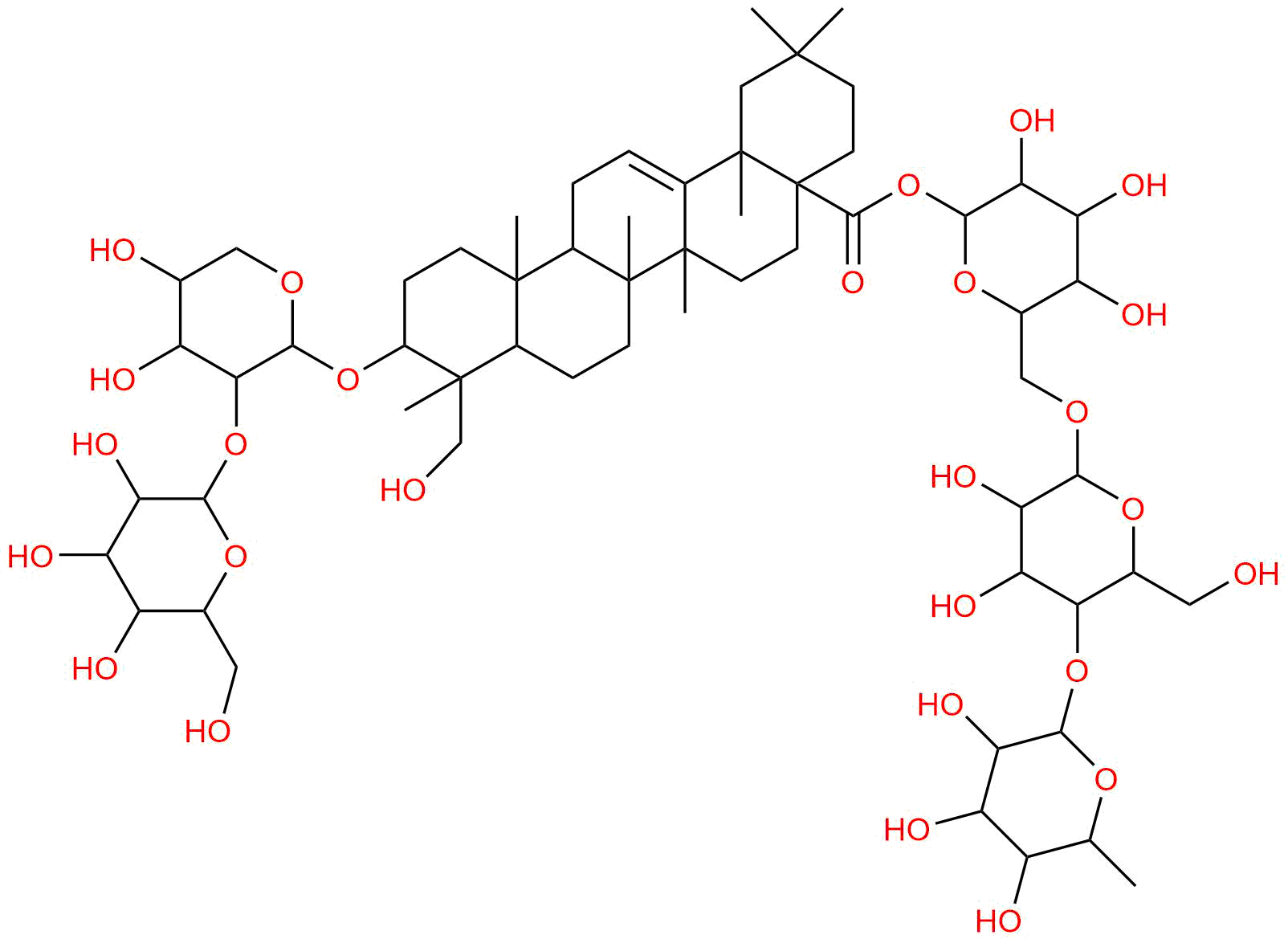


Product name: Cauloside F
Synonym name: Cauloside G
Catalogue No.: BP1713
Cas No.: 60451-47-0
Formula: C60H98O27
Mol Weight: 1251.42
Botanical Source: "Hedera nepalensis K,Koch var.sin ensis (Tobl.) Rehd"
Physical Description:
Type of Compound: Triterpenoids
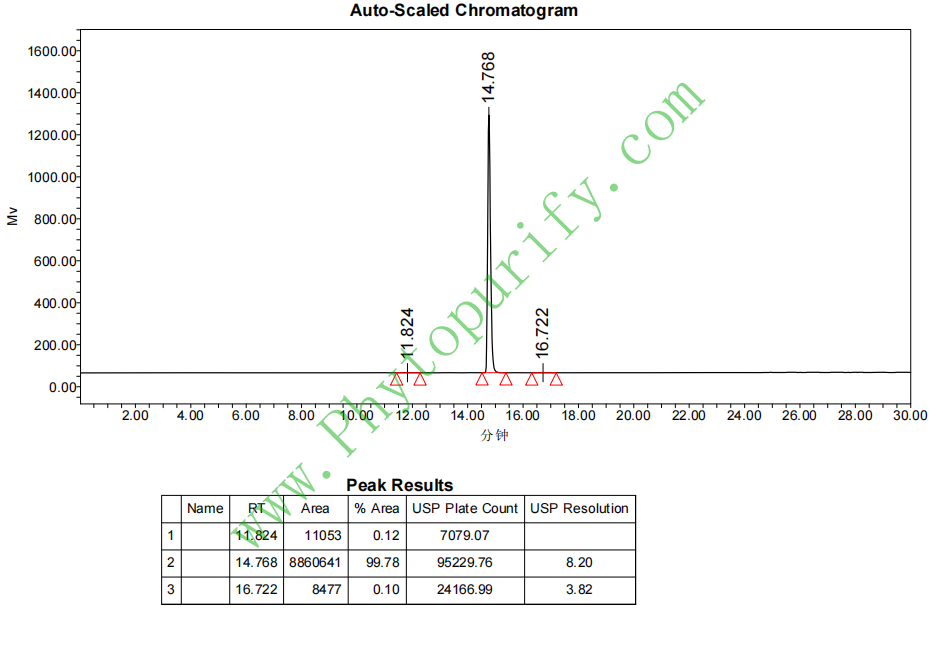
Purity: 95%~99%
Analysis Method: HPLC-DAD or/and HPLC-ELSD
Identification Method: Mass, NMR
Packing: Brown vial or HDPE plastic bottle
The product could be supplied from milligrams to grams. Inquire for bulk scale.
We provide solution to improve the water-solubility of compounds, thereby facilitating the variety of activity tests and clinic uses.
For Reference Standard and R&D, Not for Human Use Directly.
HPLC of Cauloside F
Storage conditions:Short-term storage at 2~8℃, long-term storage at -20 ~ -80℃
433.0500
1.6784
1.6783
.3370
.4750
.1710
Low
67.9022
7.4172
Yes
No
No
No
No
No
0.0
Yes
No
No
Yes
Ovarian cancer is one of the common malignant tumors of the female reproductive system worldwide, with the highest mortality rate among gynecological cancers. Due to the insidious early symptoms, most patients are diagnosed in the late stage and are prone to developing resistance to traditional platinum based chemotherapy drugs, leading to treatment failure and poor prognosis. Therefore, the development of new, efficient, and low toxicity anti ovarian cancer drugs is an urgent need in current research. Natural products have always been an important source of innovative drug discovery due to their structural diversity and rich biological activity. Cauloside F, a triterpenoid saponin compound isolated from traditional medicinal plants, has attracted much attention in recent years due to its significant pharmacological activity in various tumor models, especially ovarian cancer. This article aims to systematically review the chemical structure, plant origin, pharmacological activity, mechanism of action, pharmacological properties, and application prospects of red hair seven saponins F in the treatment of ovarian cancer, in order to provide comprehensive scientific references for the in-depth research and development of this compound.
Cauloside F, CAS number 60451-47-0, is a relatively large triterpenoid saponin compound with a molecular weight of 1251.4170. Triterpenoid saponins are typically composed of hydrophobic triterpenoid glycosides (often oleanane or ursolic) connected to one or more hydrophilic sugar chains through glycosidic bonds, giving them amphiphilic characteristics.
From the analysis of physical and chemical properties, the theoretical lipid water partition coefficient (LogP) of red hair seven saponins F is 1.6784, indicating that it has a certain lipophilicity, but not highly lipophilic. Its topological polar surface area (TPSA) is as high as 433.0500 Å ², mainly due to the presence of a large number of polar groups such as hydroxyl groups on the polysaccharide chains connected in the molecule. A high TPSA value usually indicates strong molecular polarity and a unique interaction mode with the phospholipid bilayer of the cell membrane. Its water solubility value is 0.3370 (usually measured in mg/mL or log mol/L, relative here), indicating limited solubility in water and a moderate to low solubility, which may affect its oral bioavailability. In the preliminary assessment of drug efficacy, the ability of the compound to cross the blood-brain barrier (BBB) was predicted to be "low", suggesting that it may not be suitable for the treatment of primary or metastatic tumors of the central nervous system, but it may also reduce the potential risk of neurotoxicity. In addition, preliminary toxicity predictions indicate that it does not significantly inhibit hERG potassium channels (hERG inhibition: No), indicating a lower risk of inducing QT interval prolongation in the heart; The Ames test predicted a value of 0.0, indicating that it may not be mutagenic and has good genetic toxicity safety prospects. These physicochemical and preliminary toxicological parameters provide important basis for its subsequent pharmacological research and structural optimization.
Red hair seven saponins F are mainly isolated from various plants in the genus Clematis of the Ranunculaceae family. Iron wire lotus plants are widely distributed worldwide, and many of them have a long history of application in traditional Chinese medicine and ethnic medicine. They are commonly used to treat diseases such as rheumatism, inflammation, and tumors. Red hair seven saponins F, as one of the characteristic active ingredients of this genus of plants, often coexist with other triterpenoid saponins with similar structures.
The extraction and separation process follows the conventional process of natural product chemistry. Firstly, dry plant roots, stems, or whole plants are crushed and subjected to reflux extraction or ultrasound assisted extraction using polar solvents such as methanol, ethanol, or aqueous ethanol to fully extract polar components including saponins. After vacuum concentration, the crude extract obtained was subjected to gradient extraction using solvents such as petroleum ether, ethyl acetate, and n-butanol. Red hair saponin F is usually enriched in the n-butanol extraction site due to its strong polarity and sugar chain structure. Subsequently, various modern chromatographic techniques were comprehensively utilized for separation and purification. Generally, silica gel column chromatography is used for preliminary separation, and then combined with reversed phase silica gel (such as ODS), macroporous adsorption resin (such as D101, AB-8), and dextran gel (such as Sephadex LH-20) column chromatography for further subdivision. Ultimately, high performance liquid chromatography (HPLC), especially preparative or semi preparative HPLC, is the key step in obtaining high-purity monomers of red hair seven saponins F. The structural identification relies on spectroscopic techniques such as nuclear magnetic resonance (NMR, including 1H-NMR, 13C-NMR, 2D-NMR), mass spectrometry (MS, such as ESI-MS, HR-ESI-MS), and infrared spectroscopy (IR). By comparing with literature data or known standards, the glycoside structure, glycosylation type, linkage position, and sequence are confirmed.
A large number of in vitro and in vivo pharmacological studies have shown that red hair seven saponins F have a wide range of biological activities, among which anti-tumor activity is the most prominent, especially showing great potential in the field of ovarian cancer.
1. Anti ovarian cancer activity:
In vitro cell experiments have confirmed that red hair saponin F can effectively inhibit the proliferation of various human ovarian cancer cell lines (such as SKOV3, A2780, OVCAR-3, etc.), and its inhibitory effect is concentration - and time-dependent. In addition to inhibiting cell growth, this compound can significantly induce apoptosis in ovarian cancer cells, manifested by morphological changes such as wrinkling and nuclear fragmentation, phosphatidylserine eversion, and activation of caspase family proteins. In addition, the study also found that red hair seven saponins F can inhibit the migration and invasion ability of ovarian cancer cells, suggesting that it may have the potential to resist metastasis. In animal models such as nude mouse transplantation tumors, intraperitoneal injection or gavage administration of red hair seven saponins F can significantly inhibit the growth of ovarian cancer tumors, with little effect on mouse body weight, showing a certain therapeutic window and low acute toxicity.
2. Other pharmacological activities:
In addition to its core anti ovarian cancer effect, research also suggests that red hair seven saponin F may have other beneficial pharmacological effects. For example, it may have a regulatory effect on related diseases through anti-inflammatory and antioxidant pathways. However, the current research focus is mainly on anti-tumor effects, and other activities need to be further explored.
The anti ovarian cancer effect of red hair seven saponins F involves a complex regulatory network of multiple targets and pathways, and significant progress has been made in its molecular mechanism research, mainly focusing on the following key targets:
1. Inducing apoptosis and regulating apoptosis related proteins:
* BCL2 family: BCL2 is an important anti apoptotic protein. Red hair seven saponins F can downregulate the expression of BCL2 and may upregulate the expression of pro apoptotic proteins such as BAX, disrupt mitochondrial membrane potential, and lead to the release of cytochrome C, thereby activating endogenous apoptotic pathways.
* STAT3 signaling pathway: STAT3 is a key transcription factor for tumor cell survival, proliferation, and immune escape. Red hair seven saponins F can inhibit the phosphorylation (activated form) of STAT3, block its nuclear translocation and the transcription of downstream target genes (such as Cyclin D1, Bcl xl, Survivor), thereby inhibiting cell proliferation and promoting apoptosis.
2. Inhibit tumor invasion and metastasis:
* MMP2: Matrix metalloproteinase 2 (MMP2) can degrade extracellular matrix and plays a crucial role in tumor invasion and metastasis. Red hair seven saponins F can downregulate the expression or activity of MMP2, thereby weakening the invasive ability of ovarian cancer cells.
* HIF1A: Hypoxia inducible factor 1 alpha (HIF1A) is crucial in tumor adaptation to hypoxic microenvironment, promotion of angiogenesis, and metastasis. Red hair seven saponins F may interfere with tumor hypoxia response and inhibit the expression of factors such as vascular endothelial growth factor (VEGF) by inhibiting the stability or transcriptional activity of HIF1A.
3. Reversing multidrug resistance:
* ABCB1: ABCB1 (P-gp) is an ATP binding cassette transporter that can pump chemotherapy drugs out of cells and is one of the main causes of chemotherapy resistance in ovarian cancer. Research has shown that red hair seven saponins F may increase the accumulation of chemotherapy drugs (such as paclitaxel and doxorubicin) in cells by inhibiting the transport function or expression of ABCB1, thereby reversing multidrug resistance and enhancing chemotherapy sensitivity.
4. Other potential targets:
* ESR2 (estrogen receptor beta): May affect the growth of hormone sensitive ovarian cancer by regulating estrogen receptor signaling.
* NFE2L2(NRF2): Regulating cellular oxidative stress response, its overactivation is associated with chemotherapy resistance, and red hair saponin F may regulate this pathway.
* TOP1 (Topoisomerase I): May interfere with DNA replication and repair.
* TYR (tyrosinase) and MAPT (microtubule associated protein tau): Its correlation in ovarian cancer is not yet clear and may involve broader cellular metabolism or skeletal regulation.
These targets do not exist in isolation. Red hair seven saponin F is likely to act on a core signaling node (such as STAT3) or multiple targets simultaneously, forming a synergistic network that ultimately leads to growth inhibition, apoptosis, and decreased metastatic ability of ovarian cancer cells.
Although the pharmacological activity of red hair seven saponins F is significant, its medicinal properties still face challenges, and related research is still in its early stages.
1. Analysis of pharmacological parameters:
As mentioned earlier, its large molecular weight (>1000 Da) and high TPSA value comply with multiple unfavorable factors in the "Rule of Five", indicating that its oral absorption may be poor. The moderate LogP value and limited water solubility pose obstacles to its dissolution and transmembrane permeability in the gastrointestinal tract, leading to potentially low oral bioavailability. The low permeability of the blood-brain barrier limits its application in central nervous system tumors, but for peripheral tumors such as ovarian cancer, this characteristic may reduce central side effects.
2. Pharmacokinetic (PK) studies:
At present, there are few reports on the pharmacokinetic studies of the red hair seven saponin F system. Based on the commonality of its saponin compounds, it can be inferred that its possible PK characteristics may be: after oral administration, it may be partially hydrolyzed by acids or enzymes in the gastrointestinal tract, or metabolized by gut microbiota into aglycones or secondary glycosides, which are absorbed into the bloodstream. The prototype drug and its metabolites may be mainly excreted through bile and kidneys. Due to its high polarity, the distribution volume may be small, and tissue permeability (especially in deep solid tumors) is a concern. In the future, comprehensive in vivo PK research is needed to clarify its absolute bioavailability, half-life, tissue distribution, metabolites, and main excretion pathways.
3. Preliminary safety assessment:
HERG inhibition negative and Ames test negative predictions are good early signals. However, triterpenoid saponins may sometimes have hemolytic activity or gastrointestinal irritation, requiring systematic preclinical toxicology studies, including acute toxicity, long-term toxicity, reproductive toxicity, etc., to comprehensively evaluate their safety window.
Red hair seven saponin F, as a natural compound with multi-target anti ovarian cancer activity, has broad clinical application prospects, but the road is long. Future research can be conducted in the following directions:
1. Combination therapy strategy: Given its ability to target resistance related pathways such as STAT3 and HIF1A, as well as inhibit ABCB1, the combination of red hair seven saponins F with existing standard chemotherapy drugs (such as paclitaxel and carboplatin) is a highly promising research direction. This combination is expected to overcome drug resistance, reduce the dosage of chemotherapy drugs, thereby reducing toxic side effects and improving efficacy.
2. Structural modification and optimization: To address the issue of insufficient medicinal properties, structural modification can be carried out through medicinal chemical methods. For example, modifying or simplifying sugar groups to synthesize glycoside derivatives to reduce molecular weight, regulate LogP and TPSA, improve their solubility and membrane permeability, and enhance oral bioavailability.
3. Development of a new drug delivery system: The use of nanotechnology, such as liposomes, polymer micelles, nanoparticles, etc., to encapsulate red hair seven saponins F can significantly improve its water solubility, prolong blood circulation time, enhance passive targeting of tumor sites (EPR effect) or achieve active targeting through surface modification, improve therapeutic efficacy, and reduce systemic toxicity.
4. Deep mechanism mining and biomarker exploration: Further elucidation of its core mechanism of action and signaling network requires the use of omics techniques (proteomics, transcriptomics). Meanwhile, searching for biomarkers that predict its therapeutic efficacy (such as tumor subtypes with high expression of specific targets) can help achieve precision medicine.
5. Expand the scope of disease research: In addition to ovarian cancer, its targets (such as STAT3 and MMP2) are also generally abnormally activated in other malignant tumors (such as breast cancer, lung cancer and liver cancer). Therefore, exploring the therapeutic effect of red hair seven saponins F in other types of cancer is also of great significance.
Red hair seven saponin F is an active triterpenoid saponin isolated from the traditional medicinal plant Clematis chinensis. It exhibits significant comprehensive pharmacological activity in inhibiting ovarian cancer cell proliferation, inducing apoptosis, resisting invasion and metastasis, and reversing multidrug resistance by acting on multiple key targets such as BCL2, STAT3, MMP2, ABCB1, and HIF1A. Although its large molecular structure and current pharmacokinetic parameters suggest challenges in oral absorption and pharmacokinetics, these challenges provide clear optimization directions for research in medicinal chemistry and pharmacy. Through structural modification, application of novel drug delivery systems, and combination strategies with existing therapies, red hair seven saponin F is expected to be developed as a novel candidate drug or adjuvant therapy for ovarian cancer. In the future, deeper mechanism research, systematic preclinical development, and ultimately clinical translation will be a modern scientific validation of this ancient plant gift, and also bring new hope for overcoming the stubborn disease of ovarian cancer.
