


Product Name: Hederacoside C
Synonym name: HDC; Hederasaponin C; Hederacaucaside D
Cas No.: 14216-03-6
Formula: C59H96O26
Mol Weight: 1221.39
Botanical Source: Hedera helix; Chinese ivy; Hedera nepalensis K,Koch var.sinensis (Tobl.) Rehd
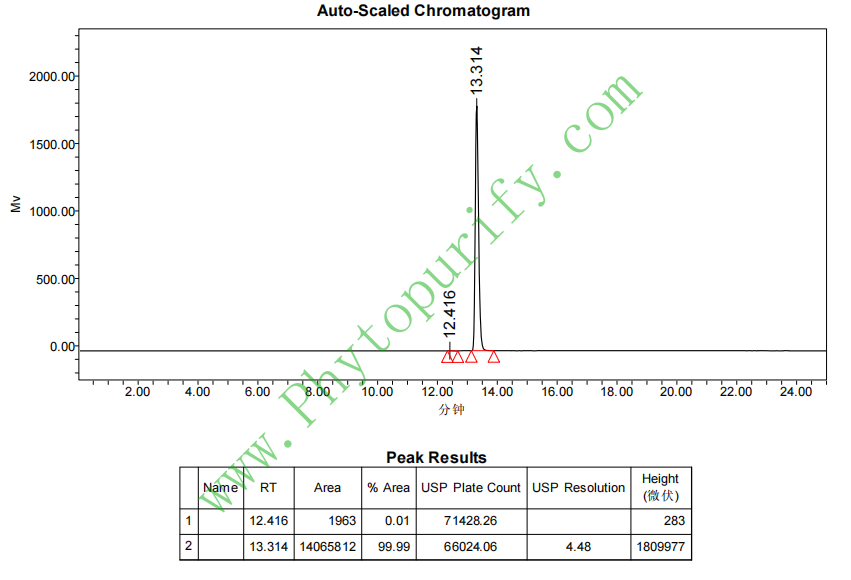
Purity: 95%~99%
Analysis Method: HPLC-DAD or/and HPLC-ELSD
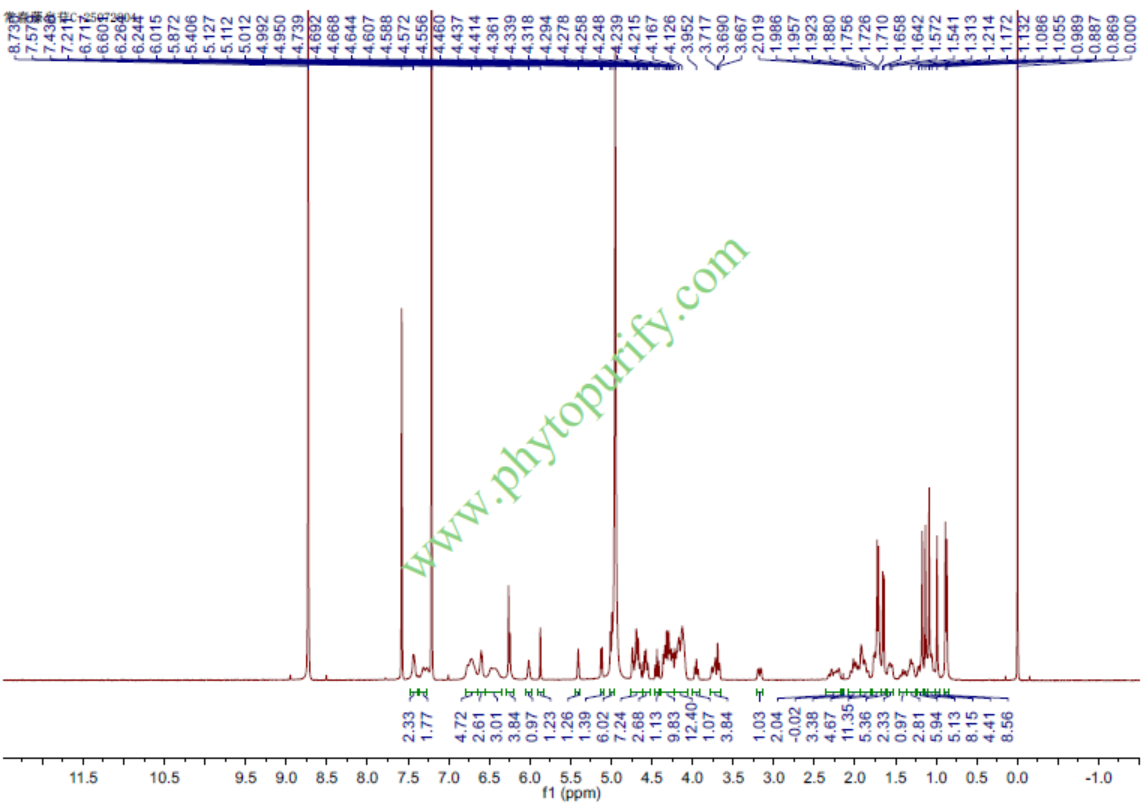
Identification Method: Mass, NMR
Packing: Brown vial or HDPE plastic bottle
Can be supplied from milligrams to grams, up to kilograms.
Inquire for bulk scale.
Reference
Pharmacokinetics of hederacoside C, an active ingredient in AG NPP709, in rats.
Xenobiotica. 2013 Nov;43(11):985-92.
Abstract
1. Hederacoside C (HDC) is one of the active ingredients in Hedera helix leaf extract (Ivy Ex.) and AG NPP709, a new botanical drug to treat acute respiratory infection and chronic inflammatory bronchitis. However, information regarding its pharmacokinetic properties remains limited. 2. Here, we report the pharmacokinetics of HDC in rats after intravenous administration of HDC (3, 12.5, and 25 mg/kg) and after oral administration of HDC, Ivy Ex., and AG NPP709 (equivalent to 12.5, 25, and 50 mg/kg HDC). 3. Linear pharmacokinetics of HDC were identified upon its intravenous administration at doses of 3-25 mg/kg. Intravenous administration of HDC results in relatively slow clearance (1.46-2.08 mL/min/kg) and a small volume of distribution at steady state (138-222 mL/kg), while oral administration results in a low absolute oral bioavailability (F) of 0.118-0.250%. The extremely low F of HDC may be due to poor absorption of HDC from the gastrointestinal (GI) tract and/or its decomposition therein. 4. The oral pharmacokinetics of HDC did not differ significantly among pure HDC, Ivy Ex., and AG NPP709.
HPLC of Hederacoside C
HNMR of Hederacoside C
Storage conditions:Short-term storage at 2~8℃, long-term storage at -20 ~ -80℃
412.8200
1.8840
1.8839
.3485
.5437
.1302
Low
70.6480
7.2562
Yes
No
No
No
No
No
0.0
Yes
No
No
Yes
Hederacoside C (CAS number: 14216-03-6) is a natural triterpenoid saponin compound extracted from Hedera helix leaves, also known as Kalopanaxsaponin B. As an important member of the ivy saponin family, ivy saponin C has received widespread attention in recent years due to its significant biological activity, especially in the fields of anti-inflammatory and antibacterial effects, showing good pharmacological potential. Inflammatory response is a key link in the occurrence and development of various diseases. Ivy saponin C exhibits good anti-inflammatory effects by regulating the MAPK/NF - κ B signaling pathway, inhibiting the expression of inflammatory mediators. In addition, ivy saponin C has shown potential application value in the treatment of malignant tumors such as lung cancer, with related targets involving multiple key molecules such as BCL2, STAT3, TLR4, suggesting that it may exert anti-tumor effects through multi-target and multi pathway synergy.
This article aims to systematically review the chemical structure and physicochemical properties, plant sources and extraction methods, pharmacological activity and mechanism of action, pharmacological evaluation and pharmacokinetic characteristics of ivy saponin C, and explore its clinical application prospects and future research directions, providing theoretical basis and research reference for the deep development and application of this natural product.
Ivy saponin C is a triterpenoid saponin with a molecular weight of 1221.3910, belonging to the glycoside class of natural products. Its chemical structure consists of polysaccharide chains and triterpenoid skeleton, connected by glycosidic bonds, with a complex structure and high polarity. The LogP value is 1.8840, indicating that it has moderate lipid solubility, which facilitates membrane penetration but is not overly hydrophobic. The polar surface area (TPSA) is as high as 412.8200, indicating strong molecular polarity and a water solubility of 0.3485, making it a moderately low water-soluble compound.
From a molecular structure perspective, the triterpenoid skeleton of ivy saponin C provides the basic framework for its biological activity, while the polysaccharide component may affect its solubility, bioavailability, and binding ability with biomolecules. The compound has low blood-brain barrier permeability, indicating its limited distribution in the central nervous system. The negative result of hERG channel inhibition experiment indicates a low risk of cardiac toxicity. The Ames mutagenicity test result was 0, indicating no significant genetic toxicity.
In summary, the physicochemical properties of ivy saponin C are suitable for further pharmacological and pharmacokinetic studies as a drug candidate molecule.
Ivy saponin C mainly comes from the leaves of Hedera helix, an evergreen climbing plant in the Araliaceae family, widely distributed in Europe, Asia, and North America. Its leaves are rich in various saponin components, among which ivy saponin C is more abundant.
The extraction of ivy saponin C is usually carried out by solvent extraction combined with chromatographic separation. The specific steps include:
In recent years, ultrasound assisted extraction and microwave-assisted extraction techniques have also been attempted to be applied to the extraction of ivy saponin C, significantly improving extraction efficiency and purity, and reducing energy consumption and time costs.
The anti-inflammatory effect of ivy saponin C has been validated in various in vitro and in vivo models. It mainly reduces inflammation by inhibiting the expression of pro-inflammatory cytokines such as TNF - α, IL-1 β, and IL-6. Research has shown that ivy saponin C can significantly inhibit the activation of MAPK (including ERK, JNK, p38) and NF - κ B signaling pathways in macrophages, block the transmission of inflammatory signals, and reduce the release of inflammatory mediators.
In the mouse acute inflammation model, ivy saponin C showed significant anti swelling and anti exudative effects, indicating its good anti-inflammatory pharmacological effects. In addition, ivy saponin C can regulate the function of immune cells and promote the self repair process of inflammation.
Ivy saponin C exhibits inhibitory effects on various Gram positive and Gram negative bacteria, particularly exhibiting strong antibacterial activity against common respiratory pathogens such as Streptococcus pneumoniae and Staphylococcus aureus. Its antibacterial mechanism may involve disrupting the integrity of bacterial cell membranes, interfering with bacterial metabolic processes, and inhibiting bacterial biofilm formation.
In recent years, the anti-tumor potential of ivy saponin C in tumor models such as lung cancer has gradually been revealed. In vitro experiments have shown that ivy saponin C can induce apoptosis in lung cancer cells, inhibit cell proliferation and migration. Its target proteins involve key proteins such as BCL2, STAT3, MMP2, indicating that it exerts anti-tumor effects by regulating cell apoptosis and signal transduction pathways.
In addition, ivy saponin C also has a regulatory effect on the inflammatory response in the tumor microenvironment, possibly by inhibiting the TLR4 and NF - κ B signaling pathways, reducing tumor associated inflammation, and inhibiting tumor progression.
The pharmacological effects of ivy saponin C mainly depend on its regulation of multiple cellular signaling pathways. The following are its main mechanisms of action and related molecular targets:
MAPK (mitogen activated protein kinase) and NF - κ B (nuclear factor kappa B) are core signaling pathways in inflammatory responses. Ivy saponin C can inhibit the phosphorylation activation of MAPK family members (such as MAPK1/ERK2), block signal transduction, and thereby inhibit the transfer of NF - κ B (RELA) from cytoplasm to nucleus, reducing the transcriptional expression of pro-inflammatory genes.
Ivy saponin C disrupts the integrity of bacterial cell membranes, increases membrane permeability, and leads to leakage of cellular contents. In addition, it may also interfere with the activity of bacterial metabolic enzymes, inhibit the formation of bacterial biofilms, and enhance antibacterial effects.
In summary, ivy saponin C exerts its comprehensive pharmacological effects of anti-inflammatory, antibacterial, and anti-tumor through multi-target and multi pathway synergistic effects.
Ivy saponin C has a relatively high molecular weight (1221.3910), high TPSA (412.82), moderate water solubility (0.3485), and a LogP of 1.884, indicating that it has a certain degree of lipid solubility, which is beneficial for cell membrane penetration, but its large polar area may limit its oral bioavailability. The low permeability of the blood-brain barrier suggests its limited distribution in the central nervous system, which is beneficial for reducing central nervous system toxicity.
The hERG channel inhibition test was negative, indicating a low risk of cardiac toxicity. The Ames mutagenicity test result was 0, indicating no significant genetic toxicity, which provides preliminary assurance for its safety.
At present, there is limited systematic pharmacokinetic research on ivy saponin C. Due to its high molecular weight and polarity, it is speculated that its oral absorption is poor and there may be a first pass effect. The metabolic pathway may involve glycoside hydrolysis by liver enzymes and modification of triterpenoid skeletons. Its excretion pathway may be mainly through bile and urine.
In the future, in vivo pharmacokinetic studies need to be conducted to clarify its absorption, distribution, metabolism, and excretion (ADME) characteristics, in order to guide formulation design and optimize dosing regimens.
Ivy saponin C has demonstrated broad clinical application potential due to its excellent anti-inflammatory, antibacterial, and anti-tumor activities.
As a natural anti-inflammatory ingredient, ivy saponin C can be used to treat chronic inflammatory diseases such as asthma, chronic obstructive pulmonary disease (COPD), arthritis, etc. It has good safety and therapeutic advantages by regulating the MAPK/NF - κ B pathway and reducing the release of inflammatory mediators.
Ivy saponin C exhibits significant inhibitory effects on common bacteria in respiratory infections, and is expected to be developed as a new type of antibacterial drug, especially in the context of increasingly severe antibiotic resistance, with important clinical value.
Lung cancer is one of the malignant tumors with the highest incidence rate and mortality in the world. Ivy saponin C regulates tumor cell proliferation, apoptosis, and migration through multiple targets, providing a new approach for adjuvant therapy of lung cancer. It can be used in combination with existing chemotherapy drugs to improve efficacy and reduce side effects.
Future research should focus on:
Through interdisciplinary collaboration, promote the translation of ivy saponin C from laboratory research to clinical application.
Ivy saponin C, as a widely sourced and structurally unique natural triterpenoid saponin, has become a hot topic in natural product pharmacology research due to its significant anti-inflammatory, antibacterial, and anti-tumor activities. It exerts multi-target effects by regulating MAPK/NF - κ B and various tumor related signaling pathways, demonstrating good pharmacological potential and safety. Although its pharmacokinetics and clinical research are still in the preliminary stage, with the advancement of extraction and purification technology and in-depth analysis of molecular mechanisms, ivy saponin C is expected to become an important candidate molecule for novel anti-inflammatory and anti-tumor drugs. In the future, its pharmacokinetics, toxicology, and preclinical research should be strengthened to promote its clinical application and provide strong support for the development of natural product drugs.
