


Synonym name:
Catalogue No.: BP0709
Cas No.: 760961-03-3
Formula: C53H86O22
Mol Weight: 1075.25
Botanical Source:
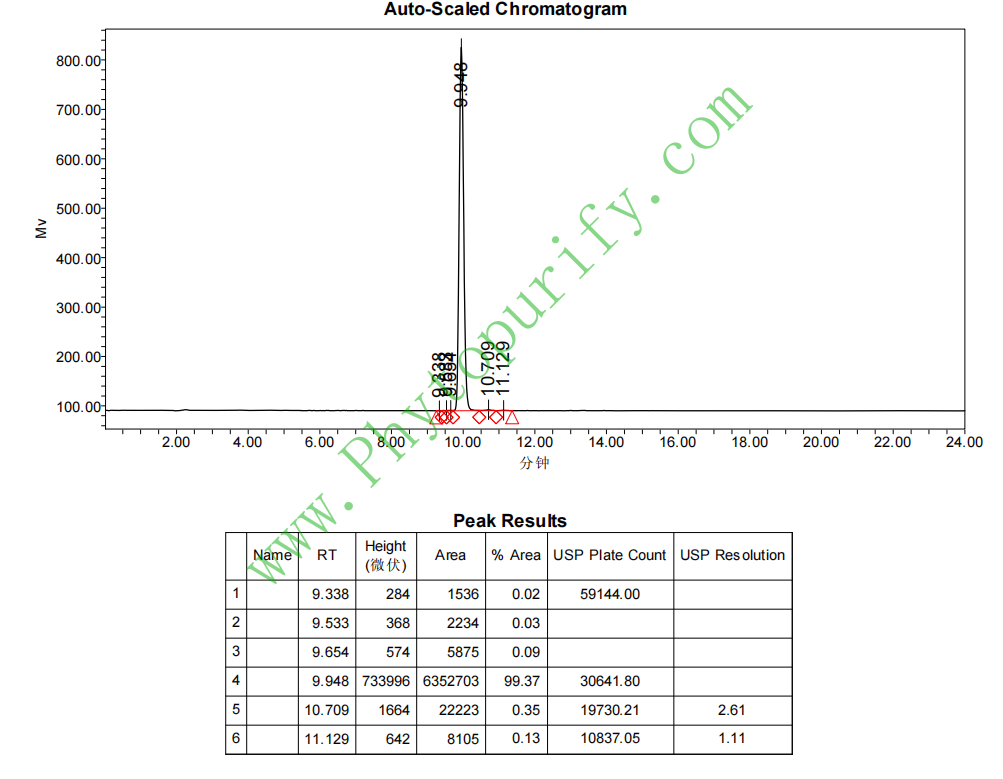
Purity: 95%~99%
Analysis Method: HPLC-DAD or/and HPLC-ELSD
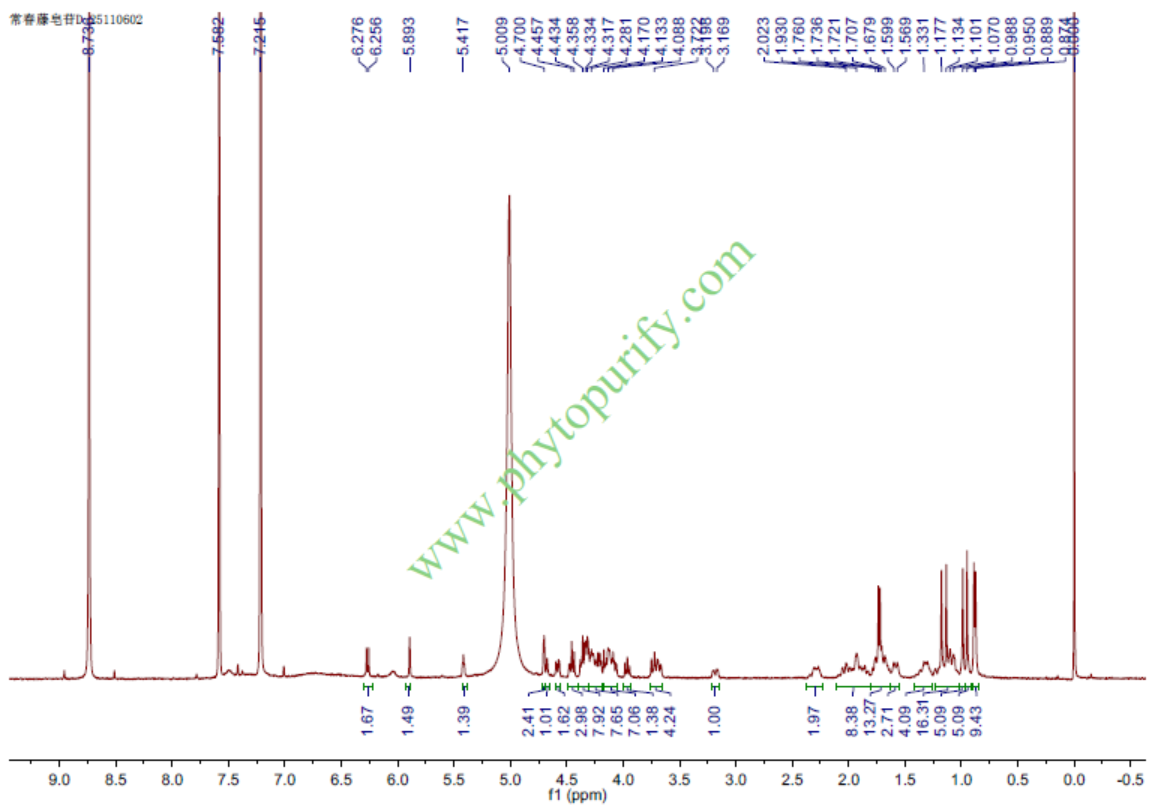
Identification Method: Mass, NMR
Packing: Brown vial or HDPE plastic bottle
Can be supplied from milligrams to grams.
For Reference Standard and R&D, Not for Human Use Directly.
Inquire for bulk scale.
HPLC of Hederacoside D
HNMR of Hederacoside D
Storage conditions:Short-term storage at 2~8℃, long-term storage at -20 ~ -80℃
353.9000
2.0126
2.0123
.1962
.5825
.1833
Low
73.1330
6.7856
Yes
No
No
No
No
No
0.0
Yes
No
No
Yes
Hederacoside D is a natural saponin compound isolated from Hedera helix, which has received widespread attention in recent years due to its significant biological activity. Ivy, as a traditional medicinal plant, has a long history and is mainly used for the treatment of respiratory diseases. With the development of modern pharmacology and molecular biology, the various pharmacological effects of ivy saponin D have gradually been revealed, especially in the field of anti-tumor treatment, showing potential therapeutic value. As one of the malignant tumors with high incidence rate and mortality in the world, colon cancer urgently needs to develop new treatment strategies. Ivy saponin D exhibits inhibitory effects on colon cancer cells by regulating multiple signaling pathways and key molecular targets, making it a hot topic in the research of natural anti-cancer drugs. Therefore, a systematic summary of the chemical characteristics, pharmacological activity, and mechanism of action of ivy saponin D is of great significance for promoting its clinical translation.
The molecular formula of ivy saponin D is C53H84O24, with a molecular weight of 1075.2490, and it belongs to the triterpenoid saponin class. Its structural features include a steroid core based on a pentacyclic triterpenoid skeleton, connecting multiple glycoside residues to form a typical saponin structure. The LogP value of this compound is 2.0126, indicating that it has moderate lipid solubility, which is beneficial for cell membrane penetration. The TPSA (Topological Polarity Surface Area) is as high as 353.9, demonstrating strong polarity and hydrogen bond donor acceptor ability, which has a significant impact on its binding with biomolecules. The water solubility is 0.1962, indicating that its solubility in water is low, suggesting that solubility improvement strategies need to be considered in formulation development. Low blood-brain barrier permeability suggests limited distribution in the central nervous system, reducing the risk of central toxicity. The negative result of hERG inhibition experiment indicates a low risk of cardiac toxicity. The Ames test showed 0.0, indicating no genetic toxicity and good safety.
Hedera helix is an evergreen climbing plant in the Araliaceae family, widely distributed in Europe, Asia, and North America. Its leaves and stems contain abundant saponin compounds, from which ivy saponin D is extracted. Traditional extraction methods often use ethanol or methanol as solvents to obtain crude extracts through reflux extraction or ultrasound assisted extraction. Subsequently, separation and purification were carried out using liquid-liquid partitioning, silica gel column chromatography, reverse phase high performance liquid chromatography (RP-HPLC), and other methods. In recent years, the application of supercritical fluid extraction and membrane separation technology has improved extraction efficiency and purity. During the extraction process, temperature, solvent polarity, and pH value have a significant impact on the stability and recovery rate of saponin D. To ensure the activity and structural integrity of the compound, it is necessary to optimize the extraction process parameters. In addition, the seasonal changes and geographical environment of plant sources also have an impact on the content of saponin D, and a standardized planting and collection system needs to be established.
Ivy saponin D exhibits various pharmacological activities, especially significant effects in anti-tumor, anti-inflammatory, and immune regulation. Numerous in vitro cell experiments and in vivo animal model studies have confirmed its ability to inhibit the proliferation, induce apoptosis, and suppress metastasis of colon cancer cells.
Anti colon cancer activity
Ivy saponin D exhibits dose-dependent cytotoxicity in various colon cancer cell lines and can significantly inhibit cell proliferation. The mechanism involves cell cycle arrest, mainly in the G0/G1 phase or G2/M phase, which prevents cells from entering mitosis. Apoptosis detection showed that saponin D can activate endogenous apoptotic pathways, promote mitochondrial membrane potential loss, induce cytochrome C release, activate caspase family proteins, and ultimately lead to programmed cell death.
anti-inflammatory effect
Saponin D can significantly inhibit the release of inflammatory mediators such as TNF - α, IL-6, and NO, reducing the inflammatory response. Its anti-inflammatory effect provides an important auxiliary mechanism for anti-tumor treatment, as chronic inflammation is an important promoting factor for the occurrence and development of colon cancer.
immunomodulation
Research has shown that ivy saponin D can regulate immune cell function, enhance the body's immune surveillance ability, and promote the clearance of tumor cells.
Other activities
Saponin D also exhibits multiple biological activities such as antioxidant, antibacterial, and liver protection, demonstrating its potential as a multifunctional drug molecule.
The anti colon cancer mechanism of ivy saponin D involves multiple signaling pathways and key molecular targets, including:
AMPK (PRKAA1) activation
Saponin D can activate AMP activated protein kinase (AMPK), regulate cellular energy metabolism, and inhibit the growth and proliferation of tumor cells. The activation of AMPK also promotes autophagy and apoptosis, and inhibits drug resistance in tumor cells.
Inhibition of BCL2 expression
BCL2 family proteins are key factors in regulating cell apoptosis. Saponin D downregulates the expression of anti apoptotic protein BCL2, promotes the transmission of apoptotic signals, and enhances the sensitivity of tumor cells to apoptosis.
Inhibition of STAT3 signaling pathway
STAT3 plays an important role in tumor cell proliferation, metastasis, and immune escape. Saponin D inhibits the phosphorylation and activation of STAT3, blocks the expression of downstream oncogenes, and suppresses tumor progression.
Regulating ABC transporter protein (ABCB1)
ABCB1 mediates multidrug resistance, and saponin D can inhibit the function of ABCB1, reverse the drug tolerance of tumor cells, and improve the sensitivity of chemotherapy drugs.
Inhibition of lipoxygenase 5 (ALOX5) activity
ALOX5 participates in the regulation of inflammation and tumor microenvironment. Saponin D inhibits ALOX5, reduces tumor associated inflammation, and suppresses tumor growth.
Inhibition of LCK kinase (LCK)
LCK, as a key kinase for T cell receptor signaling, is regulated by saponin D, affecting the function of immune cells and enhancing anti-tumor immune response.
Inhibition of Topoisomerase I (TOP1)
TOP1 is a key enzyme for DNA replication and transcription, and saponin D inhibits TOP1 activity, blocking DNA repair and proliferation of tumor cells.
Regulating the MAPK1 signaling pathway
MAPK1 is involved in cell proliferation and differentiation, and saponin D inhibits tumor cell growth and migration by regulating MAPK1 signaling.
Inhibition of tumor necrosis factor (TNF) expression
TNF acts as a pro-inflammatory factor, promoting the formation of the tumor microenvironment. Saponin D reduces TNF levels and inhibits inflammation related tumor progression.
Regulating the activity of glycogen synthase kinase 3 β (GSK3B)
GSK3B plays a dual role in cell cycle and apoptosis, and saponin D promotes tumor cell apoptosis by regulating its activity.
In summary, ivy saponin D exerts its comprehensive anti colon cancer effect through multi-target and multi pathway synergistic effects.
The pharmacological parameters of ivy saponin D indicate its potential for development. A higher molecular weight (1075.2490) may affect its oral bioavailability, but a moderate LogP value (2.0126) is beneficial for membrane penetration. A higher TPSA (353.9) suggests stronger polarity and may limit its oral absorption. Low water solubility (0.1962) needs to be improved through formulation technology. Low blood-brain barrier permeability reduces the risk of central nervous system side effects. The hERG channel inhibition test was negative, indicating a low risk of cardiac toxicity. The Ames test result is negative, indicating no genetic toxicity.
In terms of pharmacokinetics, existing research is relatively limited. Preliminary in vivo experiments have shown that saponin D is absorbed slowly through oral administration, with a moderate plasma half-life, mainly through liver metabolism and bile excretion. The specific information of its metabolites and metabolic enzymes still needs further research. In the future, systematic pharmacokinetic and toxicological studies need to be conducted to clarify its in vivo behavior and safety, providing a basis for clinical application.
Ivy saponin D, as a natural product, has multi-target anti-tumor activity and good safety, showing broad clinical application prospects. Especially in the treatment of colon cancer, saponin D not only directly inhibits tumor cell proliferation and induces apoptosis, but also regulates the tumor microenvironment, enhances immune response, overcomes multidrug resistance, and has potential adjuvant therapeutic value.
Future research directions include:
In depth mechanism research
Further analyze the interaction mechanism between saponin D and molecular targets, and use genomics, proteomics and other technologies to reveal its comprehensive regulatory network.
Optimization of drug formulations
To solve the problems of poor water solubility and low oral absorption of saponin D, new drug delivery systems such as nanocarriers and liposomes will be developed to improve bioavailability and targeting.
Preclinical and clinical research
Conduct systematic toxicological evaluation and pharmacokinetic studies, design reasonable clinical trial protocols, and verify their safety and effectiveness.
Combination therapy strategy
Explore the combined application of saponin D with existing chemotherapy drugs, immune checkpoint inhibitors, etc., to improve treatment efficacy and reduce side effects.
Development of indications for multiple diseases
Evaluate the potential application of saponin D in other tumors and inflammation related diseases, in addition to colon cancer, and broaden its clinical indications.
Ivy saponin D, as a natural saponin compound derived from traditional medicinal plants, has shown significant value in the treatment of malignant tumors such as colon cancer due to its unique chemical structure and multi-target pharmacological activity. It exerts anti-tumor, anti-inflammatory, and immune regulatory effects by regulating key molecular targets such as AMPK, BCL2, and STAT3, and has good safety and potential as a drug. Although there are still shortcomings in pharmacokinetics and clinical research, with the advancement of modern drug development technology, ivy saponin D is expected to become an important candidate molecule for the development of natural anti-cancer drugs. In the future, it is necessary to strengthen the combination of basic and clinical research, promote its clinical translation, and benefit the vast number of patients.
