Mulberry flavonoids A: Potential anti-tumor natural flavonoids derived from mulberry root bark
1. Overview
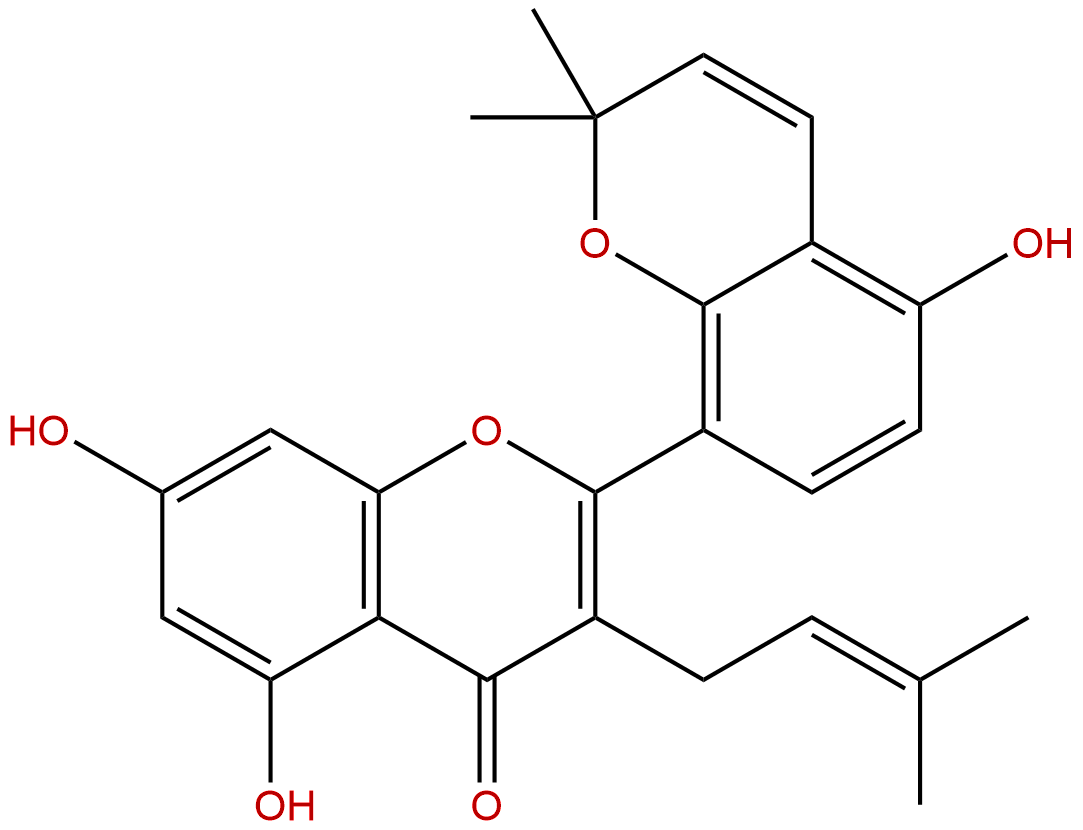
Kuwanon A, CAS number 62949-77-3, is a traditional medicinal plant derived from the mulberry tree(Morus alba L. Flavonoid derivatives isolated from the root bark (mulberry bark) of). Its molecular formula is C ₂₅ H ₂₄ O ₆, and its molecular weight is 420.4610 g/mol. It belongs to the complex flavonoid compounds in natural products. Mulberry trees, as members of the mulberry family, have long been recorded in traditional Chinese medicine for their root bark, which is used to relieve cough, asthma, promote diuresis, and reduce swelling. Modern pharmacological research has revealed that the various flavonoid components it contains have a wide range of biological activities, and mulberry flavonoids A is one of them with significant research value.
Existing research data indicate that mulberry flavonoids A can significantly inhibit the production of nitric oxide (NO), with a half maximal inhibitory concentration (IC ₅₀) of 10.5 μ M. This activity suggests that it may have anti-inflammatory and immunomodulatory potential. More importantly, based on database information, the role of mulberry flavonoids A is associated with multiple key cell cycle regulation and apoptosis related targets (such as TP53, CASP3, MYC, BAX, CDKN1A), making it a promising research prospect in the field of "anti-tumor". This article will provide a systematic professional popularization of mulberry flavonoids A from the aspects of its chemical structure, plant origin, pharmacological mechanism, medicinal evaluation, and research prospects.
2. Chemical structure and physicochemical properties
The chemical structure of mulberry flavonoids A is precisely described by its SMILES string "CC (C)=CCc1c (- c2cc (O) c3c2OC (C) (C) C=C3) oc2cc (O) cc (O) c2c1=O". By analyzing its structure, it can be concluded that it is a derivative with a flavonoid parent nucleus (benzo - γ - pyranone), which is connected to hydrophobic groups such as isopentenyl, forming a unique molecular skeleton. This structural characteristic directly affects its physical and chemical properties.
From the perspective of pharmacological parameters:
- Molecular weight (MW):420.46 g/mol, Slightly higher than the common threshold of 500 Da for small molecule drugs, but still within an acceptable range.
- Lipid water partition coefficient (LogP/LogD)LogP is 5.14 and LogD is 4.92, both significantly higher than 5. This indicates that mulberry flavonoids A have extremely strong lipophilicity. High lipophilicity is beneficial for compounds to penetrate cell membranes, but it may also lead to poor water solubility, rapid metabolism, non-specific binding, and other issues.
- Water solubility Only 0.0151 mg/mL, it is a compound that is extremely insoluble in water, which is consistent with its high LogP value and is one of the main obstacles it needs to overcome in formulation development.
- Topological Polarity Surface Area (TPSA)100.13 Å ² reflects the surface area of polar atoms (such as oxygen atoms) in the molecule. This value is moderate and usually compatible with a certain membrane permeability.
- Membrane permeability The permeability of Caco-2 cells is 10.16 × 10 ⁻⁶ cm/s, which is a high value indicating its good intestinal absorption potential. The effective penetration rate (Peff) is 3.26 cm/s × 10 ⁻⁴, further supporting its good oral absorption potential.
- Blood-brain barrier (BBB) penetrability Evaluated as' low ', it means that it is difficult for it to enter the central nervous system, which may actually reduce the risk of central neurotoxicity for the treatment of peripheral tumors.
In summary, mulberry flavonoids A are a natural compound with medium molecular weight, high lipophilicity, low water solubility, but good intestinal absorption potential. The multiple phenolic hydroxyl groups (- OH) in its structure are the key sites for its biological activity and also the source of its polarity.
3. Plant sources and traditional applications
The plant source of mulberry flavonoids A is single and clear:Mulberry white skin, namely mulberry tree(Morus alba L. The dried root bark of the plant comes from the Moraceae family. Mulberry trees have a high status in the agricultural and cultural history of China and even East Asia, and their main value lies in raising silkworms with mulberry leaves. However, its medicinal parts - root bark, leaves, and fruit (mulberries) - have also been used in traditional medicine for a long time.
Mulberry white skin, first recorded in the Shennong Bencao Jing, is classified as a medium grade. Its nature is cold, its taste is sweet, and it belongs to the lung meridian. The traditional benefits mainly include:
- Purging the lungs and relieving asthma Used for symptoms of lung heat, cough, asthma, and excessive phlegm.
- Promote diuresis to reduce edema Used for edema and difficulty urinating.
Throughout history, medical experts such as Zhang Zhongjing have recorded the use of "Sang Bai Pi Tang" in the "Synopsis of the Golden Chamber". Modern Chinese medicine categorizes its efficacy as "clearing lung heat, relieving asthma and cough, promoting diuresis and reducing swelling". The traditional perception of "clearing lung heat" is highly consistent with modern research findings that mulberry bark extract has anti-inflammatory, antibacterial, cough suppressing, and phlegm dispelling activities. As one of the many active ingredients in mulberry bark, mulberry flavonoids A inhibit the production of nitric oxide (an important inflammatory mediator), which can be regarded as one of the modern scientific annotations on the anti-inflammatory effect of mulberry bark in clearing lung heat. The extension of research from traditional "lung cleansing" to modern "anti-inflammatory" and even "anti-tumor" reflects the classic path from traditional experience to modern pharmacological exploration.
4. Pharmacological activity and mechanism of action
The most noteworthy pharmacological activity of mulberry flavonoids A is its potential antitumor Function. The database information associates it with five key cellular targets: TP53, CASP3, MYC, BAX, and CDKN1A. These targets do not exist in isolation, but form a core network that regulates cell fate (proliferation, apoptosis, and cell cycle arrest). Mulberry flavonoids A may exert anti-tumor effects by acting on multiple targets and synergistically affecting this network.
1. Analysis of core target functions:
- TP53(p53)The famous "genome guardian" is a tumor suppressor protein. Under stress conditions such as DNA damage, p53 is activated, which can induce cell cycle arrest (allowing cells time to repair damage) or initiate programmed cell death (apoptosis). The inactivation of p53 function is a common feature of over 50% of human tumors.
- CASP3(Caspase-3)It is a key protease in the execution stage of cell apoptosis, known as the "death protease". Once activated by upstream signals, Caspase-3 will cleave various cytoskeletal and nuclear proteins, leading to irreversible cell death.
- BAX It is a pro apoptotic protein in the Bcl-2 family. Under the stimulation of apoptotic signals, BAX will transfer to the outer membrane of mitochondria, leading to increased membrane permeability and the release of apoptotic factors such as cytochrome C, thereby activating the Caspase cascade reaction (including CASP3).
- CDKN1A(p21/WAF1)It is one of the important downstream target genes of p53. P21 protein is a potent inhibitor of cyclin dependent kinase (CDK), mainly causing G1 phase cell cycle arrest and creating conditions for DNA repair.
- MYC It is a proto oncogene that encodes the transcription factor c-Myc, which can strongly drive cell proliferation, metabolism, and growth. In many tumors, overexpression or amplification of MYC gene is an important driving force for the unlimited proliferation of tumor cells.
2. Potential mechanism of action deduction:
Based on the background that mulberry flavonoids A can inhibit the production of nitric oxide (with anti-inflammatory and tumor microenvironment regulating effects), its anti-tumor mechanism may be a multi link, multi-target process:
- Activate tumor suppression pathway Mulberry flavonoids A may be triggered by certain stress signals, such as oxidative stress Activate or stabilize p53 (TP53)Activated p53 upregulates its downstream targets on one hand p21(CDKN1A)The expression of tumor cells leads to G1 phase arrest and inhibited proliferation.
- Activate mitochondrial apoptosis pathway Meanwhile, activated p53 can also upregulate transcription BAX Expression of pro apoptotic proteins. BAX forms pores on the mitochondrial membrane, releasing apoptotic factors and ultimately activating them Caspase-3(CASP3)Execute the apoptosis program.
- Inhibition of oncogene drive Mulberry flavonoids A may also have Inhibition of c-Myc (MYC) The ability to express or activate. The inhibition of c-Myc directly weakens the proliferation and metabolic capacity of tumor cells, and synergizes with the p53/p21 pathway to enhance cell cycle arrest and pro apoptotic effects.
Therefore, mulberry flavonoids A may play a role as a "network regulator": it Promote tumor suppressor factors (TP53, CDKN1A, BAX) The function,Inhibition of oncogenic factors (MYC) The activity, and Activate Apoptosis Executor (CASP3)Apply pressure to tumor cells from multiple dimensions to induce them to stop proliferation or move towards death. This multi-target characteristic is an advantage of many natural products, but it also increases the complexity of studying their mechanisms of action.
5. Evaluation of drug properties
By comparing the physicochemical parameters of mulberry flavonoids A with the classic Lipinski's Rule of Five (Ro5), its potential as an oral medication can be preliminarily evaluated
1. Molecular weight<500 Da 420.46, compliant.
2. LogP < 5:5.14,Slightly higher than 5, there is a violation This suggests that its lipid solubility is too strong.
3. The number of hydrogen bond donors (HBDs) is less than 5 According to the structure, there are about 3-4 phenolic hydroxyl groups, which is consistent.
4. The number of hydrogen bond acceptors (HBAs) is less than 10 The number of oxygen atoms (including carbonyl and ether bonds) in the molecule is about 6, which is consistent.
Mulberry flavonoids A only slightly exceeded one of the five rules (LogP), indicating a good overall drug like basis. However, a more in-depth analysis of drug efficacy needs to be combined with other parameters:
-
Advantage:
- Good absorption potential High Caco-2 permeability and Peff value suggest that its oral bioavailability may be better.
- Plasma protein binding rate (PPB)As high as 91.74%, this means that most drugs bind to proteins in the blood. High PPB can prolong the half-life of drugs in the body, but it can also reduce the concentration of free drugs, which may affect their efficacy.
- No hERG inhibition The risk of causing QT interval prolongation in the heart is low, indicating good cardiovascular safety.
-
Challenges and Risks:
- Very low water solubility(0.0151 mg/mL): This is the biggest obstacle to its development as a formulation (especially an injection), which needs to be solved through techniques such as salt formation, making nanocrystals, liposomes, or using solubilizers.
- Potential toxic signals:
- Ames test The result is 0.6 (usually<1.0 is considered negative or weakly positive, but it needs to be determined based on specific experimental systems), indicating a low risk of mutagenicity, but further confirmation is needed.
- chromosome aberration Displaying 'Yes' is a clear indication Genetic toxicity warning signal Strict evaluation is required in the early stages of drug development.
- Phototoxicity Displaying 'yes' means that it may cause adverse skin reactions under light exposure.
- Respiratory sensitization Displaying 'Yes' indicates a possible risk of inducing respiratory allergic reactions.
- Elevated serum biomarkers The data shows that it has an effect on serum alkaline phosphatase (ALK), gamma glutamyltransferase (GGT), aspartate aminotransferase (AST), and alanine aminotransferase (ALT) ("Yes"), which usually suggests potential Risk of liver cell injury or bile stasis It is an important indicator of drug hepatotoxicity.
Comprehensive Assessment Mulberry flavonoids A have a good structural basis for becoming orally active small molecules, and its multi-target anti-tumor mechanism is also attractive. However, it Extremely low water solubility, especially potential genetic toxicity (chromosomal aberration), hepatotoxicity, and phototoxicity This constitutes a significant obstacle to its conversion into drugs. In subsequent research, it is necessary to clarify the degree of these risks through systematic toxicology studies, including in vivo and in vitro genotoxicity complete sets of tests, repeated administration toxicity tests. Meanwhile, improving solubility and reducing toxicity through structural modifications, such as preparing water-soluble prodrugs, is a key research direction driving its development.
6. Research Status and Application Prospects
At present, research on mulberry flavonoids A is still in progress Early preclinical stage The existing literature mainly focuses on its phytochemical isolation, preliminary in vitro activity screening (such as NO inhibition), and target prediction based on database mining. Its clear multi-target anti-tumor mechanism has not been fully and systematically validated in cell and animal models.
Future research directions may include:
1. Mechanism deep validation In specific tumor cell lines, the regulatory effects of mulberry flavonoids A on targets such as TP53 and MYC, as well as the resulting cell cycle arrest, apoptosis, and other phenotypes, were empirically demonstrated using techniques such as gene knockout/overexpression, reporter genes, confocal microscopy, and flow cytometry.
2. Pharmacodynamic evaluation in vivo Establish mouse or rat transplant tumor models, evaluate the in vivo anti-tumor activity, optimal administration route and dosage of mulberry flavonoids A, and preliminarily investigate its pharmacokinetic characteristics.
3. Optimization of drug properties Regarding its poor water solubility and toxicity warning, carry out Research on Structural Modification For example, methylation, glycosylation, or preparation of its phenolic hydroxyl group into phosphate prodrugs may improve water solubility and metabolic stability without significantly affecting activity. By studying the structure-activity relationship, we aim to identify the necessary active and toxic functional groups to guide the design of safe and effective derivatives.
4. Exploration of combination therapy Given its multi-target nature, exploring the combination of mulberry flavonoids A with existing chemotherapy drugs or targeted drugs may result in synergistic effects and reduced drug resistance.
Application Prospects:
Mulberry flavonoids A, as a natural product derived from traditional medicinal herbs, have value not only in their potential to be developed into new drugs, but also in providing an excellent lead compound Template. Through in-depth research on it, scientists can:
- Revealing the material basis of the anti-tumor effect of mulberry bark One of them is to provide scientific basis for the modernization and internationalization of traditional medicinal materials.
- Discovering a new chemical tool for regulating the p53 MYC-BAX network Used for related biological research.
- Ultimately, through rational drug chemical modification, it is expected to develop anti-tumor candidate drugs or adjuvant therapy products with independent intellectual property rights, novel mechanisms of action, and higher safety.
In short, mulberry flavonoids A are a "key" hidden in ancient mulberry trees, which opens a door to the regulatory core network of tumor cells for us. Despite the challenges on the road to clinical application, especially safety issues, its unique chemical structure and multi-target mode of action make it a star molecule worthy of continuous attention and in-depth exploration in the field of natural product anti-tumor drug development.