


Synonym name: 3'-O-Beta-D-Xylopyranoside
Catalogue No.: BP0965
Cas No.: 102841-43-0
Formula: C24H26O9
Mol Weight: 458.463
Botanical Source: the root bark of Morus lhou
Purity: 95%~99%
Analysis Method: HPLC-DAD or/and HPLC-ELSD
Identification Method: Mass, NMR
Packing: Brown vial or HDPE plastic bottle
Can be supplied from milligrams to grams.
For Reference Standard and R&D, Not for Human Use Directly.
Inquire for bulk scale.
HPLC of Mulberroside C
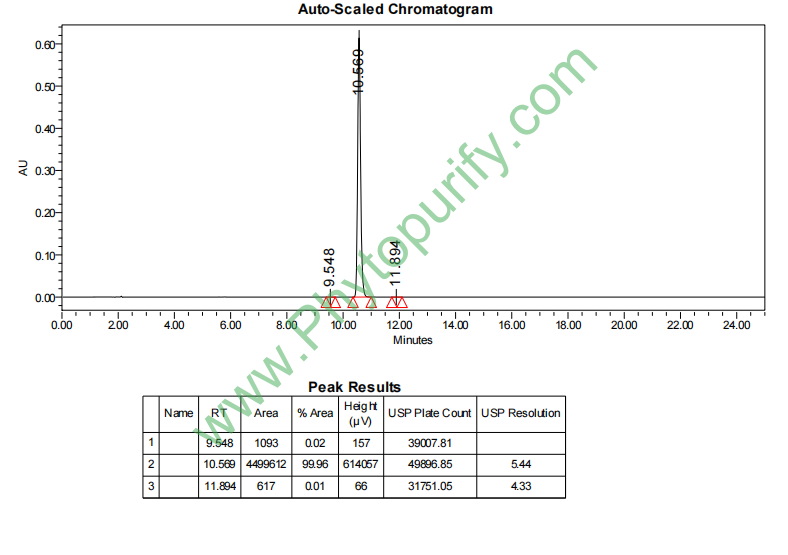
Storage conditions:Short-term storage at 2~8℃, long-term storage at -20 ~ -80℃
141.9800
1.8663
1.8646
.1268
.6133
.7119
Low
85.9595
4.3062
Yes
No
Yes
No
No
No
0.6
Yes
No
Yes
Yes
Mulberroside C is a compound derived from mulberry trees(Morus alba L. The natural glycoside compounds isolated from) have become a hot topic in natural product pharmacology research due to their significant biological activity. As one of the main bioactive components in mulberry trees, mulberry bark glycoside C not only exhibits good antiviral activity, especially in inhibiting the replication of hepatitis C virus (HCV), but also shows potential pharmacological value in anti-tumor, anti-inflammatory, and antioxidant aspects. In recent years, with the in-depth analysis of its mechanism of action and molecular targets, the position of mulberry bark glycoside C in the development of natural medicines has become increasingly prominent. This article aims to systematically review the chemical structure and physicochemical properties, plant sources and extraction methods, pharmacological activity and mechanism of action, pharmacological evaluation and pharmacokinetic characteristics of mulberry bark glycoside C, and explore its clinical application prospects and research prospects, providing theoretical basis and practical guidance for subsequent drug development.
The chemical structure of mulberry bark glycoside C is a glycoside compound with the molecular formula C21H2O_11 and a molecular weight of 458.4630. Its structure contains multiple hydroxyl and glycosidic bonds, giving it good water solubility and strong polarity. According to the calculation, its LogP value is 1.8663, indicating that it has moderate lipid solubility, which is beneficial for cell membrane penetration but not excessively hydrophobic. The topological polar surface area (TPSA) is 141.98 Å ², reflecting the strong polarity and hydrogen bond donor/acceptor ability of the molecule, which has a significant impact on its binding with biomolecules.
The water solubility of Sangpi glycoside C is about 0.1268 mg/mL, which is a moderately water-soluble compound that is beneficial for oral absorption but may have certain solubility limitations. The low permeability of the blood-brain barrier suggests limited distribution in the central nervous system. The negative result of hERG channel inhibition experiment indicates a low risk of cardiac toxicity. The Ames mutagenicity test score is 0.6, indicating a low risk of genotoxicity and a good safety basis.
The chemical structure of Sangpi glycoside C contains multiple phenolic hydroxyl groups and glycosidic moieties, which not only determine its physicochemical properties but are also closely related to its biological activity. The presence of phenolic hydroxyl groups endows it with strong antioxidant capacity, while the glycoside moiety affects its stability and bioavailability.
Mulberry bark glycoside C mainly exists in mulberry trees(Morus alba L. Among the root bark, bark, and leaves of mulberry trees, the content of mulberry root bark is particularly high. Mulberry trees, as a traditional Chinese medicinal herb, are widely distributed in China, Japan, South Korea, and Southeast Asia, with a long history of medicinal use. Mulberry bark glycoside C, as one of the active ingredients in mulberry trees, is often used to study its pharmacological effects and develop natural medicines.
The common methods for extracting mulberry bark glycoside C include solvent extraction, ultrasound assisted extraction, and high-performance liquid chromatography (HPLC) separation and purification. Traditional extraction methods often use ethanol or methanol aqueous solutions as extractants, combined with ultrasound assisted technology, which can significantly improve extraction efficiency and purity. During the extraction process, temperature and time need to be controlled to prevent component degradation. The purification steps usually use techniques such as silica gel column chromatography and reverse phase HPLC to ensure the high purity of mulberry bark glycoside C.
In recent years, green extraction techniques such as supercritical fluid extraction and microwave-assisted extraction have also been applied to the extraction of mulberry bark glycoside C, balancing extraction efficiency and environmental friendliness. The optimization of the extraction process not only provides technical support for the large-scale production of mulberry bark glycoside C, but also lays the material foundation for its pharmacological research.
Mulberry bark glycoside C was first discovered to have significant antiviral effects, especially in inhibiting the replication of hepatitis C virus (HCV). In vitro cell model studies have shown that mulberry bark glycoside C can effectively inhibit HCV RNA replication and reduce viral load, indicating its potential as an anti HCV drug. Its antiviral mechanism may involve interfering with the assembly of viral replication complexes and regulating the host cell's antiviral signaling pathway.
In addition, mulberry bark glycoside C also exhibits certain inhibitory activity against other viruses such as hepatitis B virus (HBV) and herpes simplex virus (HSV), demonstrating its broad-spectrum antiviral potential and worthy of further in-depth research.
In recent years, the research on mulberry bark glycoside C in the field of anti-tumor has gradually increased. Multiple in vitro cell experiments have shown that mulberry bark glycoside C can inhibit the proliferation of various tumor cells, induce cell apoptosis, and suppress tumor cell migration and invasion. Its anti-tumor activity involves multiple signaling pathways and molecular targets, including:
These multi-target mechanisms make mulberry bark glycoside C a potential multifunctional anti-tumor natural product.
Mulberry bark glycoside C also exhibits certain anti-inflammatory and antioxidant activities. It reduces inflammation and cell damage by inhibiting the release of inflammatory mediators and regulating the activity of oxidative stress-related enzymes. In addition, the adjunctive therapeutic effect of mulberry skin glycoside C on diabetes and neurodegenerative diseases has gradually been concerned, showing a broad pharmacological application prospect.
The pharmacological effects of Sangpi glycoside C are based on its regulation of multiple key molecular targets, and the specific mechanisms are as follows:
Regulation of MCL1 and BCL2 family proteins
Mulberry bark glycoside C disrupts the anti apoptotic defense line of tumor cells and promotes programmed cell death by downregulating the expression of MCL1 and BCL2. This mechanism is of great significance for overcoming drug resistance in tumor cells.
STAT3 signaling pathway inhibition
STAT3, as a core transcription factor in various tumor and inflammation related signaling pathways, is inhibited by mulberry bark glycoside C by inhibiting its phosphorylation activation, blocking the expression of downstream genes, and suppressing tumor growth and immune escape.
MMP2 activity inhibition
MMP2 participates in the degradation of extracellular matrix, promoting the migration and invasion of tumor cells. Mulberry bark glycoside C reduces the possibility of tumor metastasis by inhibiting MMP2 activity.
Topoisomerase TOP1 and TOP2A regulation
By affecting the functions of TOP1 and TOP2A, mulberry bark glycoside C interferes with DNA replication and repair processes, inhibiting the proliferation of tumor cells.
HIF1A inhibition
Mulberry bark glycoside C can inhibit the expression of hypoxia inducible factor HIF1A, block tumor angiogenesis, and limit the nutritional supply of the tumor microenvironment.
MAPK1 signaling pathway regulation
By regulating MAPK1 and mulberry bark glycoside C, it affects cell proliferation, differentiation, and stress response, exerting multiple biological effects.
Hormone related target regulation: ESR1 and CYP19A1
The regulation of morioside C on estrogen receptor ESR1 and aromatase CYP19A1 suggests its potential application in hormone dependent tumors such as breast cancer.
In addition, the antiviral mechanism of Sangpi glycoside C mainly involves inhibiting the assembly of viral replication complexes and activating host antiviral signaling pathways, such as interferon signaling pathways, to enhance intracellular antiviral responses.
The pharmacological evaluation of mulberry bark glycoside C shows that it has good potential for drug development. Its molecular weight is moderate, and both LogP value and TPSA are within the ideal range of drug molecules, which is conducive to absorption and distribution in vivo. Although its water solubility is not high, its bioavailability can be improved through formulation technology.
The low blood-brain barrier permeability suggests that mulberry bark glycoside C mainly acts on peripheral tissues, reducing potential side effects on the central nervous system. HERG channel inhibition negative and low mutagenicity in Ames test indicate high safety and suitability for long-term medication.
In terms of pharmacokinetics, existing studies have shown that mulberry bark glycoside C is rapidly absorbed orally, but its bioavailability is limited by first pass effects and water solubility. It is mainly metabolized in the body through the liver, and the metabolites are mostly glycoside hydrolysates and phenolic derivatives. Excretion is mainly through the renal and biliary pathways. Moderate half-life, supporting the design of daily dosing regimens.
Further systematic pharmacokinetic and toxicological studies are needed in the future to clarify its in vivo metabolic pathways, drug interactions, and long-term safety, providing a basis for clinical applications.
Mulberry bark glycoside C, as a multi-target and multifunctional natural product, has broad clinical application prospects. Its antiviral activity is particularly targeted towards hepatitis C virus, and it may become a candidate ingredient for novel anti HCV drugs, meeting the challenges of drug resistance and side effects in current antiviral therapy.
In the field of anti-tumor, mulberry bark glycoside C has shown good anti-tumor potential by regulating multiple signaling pathways and key molecular targets. In the future, chemical modification and drug carrier technology can be combined to enhance its targeting and bioavailability, and develop it into an anti-cancer adjuvant therapy drug.
In addition, the anti-inflammatory, antioxidant, and hormone related targets of mulberry bark glycoside C suggest its potential application in chronic inflammatory diseases, metabolic diseases, and hormone dependent diseases. With further elucidation of pharmacological mechanisms and in-depth preclinical research, mulberry bark glycoside C is expected to expand into more disease fields.
Future research should focus on optimizing its pharmacokinetics, developing dosage forms, and evaluating clinical safety. At the same time, modern molecular biology techniques should be combined to deeply analyze its mechanism of action and promote the clinical application of mulberry bark glycoside C from the laboratory.
Mulberry bark glycoside C, as an important bioactive component in mulberry trees, has become a hot topic in natural product pharmacology research due to its significant antiviral and anti-tumor activities. Its multi-target mechanism of action and good pharmacokinetic parameters provide a solid foundation for its drug development. Although its pharmacokinetics and clinical safety research are still in the preliminary stage, the potential of mulberry bark glycoside C in antiviral and anti-tumor fields has been widely recognized.
In the future, combining modern medicinal chemistry, pharmacokinetics, and clinical research methods, mulberry bark glycoside C is expected to become an important candidate for new natural medicines, providing new strategies and choices for antiviral and anti-tumor treatments. Continuous basic research and clinical translation will promote the application of mulberry bark glycoside C in the development of natural medicines, benefiting a wide range of patients.
