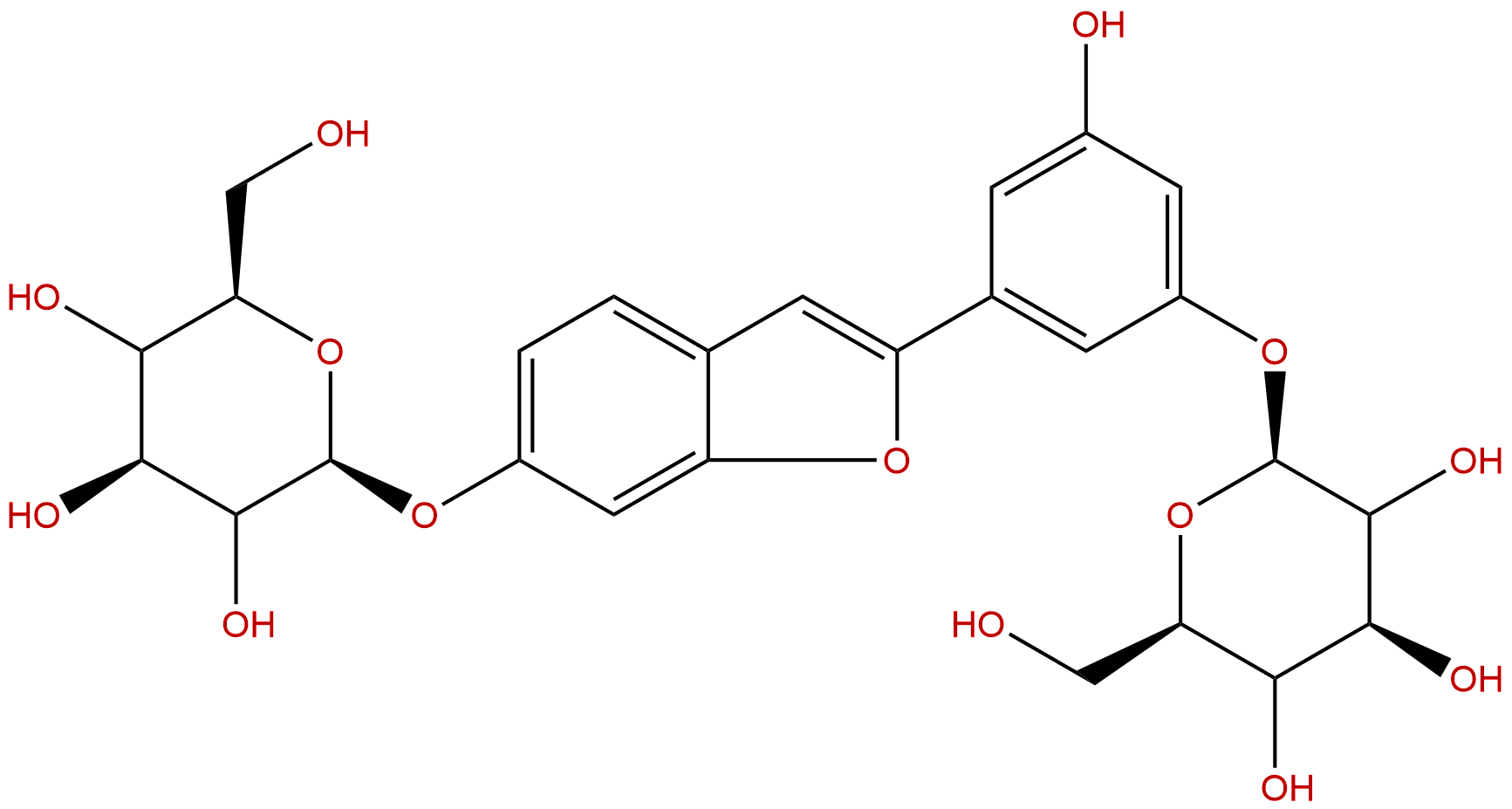
Mulberry bark glycoside F: a multi-target anti-inflammatory and whitening active molecule in mulberry trees
1. Overview
Mulberroside F is a traditional medicinal plant derived from the mulberry tree(Morus alba L.)Natural stilbene glycoside compounds obtained through separation. Its CAS number is 193483-95-3, molecular formula is C26H30O14, and molecular weight is approximately 566.51 g/mol. As one of the main bioactive components in mulberry bark, mulberry bark glycoside F has attracted much attention in recent years due to its diverse pharmacological activities. Preliminary studies have revealed that it not only effectively inhibits tyrosinase activity and melanin production, demonstrating potential as a skin whitening agent, but also has significant superoxide scavenging ability. Further research has found that mulberry bark glycoside F can act on multiple key targets closely related to inflammation, such as TNF, IL6, PTGS2, etc., indicating its potential anti-inflammatory application value. This article will provide a systematic professional popularization of this natural product with multiple biological activities from the aspects of its chemical structure, plant origin, pharmacological mechanism, medicinal evaluation, and research prospects.
2. Chemical structure and physicochemical properties
The chemical structure of mulberry bark glycoside F belongs to the class of stilbene glycosides. The SMILES string provides a detailed description of its three-dimensional configuration:OC[C@H]1O[C@@H](Oc2cc(O)cc(-c3cc4ccc(O[C@@H]5O[C@H](CO)C(O)[C@H](O)C5O)cc4o3)c2)C(O)[C@@H](O)C1OStructurally, it is composed of a stilbene glycoside (similar in structure to resveratrol) connected to two sugar groups (presumably glucose) through glycosidic bonds. This glycosylation modification significantly affects its physicochemical properties and biological activity.
From the analysis of pharmacological parameters:
- Molecular weight (MW):566.51 g/mol, Slightly higher than the recommended upper limit of 500 Da in Lipinski's Five Rules, but considering it is a natural glycoside, this deviation is within an acceptable range.
- Lipid water partition coefficient (LogP/LogD)The values are -0.4056 and -0.4067 respectively, indicating that the compound has extremely strong hydrophilicity and almost no lipophilicity. This is closely related to the presence of multiple hydroxyl and sugar groups in the structure.
- Topological Polarity Surface Area (TPSA)As high as 232.13 Å ², far exceeding the threshold commonly believed to be easy to penetrate cell membranes (about 140 Å ²), indicating weak passive diffusion ability across membranes.
- Water solubility The value is 3.1001 (usually measured in log mol/L or mg/mL, which is not specified here but can be inferred from LogP), indicating good water solubility.
- Permeability The Caco-2 cell permeability (Caco2_permeability) is only 0.1180, and the Peff value is 0.5365, both at a relatively low level, confirming that its intestinal absorption may be poor due to high TPSA and strong hydrophilicity.
In summary, mulberry bark glycoside F is a typical high polarity, high water solubility, and macromolecular glycoside, and its physical properties may pose challenges for its absorption and distribution in organisms.
3. Plant sources and traditional applications
Mulberry bark glycoside F mainly comes from mulberry trees in the mulberry family(Morus alba L.)The dried root bark, also known as the traditional Chinese medicine "mulberry white bark". Mulberry trees have a long history of cultivation and application in China and even East Asia. Their leaves (mulberry leaves) are used for raising silkworms, their fruits (mulberries) are edible, and their root bark (mulberry bark) is an important traditional Chinese medicinal herb.
In traditional Chinese medicine theory, mulberry bark is sweet and cold in nature, and belongs to the lung meridian. Its main functions are to clear the lungs, relieve asthma, promote diuresis, and reduce swelling. Commonly used for treating symptoms such as pulmonary fever, cough and asthma, edema and fullness, and difficulty urinating. The traditional usage is mostly for frying soup and taking it orally. Modern pharmacological research has provided scientific basis for these traditional effects, discovering that extracts of mulberry bark have various activities such as cough control, phlegm removal, asthma relief, anti-inflammatory, diuretic, and blood glucose lowering. Mulberry bark glycoside F, as one of the characteristic and high content active ingredients in mulberry bark, is considered an important material basis for its cough, asthma, anti-inflammatory and anti-inflammatory effects. The interpretation from traditional "purging lung fire" to modern "anti-inflammatory and antioxidant" reflects the deepening understanding of mulberry bark glycoside F.
4. Pharmacological activity and mechanism of action
The pharmacological activity of mulberry bark glycoside F is mainly reflected in two aspects: skin whitening and anti-inflammatory. Its mechanism of action involves the regulation of multiple key biological targets.
(1) Skin whitening and antioxidant activity
The existing description clearly states that mulberry bark glycoside F can inhibit tyrosinase activity and melanin formation in melano-a cells. Tyrosinase is the rate limiting enzyme in the biosynthesis of melanin, and inhibiting its activity is one of the core strategies in the development of skin whitening products. Meanwhile, mulberry bark glycoside F also has superoxide scavenging activity. In the skin, factors such as ultraviolet radiation can generate excessive reactive oxygen species (ROS), such as superoxide anions. This not only oxidizes lipids and proteins, damaging skin cells, but also directly stimulates the proliferation of melanocytes and upregulates tyrosinase expression, exacerbating pigmentation. Therefore, mulberry bark glycoside F synergistically exerts whitening and skin protection effects through dual pathways of "inhibiting tyrosinase" and "clearing superoxide", providing theoretical support for its application as a natural whitening agent.
(2) Anti inflammatory activity and its multi-target mechanism of action
The target information provided by the database (TNF, PTGS2, NFKB1, IL6, IL1B) clearly points to the strong anti-inflammatory potential of mulberry bark glycoside F. These targets form a closely interconnected inflammatory signaling network:
- TNF (tumor necrosis factor) and IL6 (interleukin-6), IL1B (interleukin-1 β)They are key pro-inflammatory cytokines that play a central role in initiating and amplifying inflammatory responses. Excessive production can lead to or exacerbate various acute and chronic inflammatory diseases.
- NFKB1 (nuclear factor kappa B1)This is a key transcription factor that serves as the "master switch" for the inflammatory response. TNF, IL-1 and other signals can activate the NF - κ B pathway, thereby inducing gene expression of a series of inflammatory mediators such as PTGS2, IL6, and IL1B.
- PTGS2 (prostaglandin endoperoxide synthase 2, also known as COX-2)This is an inducible cyclooxygenase that is highly expressed under inflammatory stimuli and is responsible for catalyzing the synthesis of prostaglandin inflammatory mediators (such as PGE2), causing inflammatory symptoms such as pain, fever, and vasodilation.
Mulberry bark glycoside F can act on multiple nodes in this network, indicating that it may downregulate the production of pro-inflammatory cytokines such as TNF, IL6, and IL1B by inhibiting the activation of upstream signaling pathways such as NF - κ B, and inhibit the expression of COX-2, reducing the synthesis of prostaglandin mediators. This multi-target, networked mode of action enables it to block the inflammatory cascade reaction from multiple links, which may have better anti-inflammatory effects and lower resistance risks than single target inhibitors. This provides a modern pharmacological explanation for the traditional use of mulberry bark in the treatment of "pulmonary heat cough asthma" (often associated with respiratory inflammation) and "edema" (often associated with inflammatory exudation).
5. Evaluation of drug properties
Based on the provided pharmacological parameters, we can conduct a preliminary evaluation of the potential development of mulberry bark glycoside F as an oral drug, and analyze it in conjunction with the famous "Lipinski Rule of Five" (Ro5):
-
Lipinski Five Rule Compliance:
- Molecular weight<500 Da:not conform to(566.51 > 500)。
- LogP < 5:Comply with(-0.41 << 5)。
- Hydrogen bond donor number (HBD)<5: From the structural formula, it contains multiple hydroxyl groups, and HBD is likely to exceed 5,May not comply。
- Hydrogen bond acceptor number (HBA)<10: The molecule contains 14 oxygen atoms (all potential HBAs),not conform to。
Overall, mulberry bark glycoside F clearly violates multiple Lipinski rules (usually two or more violations are considered to indicate poor oral bioavailability). This is consistent with the structural characteristics of its highly polar glycosides.
-
Absorption, distribution, metabolism, excretion (ADME) characteristics:
- absorb The extremely low Caco-2 permeability and Peff value indicate poor oral absorption. High TPSA and strong hydrophilicity are the main reasons. It may require active transport mechanisms in the intestine, such as glucose transporters, to be effectively absorbed.
- distribution The plasma protein binding rate (PPB) is about 73.5%, which is at a moderate level, indicating that some free drugs can be distributed to tissues. The blood-brain barrier penetrability (BBB-permeability) is "low", which conforms to its high polarity characteristics and is not easy to enter the central nervous system.
- Metabolism and toxicity The Ames test result is 0.6 (usually<1.5 considered non mutagenic), indicating no genotoxicity. No chromosomal abnormalities, hERG inhibition, skin/respiratory sensitization, and phototoxicity, indicating its preliminary safety is good. However, it should be noted that it may be hydrolyzed by gut microbiota or glycosidases in the body to generate aglycones (such as resveratrol analogs), whose physicochemical properties and activities may differ from those of the prototype drug, which is a common characteristic of glycoside compound metabolism.
- excretion The relevant parameters are not directly provided, but highly water-soluble compounds usually tend to be excreted through the kidneys.
-
Comprehensive assessment of the potential of traditional Chinese medicine:
Mulberry bark glycoside F itself faces significant challenges as an oral drug molecule, mainly due to Oral bioavailability is likely to be very low However, this does not completely negate its development value. Its development strategy may include:
- Developed as an external preparation: Its whitening and anti-inflammatory activities are very suitable for external dermatological products (such as cream, essence), which can perfectly avoid oral absorption problems.
- As a prodrug or food supplement It may be metabolized into more active aglycones in the body.
- Structural modification Improve its lipid solubility and permeability through chemical modification (such as making ester prodrugs).
- New drug delivery system Using delivery technologies such as nanoliposomes and microemulsions to encapsulate drugs and improve their oral or transdermal absorption efficiency.
6. Research Status and Application Prospects
At present, research on mulberry bark glycoside F is still in the preclinical stage. The existing research mainly focuses on activity screening and preliminary exploration of the mechanism of action, confirming its biological activities in tyrosinase inhibition, antioxidant, anti-inflammatory and other aspects. Its multi-target anti-inflammatory mechanism is particularly noteworthy, providing lead compounds for the development of new natural source anti-inflammatory drugs.
Future research directions may focus on the following areas:
1. Deepening the mechanism of action Further cell and animal experiments are needed to clarify whether mulberry bark glycoside F affects targets such as TNF and NF - κ B through direct binding or indirect regulation, and to map out its complete anti-inflammatory signaling pathway.
2. Pharmacokinetic study Systematically studying its absorption, distribution, metabolism, and excretion processes in animal bodies, clarifying its prototype and the efficacy of its main metabolites, is a key step in evaluating its pharmacological properties.
3. Pharmaceutical research Given the limitations of its oral absorption, developing efficient topical formulations (for whitening, dermatitis, etc.) or utilizing advanced drug delivery technologies to improve its oral bioavailability will be the core driving force for its application.
4. Indications expansion: Based on its anti-inflammatory target, we can explore its role in more inflammation related disease models, such as arthritis, colitis, atherosclerosis, neuritis, etc.
5. Security system evaluation Although preliminary toxicity testing is good, comprehensive subacute and chronic toxicology studies are still needed.
Application Prospects:
- Cosmetics and Dermatology As a natural and multifunctional active ingredient, it has immediate application prospects in high-end skincare products such as whitening, spot lightening, anti allergy, and soothing.
- Health products field Can be used as part of a composite formula of mulberry tree extract for antioxidant and immune enhancing health products.
- drug development As a lead compound, it is expected to be used for the treatment of specific inflammatory diseases through structural optimization or the development of novel drug delivery systems.
In short, mulberry bark glycoside F is a valuable gift bestowed upon modern pharmacy by mulberry trees, a traditional medicinal and edible plant. It has built a bridge between traditional medical wisdom and modern life sciences with its unique multi-target mechanism of action and clear biological activity. Despite the challenges on the road to becoming a traditional Chinese medicine, with the continuous deepening of research and advances in formulation technology, mulberry bark glycoside F is expected to realize its unique value in fields such as skin health and inflammation management.