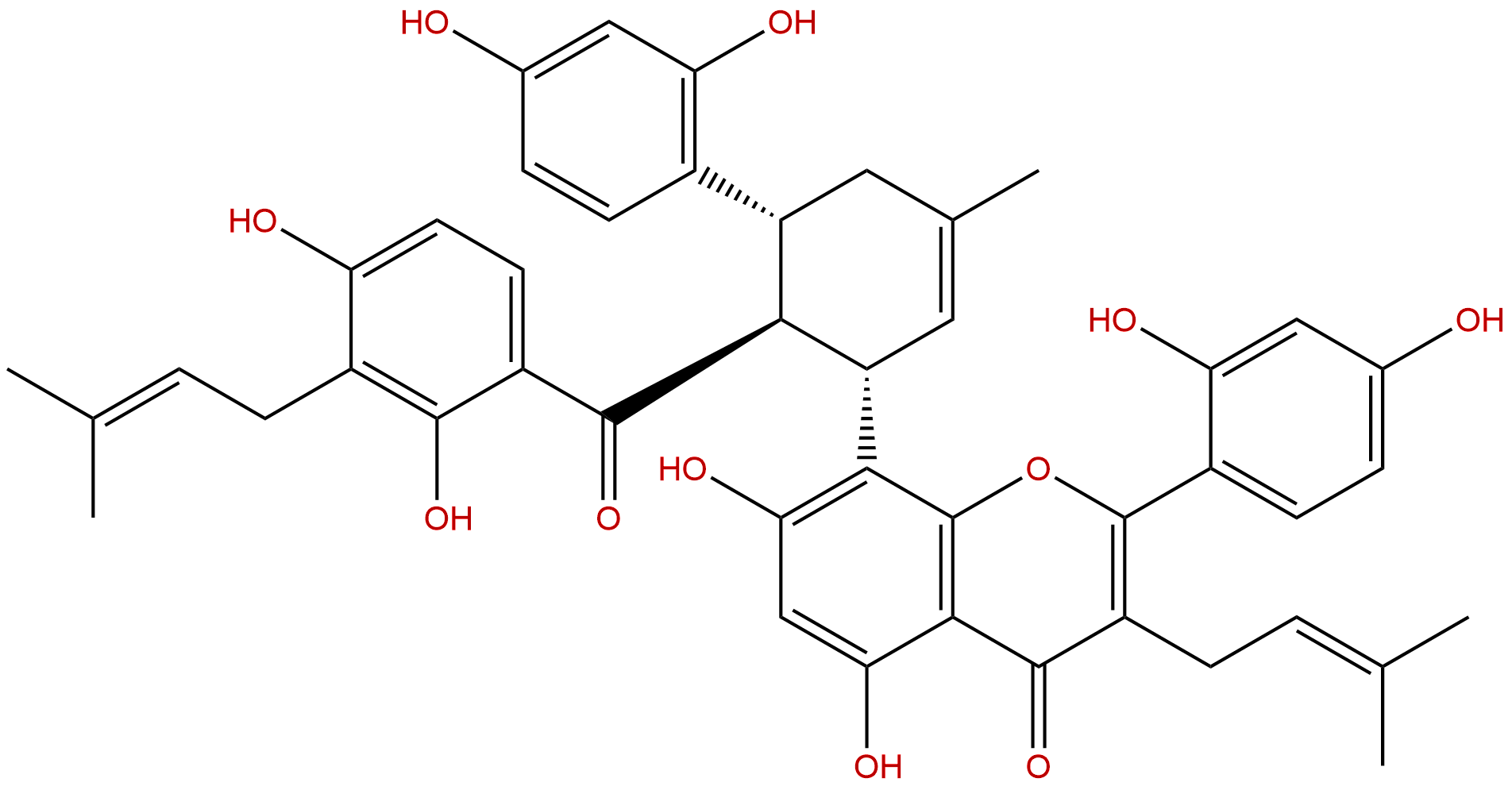
Mulberry flavonoids H: a natural anti-tumor candidate molecule in mulberry trees
1. Overview
Kuwanon H is a natural product of tetrahydroxyflavonoids isolated from plants of the Morus genus. Its CAS number is 76472-87-2, molecular formula is C45H44O11, and molecular weight is approximately 760.84 g/mol. As a typical secondary metabolite of plants, mulberry flavonoids H mainly come from Morus alba cortex, which is the dried root bark of mulberry trees. It has a long history of application in traditional medicine. Modern pharmacological research has found that mulberry flavonoids H have significant biological activity, particularly noteworthy for their role as Non peptide frog skin hormone receptor antagonist The characteristics. It can specifically inhibit the binding of gastric hormone releasing peptide (GRP) to its preferred receptor (GRP), with an inhibition constant Ki value of 290 nM, indicating its potential value in regulating physiological and pathological processes related to GRP. In recent years, with the rise of multi-target drug research concepts, mulberry flavonoids H have demonstrated regulatory effects on multiple key tumor related targets such as TP53, CASP3, MYC, BAX, CDKN1A, etc Significant anti-tumor potential It has become a hot topic molecule in the research of natural anti-tumor drugs. This article will provide a systematic scientific introduction to this compound from the aspects of its chemical structure, plant origin, pharmacological mechanism, medicinal evaluation, and research prospects.
2. Chemical structure and physicochemical properties
The chemical structure of mulberry flavonoids H belongs to the complex members of flavonoids. Its SMILES string (CC (C)=CCc1c (O) ccc (C (=O) [C @ @ H] 2)C@@H C=C (C) C [C @ H] 2c2ccc (O) cc2O) c1O) reveals that its molecule contains multiple aromatic rings, hydroxyl groups, isopentenyl groups, and specific chiral centers (indicated by the @ symbol). This complex structure is the material basis for its biological activity.
From the perspective of pharmacological parameters, the molecular weight (MW) of mulberry flavonoids H is 760.8360, which significantly exceeds the common upper limit of 500 Da for conventional small molecule drugs. Its topological polar surface area (TPSA) is 209.1200 Å ², which is a relatively high value, reflecting the presence of multiple polar groups (such as hydroxyl groups) in the molecule. The lipid water partition coefficient (LogP) is 6.0320 and the LogD is 5.6421, indicating that the compound Strong lipid solubility High lipophilicity. This characteristic is consistent with its extremely low water solubility (0.0087 mg/mL), indicating potential challenges in solubility and bioavailability in vivo. According to the famous Lipinski's Five Rules Preliminary evaluation based on the "Five Principles of Similar Drugs": The molecular weight of mulberry flavonoids H is greater than 500, LogP>5, Hydrogen bond donors (multiple - OH) may exceed 5, and hydrogen bond acceptors (O atoms) may exceed 10. Therefore, it Violation of multiple rules Strictly speaking, it does not belong to the category of "drug like" molecules. This usually means that its oral absorption and transmembrane transport may be poor, and in drug development, formulation technologies (such as nano formulations, prodrug modifications, etc.) are needed to improve its pharmaceutical properties.
3. Plant sources and traditional applications
The plant source of mulberry flavonoids H is clear and single, mainly from The dried root bark of Morus alba L., a plant in the Moraceae family, also known as the traditional Chinese medicine "mulberry white bark"Mulberry trees have a cultivation history of thousands of years in China and even East Asia. Their leaves are used for sericulture, and their roots, branches, leaves, and fruits are all used as medicine. Mulberry bark is recorded in the "Shennong Bencao Jing" as having a sweet and cold nature, returning to the lung meridian. Its traditional efficacy is mainly Purging the lungs, relieving asthma, promoting diuresis, and reducing swelling It is commonly used to treat symptoms such as lung heat, cough, asthma, edema, and fullness.
Modern plant chemistry research has revealed that mulberry bark is rich in various active ingredients such as flavonoids, stilbenes, alkaloids, etc. Mulberry flavonoids H is one of the representative isopentenyl flavonoids. The introduction of isopentenyl groups often significantly enhances the lipid solubility and biological activity of flavonoids, which may be related to the strong pharmacological effects of mulberry flavonoids H. Although traditional applications do not directly target anti-tumor effects, their efficacy descriptions of "clearing heat," "detoxifying," and "promoting diuresis" have potential similarities with the anti-inflammatory, immune regulating, and abnormal proliferation inhibiting effects discovered in modern research. This reflects the interesting correlation between traditional medical experience and modern scientific discoveries, and also provides a basis for mining lead compounds from traditional medicinal herbs.
4. Pharmacological activity and mechanism of action
The most concerned pharmacological activity of mulberry flavonoids H is its antitumor activity Existing research data indicates that its effect is not through a single pathway, but involves the regulation of multiple key tumor related targets, exhibiting characteristics of multi-target action. Analyze based on its known target information as follows:
-
As a GRP receptor antagonist This is the earliest clear mechanism of action discovered for mulberry flavonoids H. Gastrin releasing peptide (GRP) is a homolog of bombesin in mammals, which acts as an autocrine or paracrine growth factor in various tumors such as small cell lung cancer, prostate cancer, and gastrointestinal cancer by binding to GRP receptors on the cell membrane, promoting tumor cell proliferation, migration, and survival. Mulberry flavonoids H can competitively antagonize the binding of GRP to its receptor with an affinity of 290 nM, thereby Blocking the GRP mediated mitotic signaling pathway Inhibit tumor growth. This effect provides a direct molecular basis for its anti-tumor effect.
-
Regulating cell apoptosis and cycle related targets:
- TP53(p53)Famous tumor suppressor genes are the core regulators of cellular stress response, which can induce cell cycle arrest, DNA repair, or apoptosis. Mulberry flavonoids H may promote the transcriptional activity of p53 protein by stabilizing or activating it.
- CASP3(Caspase-3)It is a key protease in the execution stage of cell apoptosis. Mulberry flavonoids H may activate Caspase-3 through upstream signals such as p53 and BAX, leading to irreversible cell apoptosis.
- BAX Bcl-2 family proteins that promote apoptosis play a key role in the mitochondrial apoptosis pathway. Mulberry flavonoids H may upregulate BAX expression or promote its activation, leading to increased mitochondrial outer membrane permeability, release of cytochrome c, and initiation of apoptotic cascade reactions.
- CDKN1A(p21)It is one of the important downstream target genes of p53, and its encoded p21 protein is a potent cyclin dependent kinase (CDK) inhibitor that can cause G1 phase arrest of the cell cycle. Mulberry flavonoids H may force tumor cells to stagnate in the G1 phase and inhibit their proliferation through the p53-p21 axis.
-
Regulating the oncogene MYC MYC is a multifunctional transcription factor that is overexpressed or activated in most human cancers, driving infinite cell proliferation, metabolic reprogramming, and immune escape. Mulberry flavonoids H may have Inhibit MYC expression or interfere with its function Thereby relieving its abnormal driving force on cell growth.
Integrated explanation of mechanism of action:
Based on the above targets, a potential multidimensional anti-tumor mechanism network of mulberry flavonoids H can be outlined: on the one hand, it directly cuts off an important exogenous signal that promotes proliferation by antagonizing GRP receptors; On the other hand, it may activate tumor suppressor pathways (such as p53), upregulate pro apoptotic factors (BAX), cell cycle inhibitors (p21), and inhibit oncogenes (MYC), while activating apoptosis executing protein (Caspase-3), thereby promoting apoptosis Inducing cell cycle arrest and promoting cell apoptosis The two core components work together to exert anti-tumor effects. This multi-target characteristic may enable it to have better inhibitory effects on certain complex and heterogeneous tumors, and may reduce the risk of resistance to single target drugs.
5. Evaluation of drug properties
Based on the provided pharmacological parameters, conduct a professional evaluation of the development potential of mulberry flavonoids H as an oral medication:
- Absorption and permeability The permeability (Peff) of Caco-2 cells is 3.3928, which is acceptable, indicating its ability to passively diffuse intestinal epithelial cells. But its extremely high LogP/LogD value and extremely low water solubility are its The main obstacles to oral absorption High lipid solubility may lead to its easy aggregation in the gastrointestinal tract, making it difficult to dissolve and absorb into intestinal fluid. Its high topological polarity surface area (TPSA>140 Å ²) also suggests that its transmembrane permeability may be limited.
- distribution The plasma protein binding rate (PPB) is as high as 94.18%, which means that the vast majority of drugs in the blood bind to plasma proteins (mainly albumin), and only a small amount of free drugs can be distributed to target tissues to exert their effects, which may affect the strength of drug efficacy and prolong the half-life. The blood-brain barrier (BBB) penetration has been evaluated as' low ', which is consistent with high PPB and high molecular weight, indicating that it Not likely to be used for treating central nervous system tumors But it also reduces the potential risk of neurotoxicity.
- Metabolism and toxicity:
- The Ames test result is 0.0 (usually negative), indicating a preliminary indication No direct genetic point mutation induction。
- However, the result of the "chromosomal aberration" test is "yes", indicating that it may cause chromosomal damage at high concentrations, which is a highly vigilant issue Potential genotoxic signals It is necessary to conduct in-depth research on its mechanisms and risks in subsequent development.
- The inhibition of hERG channel is' no ', which is good news, indicating a lower risk of inducing QT interval prolongation and apical torsion ventricular tachycardia in the heart.
- In terms of organ toxicity, data shows that it has sensitization to the respiratory system (Resp_Sens: Yes), phototoxicity (Photo_tox: Yes), and can cause elevated levels of alkaline phosphatase (ALK), gamma glutamyl transferase (GGT), and aspartate aminotransferase (AST) in the serum, indicating Potential risk of liver damage or bile stasis These toxic signals are key monitoring and evaluation points in drug development.
- Summary Mulberry flavonoids H is a Natural lead compounds with high activity but facing challenges in developing medicinal properties Its advantages lie in a clear multi-target anti-tumor mechanism and strong in vitro activity. The disadvantages are also very prominent: the molecule is too large, the fat solubility is too strong, the water solubility is extremely poor, seriously violating the Lipinski rule, and the expected oral bioavailability is very low; At the same time, there are safety hazards such as chromosomal abnormalities, hepatotoxicity, and phototoxicity. Therefore, it is not suitable for direct drug development, but It is an excellent lead compound template Future directions for pharmaceutical chemistry optimization may include: reducing LogP and increasing solubility through structural simplification and introducing polar groups; Conduct prodrug design to improve absorption; Or develop new drug delivery systems (such as liposomes and polymer micelles) for delivery, in order to bypass their physical and chemical property defects, while clarifying and avoiding their safety risks through systematic toxicological studies.
6. Research Status and Application Prospects
At present, research on mulberry flavonoids H is still mainly in progress Preclinical stage Focusing on activity screening, mechanism exploration, and preliminary in vitro and in vivo pharmacological validation. Its role as a GRP receptor antagonist and multi-target anti-tumor agent has been preliminarily confirmed, but further research on signaling pathways, precise validation of direct targets (such as whether it directly binds to p53 protein), and efficacy and drug resistance studies in different tumor models still require a lot of work.
Looking ahead to the future, the research and application of mulberry flavonoids H may have the following directions:
1. lead optimization As the "starting point" for medicinal chemists, systematically modifying its structure, optimizing its physicochemical properties and safety while retaining the core pharmacophores (such as specific hydroxyl and isopentenyl groups), with the aim of developing more potent derivatives or analogues.
2. Combination therapy research Utilizing its multi-target properties, exploring the combination therapy of mulberry flavonoids H or its optimized products with existing chemotherapy drugs, targeted drugs, or immune checkpoint inhibitors may produce synergistic effects, reduce toxic side effects, or reverse drug resistance.
3. Development of new formulations Given its poor solubility, utilizing nanotechnology (such as nanocrystals, nanoliposomes, albumin nanoparticles, etc.) to develop injectable or special oral formulations is a practical path to promote its clinical application.
4. Deep exploration of the mechanism of action Using chemical biology methods such as affinity fishing and proteomics to identify its direct acting proteins in cells and comprehensively map its functional network can not only more accurately elucidate its pharmacological effects, but also potentially discover new tumor biological regulatory mechanisms.
In summary, mulberry flavonoids H is a treasure discovered from the traditional medicinal plant mulberry bark. Its unique chemical structure and multi-target anti-tumor mechanism provide new ideas and candidate molecules for the development of anti-tumor drugs. Despite the challenges on the road to becoming a drug, it has the potential to be modified or applied through a comprehensive strategy of modern medicinal chemistry, pharmacy, and toxicology, ultimately adding a natural weapon to the arsenal of cancer treatment. Continued in-depth research on it will further reveal the scientific significance of the medicinal value of mulberry plants.