


Product name: Morusin
Synonym name: Mulberrochromene
Catalogue No.: BP0961
Cas No.: 62596-29-6
Formula: C25H24O6
Mol Weight: 420.461
Botanical Source: Mori cotex
Physical Description:
Type of Compound: Flavonoids
Purity: 95%~99%
Analysis Method: HPLC-DAD or/and HPLC-ELSD
Identification Method: Mass, NMR
Packing: Brown vial or HDPE plastic bottle
The product could be supplied from milligrams to grams
Inquire for bulk scale.
Description:
Morusin exhibits antinociceptive, analgesic, anticonvulsant, antibacterial, and antitumor activities. Morusin can inhibit NF-κB and STAT3 activity, activate caspases activity, and restorate GABA level.
References:
Toxicol Lett. 2015 Jan 22;232(2):490-8.
Antitumor progression potential of morusin suppressing STAT3 and NFκB in human hepatoma SK-Hep1 cells.
Morusin is a prenylated flavonoid that has been isolated from the root bark of the mulberry tree (Morus species, Moraceae), a Chinese traditional medicine. It has been synthesized by our laboratory from commercially available phloroglucinol, and has demonstrated to possess antitumor effects of cell lines including A549, MCF-7, and MDA-MB-231.
METHODS AND RESULTS:
In this study, at non-cytotoxic concentrations, Morusin altered invasive morphology and suppressed cell-matrix adhesion, cell motility and cell invasion in SK-Hep1 cells. Morusin also increased the expression of E-cadherin, an epithelial cell junction protein, decreased the expression of vimentin, a mesecnchymal marker, and α2-, α6-, β1- integrin, which regulated cancer attachment and migration. In addition, Morusin reduced the activity of matrix metalloproteinase-2 and 9 (MMP-2 and MMP-9), which were involved in extracellular matrix (ECM) degradation and promoting cancer cell invasion. Furthermore, Morusin suppressed the signal transducer and activator of transcription 3 (STAT3) and nuclear factor-κB (NFκB) signaling pathways, which modulate the protein expression involved in the invasion process. Finally, Morusin decreased the lung colonization of the SK-Hep1 cells in the nude mice.
CONCLUSIONS:
These results indicate Morusin possesses antitumor progression potential through suppressing STAT3 and NFκB.
Mol Carcinog. 2014 Dec 31.
Morusin inhibits glioblastoma stem cell growth in vitro and in vivo through stemness attenuation, adipocyte transdifferentiation, and apoptosis induction.
Glioblastoma multiforme (GBM) cancer stem cells (GSCs) are responsible for the progression and recurrence of GBM after conventional therapy. Morusin possesses anti-cancer activity in vitro. The purpose of this study is to confirm the growth inhibition effect of Morusin on human GSCs growth in vitro and in vivo and to explore the possible mechanism of its activity.
METHODS AND RESULTS:
Human GSCs were enriched under nonadhesive culture system, and characterized through neurosphere formation, toluidine blue staining, immunofluorescence staining, Western blotting analysis of stemness markers of CD133, nestin, Sox2 and Oct4, and tumorigenecity in vivo; the growth inhibition effect of Morusin on human GSCs in vitro and in vivo were tested by cell cytotoxicity, neurosphere formation inhibition, adipogenic differentiation, apoptosis induction, and tumor growth inhibition in vivo assays. The potential molecular mechanisms underlying the growth inhibition effect of Morusin on GSCs in vitro and in vivo were investigated with Western blotting evaluation of stemness, adipogenic, and apoptotic proteins in Morusin treated GSCs and tumor tissues. GSCs enriched under nonadhesive culture system possess stemness characterstics; Morusin inhibited GSCs growth in vitro and in vivo, it reduced stemness of GSCs, induced them adipocyte-like transdifferention and apoptosis.
CONCLUSIONS:
Morusin has the potential to inhibit human GSCs growth in vitro and in vivo through stemness attenuation, adipocyte transdifferentiation, and apoptosis induction.
Science of Sericulture, 2013, 39(6):1150-4.
An Investigation on Antibacterial Activity and Stability of Morusin.
METHODS AND RESULTS:
In this study,inhibitory effects of Morusin from mulberry( Morus L.) against 5 common food-borne pathogenic bacteria,namely Staphyloccocus aureus,Bacillus subtilis,Escherichia coli,Salmonella spp. and Proteus vulgaris,were tested by agar diffusion method and microscale double dilution method. Meanwhile,the effects of thermal treatment,ultraviolet illumination,medium pH value,oxidant and reducer on the antibacterial activity of Morusin were also investigated. The results indicated that inhibitory effects of Morusin against the 5 tested bacterial strains were different. The two Gram-positive bacteria( G+),Bacillus subtilis and Staphylococcus aureus,were remarkably inhibited. Morusin had the highest antibacterial activity against Bacillus subtilis,with the minimum inhibitory concentration( MIC) below 1. 56μg /mL. Its inhibition to the three Gram-negative bacteria( G-),Salmonella spp.,P. vulgaris and E. coli,was relatively weak. Ultraviolet illumination and thermal treatment below 100 ℃ had no obvious influence on the antibacterial activity of Morusin. After thermal treatment of above100 ℃,the antibacterial activity of Morusin decreased obviously. Within pH 6 ~ 9 range,the antibacterial activity of Morusin decreased with increase of medium pH value.When the concentration of reducer Na2SO3was increased,the antibacterial activity of Morusin to Staphylococcus aureus declined gradually. The concentration of oxidant H2O2 had little influence on the antibacterial activity of Morusin.
CONCLUSIONS:
These results suggest that Morusin is one of the important substances of mulberry with antibacterial activity. High temperature( above 100 ℃),strong alkaline and high concentration reducer had influence on the antibacterial activity of Morusin.
Z Naturforsch C. 2000 Mar-Apr;55(3-4):256-60.
Antinociceptive properties of morusin, a prenylflavonoid isolated from Morus nigra root bark.
The antinociceptive effects of Morusin (1), the main prenylflavonoid present in the Morus nigra root barks have been investigated in classical models of pain in mice.
METHODS AND RESULTS:
The results showed that 1 exhibits a promising antinociceptive or analgesic profile by the intraperitoneal route, being more potent than some standard drugs used as reference.
CONCLUSIONS:
The mechanism by which the Morusin exerts antinociceptive activity still remains undetermined, but our results strongly suggest that it involves the participation of the opioid system.
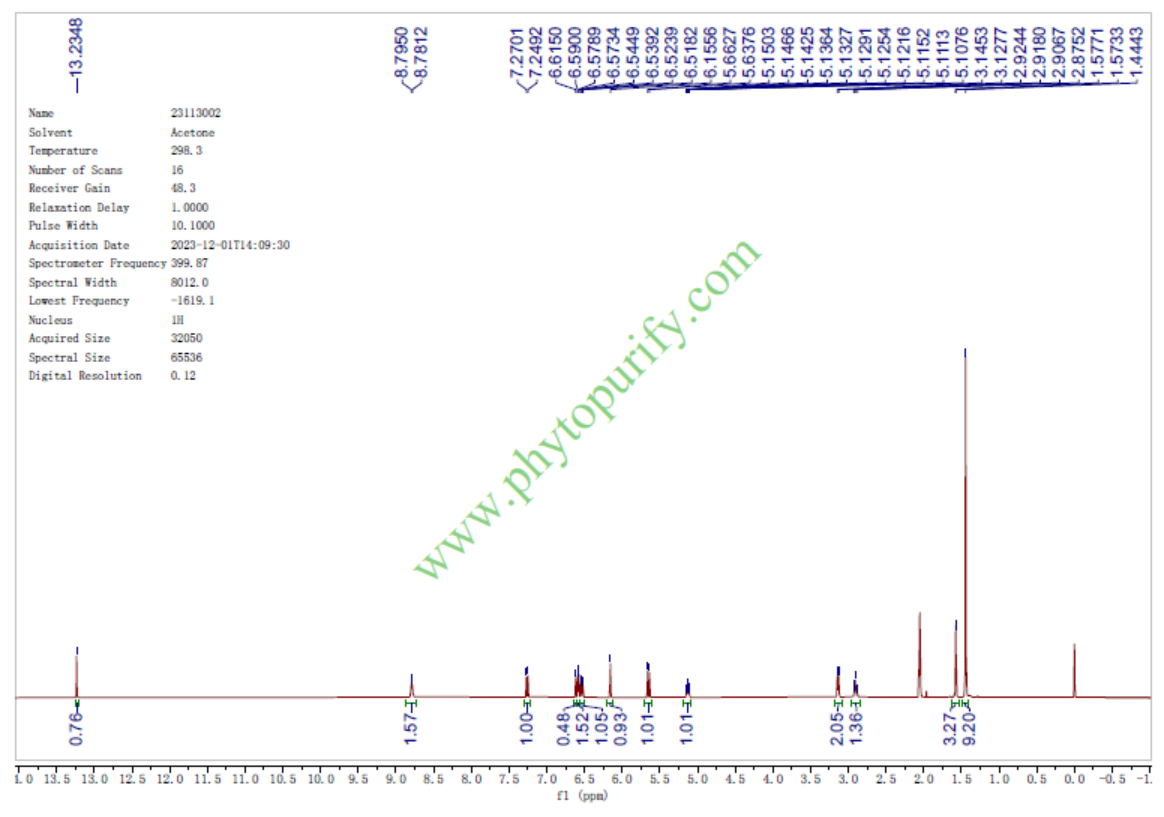
HNMR of Morusin
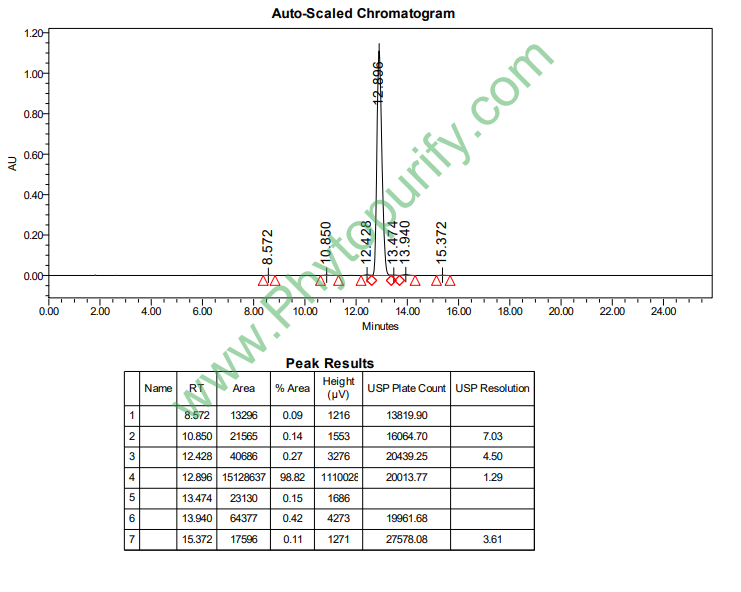
HPLC of Morusin
Storage conditions:Short-term storage at 2~8℃, long-term storage at -20 ~ -80℃
100.1300
5.0925
4.9744
.0168
4.5373
3.6173
Low
91.3044
3.2836
Yes
No
Yes
No
Yes
Yes
0.6
Yes
Yes
Yes
Yes
Natural products, as an important source of drug discovery, play an indispensable role in the long struggle between humans and diseases. The deepening of research in plant chemistry and pharmacology has revealed numerous natural small molecules with unique biological activities. Among them, isopentenyl flavonoids derived from Moraceae plants have attracted much attention due to their structural diversity and significant pharmacological activities. Morusin, as a representative Diels Alder type adduct, has been derived from plants in the genus Morusin since the 1980s(Morus alba Since the isolation and identification of Linn., its broad spectrum of biological activities, especially anti-tumor, anti-inflammatory, antioxidant, and antibacterial effects, has attracted the attention of researchers worldwide.
The chemical structural feature of sanxinsu lies in the presence of an isopentenyl side chain attached to its flavonoid parent nucleus. This structural modification not only endows the molecule with unique hydrophobic properties, but also provides a structural basis for its interaction with various biological targets. Early research mainly focused on its potential as a natural antioxidant, while studies in the past two decades have gradually revealed its core role in regulating key cellular signaling pathways such as nuclear factor kappa B (NF - κ B) and signal transduction and transcriptional activation factor 3 (STAT3). NF - κ B and STAT3 are key transcription factors linking inflammation and cancer, and their abnormal activation is closely related to the occurrence and development of various malignant tumors, chronic inflammatory diseases, and autoimmune diseases. Sangxinsu can effectively inhibit the activity of these two pathways, demonstrating multi-target and multi pathway pharmacological properties, making it a highly promising lead compound for development.
In addition, sanxinsu has also shown potential application value in the field of anti allergy. Allergic reactions, especially type I hypersensitivity reactions, involve a cascade reaction of mast cell degranulation, histamine release, and Th2 cytokines (such as IL-4, IL-5, IL-13). Sangxinsu can inhibit allergic reactions at multiple stages by intervening in multiple key targets such as ALOX5, HRH1, STAT6, TSLP, etc. This article aims to provide a systematic review of the chemical and biological characteristics of sanxinsu, covering its plant origin, extraction process, pharmacological activity, molecular mechanism, pharmacological evaluation, and clinical application prospects, in order to provide comprehensive academic references for the in-depth research and development of this natural product.
The chemical name of Morusin is 2- (2,4-dihydroxyphenyl) -5-hydroxy-8,8-dimethyl-3- (3-methyl-2-buten-1-yl) -4H, 8H-benzo [1,2-b: 3,4-b] dipyran-4-one, with the chemical formula C ₂ ₅ H ₂ ₄ O ₆ and a molecular weight of 420.4610 g/mol. From a structural classification perspective, sanxinsu belongs to prenylated flavonoids, and more specifically, it is a Diels Alder adduct. Its core skeleton is composed of a flavonoid nucleus (A, B, and C rings) connected to an isopentenyl side chain (3-methyl-2-butenyl) at the C-3 position. In addition, its molecule also contains a unique 2,2-dimethylpyran ring, which is fused with the A ring to form a benzopyran structure.
This unique chemical structure endows sanxinsu with a series of key physicochemical properties. Firstly, there are multiple phenolic hydroxyl groups in its molecule (located at the C-5 position of the A ring and the C-2 'and C-4' positions of the B ring), which are the main structural basis for the antioxidant activity of quercetin and can effectively scavenge free radicals. Secondly, the introduction of isopentenyl side chains and 2,2-dimethylpyran ring significantly increased the lipophilicity of the molecule. The calculated lipid water partition coefficient (LogP) is 5.0925, indicating its strong lipophilicity. This characteristic is beneficial for sanxin to penetrate the cell membrane and interact with membrane-bound proteins or intracellular targets, but it also leads to poor water solubility. Its water solubility parameter is only 0.0168 mg/mL, which constitutes one of the main challenges in its drug development.
The topological polar surface area (TPSA) is 100.13 Å ², which reflects the surface area of polar atoms (such as oxygen atoms) in the molecule. Generally, molecules with TPSA less than 140 Å ² are considered to have good oral absorption potential, while the TPSA value of sanxinsu is within an acceptable range. However, the contradiction between its high LogP and low water solubility may limit its bioavailability by both solubility and permeability. In addition, according to the prediction model, the blood-brain barrier (BBB) penetration ability of sanxinsu is relatively low, indicating limited potential for its application in central nervous system diseases, but it may also mean a lower risk of peripheral effects related side effects. In terms of safety prediction, sanxinsu has a low risk of inhibiting hERG potassium ion channels (predicted as' no '), reducing the possibility of serious adverse reactions such as prolonged QT interval in the heart. The Ames test predicted a value of 0.6, indicating a potential genetic toxicity risk, but further experimental verification is needed.
Sangxinsu mainly comes from the Moraceae genus of the Moraceae family(Morus)Plants, including white mulberry(Morus alba Linn. has the most abundant content in its root bark (mulberry bark). As a traditional Chinese medicine, Sangbaibai has a long medicinal history in China, Japan, South Korea and other East Asian countries, and is commonly used to treat cough, edema, hypertension and diabetes. In addition, mulberry extract is also present in other mulberry plants, such as chicken mulberry(Morus australis)Meng Sang(Morus mongolica)And Black Mulberry(Morus nigra)Within the root bark, stem bark, or branches. There are significant differences in the content of sericin among mulberry trees of different species, origins, and harvest seasons. Usually, the content in the root bark is higher than that in the stem bark, while the content in the branches is the lowest.
The extraction method of sanxinsu mainly relies on its chemical properties, which utilize its lipophilicity under neutral conditions and its increased water solubility after the dissociation of phenolic hydroxyl groups under alkaline conditions. The classic extraction process usually includes the following steps:
In recent years, in order to improve extraction efficiency and purity, some green and efficient extraction techniques have also been applied to the extraction of quercetin, such as ultrasound assisted extraction (UAE), microwave-assisted extraction (MAE), and supercritical fluid extraction (SFE). These methods can shorten extraction time, reduce solvent usage, and improve the yield of the target product. However, due to the relatively low content of quercetin in plants (usually 0.1% -0.5% of dry weight), large-scale production still faces cost challenges. Therefore, using biotechnology methods such as mulberry cell suspension culture or hairy root culture system to produce mulberry extract has also become a direction worth exploring.
As a multifunctional natural product, the pharmacological activity research of sanxinsu has covered multiple fields such as anti-tumor, anti-inflammatory, antioxidant, antibacterial, anti allergic, and neuroprotective effects.
The anti-tumor activity of sanxinsu is one of the most in-depth research directions. A large number of in vitro experiments have shown that Sangxine has significant proliferation inhibition and apoptosis inducing effects on a variety of human cancer cell lines, including breast cancer (MCF-7, MDA MB-231), lung cancer (A549, H1299), colorectal cancer (HCT116, HT-29), liver cancer (HepG2), prostate cancer (PC-3), gastric cancer (AGS) and melanoma (A375). Its mechanism of action involves multiple levels:
* Inducing apoptosis Sangxinsu can induce cancer cell apoptosis by activating the mitochondrial pathway (endogenous pathway) and the death receptor pathway (exogenous pathway). It can upregulate the expression of pro apoptotic proteins (such as Bax, Bak, Bad) and downregulate the expression of anti apoptotic proteins (such as Bcl-2, Bcl xL, Mcl-1), leading to loss of mitochondrial membrane potential, release of cytochrome c, and activation of the Caspase-9 and Caspase-3 cascade reaction.
* Inhibition of proliferation and metastasis Sangxinsu can inhibit cancer cell proliferation by suppressing the PI3K/Akt/mTOR signaling pathway, blocking the cell cycle in G0/G1 or G2/M phases. Meanwhile, it can also downregulate the expression of matrix metalloproteinases (MMP-2, MMP-9) and inhibit the invasion and migration ability of cancer cells.
* Induce autophagy In some cancer cells, sanxinsu can also induce protective or non protective autophagy. For example, in breast cancer cells, Sangxine induced autophagy may be a survival promoting mechanism, and the combined use of autophagy inhibitors (such as chloroquine) can enhance its anti-tumor effect.
Inflammation and oxidative stress are common pathological foundations of many chronic diseases. Sangxinsu exhibits strong anti-inflammatory and antioxidant activities.
* anti-inflammatory Sangxinsu can significantly inhibit the production of nitric oxide (NO), prostaglandin E2 (PGE2), and various pro-inflammatory cytokines (TNF - α, IL-6, IL-1 β) in macrophages (such as RAW264.7 cells) stimulated by lipopolysaccharide (LPS) or cytokines (such as TNF - α, IL-1 β). The molecular mechanism is mainly related to the inhibition of the activation of NF - κ B and STAT3 signaling pathways.
* antioxidant The multiple phenolic hydroxyl groups in the molecule of sanxinsu make it an effective free radical scavenger. It can directly scavenge DPPH radicals, ABTS cationic radicals, and hydroxyl radicals, and chelate transition metal ions (such as Fe ² ⁺), thereby inhibiting lipid peroxidation. In addition, sanxinsu can also activate the nuclear factor E2 related factor 2 (Nrf2)/antioxidant response element (ARE) pathway, induce the expression of downstream antioxidant enzymes (such as HO-1, NQO1, SOD, CAT), and enhance the endogenous antioxidant defense ability of cells.
Sangxinsu has inhibitory effects on various bacteria and fungi. Research has shown that it is effective against Staphylococcus aureus(Staphylococcus aureus)Methicillin resistant Staphylococcus aureus (MRSA), Bacillus subtilis(Bacillus subtilis)Escherichia coli(Escherichia coli)And Candida albicans(Candida albicans)All of them exhibit varying degrees of antibacterial activity. Its antibacterial mechanism may include disrupting the integrity of bacterial cell membranes, inhibiting the synthesis of bacterial nucleic acids or proteins, and inhibiting the formation of bacterial biofilms.
The potential of sanxinsu in anti allergic reactions is closely related to its intervention in key stages of allergic reactions. Allergic reactions involve the activation of mast cells and eosinophils, as well as an imbalance of Th2 type immune responses. Sang Xin Su can:
* Inhibit degranulation of mast cells By stabilizing the mast cell membrane and inhibiting the influx of calcium ions, the release of allergens such as histamine and leukotrienes can be reduced.
* Inhibition of Th2 cytokine production By inhibiting the STAT6 signaling pathway, downregulating the expression of Th2 cytokines such as IL-4, IL-5, IL-13, etc., the production of IgE and the recruitment of eosinophils are inhibited.
* Antagonistic allergen receptor Sangxinsu may have a certain antagonistic effect on histamine H1 receptor (HRH1) and thromboxane A2 receptor (TBXA2R), thereby directly combating smooth muscle contraction and increased vascular permeability caused by allergic mediators.
* Inhibition of ALOX5 activity ALOX5 (5-lipoxygenase) is a key enzyme in the synthesis of leukotrienes, and quercetin can reduce the production of leukotrienes, a potent inflammatory and sensitizing mediator, by inhibiting its activity.
The various pharmacological activities of sanxinsu ultimately stem from its regulation of key signaling molecules and transcription factors within cells. Among them, inhibition of the NF - κ B and STAT3 pathways is its core mechanism of action.
NF - κ B is a key transcription factor family that regulates the expression of numerous genes related to inflammation, immunity, cell proliferation, and apoptosis. In the resting state, NF - κ B binds to its inhibitory protein I κ B and exists in an inactive form in the cytoplasm. When cells are stimulated by TNF - α, IL-1 β, LPS, etc., the I κ B kinase (IKK) complex is activated, phosphorylating I κ B α, leading to its ubiquitination and degradation, releasing free NF - κ B (mainly p65/p50 dimer). The free NF - κ B then translocates into the nucleus and binds to the κ B site on the target gene promoter, initiating transcription of downstream genes.
Sangxinsu can inhibit the NF - κ B pathway in various ways:
* Inhibition of IKK activity Sangxinsu can directly bind to IKK β, inhibit its kinase activity, and thus prevent the phosphorylation and degradation of I κ B α.
* Inhibition of p65 nuclear translocation Sangxinsu may directly prevent p65 subunits from entering the nucleus by interfering with the nuclear localization signal (NLS) of p65 or affecting the function of nuclear transporters.
* Inhibition of p65 binding to DNA Sangxinsu may directly bind to p65 protein, altering its conformation and hindering its binding to the target gene promoter DNA.
* Inhibit the transcriptional activity of p65 Sangxinsu may reduce its transcriptional activation ability by inhibiting post-translational modifications such as phosphorylation or acetylation of p65.
By inhibiting NF - κ B, sanxinsu can downregulate the expression of various pro-inflammatory factors (TNF - α, IL-6, IL-1 β), chemokines, adhesion molecules (ICAM-1, VCAM-1), inducible nitric oxide synthase (iNOS), and cyclooxygenase-2 (COX-2), thereby exerting anti-inflammatory and anti-tumor effects.
STAT3 is another transcription factor closely associated with inflammation and cancer. Multiple cytokines (such as IL-6) and growth factors (such as EGF) can phosphorylate the C-terminal tyrosine residue (Tyr705) of STAT3 by activating JAK kinase. Phosphorylated STAT3 forms homodimers, translocates into the nucleus, binds to STAT3 response elements on target gene promoters, and initiates transcription of downstream genes. The sustained activation of STAT3 is a characteristic of many cancers, which can promote cell proliferation (such as Cyclin D1, c-Myc), inhibit apoptosis (such as Bcl xL, Survivors), promote angiogenesis (such as VEGF), and immune escape.
The mechanism by which sanxinsu inhibits the STAT3 pathway includes:
* Inhibition of JAK kinase activity Sangxinsu can directly inhibit the activity of upstream kinases such as JAK1 and JAK2, thereby reducing the phosphorylation of STAT3.
* Inhibition of STAT3 dimerization Sangxinsu may interfere with the binding of phosphorylated tyrosine residues by binding to the SH2 domain of STAT3, thereby inhibiting the dimerization of STAT3.
* Inhibition of STAT3 nuclear translocation Similar to NF - κ B, sanxinsu may also inhibit the transport of STAT3 dimers to the nucleus.
* Upregulation of negative regulatory factors Sangxinsu may induce the expression of negative regulatory factors of STAT3, such as SOCS3 (cytokine signaling inhibitory factor 3) and PIAS3 (protein inhibitor 3 that activates STAT).
In addition to NF - κ B and STAT3, sanxinsu also acts on multiple other molecular targets:
* Nrf2/ARE pathway Sangxinsu can activate Nrf2, causing it to dissociate from Keap1, translocate into the nucleus, bind to ARE, and initiate the expression of antioxidant enzyme genes.
* PI3K/Akt/mTOR pathway Sangxinsu can inhibit the activity of this pro survival pathway, induce cancer cell apoptosis and autophagy.
* MAPK pathway The effects of sanxinsu on pathways such as ERK, JNK, p38 MAPK are cell type dependent, sometimes manifested as activation and sometimes as inhibition.
* Epigenetic regulation Studies have shown that sanxinsu may affect epigenetic regulation of gene expression by inhibiting the activity of histone deacetylase (HDAC) or DNA methyltransferase (DNMT).
Although sanxinsu has remarkable pharmacological activity, its drug-induced properties are the key to determining whether it can move from laboratory to clinical application. Based on the aforementioned physicochemical properties, the pharmacological properties of sanxinsu face significant challenges, mainly reflected in the following aspects:
At present, research on the pharmacokinetics (PK) of sanxinsu in vivo is relatively limited. Existing animal experiments have shown that after oral administration of sanxinsu, its plasma concentration is very low, which meets the expectations of poor water solubility and metabolic instability. After intravenous injection, its distribution half-life is shorter and clearance is faster. Its tissue distribution may lean towards organs with abundant blood flow such as the liver, lungs, and kidneys.
To overcome these barriers to drug formation, medicinal chemists are exploring various strategies:
* Prodrug design Esterification or etherification modification of the phenolic hydroxyl group in the molecule of sanxinsu is carried out to produce a prodrug, which enhances its water solubility and lipid solubility. After enzymatic or chemical hydrolysis in vivo, the prodrug is released.
* nano-formulation The use of nano delivery systems such as liposomes, polymer nanoparticles, solid lipid nanoparticles, and micelles to encapsulate sanxinsu can significantly improve its water solubility, stability, and bioavailability, and achieve targeted delivery.
* Structural modification On the premise of retaining the core pharmacophore, structural modifications are made to the isopentenyl side chain or pyran ring of sanxinsu to optimize its physicochemical properties and metabolic stability, while reducing toxicity. For example, introducing polar groups (such as hydroxyl, carboxyl, amino) to improve water solubility, or saturating double bonds to enhance metabolic stability.
* Eutectic/salt type Forming a eutectic or salt with a suitable eutectic forming agent or salt forming agent can alter the crystal form of quercetin, thereby improving its solubility and dissolution rate.
Despite the challenges in drug development, the unique pharmacological activity and multi-target mechanism of action of sanxinsu have shown broad clinical application prospects in multiple disease fields.
Antitumor therapy Given that sanxinsu can effectively inhibit the pathways of NF - κ B and STAT3, which play a central role in tumor development, it is expected to become a novel anti-tumor candidate drug. Especially for refractory tumors with highly activated NF - κ B or STAT3 (such as triple negative breast cancer, pancreatic cancer, and some types of leukemia), Sangxine or its derivatives may have unique therapeutic value. Future research should focus on its combination strategy with chemotherapy drugs (such as cisplatin, paclitaxel, doxorubicin) or targeted drugs (such as imatinib, sorafenib), in order to achieve synergistic effects and reduce toxicity. In addition, the development of immune regulatory effects targeting the tumor microenvironment, such as tumor associated macrophage TAMs, is also worth further exploration.
Chronic inflammatory diseases The anti-inflammatory activity of sanxinsu makes it promising in the treatment of chronic inflammatory diseases such as rheumatoid arthritis, inflammatory bowel disease (such as Crohn's disease and ulcerative colitis), asthma, and chronic obstructive pulmonary disease (COPD). By local administration (such as inhalation, enema) or using advanced drug delivery systems, its local anti-inflammatory effect can be maximized while reducing systemic side effects.
allergic diseases The inhibitory effect of sanxinsu on multiple key targets of allergic reactions, such as ALOX5, HRH1, STAT6, TSLP, makes it a multi-target anti allergic drug. It may be effective for diseases such as allergic rhinitis, atopic dermatitis, urticaria, and food allergies. Compared with existing single target anti allergic drugs such as antihistamines and leukotriene receptor antagonists, sanxinsu may provide more comprehensive and effective therapeutic effects.
Metabolic diseases The antioxidant and anti-inflammatory properties of Sangxine, as well as its activation of Nrf2 pathway, make it also show potential in the treatment of diabetes and its complications, non-alcoholic fatty liver disease (NAFLD), atherosclerosis and other metabolic diseases. Preliminary studies have shown that sanxinsu can improve insulin resistance, lower blood sugar and lipid levels.
Future research directions should focus on:
* In depth mechanism research Using gene editing techniques such as CRISPR-Cas9, validate the key targets of sanxinsu in in in vitro and in vivo models, and elucidate its specific binding mode with target proteins.
* Pharmaceutical Chemistry Optimization The system conducts structure-activity relationship (SAR) research, designs and synthesizes a series of derivatives of quercetin, and screens candidate compounds with higher activity, better pharmacokinetic properties, and lower toxicity.
* Formulation development Focus on developing nano formulations or prodrugs that can significantly improve the oral bioavailability of sanxinsu, and conduct comprehensive pharmacokinetic and pharmacodynamic evaluations.
* toxicological evaluation Conduct systematic acute, subchronic, and chronic toxicity experiments, especially to evaluate their potential genetic and reproductive toxicity, and provide safety basis for clinical trials.
* clinical translation After completing sufficient preclinical research, proceed with clinical trials cautiously, starting with indications for local or combination therapy, gradually verifying their clinical efficacy and safety.
Sangxinsu, an isopentenyl flavonoid derived from traditional Chinese medicine mulberry bark, has become a shining pearl in the field of natural product pharmacology research due to its unique chemical structure and multi effect pharmacological activity. From anti-tumor, anti-inflammatory, antioxidant to anti allergic, its broad spectrum of biological activities, especially its precise regulation of the two key signaling pathways NF - κ B and STAT3, reveals its enormous potential as a multi-target lead compound.
However, the road from laboratory discovery to clinical drug conversion of sanxinsu is not smooth. Its extremely poor water solubility, potential metabolic instability, and potential genetic toxicity risks constitute the 'Achilles heel' in its drug development. This requires us not only to deeply reveal its mechanism of action at the basic research level, but also to make bold innovations and breakthroughs in medicinal chemistry and pharmacy. Through strategies such as prodrug design, nanomedicine, and structural optimization, it is expected to overcome these obstacles and translate the therapeutic potential of sanxinsu into clinical reality.
Looking ahead to the future, with the deepening understanding of the structure-activity relationship of quercetin, the maturity of advanced drug delivery systems, and the improvement of system toxicology evaluations, we have reason to believe that quercetin or its superior derivatives will play an important role in the treatment of major diseases such as anti-tumor, anti-inflammatory, and anti allergic effects. The in-depth study of sanxinsu is not only a modern interpretation of the wisdom of traditional Chinese medicine, but also an important way to contribute new drugs and strategies to the cause of human health.
