


Synonym name: Ginkgolic Acid C15:1; Ginkgoic acid; Ginkgolic acid; Romanicardic acid; (15:1)-Anacardic acid; Ana B
Catalogue No.: BP0644
Cas No.: 22910-60-7
Formula: C22H34O3
Mol Weight: 346.511
Botanical Source: Ginkgo biloba (ginkgo) and minor cashew nut shellBiological Use / Importance: Possesses antitubercular activity
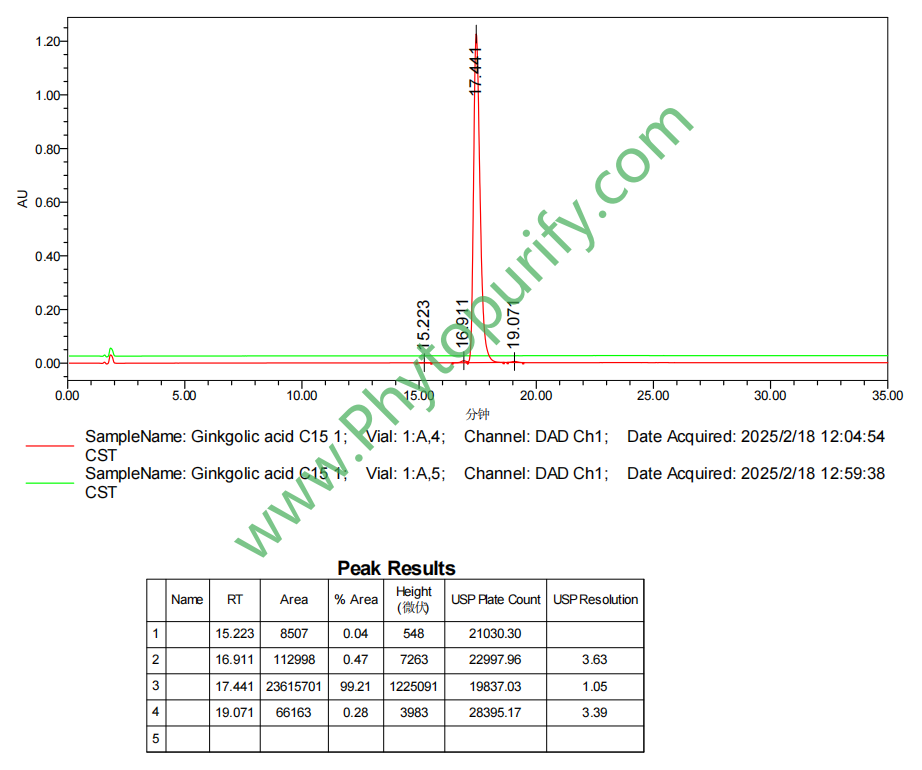
Purity: 95%~99%
Analysis Method: HPLC-DAD or/and HPLC-ELSD
Identification Method: Mass, NMR
Packing: Brown vial or HDPE plastic bottle
Can be supplied from milligrams to grams.
For Reference Standard and R&D, Not for Human Use Directly.
Inquire for bulk scale.
HPLC of Ginkgolic Acid C15:1
Storage conditions:Short-term storage at 2~8℃, long-term storage at -20 ~ -80℃
Ginkgolic Acid C15:1 (CAS number: 22910-60-7) is a natural hydroxybenzoic acid derivative derived from Ginkgo biloba leaves. Due to its unique chemical structure and diverse biological activities, it has attracted widespread attention in the field of natural product pharmacology in recent years. Ginkgolic acid, as one of the important secondary metabolites in Ginkgo biloba leaves, functions similarly to salicylic acid compounds and exhibits multiple pharmacological activities such as anti-inflammatory, antibacterial, and anti-tumor effects. Although the toxicity of ginkgolic acid once limited its application, with further research on its structural modification and mechanism of action, the potential medicinal value of ginkgolic acid C15:1 has gradually been recognized.
This article aims to systematically review the chemical structure and physicochemical properties, plant sources and extraction methods, pharmacological activity and mechanism of action, pharmacological evaluation and pharmacokinetic characteristics of ginkgolic acid C15:1, and explore its clinical application prospects and challenges. It is expected to provide theoretical basis and research direction for the drug development of this natural product.
Ginkgolic acid C15:1 belongs to the class of hydroxybenzoic acid compounds, which are structurally connected to a fifteen carbon fatty acid side chain containing an unsaturated carbon carbon double bond through a hydroxyl substituted benzene ring. Its molecular formula is C22H34O3 and its molecular weight is 346.5110. The LogP value of this compound is as high as 7.9017, indicating its strong hydrophobicity and extremely low water solubility (0.0188 mg/mL), which has a significant impact on its bioavailability and in vivo distribution. The topological polar surface area (TPSA) is 57.53 Å ², indicating that its polarity is moderate and may affect its membrane permeability.
The hydroxyl and carboxyl groups in the C15:1 structure of ginkgolic acid endow it with certain chemical reactivity, while the unsaturated bond positions on the fatty acid side chains may become targets for metabolic modification. Due to its high hydrophobicity, ginkgolic acid tends to be distributed in a lipid environment in the body, but its blood-brain barrier penetration ability is low, limiting its direct application in central nervous system diseases. It is worth noting that ginkgolic acid C15:1 did not exhibit hERG channel inhibitory activity, and the Ames mutagenicity test result was negative, indicating a low risk of cardiac and genetic toxicity and a certain safety basis.
Ginkgolic acid C15:1 mainly exists in the leaves and seeds of Ginkgo biloba trees, and is one of the main components of ginkgolic acid mixtures. Ginkgo biloba leaves, as a traditional Chinese medicinal herb, contain various bioactive components, among which ginkgolic acid has attracted much attention for its unique pharmacological effects.
The traditional methods for extracting ginkgolic acid C15:1 mainly include solvent extraction and supercritical fluid extraction. Commonly used solvents include organic solvents such as ethanol, methanol, and ethyl acetate. Due to their high hydrophobicity, ginkgolic acid is often extracted using medium to non-polar solvents. The extraction process usually combines ultrasound assisted or microwave-assisted techniques to improve extraction efficiency and purity.
During the purification process, column chromatography techniques such as silica gel column chromatography and reverse phase high-performance liquid chromatography are commonly used to separate the extract and obtain high-purity ginkgolic acid C15:1. In recent years, with the advancement of chromatographic technology, it has become possible to prepare ginkgolic acid C15:1 with a purity of over 95%, providing a material basis for its subsequent pharmacological research.
Ginkgolic acid C15:1 exhibits various significant biological activities, covering multiple fields such as anti-inflammatory, antibacterial, antiviral, anti-tumor, and neuroprotective effects.
Ginkgolic acid C15:1 exhibits good anti-inflammatory effects by inhibiting the release of inflammatory mediators such as tumor necrosis factor - α (TNF - α), interleukin-6 (IL-6), and nitric oxide (NO). Both in vitro cell models and animal inflammation models have confirmed that it can significantly reduce inflammatory response, inhibit macrophage activation, and activate inflammatory signaling pathways.
Ginkgolic acid C15:1 exhibits inhibitory effects on various Gram positive and Gram negative bacteria, especially exhibiting certain activity against drug-resistant strains. In addition, relevant studies have shown that it has the potential to inhibit replication of some viruses (such as herpes simplex virus and influenza virus), indicating its development value as an anti infective drug.
Ginkgolic acid C15:1 exhibits inhibitory effects on cell proliferation and induces apoptosis in various tumor cell lines. Its mechanism involves cell cycle arrest, mitochondrial function regulation, and regulation of apoptosis related protein expression. Some studies suggest that ginkgolic acid C15:1 can enhance the sensitivity of chemotherapy drugs and has potential adjuvant anti-cancer effects.
Although ginkgolic acid C15:1 has lower blood-brain barrier penetration ability, it exhibits certain protective effects in neuroinflammatory and oxidative stress models, and may exert its effects by regulating neuroinflammatory responses and antioxidant mechanisms, providing potential targets for the treatment of neurodegenerative diseases.
The pharmacological effects of ginkgolic acid C15:1 involve multiple signaling pathways and molecular targets, mainly including:
Ginkgolic acid C15:1 can inhibit the activation of the nuclear factor kappa B (NF - κ B) signaling pathway, reduce the expression of pro-inflammatory cytokines, and lower the inflammatory response. It inhibits the phosphorylation and degradation of I κ B α, blocks the translocation of NF - κ B from the cytoplasm to the nucleus, and regulates downstream gene expression.
This compound can induce tumor cell apoptosis by regulating the expression ratio of Bcl-2 family proteins, activating mitochondrial dependent apoptosis pathways. It can also activate key apoptotic enzymes such as caspase-3 and caspase-9, promoting programmed cell death.
Ginkgolic acid C15:1 enhances the activity of intracellular antioxidant enzymes such as superoxide dismutase (SOD) and glutathione peroxidase (GPx), reduces reactive oxygen species (ROS) levels, and alleviates oxidative stress damage.
Ginkgolic acid C15:1 exerts antibacterial effects by disrupting the integrity of bacterial cell membranes, interfering with cell wall synthesis and protein synthesis. In addition, its hydrophobic side chains help to bind with bacterial membrane lipids, enhancing the bactericidal effect.
The pharmacological parameters of ginkgolic acid C15:1 indicate that it has certain potential for drug development, but there are also challenges.
A high LogP value (7.9017) indicates that ginkgolic acid C15:1 has strong hydrophobicity, which may lead to lower solubility and bioavailability in vivo. The low water solubility (0.0188 mg/mL) limits its oral absorption efficiency and requires formulation improvement or structural modification to enhance solubility.
At present, research on the in vivo absorption, distribution, metabolism, and excretion (ADME) of ginkgolic acid C15:1 is relatively limited. Existing data indicates that its blood-brain barrier penetration ability is relatively low, suggesting that it mainly acts on peripheral tissues. The metabolic pathway may involve phase II metabolic reactions of fatty acid beta oxidation and phenolic hydroxyl groups.
Ginkgolic acid C15:1 did not exhibit hERG channel inhibition and reduced the risk of cardiac toxicity. The negative result of Ames test indicates low genetic toxicity. In addition, animal toxicity tests have shown that its acute toxicity is low, but long-term toxicology research still needs to be improved.
Due to the high hydrophobicity and metabolic characteristics of ginkgolic acid C15:1, it may interact with liver drug metabolizing enzymes (such as CYP450 family), affecting the metabolism of other drugs, and further research is needed.
Ginkgolic acid C15:1 has shown broad application prospects, especially in the fields of anti-inflammatory, antibacterial, and anti-tumor, due to its multiple pharmacological activities. As one of the active ingredients in Ginkgo biloba leaf extract, it is expected to become a new natural medicine or drug lead compound.
For chronic inflammatory diseases such as arthritis and inflammatory bowel disease, ginkgolic acid C15:1 can be a potential candidate molecule for anti-inflammatory drugs. In the future, its bioavailability and targeting can be improved through structural optimization and nanocarrier technology.
Faced with the problem of antibiotic resistance, the antibacterial and antiviral activities of ginkgolic acid C15:1 provide new ideas for the development of new anti infective drugs. Combination therapy strategies or structural modifications may enhance their clinical application value.
Ginkgolic acid C15:1 exhibits outstanding inhibition of tumor cell proliferation and induction of apoptosis, and can be used as a chemotherapy adjuvant in the future to enhance anti-cancer efficacy and reduce side effects.
Although the blood-brain barrier penetration ability is limited, the application of ginkgolic acid C15:1 in neurodegenerative diseases still has potential for improvement through drug delivery systems.
The high hydrophobicity and low water solubility of ginkgolic acid C15:1 limit its clinical application and need to be overcome through drug design and formulation technology. The pharmacokinetic and toxicological studies of the system are not yet complete, and there is a lack of preclinical and clinical trial data, which urgently requires further exploration.
In addition, the structural modification and derivative development of ginkgolic acid C15:1 are future research focuses aimed at improving its pharmacokinetic properties, enhancing biological activity, and reducing potential toxicity.
Ginkgolic acid C15:1, as an important natural hydroxybenzoic acid compound in Ginkgo biloba leaves, has shown great potential for drug development due to its diverse pharmacological activities and good safety. Its research achievements in anti-inflammatory, antibacterial, anti-tumor, and neuroprotective fields continue to enrich, providing important examples for natural product pharmacology.
In the future, combining modern medicinal chemistry, drug delivery, and systems biology technologies, in-depth analysis of the mechanism of action of ginkgolic acid C15:1 and optimization of its drug properties will help promote its clinical application and innovative development of natural products in modern medicine.
