


Product name: Soyasaponin Bb
Synonym name: Soyasaponin I
Catalogue No.: BP1332
Cas No.: 51330-27-9
Formula: C48H78O18
Mol Weight: 943.134
Botanical Source: Glycine max
Physical Description:
Type of Compound: Triterpenoids
Purity: 95%~99%
Analysis Method: HPLC-DAD or/and HPLC-ELSD
Identification Method: Mass, NMR
Packing: Brown vial or HDPE plastic bottle
Storage: Store in a well closed container, protected from air and light. Put into refrigerate or freeze for long term storage.
Whenever possible, you should prepare and use solutions on the same day. However, if you need to make up stock solutions in advance, we recommend that you store the solution as aliquots in tightly sealed vials at -20℃. Generally, these will be useable for up to two weeks.
The product could be supplied from milligrams to grams
Inquire for bulk scale.
Description:
Soyasaponin Bb can suppress Eca-9706 cell growth, reverse effects on over expression of c-met, VEGF, and induce cell apoptosis through inhibiting HDAC1-NF-kappaB and activating PETEN and caspase-3 signaling pathways.
References:
Wei Sheng Yan Jiu. 2010 Jul;39(4):444-6.
Apoptosis effects on human esophageal cancer cells by soyasaponin Bb and its machanism.
To explore the effect and potential mechanism of apoptosis in the Eca-9706 cells induced by Soyasaponin Bb.
METHODS AND RESULTS:
Different concentrations of Soyasaponin Bb were on the Eca-9706 cell. Cell growth suppression rate was detected by MTT. Apoptotic rate was detected by TUNEL. The expression changes of HDAC1, NF-kappaB, PTEN, cyclin D1, c-met, VEGF or caspase-3 in the SSBb were detected by immunohistochemistry and immunoblotting. Compared with the control group, the growth-inhibition rate and apoptotic rate were increased, the expressions of PTEN, caspase 3 were increased, the expressions of c-met, VEGF, HDAC1, NF-kappaB and cyclin D1 were decreased.
CONCLUSIONS:
SSBb can suppress Eca-9706 cell growth. SSBb can exhibit reverse effects on over expression of c-met, VEGF in Eca-9706 cells. Eca-9706 cell apoptosis can be induced by SSBb through inhibiting HDAC1-NF-kappaB and activating PETEN and caspase-3 signaling pathways.
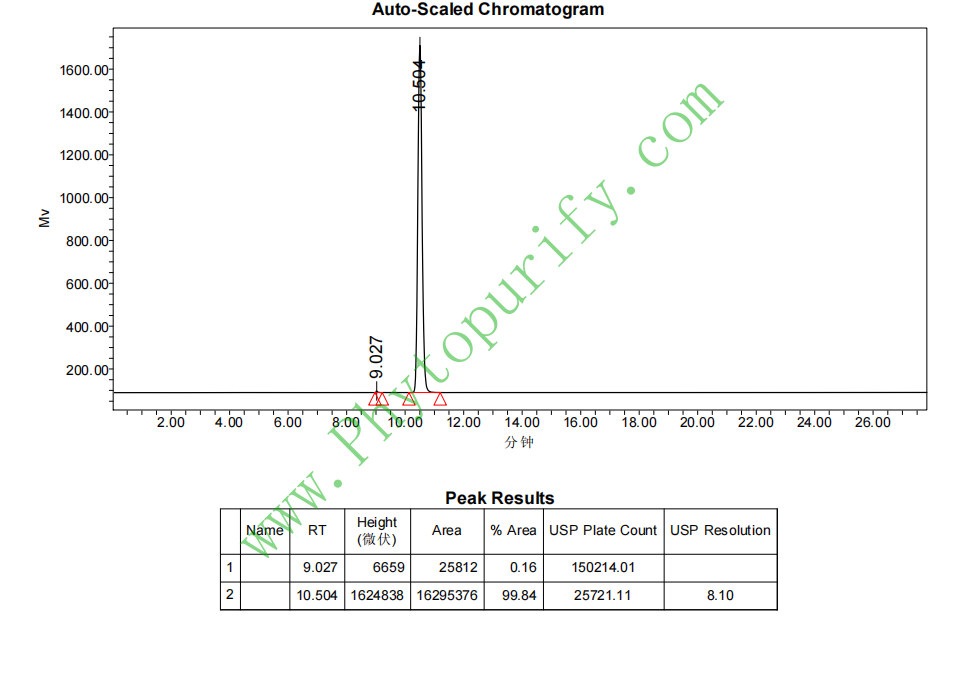
HPLC of Soyasaponin Bb
Storage conditions:Short-term storage at 2~8℃, long-term storage at -20 ~ -80℃
Soyasaponin Bb is a type of natural triterpenoid saponin derived from soybean (Glycine max). Due to its diverse biological activities and potential medicinal value, it has received widespread attention in the field of natural product pharmacology in recent years. As an orally effective covalent inducer of heme oxygenase-1 (HO-1) and inhibitor of aldose reductase (AKR1B1), soybean saponin Bb exhibits significant pharmacological effects in regulating oxidative stress, anti-inflammatory, hepatoprotective, and neuroprotective effects. It exhibits good tissue protective effects by regulating intracellular antioxidant pathways, reducing reactive oxygen species (ROS) generation, inhibiting lipid peroxidation and hepatocyte apoptosis, especially in alcohol induced liver injury and Scopolamine induced cognitive impairment models, with significant therapeutic potential.
In addition, research on the lipid-lowering effects of soy saponin Bb has gradually deepened, with related targets including cholesterol ester transfer protein (CETP), 3-hydroxy-3-methylglutaryl-CoA reductase (HMGCR), low-density lipoprotein receptor (LDLR), apolipoprotein B (APOB), pre protein transferase subtilisin 9 (PCSK9), apolipoprotein E (APOE), and peroxisome proliferator activated receptor alpha (PPARA), demonstrating its potential value in regulating lipid metabolism and preventing and treating cardiovascular diseases. This article will provide a systematic review of the chemical structure, sources, pharmacological activity, mechanism of action, pharmacological properties, and clinical application prospects of soybean saponin Bb, aiming to provide a theoretical basis and research direction for its subsequent development and application.
Soy saponin Bb belongs to the triterpenoid saponin class, with a molecular formula of C48H78O18 and a molecular weight of 943.1340 Da. Its structure consists of a triterpenoid mother nucleus connected to multiple glycosides through glycosidic bonds, including β - glucose and other monosaccharide residues. The LogP value of this compound is 2.2234, indicating that it has moderate lipid solubility, which is beneficial for cell membrane penetration and bioavailability. The TPSA (topological polar surface area) is 294.98 Å ², and a higher polar surface area indicates that it has average water solubility, with a water solubility of 0.2598, making it a low solubility compound.
The structural characteristics of soybean saponin Bb endow it with strong biological activity, especially the sugar moiety plays a key role in binding to target proteins and regulating signaling pathways. Its ability to penetrate the blood-brain barrier is relatively low, suggesting that its direct role in the central nervous system may be limited, but it still has potential to regulate central function through peripheral neuroprotective mechanisms or indirectly. In addition, the compound does not inhibit hERG channels and the Ames mutagenicity test is negative, indicating its high safety and good pharmacological basis.
Soybean saponin Bb mainly exists in soybeans and their products, and is an important member of the soybean saponin family. Soybeans, as an important global grain and oil crop, contain abundant saponin compounds, especially in the seed coat and embryo parts where the content is relatively high. Traditionally, the extraction of soybean saponins is often carried out by combining organic solvent extraction with column chromatography separation.
During the extraction process, 70% ethanol or methanol is commonly used as the extraction solvent, and ultrasound assisted or reflux extraction techniques are used to improve the efficiency of saponin extraction. Subsequently, the crude extract was separated and purified using liquid-liquid distribution, silica gel column chromatography, and reverse phase high performance liquid chromatography (RP-HPLC) to obtain high-purity soybean saponin Bb. Modern extraction processes have gradually introduced green and environmentally friendly methods such as supercritical CO2 extraction and membrane separation technology to improve extraction efficiency and purity, and reduce production costs.
In addition, with the progress of research on biosynthetic pathways, the use of genetic engineering technology to heterologous express soybean saponin Bb related synthases in microorganisms or plant cells has become an important direction for future large-scale production and has broad application prospects.
Numerous in vitro and in vivo studies have shown that soybean saponin Bb significantly enhances the antioxidant defense ability of cells by inducing the expression of heme oxygenase-1 (HO-1). HO-1, as an important antioxidant enzyme in cells, can break down hemoglobin to produce products with antioxidant and anti-inflammatory effects, such as carbon monoxide (CO) and biliverdin. Soy saponin Bb covalently induces HO-1, reduces reactive oxygen species (ROS) generation, inhibits lipid peroxidation, and alleviates oxidative stress damage.
In addition, soyasaponin Bb can inhibit aldose reductase (AKR1B1), which plays an important role in the formation of complications of diabetes, and its inhibition helps to reduce oxidative stress and inflammatory reaction related to diabetes. Related studies have shown that soybean saponin Bb significantly reduces the expression of inflammatory factors such as TNF - α and IL-6, and alleviates tissue inflammatory responses.
Alcoholic liver injury is a common type of liver disease in clinical practice, with oxidative stress and lipid peroxidation as its main pathogenesis. Soy saponin Bb enhances HO-1 expression and antioxidant enzyme activity, reduces ROS accumulation in liver cells, inhibits lipid peroxidation, protects liver cell membrane stability, and prevents liver cell apoptosis. Animal model studies have confirmed that soy saponin Bb significantly improves alcohol induced liver dysfunction, reduces serum transaminase levels, and alleviates liver tissue pathological damage.
In the study of neurodegenerative diseases and cognitive disorders, soybean saponin Bb exhibits good neuroprotective activity. In the Scopolamine induced memory impairment model, soybean saponin Bb improves cognitive function and reduces neuronal damage through antioxidant and anti-inflammatory mechanisms. Its low blood-brain barrier penetration suggests that its effect may be achieved by regulating the peripheral nervous system or indirectly affecting the central nervous system.
The research on the regulation of lipid metabolism by soybean saponin Bb is gradually increasing. Its targets include cholesterol ester transfer protein (CETP), HMGCR, LDLR, APOB, PCSK9, APOE, PPARA and other key molecules, indicating that it can synergistically regulate cholesterol synthesis, transport and metabolism through multiple targets, reduce plasma low-density lipoprotein cholesterol (LDL-C) level, improve dyslipidemia, and prevent atherosclerosis and cardiovascular disease.
The pharmacological effects of soybean saponin Bb are attributed to its regulation of multiple signaling pathways and key targets:
HO-1 induction mechanism
Soy saponin Bb activates the Nrf2 ARE signaling pathway, promotes Nrf2 nuclear translocation, and enhances HO-1 gene expression. HO-1 products have antioxidant, anti-inflammatory, and cell protective effects, significantly reducing oxidative stress levels.
Inhibition of aldose reductase (AKR1B1)
AKR1B1 is involved in the occurrence of various complications of diabetes. As its inhibitor, soyasaponin Bb blocks the polyol pathway, reduces the formation of advanced glycation end products (AGEs), and alleviates diabetes related tissue damage.
Lipid metabolism regulation
Soy saponin Bb affects cholesterol synthesis, transport, and receptor-mediated clearance processes by regulating targets such as CETP, HMGCR, LDLR, and PCSK9. The activation of PPARA promotes fatty acid oxidation, reduces blood lipid levels, and overall improves lipid metabolism.
Anti inflammation and anti apoptosis
By inhibiting the NF - κ B signaling pathway, soybean saponin Bb reduces the expression of pro-inflammatory cytokines and suppresses inflammatory responses. At the same time, by regulating Bcl-2 family proteins, apoptosis of liver cells and nerve cells is inhibited, and tissue homeostasis is maintained.
The molecular weight of soybean saponin Bb is relatively large (943.1340 Da) and the TPSA is high (294.98 Å ²), indicating that its oral absorption may be limited. However, its moderate LogP value (2.2234) is beneficial for cell membrane permeability. Low water solubility (0.2598) may affect bioavailability and needs to be improved through formulation optimization or structural modification.
The blood-brain barrier has low penetrability, which limits its direct effect on the central nervous system, but its protective effect on surrounding tissues is still significant. In terms of safety, soybean saponin Bb does not inhibit hERG channels and the Ames mutagenicity test is negative, indicating low risks of cardiac and genetic toxicity and a good safety foundation.
Pharmacokinetic studies have shown that soy saponin Bb is widely distributed in the body after oral administration, mainly metabolized through the liver, and has a moderate half-life. Its metabolites may have certain biological activity, and further research is needed on metabolic pathways and pharmacological effects of metabolites.
Soy saponin Bb, with its multi-target and multi pathway pharmacological properties, has shown broad clinical application potential in fields such as antioxidant, liver protection, neuroprotection, and lipid-lowering. Especially in the prevention and treatment of alcoholic liver disease, diabetes complications, cognitive impairment and cardiovascular disease, it has important therapeutic value.
Future research should focus on the following aspects:
In addition, the design and synthesis of derivatives based on the structure of soybean saponin Bb will provide new ideas and means for improving its pharmacological efficacy and pharmacokinetic properties.
Soy saponin Bb, as a natural triterpenoid saponin with significant antioxidant, hepatoprotective, neuroprotective, and lipid-lowering activities, exhibits a wide range of pharmacological effects and good safety, and has the potential to become an adjuvant therapy for various chronic diseases. It exerts multi-level protective effects by regulating HO-1, AKR1B1, and various lipid metabolism targets, demonstrating the advantages of natural product multi-target therapy.
In the future, with the advancement of extraction and purification technology, in-depth analysis of the mechanism of action, and the promotion of clinical research, soybean saponin Bb is expected to become an important research object in the field of natural product pharmacology and an emerging drug for clinical applications. Continuous basic and applied research will provide solid scientific support for its development and promote its widespread application in modern medicine.
