


Product name: Rebaudioside A
Synonym name: Stevioside A3; Rebiana
Catalogue No.: BP1198
Cas No.: 58543-16-1
Formula: C44H70O23
Mol Weight: 967.021
Botanical Source: Stevia rebaudiana (Bertoni) Hemsl.
Physical Description:
Type of Compound: Diterpenoids
Purity: 95%~99%
Analysis Method: HPLC-DAD or/and HPLC-ELSD
Identification Method: Mass, NMR
Packing: Brown vial or HDPE plastic bottle
Storage: Store in a well closed container, protected from air and light. Put into refrigerate or freeze for long term storage.
Whenever possible, you should prepare and use solutions on the same day. However, if you need to make up stock solutions in advance, we recommend that you store the solution as aliquots in tightly sealed vials at -20℃. Generally, these will be useable for up to two weeks.
The product could be supplied from milligrams to grams
Inquire for bulk scale.
Chengdu Biopurify Phytochemicals Ltd. is a leading company in the research, development, manufacture and marketing of High Quality Phytochemicals and Extracts(especially Active Ingredients from Traditional Chinese Medicine,TCM), Natural Active Pharmaceutical Ingredients worldwide.
The main services:
A. Supply active ingredients and reference standards of TCM, from mgs to kgs scale
B. Custom extraction and purification, target Herb Active Ingredients
C. Custom synthesis and semi-synthesis for Natural Active Ingredients
D. CR(contract research), CM(contract manufacture) and PD(process development) services from lab scale, pilot scale to commercial scale(GMP is also available)
E. TCM compounds library for drug screen,more than 3000 compounds available, many of them are rare and unique.
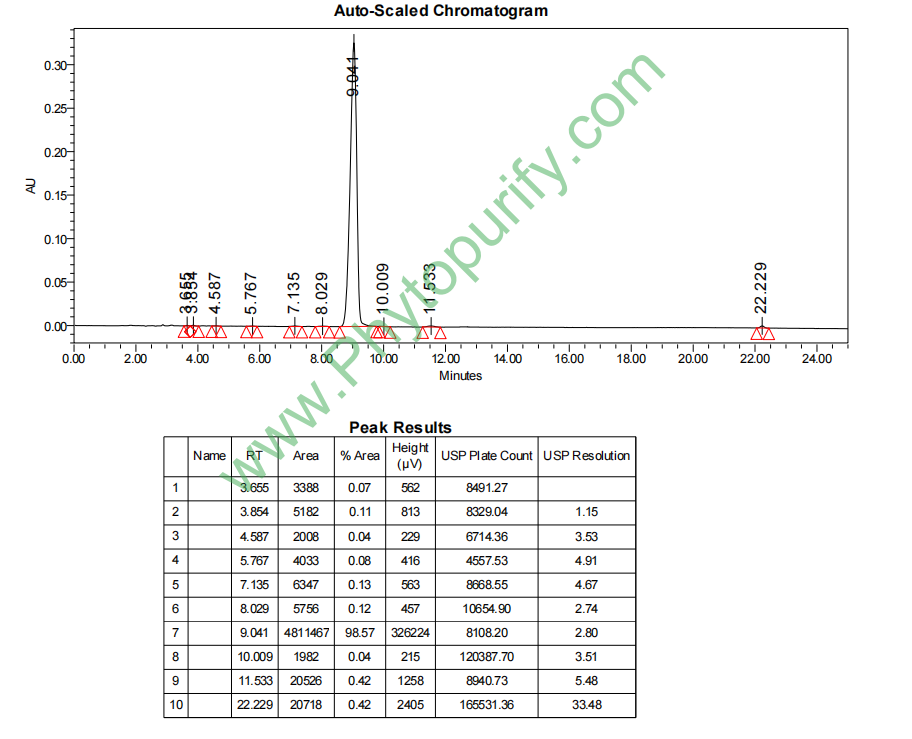
HPLC of Rebaudioside A
Storage conditions:Short-term storage at 2~8℃, long-term storage at -20 ~ -80℃
374.1300
-.6794
-.6788
2.2394
.4459
.3482
Low
55.8096
7.6056
Yes
No
No
No
Yes
No
0.0
Yes
No
No
Yes
Globally, the incidence rate of metabolic diseases such as diabetes, obesity and dyslipidemia continues to rise, which has become a serious public health challenge. Developing safe and effective treatment and intervention strategies, especially searching for active lead compounds from natural products, is one of the important directions in current drug development. Stevia rebaudiana(Stevia rebaudiana Bertoni, as a traditional sweet plant, has been widely used as a food additive due to its high sweetness and low calorie content, which is rich in steviol glycosides in its leaves. Rebaudioside A (Reb A) is one of the steviol glycosides with the highest sweetness and closest taste to sucrose in stevia. In recent years, research has gradually revealed that rebaudin A is not only an excellent natural sweetener, but also a potential drug lead molecule with multiple biological activities. Its pharmacological effects have surpassed simple taste regulation, demonstrating significant potential for lowering blood sugar, regulating blood lipids, and anti obesity. Its mechanism of action involves precise regulation of multiple key physiological processes such as insulin secretion, glucose metabolism, cholesterol synthesis and clearance. This article aims to provide a systematic review of the chemical properties, plant sources, pharmacological activities, molecular mechanisms of action, pharmacological characteristics, and clinical application prospects of rabidicin A, in order to provide comprehensive scientific references for the deep development and utilization of this natural product.
The chemical name of Rabobasidin A is 13- [(2-O - β - D-glucopyranosyl - α - D-glucopyranosyl) oxy] kaempferol-16-en-18-acid - β - D-glucopyranosyl ester, CAS number 58543-16-1. Its molecular formula is C44H70O23 and its molecular weight is 967.0210 daltons.
Structurally, rebaudin A belongs to the tetracyclic diterpenoid class, with steviol as the aglycone. Its structural feature is that the carboxyl group at position C19 of steviol alcohol forms an ester bond with a β - D-glucosyl group, and a sugar chain composed of three sugars is connected to the hydroxyl group at position C13. The sugar chain sequence is β - D-glucosyl - (2 → 1) - α - D-glucosyl - (3 → 1) - β - D-glucosyl. This unique glycosylation pattern is the structural basis for its high sweetness (about 200-400 times that of sucrose) and good taste (with weaker aftertaste).
In terms of physical and chemical properties, rebaudin A is a white to off white crystalline powder. The calculated lipid water partition coefficient (LogP) is -0.6794, indicating that it has good hydrophilicity. The topologically polar surface area (TPSA) is as high as 374.1300 Å ², which is consistent with the presence of multiple hydroxyl and sugar ring structures in its molecule, and also indicates its strong hydrogen bonding ability. Its water solubility value is 2.2394 (usually measured in mg/mL or log mol/L, indicating a certain solubility in water, but not extremely high). These properties collectively determine the distribution and metabolic characteristics of rebaudin A in organisms.
Ruibaodi glycoside A is mainly derived from the Asteraceae plant Stevia rebaudiana(Stevia rebaudiana Bertoni's dried leaves. Stevia is native to the border region between Paraguay and Brazil in South America, and is now widely cultivated in Asia, North America, and other regions. The total content of steviol glycosides in leaves accounts for about 10% -20% of dry weight, among which the content of rebaudin A varies greatly depending on the variety, cultivation conditions, harvest season, and processing technology, usually between 2% -8%. Through modern breeding techniques such as hybridization and mutagenesis, stevia varieties with significantly increased levels of rebaudin A have been cultivated.
The extraction and purification of rebaudin A from Stevia leaves is a multi-step process that mainly includes:
1. Preprocessing and Extraction Dry stevia leaves are usually extracted using hot water or alcohol water solutions (such as ethanol and methanol) after being crushed, and the hydrophilicity of glycosides is utilized to dissolve them from plant cells.
2. Preliminary purification After filtration and concentration, the extraction solution is used to remove impurities such as proteins, pigments, and tannins through methods such as flocculation and adsorption (such as using activated carbon or macroporous adsorption resin).
3. Separation and refinement The preliminary purified glycoside mixture needs to be further separated to obtain high-purity rebaudin A. Key technologies include:
* Chromatographic separation method Preparation based high-performance liquid chromatography (HPLC) or simulated moving bed chromatography (SMB) are currently the most effective methods for obtaining high-purity (>95%) rebaudin A, but the cost is relatively high.
* Crystallization method The use of the difference in solubility of rebaudin A in different solvents (such as water alcohol systems) for recrystallization by controlling temperature, concentration, and other conditions is a commonly used purification method in industry.
* Enzymatic modification Using specific glycosidases to glycosylation or deglycosylation modify other steviol glycosides (such as steviol glycosides) in the extract can selectively increase the yield of rebaudin A.
4. Drying and finished products: The refined solution is concentrated, spray dried or vacuum dried to obtain the final product.
Optimizing the extraction and purification process, improving the yield and purity of Rabobasidin A, while reducing costs, is one of the key steps in achieving its large-scale pharmaceutical development.
A large number of in vitro and in vivo studies have shown that rebaudin A has a wide range of pharmacological activities, mainly concentrated in the field of metabolic regulation.
Hypoglycemic activity Ruibaodi glycoside A has inhibitory activity against alpha glucosidase, with an IC50 value of 35.01 μ g/mL. This enzyme is located at the brush border of the small intestine and is responsible for catalyzing the breakdown of dietary polysaccharides into absorbable monosaccharides. Inhibiting this enzyme can delay the digestion of carbohydrates and absorption of glucose, thereby reducing postprandial blood glucose peak. In diabetes animal models (such as streptozotocin induced diabetes rats), oral rebaudioside A can significantly reduce fasting and postprandial blood glucose levels and improve glucose tolerance in a dose-dependent manner.
Stimulate insulin secretion Research has confirmed that rebaudin A can stimulate pancreatic beta cells to secrete insulin in a glucose dependent manner. In the presence of glucose, it increases the ATP/ADP ratio in beta cells, closes ATP sensitive potassium ion (KATP) channels, causes cell membrane depolarization, voltage dependent calcium channel opening, calcium ion influx, and ultimately triggers insulin vesicle exocytosis. This "glucose dependent" characteristic reduces the risk of hypoglycemia when blood sugar is normal and provides an advantage in safety.
Regulating blood lipid metabolism Ruibaodi glycoside A exhibits clear lipid-lowering effects. The mechanism involves inhibiting the activity of the rate limiting enzyme for cholesterol synthesis, 3-hydroxy-3-methylglutaryl-CoA reductase (HMGCR). At the same time, it can activate the sterol regulatory element binding protein (SREBP) signaling pathway, especially SREBP-2, thereby upregulating the expression of low-density lipoprotein receptor (LDLR) on the cell surface. The increased expression of LDLR promotes the uptake and clearance of low-density lipoprotein cholesterol (LDL-C) in the blood by tissues such as the liver, thereby reducing plasma total cholesterol and LDL-C levels. In animal models of obesity or hyperlipidemia induced by a high-fat diet, rebaudin A can effectively reduce weight gain, lower serum triglycerides, total cholesterol, and LDL-C, and increase high-density lipoprotein cholesterol (HDL-C).
Anti obesity potential In addition to indirectly affecting body weight by regulating blood lipids, some studies suggest that rabidic acid A may exert anti obesity effects by affecting appetite regulating hormones (such as GLP-1, PYY), increasing energy expenditure, or affecting adipocyte differentiation. As a zero calorie sweetener that replaces dietary sugar, it itself helps reduce energy intake.
Other activities There are also reports suggesting that Rabeprizin A may have auxiliary benefits such as anti-inflammatory, antioxidant, and antihypertensive effects (possibly related to improving endothelial function), which complement its overall effect of improving metabolic disorders.
The multiple pharmacological activities of ribavirin A stem from its interaction with multiple molecular targets and signaling pathways, forming a networked mechanism of action.
Core hypoglycemic mechanisms and targets:
Core lipid-lowering mechanism and targets:
Signal pathway integration:
The multiple effects of rabidicin A may be integrated through a common superior signaling molecule. For example, certain pathways activated by it may affect key energy metabolism and cell survival signaling pathways such as AMPK (AMP activated protein kinase), PI3K/Akt (phosphatidylinositol 3-kinase/protein kinase B), thereby coordinating their effects in glucose metabolism, lipid metabolism, and even anti-inflammatory effects.
Based on the provided pharmacological parameters and existing research, the preliminary evaluation of the pharmacological properties of Ribadine A is as follows:
Overall, rebaudin A has good safety and clear activity, but its low membrane permeability and oral bioavailability may be important challenges for its development as a systemic drug. Using it as a functional food ingredient or developing it into drugs targeting local intestinal effects (such as alpha glucosidase inhibitors) is a more realistic approach. Structural modifications (such as prodrugs) or novel drug delivery systems (such as nano formulations) may help improve their drug properties.
The clinical application prospects of Ribadine A are broad, mainly reflected in the following aspects:
As a functional food additive and dietary supplement This is currently the most mature application field. As a natural sweetener with high sweetness and zero calories, it is directly used for the diet management of diabetes and obesity patients, replacing sucrose and other synthetic sweeteners, which helps to control energy and carbohydrate intake. Meanwhile, its potential metabolic benefits can serve as a selling point for "functional sweeteners".
Developing natural medicines for the prevention and adjuvant treatment of metabolic diseases:
Drug development and structural optimization:
Challenges faced and future research directions:
Ruibaodi glycoside A, a natural steviol glycoside derived from stevia, has evolved from an excellent natural sweetener to a highly promising multi active molecule in the field of metabolic disease prevention and treatment. It exhibits comprehensive benefits in lowering blood sugar, regulating blood lipids, and combating obesity through multiple mechanisms such as inhibiting alpha glucosidase, glucose dependent stimulation of insulin secretion, inhibition of HMGCR, and upregulation of LDLR expression. Although it has certain limitations in oral absorption and bioavailability, its excellent safety, clear target of action, and diverse pharmacological activities have laid a solid foundation for its development in functional foods, dietary supplements, and new plant or chemical lead compounds. With more in-depth disclosure of its molecular mechanism, continuous advancement of clinical research and innovation of preparation technology, Rabodioside A is expected to play a more important and unique role in the process of human coping with global health challenges such as diabetes, dyslipidemia and obesity. Future research should focus on translational medicine, bridging the gap between its promising preclinical profile and proven clinical utility, Ultimately achieving a magnificent transformation from a "sweet substance" to a "health guardian".
