


Product name: Soyasaponin Ba
Synonym name: Soyasaponin V
Catalogue No.: BP1331
Cas No.: 114590-20-4
Formula: C48H78O19
Mol Weight: 959.133
Botanical Source: Glycine max
Physical Description:
Type of Compound: Triterpenoids
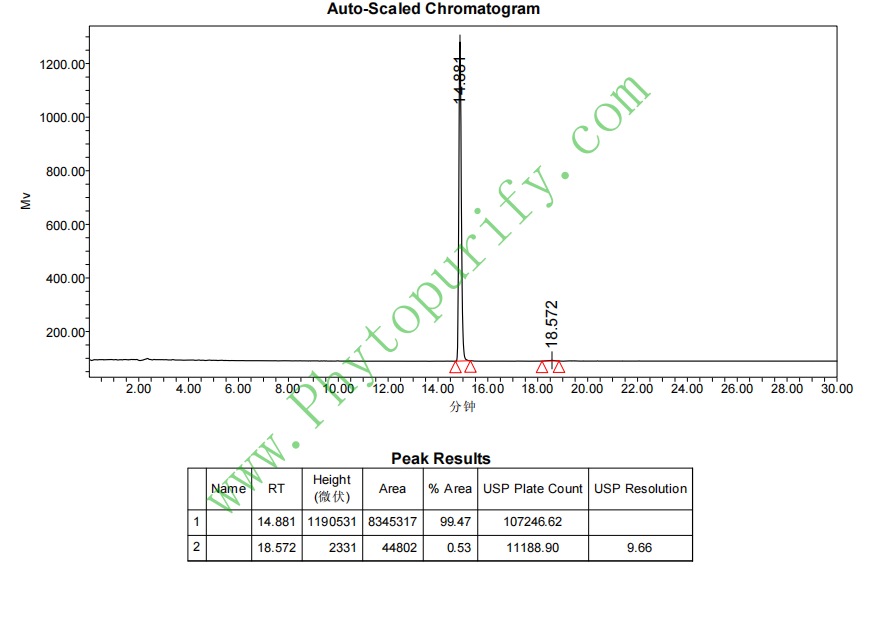
Purity: 95%~99%
Analysis Method: HPLC-DAD or/and HPLC-ELSD
Identification Method: Mass, NMR
Packing: Brown vial or HDPE plastic bottle
Storage: Store in a well closed container, protected from air and light. Put into refrigerate or freeze for long term storage.
The product could be supplied from milligrams to grams
Inquire for bulk scale.
Description:
Soyasaponins(Aa, Ab, Af, Ba, Bb, and Bb') together with their derivatives may represent viable candidates for effective vaccine adjuvants due to their higher and lower or non-haemolytic effects.Soyasaponins Ab and Bb prevent scopolamine-induced memory impairment in mice without the inhibition of acetylcholinesterase.
References:
J.Agr.Food Chem., 2014, 62(9):2062-8.
Soyasaponins Ab and Bb prevent scopolamine-induced memory impairment in mice without the inhibition of acetylcholinesterase.
Soy (Glycine max, family Leguminosae), which contains isoflavones and saponins as main constituents, is known to exhibit memory-enhancing effects.
METHODS AND RESULTS:
Therefore, to investigate the role of soyasaponins in memory impairments, we isolated soyasaponin Ab (SA) and soyasaponin Bb (SB) from soybean and measured their protective effects against scopolamine-induced memory impairment in mice. SA and SB significantly prevented scopolamine-induced memory impairment in passive avoidance and Y-maze tasks. Compared to SA, SB rescued memory impairment more potently. Treatment with SB (10 mg/kg, p.o.) protected memory impairment in passive avoidance and Y-maze tasks to 97% (F = 68.10, P < 0.05) and 78% (F = 35.57, P < 0.05) of untreated normal control level, respectively. SA and SB (10 mg/kg) also rescued scopolamine-induced memory impairment in Morris water maze task (F = 14.51, P < 0.05). In addition, soyasaponins preserved brain-derived neurotrophic factor (BNDF) expression (F = 33.69, P < 0.05) and cAMP response element-binding (CREB) protein phosphorylation (F = 91.62, P < 0.05) in the hippocampus of scopolamine-treated mice. However, SA and SB did not inhibit acetylcholinesterase in vitro and ex vivo.
CONCLUSIONS:
On the basis of these findings, we suggest that soybean, particularly soyasaponins, may protect memory impairment by increasing BDNF expression and CREB phosphorylation.
HPLC of Soyasaponin Ba
Storage conditions:Short-term storage at 2~8℃, long-term storage at -20 ~ -80℃
315.2100
1.7431
-.8867
.3575
.4298
.1452
Low
79.9482
6.4222
No
No
No
No
No
No
0.0
Yes
No
Yes
No
Soyasaponin Ba is an important natural product isolated from plants in the family Fabaceae, and belongs to the family of soy saponins. As a triterpenoid saponin compound with multiple biological activities, soybean saponin Ba has received widespread attention in the field of natural product pharmacology in recent years due to its unique structure and significant pharmacological effects. Especially in the field of prevention and treatment of metabolic diseases, it has shown potential therapeutic value as an aldose reductase inhibitor (ARI). In addition, the activity of soybean saponin Ba in regulating blood lipid metabolism involves multiple key targets, such as cholesterol ester transfer protein (CETP), 3-hydroxy-3-methylglutaryl-CoA reductase (HMGCR), low-density lipoprotein receptor (LDLR), etc., providing a theoretical basis for its application in lipid-lowering and cardiovascular disease prevention and treatment. This article aims to systematically review the chemical structure and physicochemical properties, plant sources and extraction methods, pharmacological activity and mechanism of action, pharmacological evaluation and pharmacokinetic characteristics of soybean saponin Ba, and explore its clinical application prospects and development trends in combination with current research progress.
The molecular formula of soybean saponin Ba is C48H78O19, with a molecular weight of 959.1330, and it belongs to the typical triterpenoid saponin class. Its structural core is a pentacyclic triterpenoid skeleton, connecting multiple sugar residues to form a typical saponin structure. The presence of sugar chains in the structure endows it with high polarity, reflected in a larger topological polar surface area (TPSA) of 315.2100. The LogP value is 1.7431, indicating moderate lipid solubility that facilitates membrane penetration, but low water solubility (0.3575), which may affect its bioavailability and in vivo distribution.
Soy saponin Ba has good chemical stability and does not exhibit hERG channel inhibitory activity, indicating a low risk of cardiac toxicity. The Ames test result is 0.0, indicating no significant genotoxicity risk. The low penetration ability of the blood-brain barrier indicates that its main target is limited to peripheral tissues, reducing the possibility of central nervous system side effects.
Soybean saponin Ba is mainly present in leguminous plants, especially in soybean (Glycine max) and its related species. Its content is significantly affected by variety, planting environment, and growth stage. Traditional extraction methods often use alcohol solvents (such as methanol and ethanol) for reflux or ultrasound assisted extraction of plant dried powders, followed by liquid-liquid distribution, silica gel column chromatography, and high-performance liquid chromatography (HPLC) for separation and purification.
In recent years, the application of supercritical fluid extraction (SFE) and membrane separation technology has improved the extraction efficiency and purity of soybean saponin Ba, and reduced the use of organic solvents, in line with the principles of green chemistry. The purified soybean saponin Ba can be structurally confirmed and purity detected by modern analytical methods such as mass spectrometry (MS) and nuclear magnetic resonance (NMR).
Aldose reductase (AR) is a rate limiting enzyme in the polyol pathway, which catalyzes the reduction of glucose to sorbitol. Overactivation is closely related to diabetes complications such as diabetes retinopathy and neuropathy. As an effective ARI, soyasaponin Ba can significantly inhibit AR activity, reduce sorbitol accumulation in tissues, and thus slow down the occurrence and development of chronic complications of diabetes.
In vitro experiments have shown that soybean saponin Ba has a concentration dependent inhibitory effect on aldose reductase, with an IC50 value in the low micromolar range, indicating its high inhibitory efficacy. Animal model studies further confirmed that it significantly reduced AR activity and tissue damage in the retina and nerve tissue of diabetes rats.
Soy saponin Ba exerts a lipid-lowering effect by regulating various lipid metabolism related targets. Its main targets include:
Cell and animal experiments have shown that soybean saponin Ba can inhibit cholesterol synthesis by downregulating HMGCR expression; Upregulation of LDLR and PPARA promotes cholesterol clearance and fatty acid metabolism; Simultaneously regulating CETP and PCSK9 levels, improving blood lipid profile, reducing plasma total cholesterol, low-density lipoprotein cholesterol (LDL-C), and triglycerides (TG), and increasing high-density lipoprotein cholesterol (HDL-C) levels.
In addition, soyasaponin Ba has antioxidant and anti-inflammatory effects, can reduce inflammation related to atherosclerosis, protect vascular endothelial function, and further enhance its cardiovascular protective effect.
The pharmacological mechanism of soybean saponin Ba is complex, involving multiple signaling pathways and molecular targets, mainly including:
Inhibition mechanism of aldose reductase
Soy saponin Ba binds to the active site of aldose reductase, blocking its catalytic activity, reducing the production of excess sorbitol, and preventing cell osmotic pressure imbalance and oxidative stress damage. Molecular docking and dynamic simulations show that its sugar chain structure forms stable hydrogen bonds and hydrophobic interactions with enzyme active sites, enhancing binding affinity.
Regulating the expression of genes related to lipid metabolism
Soy saponin Ba activates PPARA, promotes fatty acid beta oxidation, and reduces fat accumulation. Simultaneously inhibiting HMGCR and reducing cholesterol synthesis. Its inhibitory effect on PCSK9 reduces LDLR degradation and enhances LDL clearance. Improving lipoprotein metabolism and transport by regulating the expression of APOB and APOE.
Antioxidant and anti-inflammatory pathways
Soy saponin Ba can activate the Nrf2/ARE antioxidant signaling pathway, increase intracellular antioxidant enzyme activity, and reduce ROS generation. It also inhibits the NF - κ B signaling pathway, reduces the expression of pro-inflammatory factors such as TNF - α and IL-6, alleviates chronic inflammatory reactions, and protects the cardiovascular system.
Cell protection and apoptosis regulation
By regulating mitochondrial function and expression of apoptosis related proteins, soybean saponin Ba alleviates cell damage in high glucose environments and promotes cell survival.
The pharmacological evaluation of soybean saponin Ba shows that it has certain development potential:
Molecular weight and structural characteristics
The high molecular weight (959.1330) and abundant sugar chains may limit oral bioavailability. Its LogP is 1.7431, indicating moderate lipophilicity that facilitates membrane penetration, but a high TPSA value (315.2100) suggests strong polarity and may affect passive diffusion.
Water solubility and stability
Low water solubility (0.3575), it is necessary to optimize the formulation to improve solubility and absorption rate. The chemical structure is stable, with no significant risk of cardiac toxicity (hERG negative), low genotoxicity (Ames test negative), and good safety.
Blood-brain barrier penetrability
The blood-brain barrier has low penetration ability and is suitable for peripheral target diseases to reduce central nervous system side effects.
Pharmacokinetic characteristics
At present, there is limited data on the in vivo absorption, distribution, metabolism, and excretion (ADME) of soybean saponin Ba. Preliminary animal experiments have shown that its oral absorption rate is relatively low, mainly through the metabolic transformation of intestinal microbiota, generating various metabolites. The liver is the main metabolic organ, and the excretion pathways include bile and urine.
toxicological evaluation
Long term toxicology research is still lacking, and further systematic evaluation of its safety window and potential toxicity is needed.
Soy saponin Ba, as a natural macromolecular saponin, has broad clinical application potential due to its multi-target and multi mechanism pharmacological activity. Its ARI role in the prevention and treatment of diabetes and its complications provides a new candidate drug for the treatment of chronic complications such as diabetes retinopathy and neuropathy. In addition, by regulating lipid metabolism related targets, soybean saponin Ba is expected to become a natural drug resource for lowering blood lipids and preventing cardiovascular diseases.
Future research should focus on the following aspects:
Pharmacokinetic and bioavailability enhancement
Improving the oral absorption and in vivo stability of soybean saponin Ba through novel drug delivery systems such as nano formulations and liposome encapsulation.
In depth analysis of the mechanism of action
Using multi omics techniques (genomics, proteomics, metabolomics) to systematically reveal its molecular action network and signaling pathways.
Preclinical and clinical research
Conduct systematic toxicological evaluation and pharmacological research, design reasonable clinical trials, and verify their safety and effectiveness.
Structural modification and derivative development
By optimizing the structure through chemical modification, improving activity and pharmacokinetic properties, and developing highly efficient and low toxic new soybean saponin derivatives.
Research on Compound Preparations and Synergistic Effects
Explore the combined application with other natural products or Western medicine to enhance synergy and expand the scope of application.
Soybean saponin Ba, as a natural triterpenoid saponin with significant aldose reductase inhibitory activity and multi-target regulation of blood lipids, exhibits good pharmacological potential and safety. Its multiple mechanisms of action provide new ideas for the comprehensive treatment of metabolic diseases. Although there are still certain challenges in pharmacokinetics and clinical research, with the continuous advancement of extraction and purification technology, drug delivery systems, and molecular biology research, soybean saponin Ba is expected to become an important candidate molecule for future natural drug development. Through in-depth and systematic research and rational drug design, it will promote its clinical translation and bring new treatment options for patients with metabolic diseases.
