


Synonym name: 5-O-Methylvisamminol glucoside
Catalogue No.: BP0089
Cas No.: 84272-85-5
Formula: C22H28O10
Mol Weight: 452.456
Botanical Source: Diplolophium buchananii and Ledebouriella seseloides
Purity: 95%~99%
Analysis Method: HPLC-DAD or/and HPLC-ELSD
Identification Method: Mass, NMR
Packing: Brown vial or HDPE plastic bottle
Can be supplied from milligrams to grams.
For Reference Standard and R&D, Not for Human Use Directly.
Inquire for bulk scale.
HPLC of 5-O-methylvisammioside
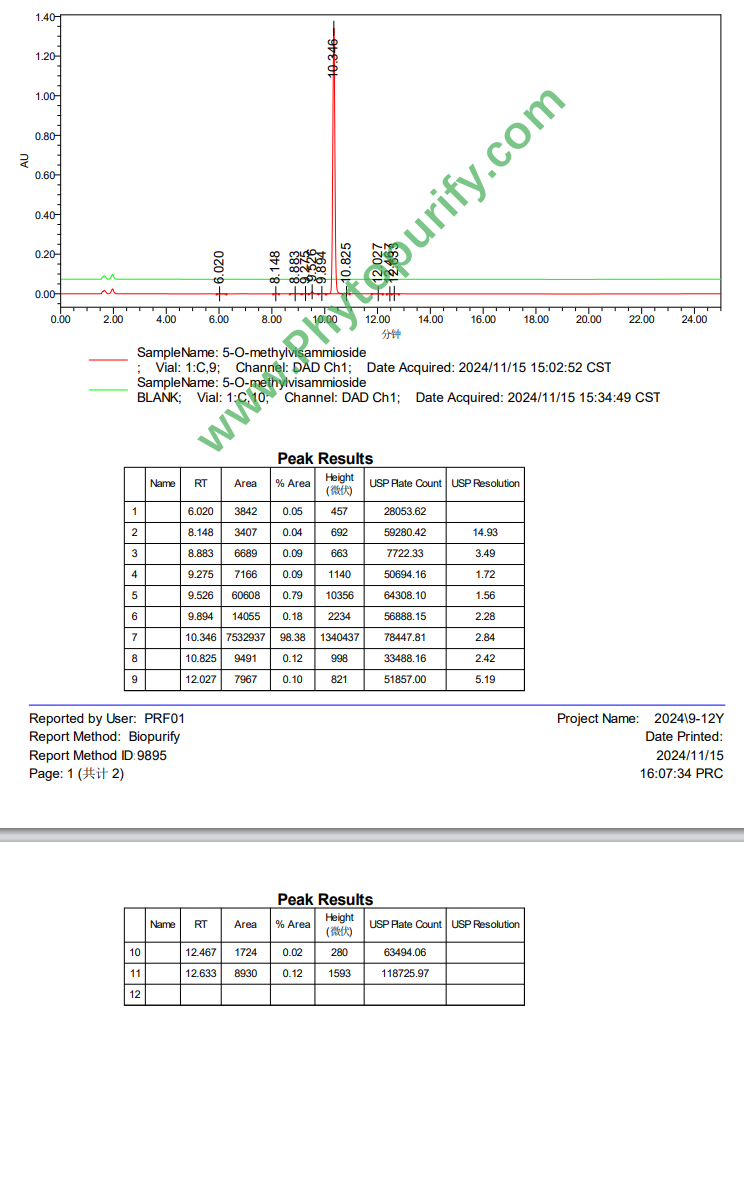
Storage conditions:Short-term storage at 2~8℃, long-term storage at -20 ~ -80℃
169.5800
1.3000
No
null
Unknown
Unknown
Unknown
Unknown
Unknown
Unknown
Unknown
5-O-methylvisammioside (CAS number: 84272-85-5) is a natural product isolated from the traditional Chinese medicine Saposhnikovia divaricata and belongs to the glycoside class of compounds. Windproof, as a commonly used surface clearing medicine in traditional Chinese medicine, has the effects of dispelling wind, dispelling cold, relieving pain and fever. The study of its active ingredients has always been a hot topic in the field of natural product pharmacology. 5-O-methylvisamminol glycoside has received widespread attention in recent years for its potential therapeutic value in neurological diseases, especially in pathological states related to cerebral ischemia, due to its significant analgesic, antipyretic, anti-inflammatory, and antiplatelet aggregation effects.
Cerebral ischemia, as a serious neurological disease, leads to nerve cell damage due to insufficient blood flow supply to the brain, and there is a lack of effective drug intervention methods in clinical practice. Related molecular targets such as APP, BACE1, PTPN1, ABCB1, APEX1, PRKCA, CLEC4E, MAPT, MAPK1, and TNF play key roles in the pathogenesis of cerebral ischemia. 5-O-methylvisamminol glycoside has shown promising therapeutic potential through multi-target and multi pathway regulation.
This article aims to systematically review the chemical structure, physicochemical properties, plant sources and extraction methods, pharmacological activity and mechanism of action, pharmacological evaluation and pharmacokinetic characteristics of 5-O-methylvisamminol glycoside, and explore its clinical application prospects in diseases such as cerebral ischemia based on current research progress, providing theoretical basis for further in-depth research and drug development.
The molecular formula of 5-O-methylvisamminol glycoside is C22H28O11, with a molecular weight of 468.46. Its structural feature is that the glycoside moiety is connected to the glycoside through 5-O-methylation modification, belonging to the glycoside class of natural products. The LogP value of this compound is 1.3, indicating that it has moderate lipid solubility, which is beneficial for cell membrane penetration but not easily affected by excessive lipid solubility and bioavailability. The topological polar surface area (TPSA) is 169.58 Å ² and the number of hydrogen bond acceptors is 10, indicating a high molecular polarity that may affect its ability to pass through the blood-brain barrier.
Structurally, 5-O-methylvisamminol glycoside contains multiple hydroxyl and methoxy groups, endowing it with strong hydrophilicity and multi-point hydrogen bonding ability, which is of great significance for its binding with biomolecules. Its physicochemical properties comprehensively reflect the potential advantages and limitations of the compound in terms of distribution, metabolism, and targeting in vivo.
5-O-methylvisamminol glycoside is mainly extracted from the roots of Saposhnikovia divaricata. Windproof is a plant of the Umbelliferae family, widely distributed in Northeast and North China. It has always been used to treat symptoms such as wind cold, cold, headache, and rheumatic pain.
The extraction process usually adopts the alcohol extraction method, and the specific steps include:
This extraction method has the advantages of simple operation, high extraction efficiency, and stable purity, providing a reliable material basis for subsequent pharmacological research and formulation development.
The pharmacological activities of 5-O-methylvisamminol glycoside mainly focus on analgesia, antipyretic, anti-inflammatory, and antiplatelet aggregation, especially showing significant protective effects in the field of neurological diseases.
In vitro and in vivo experiments have shown that 5-O-methylvisamminol glycoside can significantly alleviate pain responses caused by chemical or physical stimuli. Its analgesic mechanism may involve inhibiting the release of inflammatory mediators and regulating neurotransmitters. The antipyretic effect is achieved by downregulating thermogenic factors such as prostaglandin E2 (PGE2) and tumor necrosis factor alpha (TNF - α), demonstrating a good antipyretic effect.
This compound can inhibit various inflammatory signaling pathways and reduce the expression of inflammatory cytokines, including TNF - α, IL-1 β, IL-6, etc. In vitro cell models and animal inflammation models, 5-O-methylvisamminol glycoside significantly reduces tissue inflammatory response, slows down inflammatory cell infiltration and oxidative stress levels.
5-O-methylvisamminol glycoside has an inhibitory effect on platelet aggregation, which may reduce the risk of thrombosis by regulating platelet membrane receptors and downstream signaling pathways. This characteristic provides theoretical support for its application in cerebral ischemia and cardiovascular diseases.
In recent years, the neuroprotective effect of 5-O-methylvisamminol glycoside in cerebral ischemia models has gradually been revealed. It can alleviate ischemia-reperfusion injury, inhibit neuronal apoptosis, improve neurological dysfunction, indicating its potential value in the treatment of cerebral ischemia.
The pharmacological effects of 5-O-methylvisamminol glycoside involve multiple molecular targets and signaling pathways, especially in the pathological mechanism of cerebral ischemia, showing the characteristic of multi-target synergistic regulation.
APP (amyloid precursor protein) and BACE1 (β - secretase 1)Abnormal metabolism of APP and elevated BACE1 activity are important mechanisms of neurodegenerative diseases. 5-O-methylvisamminol glycoside may protect nerve cells by regulating APP treatment and inhibiting BACE1 activity, reducing the production of harmful β - amyloid proteins.
PTPN1 (protein tyrosine phosphatase 1)PTPN1 is involved in cellular signal transduction and inflammatory response, and its regulation by 5-O-methylvisamminol glycoside can help alleviate inflammation and oxidative stress.
ABCB1 (ATP binding cassette transporter B1)As an important drug efflux pump, ABCB1 affects the distribution of drugs in the brain. Although 5-O-methylvisamminol glycoside is not easily able to pass through the blood-brain barrier, it may affect the stability of the brain environment by regulating ABCB1 expression.
APEX1 (DNA lyase repair enzyme)Participating in DNA repair and antioxidant reactions, 5-O-methylvisamminol glycoside activates APEX1, which helps alleviate oxidative damage caused by ischemia.
PRKCA (protein kinase C alpha)Regulating cell proliferation, apoptosis, and inflammation, 5-O-methylvisamminol glycoside may exert neuroprotective effects by modulating the PRKCA signaling pathway.
CLEC4E (C-type lectin like receptor 4E)Involved in immune regulation, 5-O-methylvisamminol glycoside helps to inhibit inflammatory response by regulating it.
MAPT (microtubule associated protein Tau) and MAPK1 (mitogen activated protein kinase 1)Regulating the stability of the neural cytoskeleton and signal transduction, 5-O-methylvisamminol glycoside reduces nerve damage by affecting its phosphorylation status.
TNF (tumor necrosis factor)As the main inflammatory mediator, 5-O-methylvisamminol glycoside significantly inhibits TNF expression and reduces inflammatory damage.
5-O-methylvisamminol glycoside exerts its anti-inflammatory, anti apoptotic, and neuroprotective effects by regulating classic inflammatory and cell survival signaling pathways such as NF - κ B, MAPK, and PI3K/Akt. In addition, its regulation of oxidative stress-related pathways helps alleviate cell damage caused by ischemia-reperfusion.
The molecular weight of 5-O-methylvisamminol glycoside is 468.46, which belongs to the category of medium molecular weight compounds. LogP is 1.3, indicating moderate lipid solubility and favorable distribution in the body. The TPSA is 169.58 and the number of hydrogen bond receptors is 10, indicating a high polarity that may limit its passage through the blood-brain barrier (BBB), which is consistent with existing data and suggests poor blood-brain barrier permeability.
At present, there is no safety data on the hepatotoxicity, cardiotoxicity, hERG channel inhibition, and genotoxicity (Ames test) of this compound, and further systematic evaluation is needed.
Due to the strong polarity of 5-O-methylvisamminol glycoside, its oral bioavailability may be limited. The absorption, distribution, metabolism, and excretion (ADME) characteristics of it in the body have not been systematically reported. It is preliminarily speculated that it is mainly absorbed through the intestine, and liver metabolic enzymes may be involved in its metabolic transformation. The excretion pathway may be mainly through the kidneys.
Future research needs to focus on its in vivo dynamic behavior, optimize the administration route and dosage form design, in order to enhance its efficacy and clinical application value.
5-O-methylvisamminol glycoside has shown promising clinical development prospects due to its multiple pharmacological activities, particularly its potential therapeutic value in cerebral ischemia and related neurological diseases.
Neurological damage after cerebral ischemia is complex, involving multiple pathological processes such as inflammation, oxidative stress, cell apoptosis, and thrombosis. 5-O-methylvisamminol glycoside regulates inflammatory factors, neuroprotective proteins, and platelet function through multi-target synergistic effects, and is expected to become a new candidate drug for the prevention and treatment of cerebral ischemia.
Given its limited blood-brain barrier permeability, 5-O-methylvisamminol glycoside can be used in combination with other drugs with good brain penetration to exert synergistic effects. In addition, based on its anti-inflammatory and analgesic properties, compound preparations can be developed for the adjuvant treatment of rheumatic diseases and neuropathic pain.
The current safety evaluation and pharmacokinetic data of 5-O-methylvisamminol glycoside are insufficient, which limits its clinical translation. In the future, toxicology research should be strengthened, drug formulations should be optimized, and bioavailability and brain concentration should be improved. At the same time, modern molecular biology and medicinal chemistry methods are utilized to deeply analyze its mechanism of action, screen structurally similar compounds for structure-activity relationship (SAR) research, and enhance drug efficacy and safety.
In addition, by combining emerging nano drug delivery systems and targeted delivery technologies, it is expected to break through the limitations of the blood-brain barrier and enhance its therapeutic efficacy in neurological diseases.
5-O-methylvisamminol glycoside, as an important active ingredient in windbreak, has shown potential therapeutic value in cerebral ischemia and related neurological diseases due to its multiple pharmacological effects such as analgesia, antipyretic, anti-inflammatory, and antiplatelet aggregation. Its multi-target and multi pathway mechanism of action provides a model for natural product pharmacology research.
Although its pharmacological and pharmacokinetic characteristics still need further improvement, 5-O-methylvisamminol glycoside is still a candidate molecule worth paying attention to in the field of natural medicine research and development. In the future, through systematic safety evaluation, mechanism research, and dosage form optimization, it is expected to promote its clinical application and bring new hope for the treatment of diseases such as cerebral ischemia.
