| Catalog No | Package | Original Price | Price | Inventory | Quantity | Operating |
|---|---|---|---|---|---|---|
| BP3608-5mg | 5mg | $260.00 | Sign in |
|


Storage conditions:Short-term storage at 2~8℃, long-term storage at -20 ~ -80℃
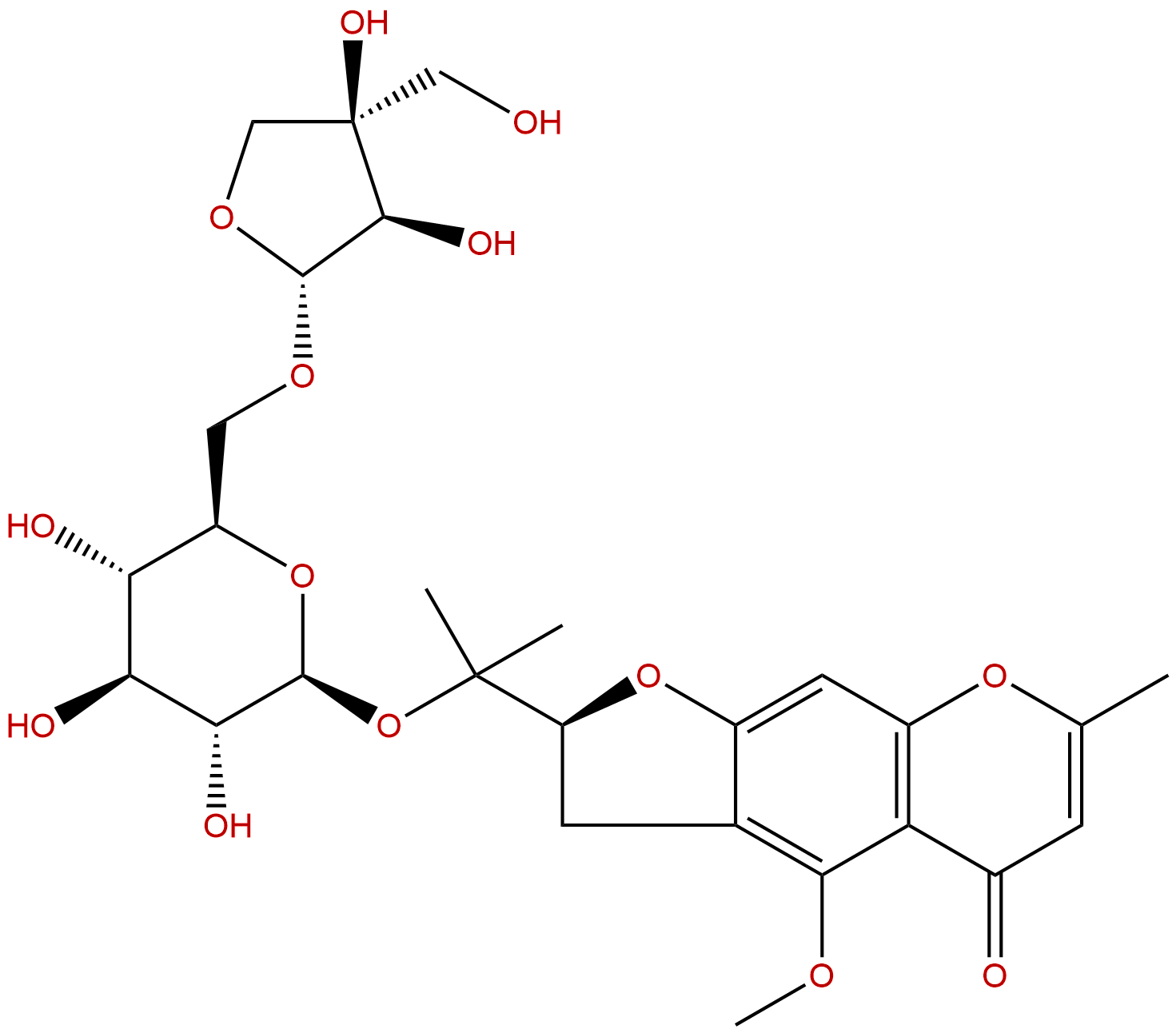
Natural products, as important resources for drug discovery, have long held a central position in new drug development due to their structural diversity and wide range of biological activities. In recent years, with the advancement of modern analytical techniques and molecular biology methods, more and more natural products with potential medicinal value have been gradually revealed and developed. 5-O-methylvisamminol-4 '- O - β - D-furanosyl - (1 → 6) - β - D-glucopyranoside (6' '- O-apiosyl-5-O-Methylvisammide, hereinafter referred to as "the compound"), as a complex natural glycoside, exhibits rich biological activity due to its unique chemical structure and polysaccharide modification, and has become a hot topic in natural product pharmacology research.
This review aims to systematically summarize the chemical structural characteristics, plant sources and extraction methods, pharmacological activity and mechanism of action, pharmacological evaluation and pharmacokinetic parameters of the compound, and explore its clinical application prospects and future development directions based on existing research results, providing reference and inspiration for researchers in related fields.
The compound has a complex molecular formula and a molecular weight of 584.5710. It belongs to the glycoside class of natural products and contains a 5-O-methylvisamminol core skeleton in its structure. It is connected to a 4 '- O - β - D-furanosyl group and linked to β - D-glucopyranoside through a (1 → 6) glycosidic bond. In addition, there is an apiosyl residue decorated at the 6' 'position. This type of polysaccharide based modification not only increases molecular weight, but also significantly affects its water solubility and biological activity.
In terms of physical and chemical properties, the compound has a LogP value of -0.0325, indicating strong hydrophilicity and a water solubility index of 1.0615, which is consistent with its polysaccharide based structural characteristics. The TPSA (Topological Polarity Surface Area) is 206.9700, indicating a high molecular polarity that may limit its ability to penetrate lipid membranes, resulting in low blood-brain barrier permeability (evaluation results show low blood-brain barrier permeability). In addition, the compound did not exhibit hERG channel inhibitory activity, indicating a low risk of cardiac toxicity. The Ames test result is 1.5, indicating a low risk of genotoxicity and a good safety basis.
This compound is mainly distributed in certain specific plant genera, especially in plants rich in visamminol glycosides. The literature reports that its main sources include certain traditional Chinese medicinal herbs, such as Visammia spp. and related species. The compound mainly exists in the roots, stems, and leaves of plants, and its content varies depending on the planting environment, harvesting period, and plant growth stage.
The extraction method usually adopts water extraction or alcohol extraction combined with multi-stage separation and purification technology. The specific steps include:
In recent years, the application of ultrasound assisted extraction and microwave-assisted extraction technologies has further improved extraction efficiency and purity, reduced solvent usage and extraction time, and promoted the large-scale preparation of this compound.
The pharmacological activity research of this compound mainly focuses on its anti-inflammatory, antioxidant, anti-tumor, and neuroprotective aspects.
In vitro cell model studies have shown that this compound can significantly inhibit the production of inflammatory mediators such as tumor necrosis factor - α (TNF - α), interleukin-6 (IL-6), and nitric oxide (NO). Its anti-inflammatory mechanism is closely related to the inhibition of the activation of the nuclear factor kappa B (NF - κ B) signaling pathway, reducing the transcriptional expression of pro-inflammatory factors.
This compound exhibits excellent free radical scavenging ability, effectively reducing reactive oxygen species (ROS) levels and protecting cells from oxidative stress damage. Its antioxidant mechanism may involve activating the intracellular antioxidant enzyme system, such as superoxide dismutase (SOD) and glutathione peroxidase (GPx).
Multiple in vitro tumor cell line experiments have shown that this compound has a proliferation inhibitory effect on various cancer cells, inducing cell cycle arrest and apoptosis. Its anti-tumor mechanism involves regulating the expression of cell cycle proteins, activating mitochondrial apoptosis pathways, and inhibiting tumor related signaling pathways such as PI3K/Akt and MAPK.
Although the compound has low blood-brain barrier permeability, it has been shown to protect neurons from glutamate excitotoxicity and oxidative stress damage in an in vitro neural cell model, suggesting its potential neuroprotective effect, which may be achieved by regulating intracellular calcium homeostasis and antioxidant mechanisms.
The biological activity of this compound is mainly achieved through multiple targets and pathways. Existing research reveals that its key mechanisms of action include:
In addition, the polysaccharide based structure of the compound may affect its binding to cell membrane receptors and transporters, regulating cell signal transduction. The specific molecular targets still need further clarification.
The pharmacological evaluation shows that the compound has good safety and low risk of toxic side effects. Its LogP is close to zero, indicating a balance between hydrophilicity and hydrophobicity, which is beneficial for in vivo distribution. The high TPSA and low blood-brain barrier permeability suggest limited application in the central nervous system, but are suitable for peripheral target therapy.
The hERG channel inhibition experiment showed a negative result, indicating a low risk of cardiac toxicity and meeting the requirements for safe medication. The Ames test results also showed no significant mutagenicity.
In terms of pharmacokinetics, although there is currently limited systematic in vivo research, preliminary data suggests that the compound has slow oral absorption and limited bioavailability, possibly due to its polysaccharide based structure leading to intestinal enzymatic hydrolysis and microbial metabolism. Its main metabolic pathways may involve glycoside hydrolysis and methylation modification of liver phase I and phase II enzyme systems. The main excretion pathways are the kidneys and bile.
In the future, it is necessary to optimize the administration method and dosage form design through in vivo pharmacokinetic studies, combined with pharmacological evaluation, to improve its bioavailability and therapeutic efficacy.
This compound has broad clinical application prospects due to its multiple pharmacological activities, especially its potential in anti-inflammatory, antioxidant, and anti-tumor fields. Its low toxicity and good safety lay the foundation for clinical translation.
In chronic inflammatory diseases such as rheumatoid arthritis and inflammatory bowel disease, as well as adjuvant therapy for tumors, this compound may act as a natural medicine or combination therapy. In addition, although the permeability of the blood-brain barrier is low, it is expected to break through the bottleneck of central nervous system applications and develop new strategies for the treatment of neurodegenerative diseases through structural modification or nanocarrier delivery technology.
Future research should focus on:
Through interdisciplinary collaboration, promote the translation of this compound from laboratory research to clinical applications, fully leveraging its natural product advantages.
5-O-methylvisamminol-4 '- O - β - D-furanosyl - (1 → 6) - β - D-glucopyranoside, as a complex and biologically active natural glycoside compound, exhibits significant anti-inflammatory, antioxidant, and anti-tumor activities. Its unique polysaccharide based modification not only endows it with good water solubility and safety, but also poses challenges to its mechanism of action and pharmacokinetic characteristics.
The current research has preliminarily revealed its multi-target mechanism of action and pharmacological advantages, but systematic in vivo pharmacology and preclinical studies still need to be strengthened. In the future, through structural optimization, delivery system improvement, and in-depth mechanism exploration, it is expected to promote this compound as a new natural drug candidate molecule and expand its application value in the treatment of various diseases.
In summary, as an important object of natural product pharmacology research, this compound has broad prospects for scientific research and clinical translation, and deserves continuous attention and in-depth development.
