


Synonym name:
Catalogue No.: BP1279
Cas No.: 80681-44-3
Formula: C21H26O10
Mol Weight: 438.429
Botanical Source: From Ledebouriella seseloides
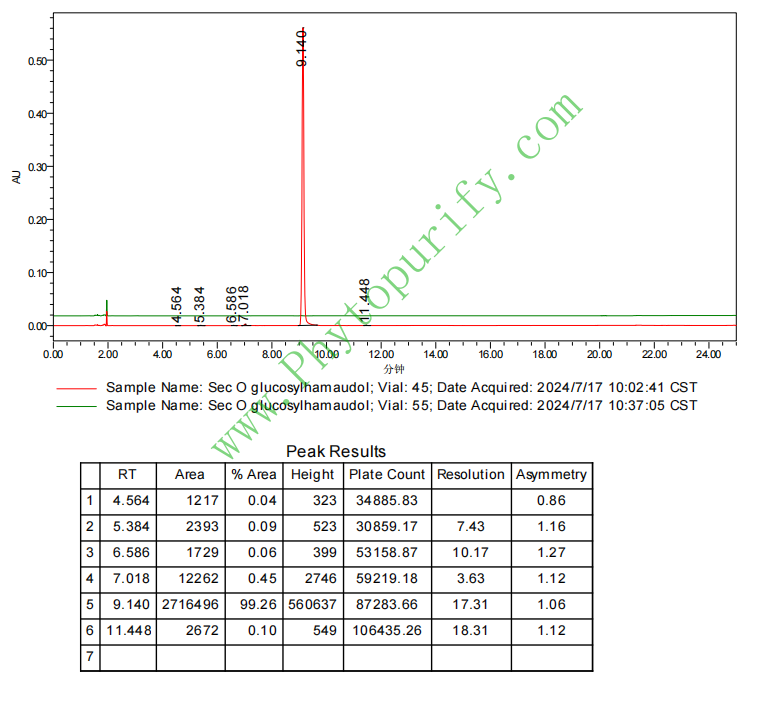
Purity: 95%~99%
Analysis Method: HPLC-DAD or/and HPLC-ELSD
Identification Method: Mass, NMR
Packing: Brown vial or HDPE plastic bottle
Can be supplied from milligrams to grams.
For Reference Standard and R&D, Not for Human Use Directly.
Inquire for bulk scale.
HPLC of Sec-O-glucosylhamaudol
Storage conditions:Short-term storage at 2~8℃, long-term storage at -20 ~ -80℃
159.0500
.4078
.3996
1.0044
.5817
.5641
Low
74.6216
4.4408
Yes
No
Yes
No
Yes
No
0.6
Yes
No
Yes
No
Pain and inflammation are common pathological features of various acute and chronic diseases, and their complex physiological and molecular mechanisms pose significant challenges to clinical treatment. At present, although analgesics represented by nonsteroidal anti-inflammatory drugs and opioid drugs are widely used, long-term use often accompanies many adverse reactions such as gastrointestinal injury, addiction, and tolerance. Therefore, searching for efficient and low toxicity new analgesic and anti-inflammatory lead compounds from natural products has always been an important direction in drug development. As a traditional medicinal plant, Binhai Qianhu has diverse chemical components and significant biological activity, making it a potential treasure trove of active molecules. Among them, coumarin compounds isolated from Binhai Houttuynia cordata, such as coumarin glycosides, have gradually attracted the attention of pharmacological researchers in recent years due to their unique chemical structure and preliminary analgesic and anti-inflammatory potential. Haimaofen glycoside not only participates in pain regulation by affecting the levels of μ - opioid receptor proteins, but also exhibits regulatory effects on various inflammation related targets and signaling pathways. This article aims to provide a systematic review of the chemical properties, plant sources, pharmacological activities, mechanisms of action, and potential medicinal properties of Haimaofen glycoside, in order to provide comprehensive scientific references for the in-depth research and future development of this natural product.
Haimao phenol glycoside, chemical name Sec-O-glucylhamaudol, has a CAS registration number of 80681-44-3. From a chemical classification perspective, it belongs to the derivatives of coumarin compounds, specifically angular pyranocoumarin. Its molecular formula is C21H26O10 and its molecular weight is 438.4290. Structurally, artemiside glycosides are composed of artemiside as the aglycone, which is linked to a glucose group via a glycosidic bond at the secondary hydroxyl (Sec OH) position on its side chain. This glycosylation modification significantly alters the physicochemical properties of its parent compound.
In terms of physicochemical parameters related to medicinal properties, the theoretical lipid water partition coefficient (LogP) of Haimaofen glycoside is 0.4078, indicating that the molecule has a certain hydrophilicity, which is consistent with the presence of polyhydroxy and glycosyl fragments in its structure. Its topological polar surface area (TPSA) is as high as 159.0500 Å ², mainly due to the numerous oxygen atoms and sugar ring structures in the molecule. High TPSA is usually not conducive to passive transmembrane diffusion. The predicted value of water solubility is 1.0044 mg/mL, which belongs to the range of slightly soluble to soluble, providing a basis for its dissolution and distribution in organisms. However, higher polarity and molecular weight also indicate that its ability to cross biological barriers may be limited. For example, predictions show that its ability to cross the blood-brain barrier (BBB) is lower, which limits its potential to act on the central nervous system. In terms of early safety indicators, the hERG inhibition risk prediction of berberine glycoside is negative, indicating a low potential risk of causing QT interval prolongation in the heart; The Ames test predicted a value of 0.6, indicating a relatively low risk of mutagenicity and providing preliminary positive signals for further safety evaluation.
Haimao phenolic glycosides are mainly isolated from the Umbelliferae family's Primulaceae plant Primulaceae. Binhai Qianhu is mainly distributed in the coastal areas of East Asia and has a certain history of application in traditional Chinese medicine. It is commonly used to treat cough, rheumatism, and pain. Modern plant chemistry research has revealed that Platycodon grandiflorus is rich in various active ingredients such as coumarins, volatile oils, and polysaccharides, among which coumarins are an important material basis for its pharmacological effects.
The extraction and separation of phenolic glycosides from Houttuynia cordata usually follow the conventional process of natural product chemistry. Firstly, the dried roots or whole plants of Platycodon grandiflorus are crushed and subjected to reflux extraction or ultrasound assisted extraction using polar solvents such as methanol, ethanol, or aqueous ethanol to fully extract polar components, including paeoniflorin. After vacuum concentration, the crude extract obtained is subjected to systematic solvent extraction using solvents such as petroleum ether, ethyl acetate, and n-butanol. Due to the strong polarity brought by its glycosidic structure, coumarin glycosides are usually enriched in n-butanol or aqueous layers. Further purification relies on various chromatographic techniques. Silica gel column chromatography is commonly used for preliminary separation, with different ratios of chloroform methanol or dichloromethane methanol gradient elution. Then, in combination with modern separation methods such as reverse phase silica gel column chromatography (such as C18 packing, methanol water or acetonitrile water as mobile phase), dextran gel column chromatography and high performance liquid chromatography, the high-purity Helmoside monomer compound can be finally obtained. Structural identification is accomplished through the comprehensive use of spectroscopic methods such as nuclear magnetic resonance, mass spectrometry, infrared spectroscopy, and ultraviolet spectroscopy.
The pharmacological activity research of Haimaofen glycoside mainly focuses on two aspects: analgesia and anti-inflammatory, and exhibits the characteristic of multi-target action.
One of the core discoveries of Haimaofen glycoside in pain relief is its regulatory effect on the mu opioid receptor (MOR). Research has shown that berberine can reduce the protein expression level of μ - opioid receptors in cells. The μ - opioid receptor is a key target of endogenous opioid system mediated analgesic effects and also the site of action for classic opioid drugs such as morphine. The regulation of MOR protein levels by Haimao phenol glycoside suggests that it may affect opioid system function through a novel mechanism different from traditional opioid receptor agonists, thereby participating in pain regulation. This provides new ideas for the development of non addictive or low addictive analgesics. In various animal pain models, such as acetic acid-induced writhing response in mice (visceral pain model), formalin test (acute and chronic biphasic pain model), and hot plate test, berberine has shown significant analgesic effects.
In terms of anti-inflammatory activity, the research on berberine glycoside is more extensive and in-depth. In vitro cell models, berberine can effectively inhibit macrophage inflammatory responses induced by stimuli such as lipopolysaccharides. In animal models in vivo, it has shown good anti-inflammatory effects in acute inflammation models such as carrageenan or carrageenan induced rat paw swelling, xylene induced mouse ear swelling, and chronic inflammation models such as Freund's complete adjuvant induced arthritis, significantly reducing tissue edema and decreasing inflammatory cell infiltration.
The analgesic and anti-inflammatory effects of Haimaofen glycoside are not achieved through a single pathway, but involve a complex multi-target network, which is closely related to its regulatory effects on multiple inflammation related targets.
1. Regulation of inflammatory mediators and cytokines:
Haimaofen glycoside can significantly inhibit the production of key pro-inflammatory cytokines, such as tumor necrosis factor - α and interleukin-6. These cytokines are the core driving force behind the amplification of the inflammatory cascade. Haimaofen glycoside inhibits the activation of nuclear transcription factor kappa B and blocks the NF - κ B signaling pathway upstream, thereby reducing the expression of a series of pro-inflammatory genes downstream.
2. Inhibition of inflammation related enzymes:
Haimao phenol glycoside has inhibitory effects on the activity or expression of cyclooxygenase and inducible nitric oxide synthase. COX-2 is a key enzyme that mediates prostaglandin synthesis and is closely related to pain and inflammation; INOS catalyzes the production of a large amount of nitric oxide, which is involved in inflammation and neuropathic pain. The inhibition of PTGS2 and NOS2 by Haimao phenol glycoside directly reduces the production of inflammatory mediators such as PGE2 and NO.
3. Regulation of ion channels in pain receptors:
Haimaofen glycoside has a regulatory effect on transient receptor potential vanillic acid subtype 1 and transient receptor potential anchor protein subtype 1. TRPV1 and TRPA1 are important nociceptors located on sensory neurons, which can be activated by capsaicin, heat, acidic environment, mustard oil, low temperature, oxidative stress, etc. Their overactivation is an important mechanism for various acute and chronic pain. Haimaofen glycoside may regulate the activity of these channels directly or indirectly, thereby reducing the sensitivity of neurons to nociceptive stimuli.
4. Potential impact on cell apoptosis pathway:
Cystatine-1 is a key protease involved in inflammasome activation and cell pyroptosis execution. Cellular pyroptosis is a pro-inflammatory programmed cell death associated with various inflammatory diseases. The potential regulatory effect of Haimaofen glycoside on CASP1 suggests that it may alleviate excessive inflammatory response and tissue damage by inhibiting inflammasome activation.
5. Intervention on signal transduction and transcription activation factors:
Signal transducer and activator of transcription factor 3 is an important hub for cytokine signaling, and its sustained activation is closely related to chronic inflammation and cancer. Haimaofen glycoside may further inhibit the persistence and development of inflammation by intervening in the JAK-STAT3 signaling pathway.
In summary, berberine exerts its comprehensive analgesic and anti-inflammatory effects by simultaneously acting on multiple signaling pathways such as NF - κ B, JAK-STAT, inflammasome, and regulating multiple key targets such as COX-2, iNOS, TRPV1/TRPA1, forming a synergistic network. Its regulation of μ - opioid receptor protein levels may provide another independent or synergistic pathway for its analgesic effect.
Based on computational predictions and preliminary experimental data, the pharmacological characteristics of Haimaofen glycoside present a situation of both opportunities and challenges.
Advantages: Firstly, the molecular weight is moderate (438.4), which meets the basic requirements of drug likeness rules. Secondly, the predicted hERG inhibition risk and Ames mutagenicity risk are relatively low, laying a good preliminary foundation for its safety. Thirdly, as a natural product, its structure is derived from plants and usually has good biocompatibility.
Challenge aspect: Firstly, its high topological polarity surface area and low LogP value indicate poor lipid solubility, which may seriously affect its oral bioavailability. Glycoside compounds are easily hydrolyzed in the gastrointestinal tract or difficult to passively diffuse through intestinal epithelial cells, which may result in poor absorption. Secondly, the blood-brain barrier permeability is predicted to be "low", which may reduce the risk of central nervous system side effects, but also limits its potential to directly act on central targets such as μ - opioid receptors if their site of action is in the central nervous system. However, its peripheral anti-inflammatory and analgesic effects (such as acting on peripheral TRP channels and inhibiting peripheral inflammation) may still be very significant. Finally, the glycoside structure is susceptible to the influence of gut microbiota and liver first pass metabolism in vivo, and may be hydrolyzed into aglycones, resulting in complex pharmacokinetic behavior.
At present, there are insufficient public reports on the pharmacokinetic studies of the Haimao phenolic glycoside system, such as absorption, distribution, metabolism, and excretion. Future research needs to focus on key parameters such as oral absorption efficiency, in vivo metabolic pathways (especially stability of glycosidic bonds), major metabolites and their activities, tissue distribution characteristics, and elimination half-life. Improving its solubility and permeability through pharmaceutical methods such as preparing nanoparticles, liposomes, phospholipid complexes, or prodrugs is an important direction to enhance its potential as a drug.
As a natural coumarin glycoside with multi-target analgesic and anti-inflammatory activities, the clinical application prospects of Haimaofen glycoside are worth exploring in depth.
Potential therapeutic areas:
1. Chronic inflammatory pain: Multi targeted anti-inflammatory mechanisms, such as osteoarthritis and rheumatoid arthritis, may alleviate inflammation and pain at the root.
2. Neuropathic pain: In view of its regulatory effect on TRPV1/TRPA1 channel, it may be effective for diabetes neuralgia, peripheral neuralgia caused by chemotherapy, etc.
3. Postoperative pain and acute pain: Its analgesic effect may take effect quickly, and non opioid mechanisms help to avoid risks such as respiratory depression and addiction.
4. Other inflammation related diseases: Its strong anti-inflammatory potential may be extended to the treatment of non painful inflammatory diseases such as colitis and dermatitis.
Future research directions and challenges:
1. In depth mechanism clarification: It is necessary to use techniques such as gene knockout, specific inhibitors, and co crystallization to accurately verify the direct interaction sites and specific modes of action (activation, antagonism, or allosteric regulation) between berberine and the aforementioned targets.
2. System pharmacology and safety evaluation: Long term efficacy observation and comprehensive preclinical toxicology studies, including acute toxicity, chronic toxicity, and reproductive toxicity, need to be conducted in animal models that are closer to human diseases.
3. Pharmacokinetic optimization: This is one of the biggest bottlenecks in the development of paeoniflorin. It is necessary to conduct systematic ADME research and actively explore new drug delivery systems or make reasonable structural modifications (such as modifying glycosides or aglycones) to improve their bioavailability and targeting.
4. Potential for combination therapy: Exploring the combined use of berberine glycoside and existing analgesic and anti-inflammatory drugs may result in synergistic effects, reducing their respective dosages and side effects.
5. Clinical translational studies: After completing sufficient preclinical research, gradually advance clinical trials to verify its effectiveness and safety in humans.
Haimao phenol glycoside is a natural active molecule with important research value discovered from the traditional medicinal plant, Binhai Qianhu. It not only has the characteristics of coumarin glycosides in its chemical structure, but also demonstrates the potential for comprehensive effects in pharmacological activity by regulating the levels of μ - opioid receptor proteins and intervening in multiple inflammatory pain related signaling pathways such as NF - κ B and TRP channels. Although it faces challenges in drug development, especially in oral absorption and blood-brain barrier permeability, its multi-target mechanism of action and good preliminary safety prediction provide a solid foundation for its subsequent development. With the in-depth analysis of its mechanism of action, systematic study of its pharmacokinetic properties, and innovative application of formulation technology, Haimaofen glycoside is expected to be developed into a new, efficient, and low toxicity candidate drug for pain and anti-inflammatory treatment, or provide novel lead compound structures for the design of related drugs, thus providing new options for the treatment of pain and inflammatory diseases. The continuous research on coumarin glycosides will further enrich our scientific understanding of the pharmacological activities of natural coumarin compounds.
