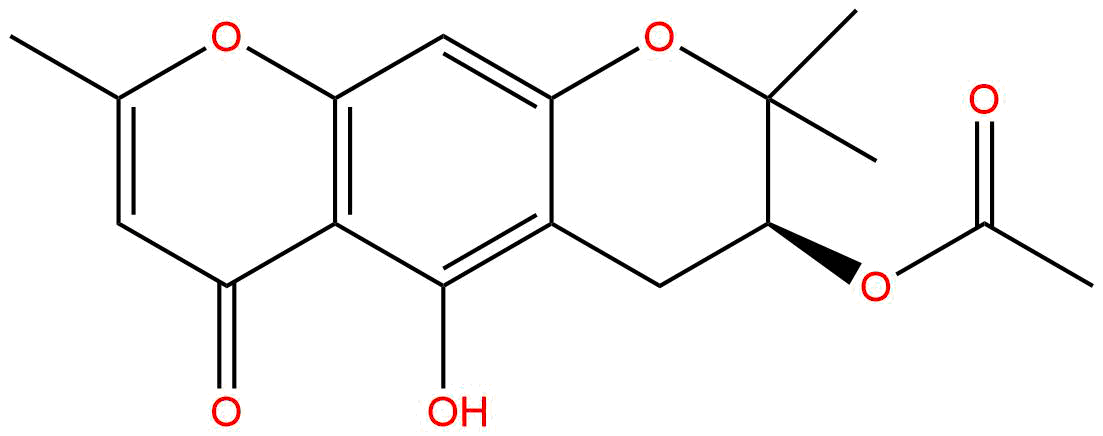


Product name: 3'-O-Acetylhamaudol
Synonym name: Acetylhamaudol; Hamaudol acetate; Hamaudol, 3'-acetate
Catalogue No.: BP2081
Cas No.: 30358-88-4
Formula: C17H18O6
Mol Weight: 318.325
Botanical Source: Saposhnikoviae Radix
Physical Description:
Type of Compound: Flavonoids
Purity: 95%~99%
Analysis Method: HPLC-DAD or/and HPLC-ELSD
Identification Method: Mass, NMR
Packing: Brown vial or HDPE plastic bottle
Storage: Store in a well closed container, protected from air and light. Put into refrigerate or freeze for long term storage.
Whenever possible, you should prepare and use solutions on the same day. However, if you need to make up stock solutions in advance, we recommend that you store the solution as aliquots in tightly sealed vials at -20℃. Generally, these will be useable for up to two weeks.
The product could be supplied from milligrams to grams
Inquire for bulk scale.
For Reference Standard and R&D, Not for Human Use Directly.
Storage conditions:Short-term storage at 2~8℃, long-term storage at -20 ~ -80℃
85.9700
2.3765
2.3398
.1127
3.3427
5.4029
Low
83.9335
3.4360
Yes
No
Yes
No
Yes
No
0.6
Yes
No
Yes
No
Natural products, as important resources for drug development, occupy a significant position in the field of new drug discovery due to their structural diversity and rich biological activity. 3 '- O-Acetylhamaudol is a natural product derived from specific plants, which has attracted academic attention in recent years due to its unique chemical structure and potential pharmacological activity. This compound belongs to acetylated flavonoid derivatives and exhibits various biological activities, especially in the fields of neuroprotection and anti-inflammatory, showing great potential for application. This article will provide a systematic review of the chemical structure, plant origin, pharmacological activity, mechanism of action, pharmacological evaluation, and clinical application prospects of 3 '- O-acetyl coumarin, aiming to provide theoretical basis and reference for the subsequent research and drug development of this compound.
The molecular formula of 3 '- O-acetyl coumarin is C18H22O5, with a molecular weight of 318.3250 and a CAS number of 30358-88-4. Its structural feature is the introduction of acetyl modification on the 3 '- hydroxyl group of the berberine skeleton, forming a 3' - O-acetyl substituent. The acetylation modification of this structure not only affects its polarity and lipophilicity, but may also alter its binding affinity and metabolic stability with biological targets.
In terms of physical and chemical properties, the LogP value of 3 '- O-acetyl coumarin is 2.3765, indicating that it has moderate lipid solubility and is conducive to cell membrane penetration; The total polar surface area (TPSA) is 85.97 Å ², indicating that it has a certain polarity and facilitates interactions such as hydrogen bonding with protein targets. Low water solubility (0.1127 mg/mL) suggests limited solubility in aqueous phase and may require optimization of its bioavailability through formulation technology. The low permeability of the blood-brain barrier suggests its limited ability to penetrate the central nervous system. The negative result of hERG channel inhibition experiment indicates a low risk of cardiac toxicity. The Ames test result is 0.6, indicating that its genotoxicity risk is relatively low and has a good safety basis.
3 '- O-Acetyl coumarin is mainly distributed in certain specific Chinese herbal plants, especially in the rhizomes or leaves of Ranunculaceae plants, where it is abundant. Typical plant sources include Hamaudolia spp., which are commonly used in traditional medicine to treat inflammation, pain, and neurological disorders.
The extraction method usually uses organic solvent extraction combined with chromatographic separation technology. The commonly used extraction process is: first, dry plant materials are refluxed and extracted with ethanol or methanol. After concentration, impurities are removed using liquid-liquid distribution method. Subsequently, separation and purification were carried out using silica gel column chromatography or high-performance liquid chromatography (HPLC) to obtain high-purity 3 '- O-acetyl coumarin. In recent years, the application of ultrasound assisted extraction and supercritical fluid extraction technology has improved extraction efficiency and purity, and is more in line with the concept of green chemistry.
The pharmacological activity research of 3 '- O-acetyl coumarin mainly focuses on its anti-inflammatory, analgesic, and neuroprotective effects. In vitro experiments have shown that the compound can significantly inhibit the release of inflammatory mediators such as tumor necrosis factor alpha (TNF - α), interleukin-6 (IL-6), and nitric oxide (NO), exhibiting good anti-inflammatory activity. In a mouse inflammatory model, 3 '- O-acetyl coumarin significantly reduced tissue inflammation and edema after oral or intraperitoneal injection, demonstrating potential anti-inflammatory therapeutic value.
In terms of analgesic effects, 3 '- O-acetyl coumarin showed dose-dependent analgesic effects in both hot plate and acetic acid writhing tests, suggesting that it may exert analgesic effects through central and peripheral mechanisms. In addition, the compound has made preliminary progress in the field of neuroprotection, especially in neurodegenerative disease models related to oxidative stress and neuroinflammation, showing the potential to reduce neuronal damage and promote neurological function recovery.
The current research on the mechanism of action of 3 '- O-acetyl coumarin mainly focuses on its regulation of inflammatory signaling pathways. Molecular biology studies have shown that this compound can inhibit the activation of the nuclear factor kappa B (NF - κ B) signaling pathway, reduce the expression of pro-inflammatory factors, and thus exert anti-inflammatory effects. In addition, its regulation of the mitogen activated protein kinase (MAPK) signaling pathway has been confirmed, manifested by inhibition of p38 and JNK phosphorylation, and alleviation of cellular inflammatory response.
In terms of analgesic mechanisms, 3 '- O-acetyl coumarin may regulate nerve conduction and pain perception by modulating opioid receptors and calcium ion channels in the central nervous system. In addition, some studies suggest that this compound may affect the function of gamma aminobutyric acid (GABA) receptors, enhance inhibitory neurotransmission, and exert analgesic and neuroprotective effects.
In terms of molecular targets, 3 '- O-acetyl coumarin exhibits certain affinities for various enzymes and receptors, including cyclooxygenase (COX) subtypes, phospholipase A2 (PLA2), and certain cytokine receptors, indicating its multi-target nature and beneficial therapeutic potential in complex diseases.
The evaluation of drug properties is a crucial step in the development of natural product drugs. The LogP value of 3 '- O-acetyl coumarin is 2.3765, indicating its good lipid solubility and suitability for cell membrane penetration; The TPSA is 85.97 Å ², which conforms to the polarity range of drug molecules and is conducive to target binding. The low water solubility (0.1127 mg/mL) may limit its oral bioavailability and needs to be improved through formulation optimization or structural modification.
The low permeability of the blood-brain barrier suggests its limited distribution in the central nervous system, which may limit its direct application in treating central nervous system diseases, but also reduces the risk of central side effects. The negative result of hERG channel inhibition experiment indicates a low risk of cardiac toxicity and good safety. The Ames test result is 0.6, indicating that its genotoxicity risk is relatively low and has a good safety basis.
Pharmacokinetic studies are still in the preliminary stage, and the main metabolic pathways in vivo are acetyl hydrolysis and oxidative metabolism through the liver enzyme system. Preliminary data shows that the compound is absorbed quickly after oral administration, but its bioavailability is limited by low water solubility and first pass effects. Moderate half-life, suitable for daily administration. In the future, further systematic research is needed on its in vivo distribution, metabolic kinetics, and excretion characteristics to guide clinical dosage form design.
Based on the multi-target anti-inflammatory and analgesic activities of 3 '- O-acetyl coumarin, it has broad application prospects in the fields of chronic inflammatory diseases, neurodegenerative diseases, and pain management. Especially in disease models such as rheumatoid arthritis, neuropathic pain, and Alzheimer's disease, 3 '- O-acetyl berberine has shown promising therapeutic potential.
However, current research is mostly focused on in vitro and animal models, and preclinical safety and efficacy data are not yet sufficient. In the future, efforts should be made to strengthen pharmacokinetics, toxicology, and preclinical efficacy evaluation, optimize administration routes and dosage forms, and address the issues of insufficient water solubility and bioavailability. In addition, based on its multi-target mechanism of action, combined with modern drug design technology, structural modification and derivative development are expected to enhance its efficacy and safety.
With the deepening of pharmacology and molecular biology research on natural products, 3 '- O-acetyl coumarin is expected to become a candidate molecule for novel anti-inflammatory and analgesic drugs, providing new strategies and choices for the treatment of related diseases.
As a natural product with unique structure and diverse pharmacological activities, 3 '- O-acetyl coumarin has shown significant potential in anti-inflammatory, analgesic, and neuroprotective fields. Its good safety and pharmacological parameters lay the foundation for subsequent drug development. Although the research on its mechanism of action and clinical application is still in its infancy, with the continuous deepening of research, 3 '- O-acetyl coumarin is expected to become an important breakthrough in the development of natural product drugs. In the future, it is necessary to strengthen systematic pharmacokinetic and toxicological research, optimize formulation technology, promote its clinical translation, and fully leverage its application value in modern medicine.
