


Product name: Prim-O-glucosylcimifugin
Synonym name: Cimifugin 7-glucoside
Catalogue No.: BP1139
Cas No.: 80681-45-4
Formula: C22H28O11
Mol Weight: 468.455
Botanical Source: Angelica, Diplolophium, Eranthis, Ledebouriella and Saposhnikovia spp
Physical Description: Powder
Type of Compound: Flavonoids
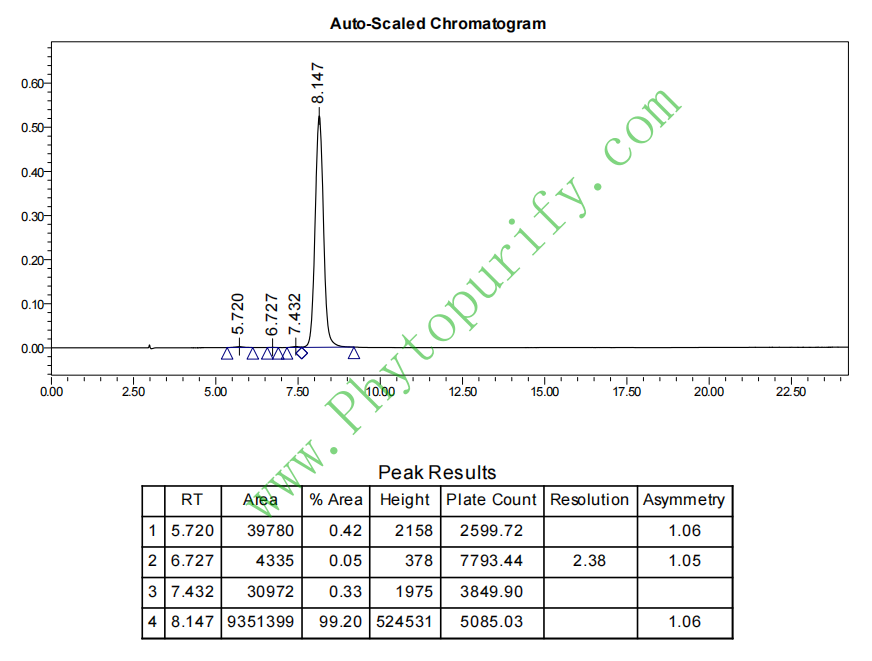
Purity: 95%~99%
Analysis Method: HPLC-DAD or/and HPLC-ELSD
Identification Method: Mass, NMR
Packing: Brown vial or HDPE plastic bottle
Storage: Store in a well closed container, protected from air and light. Put into refrigerate or freeze for long term storage.
Whenever possible, you should prepare and use solutions on the same day. However, if you need to make up stock solutions in advance, we recommend that you store the solution as aliquots in tightly sealed vials at -20℃. Generally, these will be useable for up to two weeks.
The product could be supplied from milligrams to grams, up to kilograms
Inquire for bulk scale.
Descriptions:
Prim-O-glucosylcimifugin is main medicinal component of the traditional Chinese drug Saposhnikovia divaricata, can increase concentrations of astragaloside IV and atractylenolide I in the serum, when they were given together.[1]
Prim-O-glucosylcimifugin has inhibition on NO production and DPPH free radical.[2]
Prim-O-glucosylcimifugin and 4′-O-β-D-glucosyl-5-O-methylvisammin-ol con can inhibit the proliferation of smooth muscle cell stimulated by TNF-α and increase the proportion of G0/G1 phase.[3]
References:
[1] Song J, Zheng S R, Jin Y, et al. Planta Med, 2014, 80(3):187-92.
[2] Bo Z, Xin B Y, Xiu W Y, et al. J Asian Nat Prod Res, 2012, 14(9):886-96.
[3] Wang L, Liang R X, et al. China J Chinese Materia Medica, 2008, 33(17):2157-60.
[4] Pin R, Fang B, Li P, et al. Guiding J Trad Chinese Med Pharm, 2010, 16(11):84-6.
HPLC of Prim-O-glucosylcimifugin
Storage conditions:Short-term storage at 2~8℃, long-term storage at -20 ~ -80℃
168.2800
-.0613
-.0613
1.8743
.4459
.3346
Low
65.1398
4.5049
Yes
No
No
No
Yes
No
0.6
Yes
No
Yes
Yes
In the field of natural product chemistry and pharmacology research, the search for lead compounds with clear biological activity and novel mechanisms of action has always been an important source of innovative drug development. Prim-O-glucosylcimifugin, as a phenylpropanoid glycoside isolated from traditional Chinese medicine, has attracted much attention in recent years due to its significant anti-inflammatory and neuroprotective multiple pharmacological activities. Its CAS number is 80681-45-4, with a unique molecular structure, and it is one of the key components that exert pharmacological effects in various medicinal plants. Early studies have revealed its potent anti-inflammatory effects, particularly by regulating key signaling pathways such as JAK2/STAT3, inhibiting the expression of inducible nitric oxide synthase (iNOS) and cyclooxygenase-2 (COX-2), and intervening in the inflammatory cascade. With the deepening of research, its pharmacological activity spectrum continues to expand, especially in the field of neuroprotection related to neurodegenerative diseases, showing great potential, involving the regulation of multiple key targets such as BCL2, APP, BACE1, MAPT, NFE2L2, SIRT1, MAPK1, CASP9, GSK3B, etc. This article aims to systematically review the chemical structure, plant origin, pharmacological activity, mechanism of action, pharmacological evaluation, and clinical application prospects of coumarin glycosides, in order to provide comprehensive scientific references for the in-depth research and development of this compound.
Prim-O-glucosylcimifugin is a phenylpropanoid glycoside compound, with the chemical name (2S) -2- [(2R, 3R, 4S, 5S, 6R) -4,5-dihydroxy-6- (hydroxymethyl) -3- [(2S, 3R, 4S, 5S, 6R) -3,4,5-trihydroxy-6- (hydroxymethyl) oxycyclohex-2-yl] oxycyclohex-2-yl] oxy-2-methylbutyrate-4- [(E) -3-methoxyprop-1-en-1-yl] phenyl ester. Its molecular formula is C22H28O11 and its molecular weight is 468.4550 g/mol.
Structurally, the core skeleton of coumarin glycoside is composed of a derivative of cinnamic acid (cinnamic acid) and a glycoside moiety. The benzene ring is connected to a methoxypropenyl side chain, while the carboxyl group is linked to a disaccharide (usually glucose) through a glycosidic bond, forming a typical phenylpropanoid glycoside structure. This structure endows it with a certain degree of polarity and hydrophilicity.
Based on its calculated and experimentally determined physical and chemical parameters, coumarin glycoside exhibits the following characteristics:
* Lipid water partition coefficient (LogP)Approximately -0.0613, indicating that the compound has high hydrophilicity and tends to distribute in the aqueous phase.
* Topological Polarity Surface Area (TPSA)Up to 168.28 Å ², which is closely related to the presence of multiple hydroxyl groups and glycosidic structures in its molecule, further confirming its strong polarity characteristics.
* Water solubility The value is 1.8743 (usually referring to LogS or related solubility indicators), combined with its LogP and TPSA, it is predicted that it has moderate to good solubility in water, which is beneficial for its distribution in aqueous media such as biological fluids.
* Blood-brain barrier permeability Predicted as' low '. Although its molecular weight does not exceed 500, its high polarity and TPSA may limit its ability to passively diffuse through the blood-brain barrier. However, its potential neuroprotective activity suggests that it may exert its effects in the central nervous system through active transport, changes in barrier permeability under pathological conditions, or metabolism into active products.
* Preliminary safety indicators:HERG inhibition The prediction is' no ', indicating a lower risk of causing QT interval prolongation in the heart.Ames test The result is 0.6 (usually the ratio of the number of revertant mutant colonies), which is close to 1, indicating that no significant mutagenicity was observed under the conditions of this experiment. However, further genetic toxicity tests need to be combined for comprehensive evaluation.
These physicochemical properties are the basis for evaluating its potential as a drug lead compound, directly affecting its absorption, distribution, metabolism, excretion, and toxicity (ADMET) characteristics.
Shengma glycoside is mainly derived from various traditional medicinal plants, among which the most famous is the Umbelliferae plant windproof(Saposhnikovia divaricata Dry roots of (Turcz. Schischk.). Windproof, as a classic anti surface medicine, is commonly used in traditional Chinese medicine clinical practice to treat symptoms such as colds, headaches, rheumatism, and rheumatism. Modern pharmacological research has confirmed that anti-inflammatory, analgesic, and immune regulation are important functional foundations of windproof. Cimicifugin is considered one of the main active ingredients of windproof. In addition, in plants of the same family Angelica dahurica(Angelica dahurica)It was also detected during the waiting period.
Extracting paeoniflorin from plant materials usually follows the conventional process of natural product chemistry:
1. Extract Solvent extraction method is commonly used. Commonly used methanol, ethanol, or ethanol water solutions of different concentrations are used for reflux extraction or ultrasound assisted extraction of dried root powder of windbreak. The alcohol extraction method can effectively extract highly polar phenylpropanoid glycosides such as coumarin glycosides.
2. Separation and purification After filtration and concentration, the crude extract is separated and purified using various chromatographic techniques. Usually, macroporous adsorption resins (such as D101, AB-8) are used for enrichment to remove a large amount of impurities such as sugars and proteins. Subsequently, silica gel column chromatography, reverse phase silica gel column chromatography (such as ODS-C18), and dextran gel column chromatography (such as Sephadex LH-20) were used for further separation. High performance liquid chromatography (HPLC), especially preparative HPLC, is the key final step in obtaining high-purity coumarin glycoside monomers. Usually, methanol water or acetonitrile water is used as the mobile phase for gradient elution.
3. appraisal The isolated monomer compounds were structurally confirmed by methods such as nuclear magnetic resonance spectroscopy (NMR, including 1H-NMR, 13C-NMR, 2D-NMR), mass spectrometry (MS), ultraviolet spectroscopy (UV), and comparison with reference materials or literature data.
In recent years, green extraction technologies such as supercritical fluid extraction and microwave-assisted extraction have also been applied research, aiming to improve extraction efficiency and reduce the amount of organic solvents used.
A large number of pharmacological experiments in vitro and in vivo have shown that coumarin glycosides have a wide range of biological activities, among which anti-inflammatory and neuroprotective effects are the most prominent.
1. Anti inflammatory activity
This is the earliest confirmed core activity of coumarin glycoside. In various acute and chronic inflammation models, coumarin glycosides have shown significant inhibitory effects. For example, in acute inflammation models such as mouse ear swelling and rat paw swelling, it can effectively reduce tissue edema and inflammatory cell infiltration. In a lipopolysaccharide (LPS) - stimulated macrophage model (such as RAW264.7 cells), gastrodin glycosides can dose dependently inhibit the production of key inflammatory mediators such as nitric oxide (NO), prostaglandin E2 (PGE2), tumor necrosis factor - α (TNF - α), and interleukin-6 (IL-6). Its anti-inflammatory effect is closely related to the inhibition of iNOS and COX-2 protein and mRNA expression.
2. Neuroprotective activity
This is a hot research topic in recent years, demonstrating its therapeutic potential in neurological diseases such as Alzheimer's disease (AD), Parkinson's disease (PD), and cerebral ischemia-reperfusion injury.
* Combat oxidative stress Cistanche glycosides can enhance the activity of antioxidant enzymes (such as superoxide dismutase (SOD) and glutathione peroxidase (GSH Px)) in neuronal cells, reduce the levels of reactive oxygen species (ROS) and malondialdehyde (MDA), and enhance the antioxidant defense ability of cells by activating the Nrf2/ARE pathway.
* Inhibit neuroinflammation In the neuroinflammatory model mediated by microglial activation, gastrodin glycosides reduce the release of neurotoxic inflammatory factors and protect neurons from inflammatory damage through the aforementioned anti-inflammatory mechanisms.
* antiapoptosis In neuronal models induced by β - amyloid protein (A β), ischemia, hypoxia, or toxin damage, gastrodin glycosides can upregulate the expression of anti apoptotic protein Bcl-2, downregulate the expression of pro apoptotic protein Bax, inhibit the activation of caspase-3 and caspase-9, thereby blocking the neuronal apoptosis pathway.
* Affects AD related pathology Research has shown that gastrodin glycosides may reduce the excessive phosphorylation of tau protein by regulating GSK-3 β activity; Meanwhile, there may also be regulatory effects on the processing of β - secretase 1 (BACE1) and amyloid precursor protein (APP), potentially reducing the production of A β.
3. Other activities
Some studies also suggest that coumarin glycosides have activities such as pain relief, immune regulation, and anti allergy, which are often associated with their anti-inflammatory effects.
The multiple pharmacological effects of paeoniflorin stem from its precise regulation of multiple signaling pathways within cells. The mechanism of its action network can be summarized as follows:
1. Core anti-inflammatory mechanism: inhibition of JAK2/STAT3 pathway
This is the key molecular mechanism of its anti-inflammatory effect. Under stimulation such as LPS, receptors on the cell membrane activate the non receptor tyrosine kinase JAK2, which phosphorylates and activates the transcription factor STAT3. Activated STAT3 dimer is transferred into the nucleus, initiating transcription of various inflammatory mediator genes such as iNOS, COX-2, TNF - α, IL-6, etc. Cimicifugin has been proven to effectively inhibit the phosphorylation activation of JAK2 and STAT3, thereby blocking the expression of these inflammatory mediators at the transcriptional level and exerting a powerful anti-inflammatory effect.
2. Mechanisms related to neuroprotection and target network
Its neuroprotective effect involves a complex multi-target regulatory network:
* Apoptosis regulatory targets: Through Upregulation of BCL2(Anti apoptotic) and Inhibit CASP9 Activation of the apoptosis promoter directly intervenes in the mitochondrial apoptosis pathway.
* Core of oxidative stress regulation: Activate NFE2L2(Nrf2)Promote its nuclear translocation, combine with antioxidant response elements (ARE), drive the expression of a series of phase II detoxifying enzymes and antioxidant proteins, which is the core mechanism of its anti oxidative damage.
* Energy metabolism and stress adaptation Possible activation SIRT1(Deacetylase) improves cellular energy metabolism, enhances mitochondrial function, and inhibits pro-inflammatory pathways such as NF - κ B, playing a multifunctional role in neuroprotection.
* AD pathology related targets: Yes APP Processing process BACE1 Activity MAPT Phosphorylation status of tau protein GSK3B Regulation may have a regulatory effect, directly affecting the core pathological process of AD.
* Signal pathway node: Yes MAPK1(ERK) The regulation of the mitogen activated protein kinase signaling pathway is also involved in promoting cell survival, inhibiting inflammation, and apoptosis.
In summary, gastrodin glycosides do not act on a single target, but rather exert a synergistic protective effect through a "multi-target, multi pathway" approach in the pathological network of cross dialogue such as inflammation, oxidative stress, and cell apoptosis, providing unique advantages for their treatment of complex neurodegenerative diseases.
Although gastrodin glycosides have shown good activity in vitro and animal models, their pharmacological properties still need to be comprehensively evaluated.
1. Pharmacokinetic studies
Existing pharmacokinetic studies (mainly conducted in animal models) have revealed some characteristics of coumarin glycosides:
* Absorption and bioavailability As a highly polar glycoside compound, its oral absorption may be limited to some extent. In the intestine, there may be some glycosidic bonds that are hydrolyzed by gut microbiota or enzymes to form cimifugin, which is then absorbed. Glycosides have higher lipid solubility and may be easier to absorb and exert activity, which constitutes the "prodrug" effect. But its absolute oral bioavailability needs to be accurately determined.
* distribution It is predicted that its blood-brain barrier permeability is low, which may be related to the in vivo manifestation of its neuroprotective activity. It may affect the central nervous system in the following ways: ① Under pathological conditions, the permeability of the blood-brain barrier increases; ② Its metabolites have better brain entry ability; ③ Indirectly exerting neuroprotective effects by regulating peripheral inflammation. Research on tissue distribution shows that it can be distributed in organs such as the liver and kidneys.
* Metabolism The liver may be its main metabolic site. It is speculated that its metabolic pathways include hydrolysis, demethylation, hydroxylation of glycosidic bonds, and binding reactions with glucuronic acid or sulfuric acid. It is crucial to clarify its metabolite profile and activity.
* excretion The prototype drug and its metabolites may be mainly excreted through the kidneys with urine, and partially excreted through bile from feces.
2. Analysis of drug properties parameters
Combining the physical and chemical properties of the previous text:
* Advantage Good water solubility is beneficial for the development of formulations; There is no significant risk of hERG inhibition, and the warning signal for cardiac toxicity is low; The preliminary results of the Ames test are negative, indicating a controllable risk of genetic toxicity.
* challenge:Molecular weight (468.5) Approaching the upper limit of drug like properties,High polarity (low LogP, high TPSA) Causing it Poor membrane permeability Especially Low blood-brain barrier permeability This is the key bottleneck that needs to be addressed in its development as a therapeutic drug for central nervous system diseases. The oral absorption efficiency may also be limited as a result.
3. Formulation strategy
To improve its bioavailability, especially its ability to enter the brain, the following formulation strategies can be considered:
* Prodrug modification Esterification, alkylation, and other modifications of its sugar or phenolic hydroxyl groups are carried out to prepare precursor drugs with higher lipid solubility, in order to improve membrane permeability and brain entry efficiency, and then convert them into active forms in vivo.
* Nano drug delivery system Prepare it into liposomes, solid lipid nanoparticles, polymer nanoparticles, or nanoemulsions. These nanocarriers can encapsulate drugs, protect them from premature degradation, and promote their crossing of biological membranes (including the blood-brain barrier) through mechanisms such as endocytosis.
* Phospholipid complex Forming complexes with phospholipids can significantly improve the solubility and absorption of lipophilic drugs, and may also be effective for amphiphilic molecules such as coumarin glycosides.
As a natural product with clear multi-target activity, coumarin glycoside has broad clinical application prospects, but also faces challenges.
1. Potential indications
* Neurodegenerative diseases Given its strong anti neuroinflammatory, antioxidant, and anti apoptotic effects, as well as its potential to regulate multiple pathological processes in AD and PD, it is an attractive candidate drug for treating diseases such as Alzheimer's disease, Parkinson's disease, and amyotrophic lateral sclerosis. Can be used as part of disease modifying therapy to delay or prevent disease progression.
* Cerebrovascular disease Inflammation and oxidative stress are key injury mechanisms in cerebral ischemia-reperfusion injury (stroke). The neuroprotective effect of paeoniflorin may help reduce infarct size and improve neurological function prognosis.
* Inflammatory diseases Can be used to treat chronic inflammatory diseases such as rheumatoid arthritis, inflammatory bowel disease, asthma, especially those related to excessive activation of the JAK/STAT pathway.
* Other Its analgesic and anti allergic activities are also worth further exploration and may be used to develop new analgesics or anti allergic drugs.
2. Future research directions and challenges
* In depth mechanism research It is necessary to clarify more accurately the direct interaction mode (whether it is direct binding or indirect regulation) between it and targets such as BCL2, BACE1, GSK3B, and to verify the necessity of key targets in vivo using techniques such as gene knockout/knockdown.
* Optimization of drug properties in the system We must focus on addressing its permeability and brain penetration challenges. The key to promoting its clinical translation lies in the pre drug design of the system, advanced development of nano formulations, and in-depth in vivo and in vitro ADMET evaluation.
* Preclinical and clinical research Long term efficacy and safety evaluations need to be conducted in animal models that are closer to human diseases, such as transgenic AD mice. Clearly define the effective route of administration (oral, nasal, injection, etc.) and dosage window.
* Multi component collaborative research As an active ingredient in traditional Chinese medicine, studying its synergistic effect with other components in windproof or other traditional Chinese medicines (such as paeoniflorin, 5-O-methylvisamminol glycoside, etc.) is in line with the holistic view of traditional Chinese medicine and may also discover better compound treatment plans.
Cimicin glycoside is a phenylpropanoid glycoside compound with important biological activity found in traditional Chinese medicine windbreak. It not only exerts potent anti-inflammatory effects by inhibiting the JAK2/STAT3 signaling pathway, but also demonstrates multidimensional and multi-channel therapeutic potential in the field of neuroprotection by regulating multiple key targets such as Nrf2, SIRT1, Bcl-2/Aspase, GSK-3 β, etc. Although its high polarity and low predictive blood-brain barrier permeability pose challenges for its drug development, they also provide clear directions for drug chemical modification and the development of novel drug delivery systems. With a deeper understanding of its mechanism of action and continuous breakthroughs in formulation technology, coumarin glycosides are expected to develop from an excellent natural product lead compound into a new type of drug for treating neurodegenerative and chronic inflammatory diseases, demonstrating the enormous value of exploring modern innovative drugs from the treasure trove of traditional Chinese medicine. Future research should focus on bridging the transition path from clarifying pharmacological mechanisms to optimizing the properties of drugs, promoting this promising molecule to enter clinical practice and benefiting human health.
