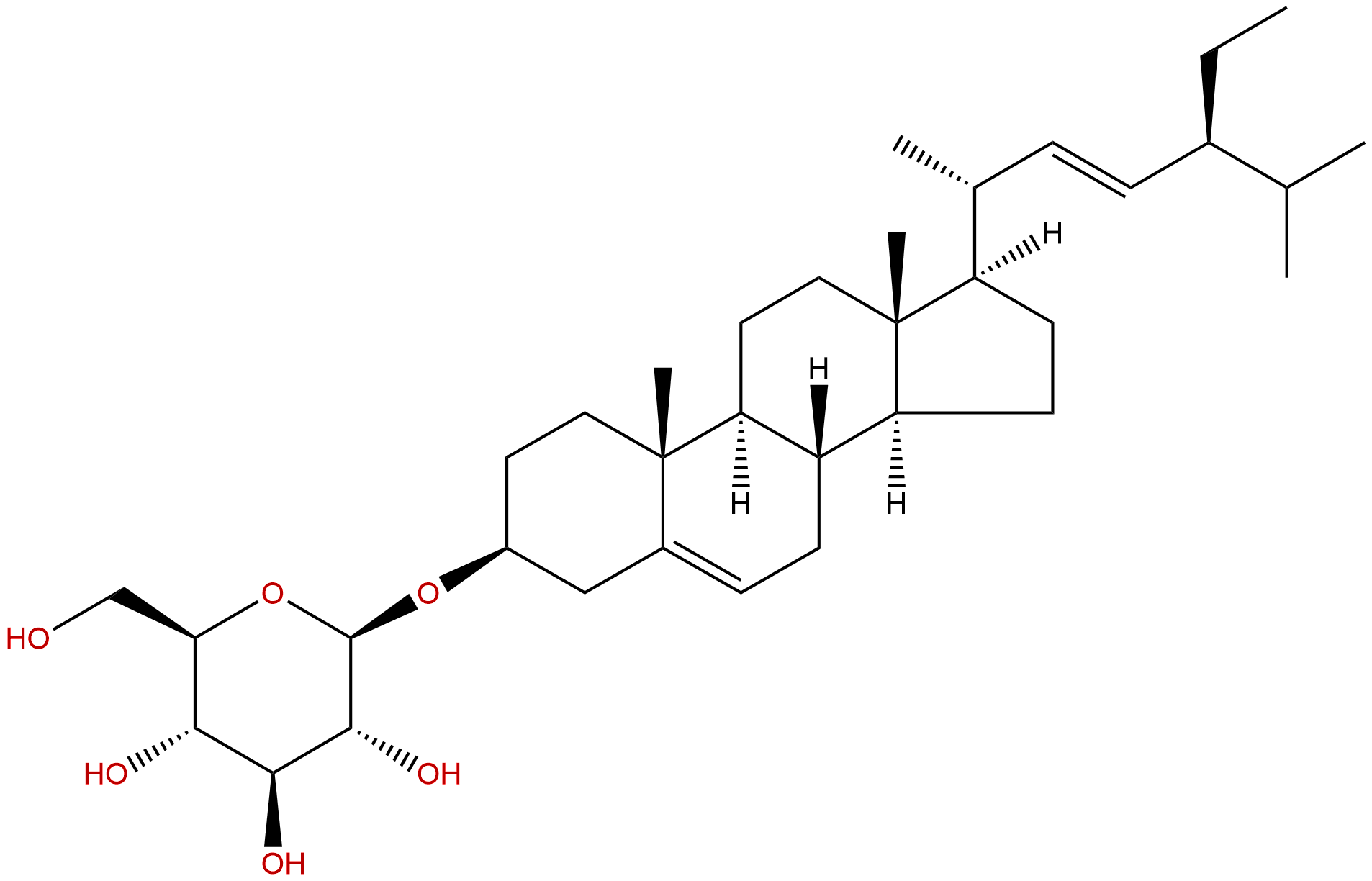


Product name: Stigmasterol glucoside
Synonym name:
Catalogue No.: BP3373
Cas No.: 19716-26-8
Formula: C35H58O6
Mol Weight: 574.843
Botanical Source:
Physical Description: Powder
Type of Compound: Steroids
Purity: 95%~99%
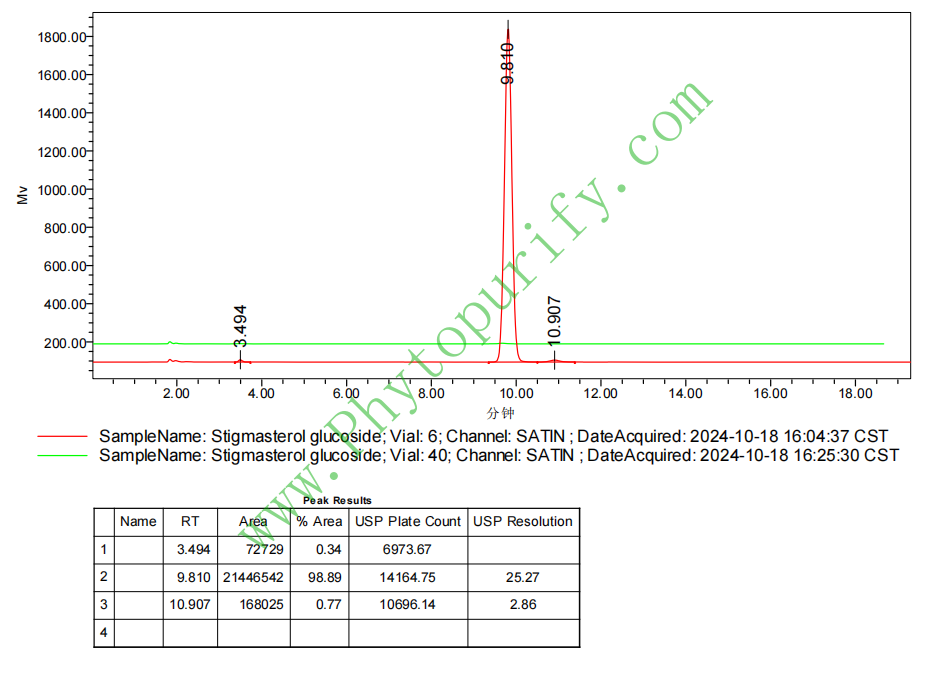
Analysis Method: HPLC-DAD or/and HPLC-ELSD
Identification Method: Mass, NMR
Packing: Brown vial or HDPE plastic bottle
Storage: Store in a well closed container, protected from air and light. Put into refrigerate or freeze for long term storage.
Whenever possible, you should prepare and use solutions on the same day. However, if you need to make up stock solutions in advance, we recommend that you store the solution as aliquots in tightly sealed vials at -20℃. Generally, these will be useable for up to two weeks.
The product could be supplied from milligrams to grams, up to kilograms
Inquire for bulk scale.
Descriptions:
Stigmasterol glucoside, a constituent of Adenanthera pavonina seed and leaf, may be a plant anticancer agent.[1,2]
References:
[1] Nigam S K, Misra G, Mitra C R. Planta Medica, 1973, 23(2):145-8.
[2] Arisawa M, Kinghorn A D, Cordell G A, et al. Planta Medica, 1985, 51(6):544-5.
[3] Chen Z, Bi X, Luo W, et al. J Guangxi Medical University, 2014, 17(1):74-6.
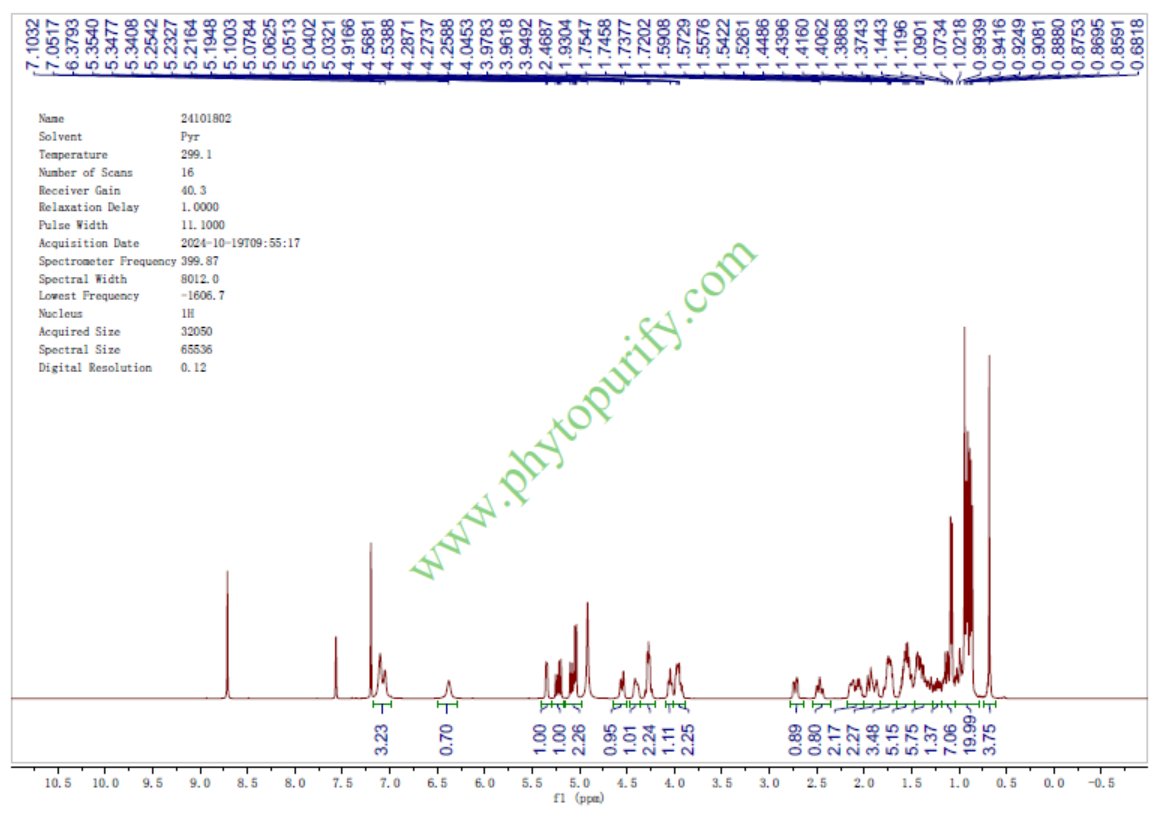
HNMR of Stigmasterol glucoside
HPLC of Stigmasterol glucoside
Storage conditions:Short-term storage at 2~8℃, long-term storage at -20 ~ -80℃
99.3800
5.6311
5.6311
.0030
.7272
.8228
Low
89.9715
5.1236
No
No
No
No
No
No
0.0
Yes
No
No
No
Cardiovascular disease (CVD) is the leading cause of death and disability worldwide, with dyslipidemia, particularly hypercholesterolemia, being its core risk factor. Although statins have achieved great success as first-line lipid-lowering drugs, their muscle toxicity, risk of liver injury, and the phenomenon of "statin intolerance" in some patients have prompted researchers to continuously search for safer, multi-target alternative or adjuvant treatment strategies from natural products. Plant sterols and their glycoside derivatives, as secondary metabolites widely present in the plant kingdom, have long been of great concern due to their structural similarity with cholesterol and clear cholesterol lowering activity. Stigmasterol glucoside (SG), as an important glycosylation form of stigmasterol, not only retains the physiological activity of parent sterols, but also changes its physicochemical properties and bioavailability due to the introduction of glycosylation, demonstrating unique pharmacological potential. In recent years, studies have revealed that SG is not only a classic 5 α - reductase inhibitor, but also shows significant activity in regulating key targets of lipid metabolism, laying a scientific foundation for its application in the field of reducing blood lipids and anti atherosclerosis. This article aims to systematically review the chemical properties, plant sources, pharmacological activities of SG, especially its multi-target lipid-lowering mechanism, drug evaluation, and clinical application prospects, in order to provide comprehensive academic references for the deep development of this natural product.
Dougesterol glucoside (CAS: 19716-26-8) is a steroid saponin compound with a molecular formula of C35H58O6 and a molecular weight of 574.8430. Its chemical structure consists of two parts: a hydrophobic sterol core and a hydrophilic glycoside group.
Based on the above structure, SG exhibits typical amphiphilic molecular characteristics, which directly affect its physicochemical properties:
* Lipid water partition coefficient (LogP)The calculated value is about 5.63, indicating that the compound has high lipophilicity, mainly due to its large steroid nucleus structure. However, compared to its aglycone sitosterol (with a higher LogP), the introduction of glucose groups reduces its LogP value and increases its dispersibility in the aqueous phase.
* Topological Polarity Surface Area (TPSA)Approximately 99.38 Å ², mainly contributed by multiple hydroxyl oxygen atoms on the glucose unit. A higher TPSA value indicates that the molecule has a certain polarity.
* Water solubility Extremely low, with an experimental or predicted value of about 0.003 mg/mL, it belongs to insoluble compounds. This limits its direct application in aqueous media and is a key issue that needs to be addressed in formulation development.
* spectral characteristics In the nuclear magnetic resonance hydrogen spectrum, characteristic proton signals of steroid nuclei (such as C-18, C-19 angle methyl, C-6 ene hydrogen), as well as glucose end group protons (δ~4.2-4.4 ppm, d, J=7-8 Hz, indicating β configuration) and other glycosyl proton signals can be observed. Excimer ion peaks such as [M+H]+or [M+Na]+can be observed in mass spectrometry, as well as glycoside fragment peaks produced by the loss of glucose groups (-162 Da).
SG is widely distributed in various plants such as leguminous, Solanaceae, Lamiaceae, and Scrophulariaceae, and often coexists with other sterol glycosides such as β - sitosterol glucoside.
Main plant sources:
Extraction and Separation Methods:
The pharmacological activity research of SG has expanded from early single target to multi-faceted biological effect evaluation, and its core activities can be summarized as follows:
Hypolipidemic and antiatherosclerotic activity This is currently the most concerned pharmacological effect of SG. In vitro and in vivo studies have shown that SG can effectively reduce the levels of total cholesterol (TC), low-density lipoprotein cholesterol (LDL-C), and triglycerides (TG) in the serum of high-fat diet induced ApoE -/- mice, while increasing high-density lipoprotein cholesterol (HDL-C). Its strength of action may be weaker than statins, but its multi-target properties show advantages. In addition, SG can reduce the area of atherosclerotic plaque, improve vascular endothelial function, inhibit vascular inflammation, and play a comprehensive anti atherosclerosis effect.
5 α - reductase inhibitory activity SG is a natural 5 α - reductase inhibitor with an IC50 value of 27.2 µ M. 5 α - reductase can convert testosterone into the more active dihydrotestosterone (DHT), which is closely related to benign prostatic hyperplasia (BPH) and androgenic alopecia. SG can potentially be used to treat BPH and hair loss by inhibiting the enzyme and reducing DHT production.
Anti inflammatory and antioxidant activity:
Antitumor activity: Preliminary studies have shown that SG can inhibit the proliferation of many cancer cell lines (such as breast cancer MCF-7, liver cancer HepG2, colon cancer HT-29, etc.), and can induce apoptosis and cell cycle arrest. Its anti-tumor mechanism may be related to regulating the Bcl-2/Bax ratio, activating the caspase cascade, and inhibiting the PI3K/Akt/mTOR signaling pathway. However, its anti-tumor activity is mostly in the stage of cell experiments, and its in vivo potency and selectivity need further evaluation.
Other activities There are also reports that SG has potential activities such as neuroprotection, liver protection, and immune regulation, but research is not yet sufficient.
The lipid-lowering effect of SG is not achieved through a single pathway, but through the coordinated regulation of lipid metabolism homeostasis through multiple targets and links. Its core molecular targets and mechanisms are as follows:
To sum up, SG cooperatively plays the role of lowering blood lipid and anti atherosclerotic hardening through multiple network mechanisms of "inhibiting synthesis (HMGCR), promoting clearance (LDLR ↑, PCSK9 ↓), improving transport (CETP ↓, APOB/E), promoting oxidation (PPARA ↑)" and "anti-inflammatory and antioxidant".
Based on the provided pharmacological parameters and existing research, the preliminary evaluation of SG's pharmacological properties is as follows:
SG, as a natural active molecule with multiple targets and effects, has broad development prospects in the following fields:
However, achieving its clinical application still requires overcoming the following challenges and conducting in-depth research:
* challenge① Poor water solubility and low bioavailability; ② The natural source content is limited, and the chemical or biological synthesis pathways need to be optimized to achieve large-scale production; ③ The multi-target characteristic is both advantageous and may bring unpredictable off target effects, requiring a more precise mechanism of action map.
* Future research directions:① structural optimization Modify the sugar moiety or steroid nucleus to enhance activity, solubility, and metabolic stability. ② Formulation innovation Develop new nano drug delivery systems (such as liposomes, polymer nanoparticles), self microemulsions, etc., to improve delivery efficiency. ③ Systematic pharmacokinetic study Clarify its ADME process in various animal models and humans. ④ In depth mechanism research Using proteomics, metabolomics, network pharmacology and other methods, comprehensively elucidate its functional network. ⑤ High quality clinical research Conduct randomized controlled clinical trials from phase I to phase III to confirm its effectiveness and safety in treating specific diseases such as mixed hyperlipidemia and mild BPH.
As a naturally occurring sterol glycoside, stigmasterol glucoside exhibits diverse pharmacological activities beyond traditional plant sterols due to its unique chemical structure. Especially in regulating lipid metabolism, it forms a synergistic network by acting on multiple key targets such as HMGCR, LDLR, PCSK9, CETP, PPARA, etc., providing a solid scientific basis for its use as a candidate drug for reducing blood lipids and anti atherosclerosis. Meanwhile, its combination of 5 α - reductase inhibition, anti-inflammatory, and antioxidant activities further expands its potential therapeutic applications. Despite the challenges of solubility and bioavailability in drug development, modern pharmaceutical chemical modifications and novel formulation technologies provide feasible solutions for this. In the future, through interdisciplinary in-depth research and development, sitosterol glucoside is expected to be transformed from a common plant component into a novel drug or highly effective functional factor for treating metabolic and chronic inflammatory diseases, contributing to human health through natural efforts.
