


Synonym name: Arteannuin; Qinghaosu; Qing Hau Sau
Catalogue No.: BP0197
Cas No.: 63968-64-9
Formula: C15H22O5
Mol Weight: 282.336
Botanical Source: Artemisia annua (Qinghaosu)
Purity: 95%~99%
Analysis Method: HPLC-DAD or/and HPLC-ELSD
Identification Method: Mass, NMR
Packing: Brown vial or HDPE plastic bottle
Can be supplied from milligrams to grams.
For Reference Standard and R&D, Not for Human Use Directly.
Inquire for bulk scale.
HPLC of Artemisinin
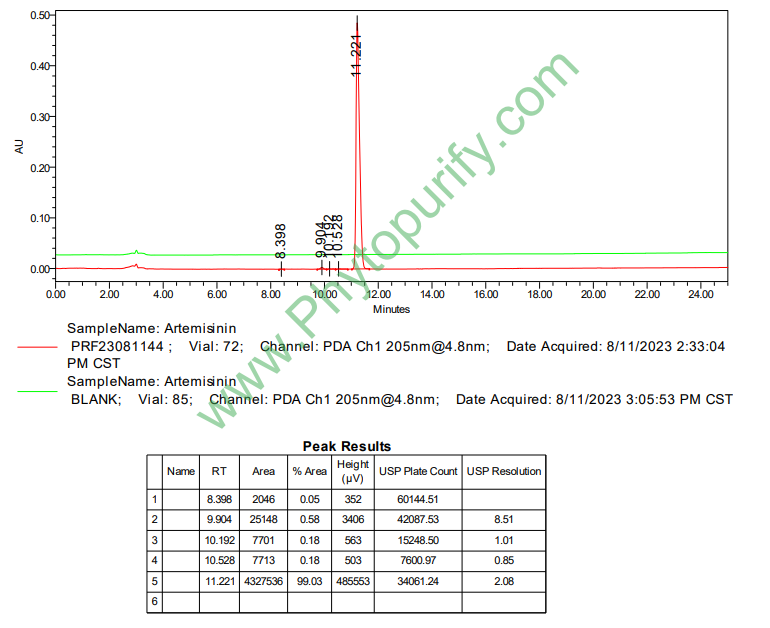
Storage conditions:Short-term storage at 2~8℃, long-term storage at -20 ~ -80℃
Artemisinin, CAS number 63968-64-9, is a type of artemisinin derived from Artemisia annua(Artemisia annua L. Natural products extracted from sesquiterpenes containing peroxides. Since its discovery by the team of Chinese scientist Tu Youyou in the 1970s, artemisinin has become a milestone in global research and clinical application of antimalarial drugs due to its significant anti malarial activity, especially its therapeutic effect on multidrug-resistant strains of malignant malaria. Artemisinin not only demonstrates excellent therapeutic effects in the field of anti malaria, but also exhibits a wide range of biological activities, including antibacterial, antifungal, anti-tumor, and neuroprotective effects, gradually becoming a hot topic in natural product pharmacology research.
In recent years, with the in-depth analysis of the mechanism of action of artemisinin, its potential therapeutic value in metabolic diseases such as steatohepatitis has gradually emerged. This article will provide a systematic review of the chemical structure and physicochemical properties of artemisinin, plant sources and extraction processes, pharmacological activity and mechanism of action, pharmacological evaluation and pharmacokinetic characteristics, with a focus on exploring its prospects and challenges in clinical applications. The aim is to provide theoretical support and research directions for the further development of artemisinin and its derivatives.
Artemisinin is a typical sesquiterpene endoperoxide with a molecular formula of C15H22O5 and a molecular weight of 282.33. Its core structure is connected to the sesquiterpene skeleton by a unique internal peroxide bridged ring (1,2,4-trioxane ring), forming an important basis for its biological activity. The peroxide bridge is a key functional group for the antimalarial activity of artemisinin, which can generate free radicals in the presence of iron ions and destroy the biomolecules of malaria parasite cells.
The physicochemical properties of artemisinin exhibit moderate lipophilicity, with a LogP of approximately 2.2, indicating its excellent cell membrane permeability. The polar surface area (TPSA) is 63.6 Å ², with 5 hydrogen bond acceptors, supporting its potential to bind to various biomolecules. In addition, artemisinin has high blood-brain barrier permeability, indicating its potential application value in neurological diseases. Its half-life is about 1 hour, indicating a relatively fast metabolic rate in the body. Toxicological evaluation shows that artemisinin has no significant hepatotoxicity, cardiotoxicity, or hERG channel inhibition, and the Ames mutagenicity test result is negative, indicating high safety.
Artemisinin mainly comes from Artemisia annua(Artemisia annua L. The above ground parts of the plant, especially the leaves and tender stems during the flowering period, have a higher content. Artemisia annua is a plant in the Asteraceae family, widely distributed in China and other temperate and subtropical regions. The artemisinin content is significantly affected by factors such as variety, cultivation conditions, harvesting time, and processing technology.
Traditional extraction methods include organic solvent extraction, such as using ethanol, ethyl acetate, or n-hexane, combined with ultrasound assisted extraction or reflux extraction techniques to improve yield. Modern technology gradually adopts supercritical CO2 extraction, microwave-assisted extraction, and membrane separation techniques, aiming to improve extraction efficiency, reduce harmful solvent residues, and lower production costs. The crude extract after extraction needs to undergo purification steps such as silica gel column chromatography and reverse phase high performance liquid chromatography (RP-HPLC) to obtain high-purity artemisinin.
In addition, with the development of synthetic biology, the technology of genetically engineered microorganisms fermenting to produce artemisinin precursors (such as artemisinin acid) and converting them into artemisinin through chemical semi synthesis has gradually matured, providing a new pathway for industrial production.
The most well-known pharmacological effect of artemisinin is its potent anti malarial activity. Its target is the heme metabolism pathway of malaria parasites. The peroxide bridge of artemisinin is cleaved by iron ions to produce free radicals, which attack proteins and membrane lipids in malaria parasite cells, leading to cell death. Artemisinin for malignant malaria(Plasmodium falciparum)Multidrug resistant strains have shown significant killing effects and take effect quickly, making them recommended first-line anti malaria drugs by the World Health Organization.
In addition to its antimalarial effect, artemisinin also exhibits certain inhibitory activity against various bacteria and fungi. Research has shown that artemisinin can inhibit the growth of both Gram positive and Gram negative bacteria, and has inhibitory effects on certain fungi such as Candida It has an inhibitory effect. These activities may be related to their induction of oxidative stress and disruption of microbial cell membrane structure.
Artemisinin has shown inhibitory effects on proliferation, migration, and invasion in various tumor cell lines. Its mechanism involves inducing cell apoptosis, blocking the cell cycle, inhibiting angiogenesis, and regulating the tumor microenvironment. Artemisinin can dose dependently reduce pAKT levels, inhibit the PI3K/AKT signaling pathway, and decrease the survival and metastasis ability of tumor cells. In addition, artemisinin can also inhibit the proliferation of vascular smooth muscle cells induced by tumor necrosis factor (TNF), demonstrating its potential in anti-tumor and anti-inflammatory effects.
Artemisinin has good blood-brain barrier permeability, and studies have found that it exhibits neuroprotective effects in neurodegenerative disease models. Its mechanism of action may involve antioxidant, anti-inflammatory, and modulation of neuronal apoptosis signaling pathways, demonstrating the potential application value of artemisinin in the treatment of neurological diseases.
The latest research shows that artemisinin has a regulatory effect on metabolic diseases such as steatohepatitis. It participates in the regulation of lipid metabolism, inflammatory response, and insulin signaling pathway by modulating multiple targets such as PTPN1, NR1H4, ESR1, GPBAR1, TNF, CETP, HMGCR, NR3C1, and NR1H3, thereby improving liver fat deposition and inflammatory status.
The biological activity of artemisinin mainly relies on its unique internal peroxide bridge structure, which decomposes in the presence of iron ions to produce reactive free radicals, leading to oxidative damage to proteins, lipids, and DNA in target cells. Its mechanism of action can be summarized as follows:
Cell damage mediated by free radicals
Artemisinin binds to intracellular free iron, breaks down peroxide bridges, and generates free radicals, attacking key biomolecules of malaria parasites and tumor cells, leading to cellular dysfunction and death.
Signal pathway regulation
Artemisinin can inhibit the PI3K/AKT signaling pathway, reduce pAKT levels, and suppress cell proliferation and migration. It also has a regulatory effect on inflammation related signaling pathways such as NF - κ B and MAPK, reducing inflammation response.
Targeting inflammatory factors
Artemisinin inhibits the expression of tumor necrosis factor (TNF) and other pro-inflammatory factors, reduces inflammation mediated tissue damage, and plays an important role in metabolic diseases such as steatohepatitis.
Nuclear receptor regulation
Artemisinin affects various nuclear receptors such as NR1H4 (farnesyl ester X receptor), ESR1 (estrogen receptor alpha), NR1H3 (liver X receptor alpha), etc., regulating lipid metabolism and energy homeostasis.
Immune regulatory effect
By regulating immune cell function, artemisinin can enhance the body's immune response, promote pathogen clearance, and enhance tumor immune surveillance.
The pharmacological parameters of artemisinin indicate that it has good potential for drug development. The molecular weight of 282.33, moderate lipophilicity (LogP 2.2), and polar surface area (TPSA 63.6) are beneficial for cell membrane penetration and oral absorption. The number of hydrogen bond receptors is 5, which conforms to Lipinski's rule and is conducive to binding with target proteins.
Artemisinin has high blood-brain barrier permeability, supporting its application in central nervous system diseases. Its half-life in the body is about 1 hour, indicating the need for dosage form optimization or derivative modification to extend the duration of action. In terms of safety, artemisinin has no hepatotoxicity, cardiotoxicity, or hERG channel inhibition, and the Ames test is negative, indicating a low toxicological risk.
Pharmacokinetic studies have shown that artemisinin is rapidly absorbed after oral administration, but its bioavailability is limited by its poor water solubility and liver first pass effect. To improve its pharmacokinetic properties, researchers have developed various drug delivery systems, such as liposomes, nanoparticles, and solid dispersions, to enhance stability and bioavailability.
Artemisinin, as an anti malaria drug, has been widely used in clinical practice, especially playing a key role in combating drug-resistant strains of malignant malaria. Its rapid onset, low toxicity, and good tolerability make it the preferred drug recommended by the World Health Organization. In the future, with the continuous improvement of malaria prevention and control strategies, artemisinin combination therapy will still be the core of controlling malaria epidemics.
In the field of anti-tumor, artemisinin and its derivatives show a wide range of anti-tumor potential, especially in lung cancer, breast cancer, colorectal cancer and other solid tumors, showing the ability to inhibit tumor growth and metastasis. Preclinical research continues to deepen, and in the future, it is expected to enter the clinical trial stage, becoming an important representative of natural anti-cancer drugs.
In addition, the potential applications of artemisinin in neuroprotection and metabolic diseases such as steatohepatitis have also attracted much attention. Its multi-target and multi mechanism pharmacological properties provide new ideas for the treatment of complex diseases. Through structural modification and drug carrier technology improvement, the efficacy and safety of artemisinin are expected to be further enhanced.
However, the clinical promotion of artemisinin still faces some challenges, such as poor drug stability, low bioavailability, and risk of drug resistance. Future research needs to focus on the optimization of artemisinin's medicinal chemistry, in-depth analysis of its mechanism of action, and clinical validation of new indications to promote its multi field clinical applications.
Artemisinin, as a unique sesquiterpene endoperoxide natural product, has become a classic representative in the field of natural product pharmacology due to its excellent anti malaria activity and diverse pharmacological effects. Its unique chemical structure endows it with rich biological activity, covering multiple aspects such as anti malaria, antibacterial, anti-tumor, neuroprotection, and metabolic regulation. The drug efficacy evaluation shows that artemisinin has good potential for drug development and high safety.
In the future, with the continuous advancement of modern drug development technology, artemisinin and its derivatives are expected to play an important role in more disease fields. Thoroughly analyzing its mechanism of action, optimizing its pharmacokinetic properties, and conducting systematic clinical research will lay a solid foundation for the widespread application of artemisinin. Artemisinin is not only a model for the modernization of traditional Chinese medicine, but also a valuable resource for the innovation of natural product drugs, which deserves continuous attention and in-depth development.
