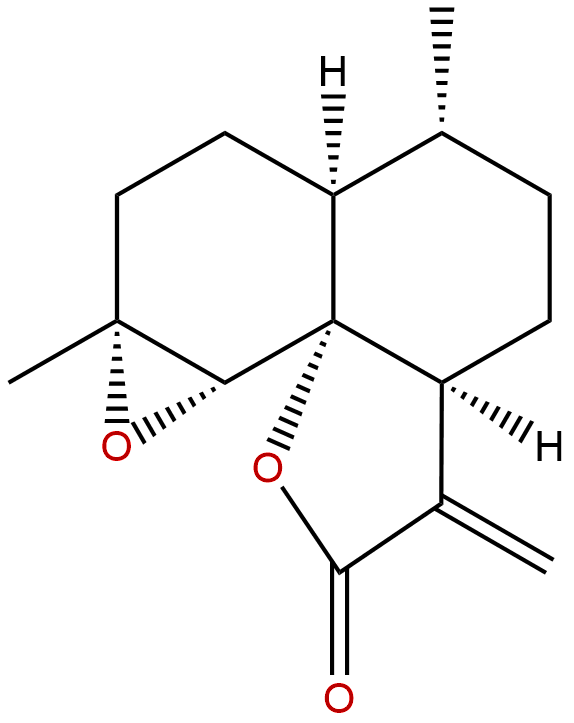


Product name: Arteannuin B
Synonym name: 107172-37-2
Catalogue No.: BP1581
Cas No.: 50906-56-4
Formula: C15H20O3
Mol Weight: 248.322
Botanical Source: Constit. of Artemisia annua
Physical Description: Powder
Type of Compound: Sesquiterpenoids
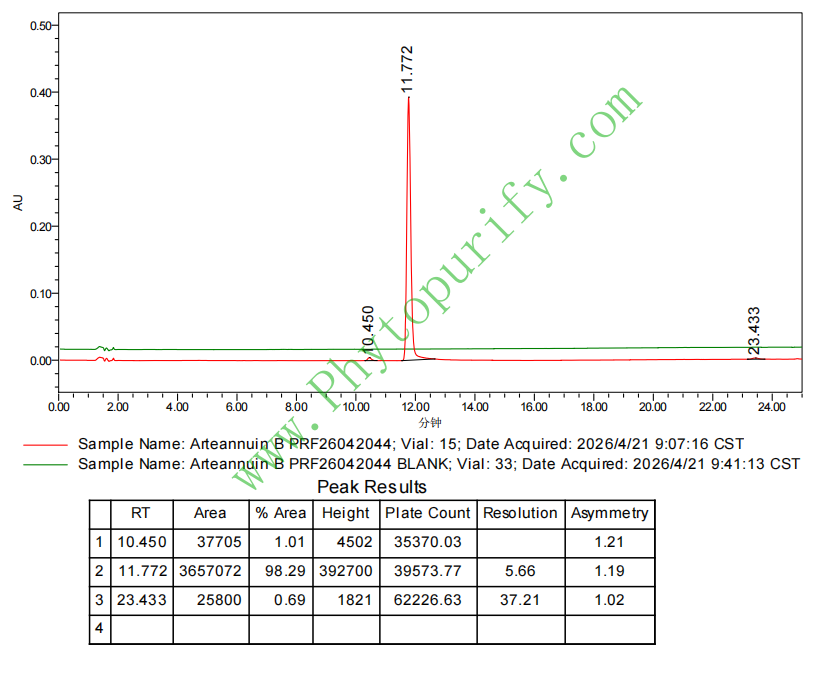
Purity: 95%~99%
Analysis Method: HPLC-DAD or/and HPLC-ELSD
Identification Method: Mass, NMR
Packing: Brown vial or HDPE plastic bottle
The product could be supplied from milligrams to grams. Inquire for bulk scale.
We provide solution to improve the water-solubility of compounds, thereby facilitating the variety of activity tests and clinic uses.
For Reference Standard and R&D, Not for Human Use Directly.
Description:
Arteannuin B and artemisinic acid are biogenetic precursors of artemisinin, an important antimalarial produced by the herb Artemisia annua, they are active against different bacteria and certain fungal species. Arteannuin B has potential antimalarialand antitumor activity.
References:
Yao Xue Xue Bao. 1992;27(4):317-20.
Derivatives of arteannuin B with antileukemia activity
METHODS AND RESULTS:
Arteannuin B (I) was converted to hydroxy lactones (VII, VIII) by a mixture of formic acid and sulfuric acid. Compound VI and Compound VII both showed activity against leukemia P 388 cell in vitro. The rate of growth inhibition were 97.5% and 11.8% for (VI) and 80% and 52.6% for (VII) at the concentration of 10 and 1 micrograms/ml respectively.
CONCLUSIONS:
It seems that the antileukemia activity of 6-membered lactone is higher than that of 5-membered and the methylene group is necessary for the antileukemia activity.
Current Science, 2000 , 78 (6) :709-713.
Antimicrobial activity of artemisinin and its precursors.
Artemisinic acid and Arteannuin B are biogenetic precursors of artemisinin, an important antimalarial produced by the herb Artemisia annua. These compounds have been screened for antimicrobial activity against a range of organisms.
CONCLUSIONS:
All the three compounds are active against different bacteria and certain fungal species.
HPLC of Arteannuin B
Storage conditions:Short-term storage at 2~8℃, long-term storage at -20 ~ -80℃
38.8300
2.7240
2.7239
.1056
6.1408
13.2445
High
70.1081
5.1775
No
No
No
No
Yes
No
0.9
Yes
No
Yes
Yes
Artemisinin B, also known as artemisinin B, is a natural product extracted from the Chinese medicinal herb Artemisia annua L. in combination with artemisinin. Artemisinin, as a globally recognized antimalarial drug, has greatly promoted the development of antimalarial drugs through its discovery and application, and was awarded the 2015 Nobel Prize in Physiology or Medicine. In contrast, artemisinin B, as a structural analogue of artemisinin, has gradually attracted attention from the pharmacological community in recent years. Studies have shown that artemisinin not only has certain anti malaria activity, but also has an inhibitory effect on novel coronavirus (SARS-CoV-2), showing a multi-target pharmacological potential.
This article aims to systematically review the chemical structure and physicochemical properties, plant sources and extraction methods, pharmacological activity and mechanism of action, pharmacological evaluation and pharmacokinetic characteristics of artemisinin B, and explore its clinical application prospects and future development directions based on current research progress. By comprehensively reviewing the research status of artemisinin B, theoretical support and practical guidance are provided for natural product pharmacology and new drug development.
The molecular formula of artemisinin B is C15H22O3, with a molecular weight of 248.3220 and a CAS number of 50906-56-4. Its chemical structure belongs to the sesquiterpene lactone class, with a sesquiterpene skeleton containing a lactone ring at its core. It has a complex cyclic structure and multiple unsaturated bonds. Compared with artemisinin, artemisinin B lacks the unique endoperoxide bridge of artemisinin, which results in significant differences in its chemical reactivity and pharmacological mechanisms.
In terms of physical and chemical properties, the LogP value of artemisinin B is 2.724, indicating its moderate lipid solubility, which is beneficial for membrane penetration and in vivo distribution. Its topological polar surface area (TPSA) is 38.83 Å ², and its lower polarity helps it cross biological membranes, including the blood-brain barrier (BBB), which is further confirmed by its high blood-brain barrier permeability. Low water solubility (0.1056 mg/mL) suggests limited solubility in aqueous phase and may require formulation optimization to enhance bioavailability.
Safety evaluation shows that artemisinin B does not inhibit hERG channels and reduces the risk of potential cardiac toxicity; The Ames mutagenicity test score is 0.9, indicating a low risk of genetic toxicity. In summary, artemisinin B has good medicinal chemical characteristics and safety basis.
Artemisinin B mainly exists in the aboveground parts of Artemisia annua L., especially in the leaves and inflorescences. Artemisia annua, as a traditional Chinese medicine, has been widely studied and applied. Its active ingredients include artemisinin and various sesquiterpenes. Artemisinin B, as a companion organism of artemisinin, is usually obtained through similar extraction processes.
The extraction method is mainly based on organic solvent extraction and chromatographic separation technology. Common solvents include ethanol, methanol, ethyl acetate, etc., which utilize their good solubility for sesquiterpenes. The extraction process generally includes the following steps:
In recent years, green extraction techniques such as supercritical CO2 extraction and microwave-assisted extraction have also been attempted to be applied to the extraction of artemisinin B, aiming to improve yield and purity, and reduce environmental burden.
Artemisinin B, as a structural analogue of artemisinin, has received widespread attention for its anti malaria activity. Artemisinin produces free radicals by disrupting the internal peroxide bridge structure of malaria parasites, leading to cell damage. Although artemisinin B does not have an internal peroxide bridge, it has shown certain antimalarial activity in vitro and in vivo experiments, indicating that it may exert its effects through different mechanisms.
Research on malaria related targets suggests that artemisinin B may act on multiple malaria parasite proteins, including:
These multi-target effects may give artemisinin B potential advantages in antimalarial treatment, especially in drug-resistant strains of malaria parasites.
Recent studies have found that artemisinin B has inhibitory effects on SARS-CoV-2, with an EC50 of approximately 10.28 μ M in vitro. Its antiviral mechanism has not been fully elucidated, but it is speculated that it may involve virus replication inhibition, host immune regulation, and inflammation response regulation. The antiviral activity of artemisinin B provides a theoretical basis for its potential application in the treatment of viral diseases such as COVID-19.
In addition to anti malaria and antiviral effects, research on artemisinin B in anti-inflammatory, anti-tumor, and immune regulation aspects has also gradually begun. Partial in vitro cell experiments have shown that artemisinin B can regulate the expression of inflammatory factors and inhibit tumor cell proliferation, indicating its broad biological activity and pharmacological potential.
The mechanism of action of artemisinin B is more complex and diverse than artemisinin. Due to the lack of internal peroxide bridges, its anti malarial mechanism does not rely on the production of free radicals, but is more likely to be achieved by targeting key proteins and metabolic pathways of malaria parasites.
The inhibitory effect of artemisinin B on SARS-CoV-2 may involve:
Although the specific targets still need further verification, the multi-target effect of artemisinin provides a new idea for its development of antiviral drugs.
The pharmacological parameters of artemisinin B indicate that it has good potential for drug development. The molecular weight is moderate (248.32 Da), in accordance with Lipinski's rule, and the LogP value (2.724) is suitable for oral absorption. A low TPSA (38.83 Å ²) is beneficial for cell membrane permeability and blood-brain barrier penetration, suggesting its potential use in central nervous system related diseases.
One of the challenges in the development of its formulation is its low water solubility (0.1056 mg/mL), which requires improvement in bioavailability through salt formation, nanocarriers, or co solvents. In terms of safety, there is no hERG channel inhibition and low genetic toxicity risk, reducing cardiac toxicity and carcinogenic risk.
Pharmacokinetic studies are still in the preliminary stage. Metabolism in the body may mainly be through the liver enzyme system, involving the CYP450 family. Its high blood-brain barrier permeability suggests potential application value in central nervous system diseases, but attention should also be paid to the risk of central toxicity. In the future, it is necessary to systematically carry out the absorption, distribution, metabolism, excretion (ADME) and toxicological evaluation of artemisinin B.
Artemisinin B, as a companion organism of artemisinin, has both anti malaria and antiviral activities, demonstrating broad clinical application prospects. Its multi-target mechanism provides a new strategy for addressing drug-resistant malaria and emerging viral infections. Especially in the context of the increasingly serious global anti malaria drug resistance and the continued COVID-19 epidemic, the research and development of artemisinin has important practical significance.
Future clinical application directions may include:
However, the clinical translation of artemisinin B still faces many challenges, including pharmacokinetic optimization, formulation development, systematic toxicology evaluation, and clinical trial validation. Strengthen basic research, clarify the mechanism of action, combine modern medicinal chemistry and formulation technology, and promote the clinical application of artemisinin B.
Artemisinin B, as a structural analogue of artemisinin, has become an important research object in the field of natural product pharmacology due to its unique chemical structure and multi-target pharmacological activity. Its potential in anti malaria and antiviral activities, especially its inhibitory effect on SARS-CoV-2, provides valuable resources for the development of new drugs. In the future, through in-depth mechanism research and drug optimization, artemisinin B is expected to become an important candidate drug for the treatment of infectious diseases, promoting the application and development of natural products in modern medicine.
