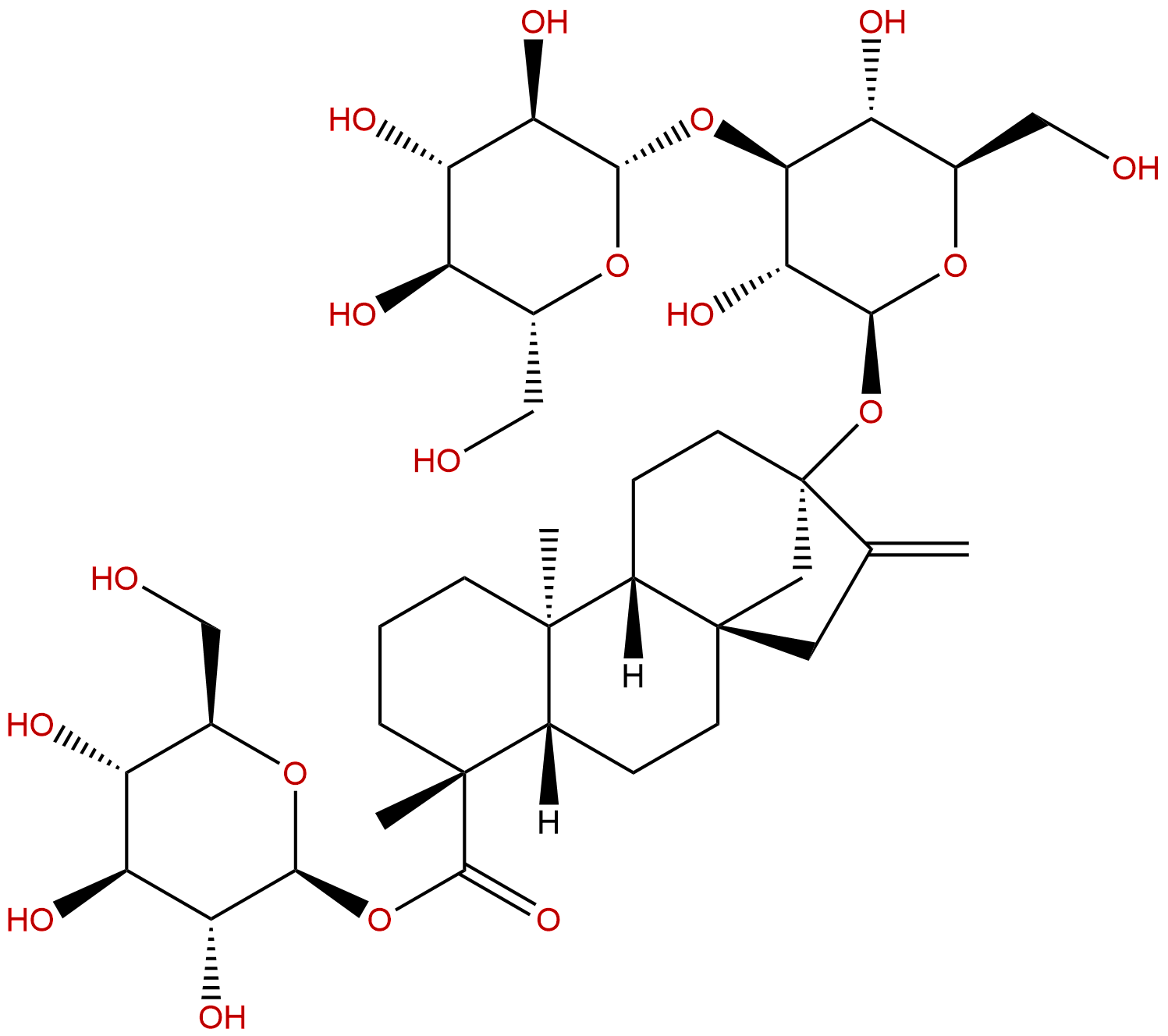
Rabadioside G: a potential anti diabetes natural sweetener in Stevia rebaudiana
1. Overview
Rebaudioside G is a compound derived from the Asteraceae plant Stevia rebaudiana(Stevia rebaudiana)Natural stevia glycosides isolated from leaves. As a minor component of the steviol glycoside family, its chemical structure is similar to the famous sweetener Reb A, but it has a unique glycosylation pattern. Despite its relatively low content in stevia extract, rebaudin G has received dual attention in the fields of food science and pharmacy in recent years due to its excellent sweet taste characteristics (sweetness about 200-300 times that of sucrose) and potential biological activity. Its CAS number is 127345-21-5 and product number is BP3612.
The initial research mainly focused on its commercial value as a high sweetness, zero calorie natural sweetener to replace sucrose and artificially synthesized sweeteners. However, with the in-depth exploration of the pharmacological effects of stevia glycosides, researchers found that rebaudioside G not only has sweet taste, but also may play an anti diabetes activity by acting on multiple targets related to glucose metabolism. This transforms it from a simple food additive to a natural product research object with potential therapeutic value. Currently, research on rebaudin G is shifting from simple sensory evaluation and extraction processes to its precise molecular mechanism of action, structure-activity relationship, and pharmacological evaluation, in order to open up new paths in the development of functional foods and novel hypoglycemic drugs.
2. Chemical structure and physicochemical properties
The molecular formula of Ribadine G is C ∝₈ H ₆₀ O ₁₈, with a molecular weight of 804.8800 g/mol, and it belongs to the class of diterpenoid glycosides. Its core structure is steviol The ent kaurene type diterpenes are connected to complex sugar chains composed of glucose and xylose at positions C13 and C19, respectively. Its stereochemical configuration can be resolved through its SMILES string:C=C1C[C@@]23CC[C@H]4[C@@](C)(CCC[C@@]4(C)C(=O)O[C@@H]4O[C@H](CO)[C@@H](O)[C@H](O)[C@H]4O)[C@@H]2CC[C@]1(O[C@@H]1O[C@H](CO)[C@@H](O)[C@H](O[C@@H]2O[C@H](CO)[C@@H](O)[C@H](O)[C@H]2O)[C@H]1O)C3This structure displays multiple chiral centers (represented by the @ symbol) and specific glycosylation connections, and this precise stereostructure is crucial for its sweet taste receptor recognition and biological activity.
Analyzing its physicochemical properties from the parameters of drug properties:
- Lipophilic nature The calculated LogP value is -0.1229 and LogD value is -0.1226, indicating that the compound has strong hydrophilicity at physiological pH. This is mainly attributed to the presence of 18 oxygen atoms and multiple hydroxyl groups in its molecule, forming a large hydrophilic region.
- Polar Surface Area The topological polar surface area (TPSA) is as high as 294.98 Å ², far exceeding most oral drugs (usually<140 Å ²), indicating extremely weak transmembrane passive diffusion ability.
- solubility The predicted value of water solubility is 1.2013 (usually in the order of log mol/L or mg/mL), confirming its high solubility in water, which is consistent with high TPSA and low LogP values.
- molecular weight:804.88 Da, Significantly exceeding the molecular weight limit of conventional oral medications (usually<500 Da).
These physical and chemical properties determine the absorption, distribution, metabolism, and excretion (ADME) characteristics of rebaudin G in vivo, which fundamentally affect its potential as a drug.
3. Plant sources and traditional applications
The only natural source of Ribadine G is Stevia rebaudiana(Stevia rebaudiana Bertoni), This is a perennial herbaceous plant of the Asteraceae family, native to South America, especially Paraguay and Brazil. Stevia is locally known as "Ka'a he 'ê" and has been used for hundreds or even thousands of years. The Guaran í indigenous people traditionally use their leaves to enhance the sweetness of matcha, as well as to treat diseases such as heartburn, obesity, and hypertension, reflecting their characteristic of "medicinal and edible homology".
It was not until the early 20th century that scientists isolated the main sweet component, steviol glycosides, from stevia. So far, more than 30 different steviol glycosides have been identified from stevia, among which rebaudin A and Stevioside are the main components, while rebaudin G and rebaudin M belong to the lower content secondary components. Although the content is relatively low, the development of modern separation and purification technologies such as column chromatography and preparative high-performance liquid chromatography has made it possible to obtain high-purity rebaudin G for research.
Traditional applications are mainly based on their overall sweetness and potential health benefits, while modern research focuses on deciphering the specific effects of individual components (such as rebaudin G), which is a scientific deepening and refinement of traditional understanding.
4. Pharmacological activity and mechanism of action
The database information shows that Rabadioside G is related to five key targets (GCK, PPARG, AKT1, SLC2A4, INS) and points to the core pharmacological activity of "anti diabetes". This reveals that it may regulate glucose homeostasis through synergistic effects of multiple targets and pathways.
Core target analysis and mechanism of action:
-
GCK (Glucokinase):
GCK is a key enzyme in liver and pancreatic beta cells, acting as a glucose sensor that catalyzes the phosphorylation of glucose to glucose-6-phosphate, which is the first step in glucose metabolism. In pancreatic beta cells, GCK activity determines the threshold for glucose stimulated insulin secretion (GSIS). Ruibaodi glycoside G may act as a conformational activator of GCK, increasing its affinity for glucose and initiating insulin secretion at lower blood glucose levels, acting as a 'glucose sensitizer'.
-
PPARG (Peroxisome proliferator activated receptor gamma):
PPARG is a member of the nuclear receptor superfamily and a classic target for insulin sensitizer thiazolidinediones (TZDs) drugs. Activation of PPARG can promote adipocyte differentiation, increase glucose uptake by adipose tissue, and improve systemic insulin sensitivity. Ruibaodi glycoside G may act as a natural PPARG ligand, gently activating the receptor to improve insulin resistance without causing side effects such as weight gain that traditional TZDs drugs may bring.
-
AKT1 (protein kinase B):
AKT1 is a core hub molecule in the insulin signaling pathway. After insulin binds to the receptor, it activates AKT1 through PI3K. Activated AKT1 further promotes GLUT4 translocation (see SLC2A4), inhibits hepatic glycogen breakdown, and promotes glycogen and protein synthesis. Ruibaodi glycoside G may indirectly activate AKT1 through upstream signals such as insulin receptors or insulin itself, thereby enhancing the downstream physiological effects of insulin.
-
SLC2A4 (glucose transporter 4, GLUT4):
GLUT4 is the main insulin sensitive glucose transporter in muscle and adipose tissue. Under insulin stimulation, GLUT4 vesicles stored in cells are translocated to the cell membrane, mediating glucose uptake. Ruibaodi glycoside G may promote GLUT4 translocation and membrane fusion by activating signaling pathways such as AKT1, directly enhancing peripheral tissue utilization of glucose and reducing blood glucose.
-
INS (Insulin):
This is the most direct correlation. Ruibaodi glycoside G may promote insulin secretion through the GCK mechanism mentioned above, or increase the total amount of insulin by protecting beta cells and reducing their apoptosis. In addition, it may also affect insulin synthesis or release through other unknown pathways.
Multi target collaborative anti diabetes network:
To sum up, the potential of Rabadioside G for anti diabetes may be derived from a sophisticated collaborative network:
- Open source By activating GCK, the sensitivity of pancreatic beta cells to glucose is enhanced, and insulin (INS) secretion is timely and appropriately promoted when needed.
- 'Throttle'Improving insulin resistance by activating PPARG and enhancing glucose uptake and utilization by peripheral tissues such as muscles and fat through the AKT1-SLC2A4 (GLUT4) pathway.
- signal amplification Maximizing the hypoglycemic effect of insulin by strengthening the INS-AKT1 core signaling axis.
This multi-target mode of action, similar to a "natural compound", may help to control blood sugar more smoothly and physiologically, avoiding the side effects or compensatory failures that single target drugs may bring. However, it should be emphasized that most of the above mechanisms are based on predictions of target associations and inferences from studies of similar compounds. Experimental evidence for the direct interaction between rebaudin G and these targets, such as binding constants and eutectic structures, still needs to be further enriched.
5. Evaluation of drug properties
Based on the provided pharmacological parameters and combined with classical methods Lipinski's Five Rules A systematic evaluation using the Rule of Five (Ro5) can objectively analyze the potential of rebaudin G as an oral medication.
Lipinski's Five Rules Compliance Analysis:
1. Molecular weight (MW) ≤ 500 Da The MW of ribavirin G is 804.88 Da, which is severely exceeded.
2. Lipid water partition coefficient (LogP) ≤ 5 Its LogP is -0.12, which is consistent.
3. Number of hydrogen bond donors (HBD) ≤ 5 From its structural formula, it can be inferred that there are numerous hydroxyl groups and the HBD number far exceeds 5.
4. Number of hydrogen bond acceptors (HBA) ≤ 10 There are numerous oxygen atoms in its molecule, and the number of HBAs far exceeds 10.
5. (The number of rotatable bonds is usually used as a supplement, and this compound has more rotatable bonds and greater flexibility).
Conclusion Ruibaodi glycoside G seriously violates three of Lipinski's rules (MW, HBD, HBA), which usually means that it Oral bioavailability will be very low Other parameters also support this judgment:
- High TPSA (294.98 Å ²) and low Caco-2 permeability (0.4127)It indicates that it is difficult to pass through intestinal epithelial cells through passive diffusion and has poor intestinal absorption.
- Low BBB penetration It indicates that it is difficult to enter the central nervous system, which is usually not a disadvantage for anti diabetes drugs, but may reduce central side effects.
- The plasma protein binding rate (PPB) is 64.05%Belonging to a moderate level, it means that some drugs will bind to plasma proteins, affecting their free concentration and distribution.
Toxicity parameter analysis:
- Genotoxicity The Ames test is negative (0.0), indicating no bacterial gene mutations. but Chromosomal aberration test positive This is a signal that requires high vigilance, indicating that it may cause chromosomal damage in mammalian cells at high concentrations or under specific conditions, and requires in-depth in vivo genetic toxicity assessment.
- cardiotoxicity HERG inhibition is' no ', preliminarily ruling out the serious cardiac risk of QT interval prolongation and apical torsion transition ventricular tachycardia.
- Other toxicities No skin/respiratory sensitization, no phototoxicity. Serum biochemical indicators (ALK, GGT, AST, ALT) show "yes" except for alkaline phosphatase (ALK), while others show "no", which may indicate the need to pay attention to potential effects on the liver or bones, but should be interpreted in conjunction with specific experimental data.
Comprehensive evaluation of drug properties:
From the perspective of traditional small molecule oral drugs, the pharmacological properties of Ribadine G Facing enormous challenges Due to its huge molecular weight, strong hydrophilicity, and high polarity, its membrane permeability is extremely poor, and it is expected to have a low oral absorption rate, making it difficult to achieve effective systemic blood drug concentration. The positive results of chromosomal abnormalities are a potential "roadblock" to drug development.
However, this does not mean that its application prospects are bleak. Its development strategy may require a different approach:
1. As a prodrug or structural optimization Modify its chemical structure (such as esterification, preparation of glycoside derivatives) to improve lipid solubility and permeability while retaining activity.
2. New drug delivery system Using delivery technologies such as nanomaterials, liposomes, and microemulsions to encapsulate drugs and enhance their intestinal absorption and targeting.
3. As a functional food/health product ingredient This is currently the most realistic path. Utilize its natural, high sweetness, zero calorie characteristics, and potential auxiliary blood sugar regulation function to develop functional sweeteners for pre diabetes or diabetes patients. Poor system exposure may actually reduce the risk of systemic side effects.
4. Local or non oral administration Explore alternative routes of administration.
6. Research Status and Application Prospects
Research status:
At present, research on rebaudin G is still in a relatively early stage, far less in-depth than rebaudin A and steviol glycosides.
- Extraction and synthesis One of the research focuses is on how to efficiently isolate and purify rebaudin G from Stevia rebaudiana, or to achieve directed synthesis by enzymatic/chemical glycosylation modification of higher content steviol glycosides.
- sensory characteristics Previous studies have confirmed that its sweetness is pure and its aftertaste is weaker than that of steviol glycosides, making it a highly promising new generation of natural sweeteners.
- Pharmacological Research: In vitro cell experiments (such as insulin secretion experiment and glucose uptake experiment) and a few animal model studies preliminarily support its anti diabetes activity, but the research on its mechanism of action is not systematic and in-depth enough, lacking high-quality pharmacodynamics, pharmacokinetics and long-term safety data in vivo. Evidence of its direct interaction with the aforementioned multiple targets is yet to be provided.
Application Prospects:
1. Next generation high-end natural sweeteners With the increasing demand for healthy eating among consumers, rebaudin G, with its excellent sweet profile and "clean label" properties, is expected to serve as a core sweet ingredient in high-end beverages, dairy products, and baked goods. Together with rebaudin M and others, it will promote the upgrading and replacement of steviol glycoside products.
2. Diabetes management aids If its hypoglycemic activity is confirmed in rigorous human clinical trials, rebaudin G can be developed into a special 'functional sweetener'. When diabetes patients use it to replace sugar, they may also obtain slight benefits of blood glucose regulation to achieve "kill two birds with one stone". This requires rigorous clinical nutrition research.
3. lead compound Although it has poor pharmaceutical properties, its chemical structure provides a valuable "template" for the design of new anti diabetes drugs. Pharmaceutical chemists can use its glycoside (steviol) or simplified structure as a basis for rational modification, in order to obtain derivatives with stronger activity and better drug properties.
4. Insights from multi-target therapy strategies: The multi target action characteristics of rebaudioside G provide a natural model and idea for the development of multi target drugs or compound preparations for complex metabolic diseases (such as type 2 diabetes).
Future research directions:
- In depth mechanism research Using techniques such as molecular docking, surface plasmon resonance (SPR), and cellular thermal shift analysis (CETSA), verify and elucidate its direct interactions with targets such as GCK and PPARG, as well as downstream signaling pathways.
- System efficacy and safety evaluation Conduct long-term administration experiments in animal models closer to human diseases, such as db/db mice and ZDF rats, to comprehensively evaluate their hypoglycemic efficacy, protective effects on pancreatic function, and systemic toxicity (with particular attention to genetic toxicity).
- Formulation technology research and development Actively exploring new delivery technologies that can effectively improve its oral bioavailability.
- Clinical translational research: Design and implement a small-scale human intervention test to evaluate the actual impact of it as a sweetener on metabolic indicators such as blood glucose and insulin levels of diabetes patients or healthy people.
In short, Ribadine G is a natural product that combines the potential for "deliciousness" and "healthiness". Although its direct development as a traditional oral medication has been fraught with obstacles, as a functional food ingredient and drug lead compound, it still shines with unique brilliance. With the continuous deepening of research and the continuous progress of technology, Rabadioside G is expected to play a new and important role in improving human health, especially in coping with the global challenge of diabetes.