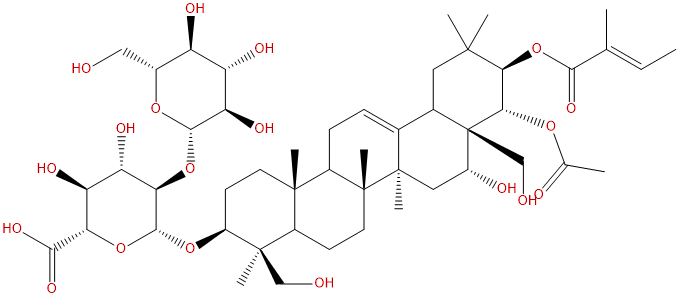


Product name: Escin Ie
Synonym name:
Catalogue No.: BP2113
Cas No.: 1613506-26-5
Formula: C49H76O19
Mol Weight: 969.128
Botanical Source: Aesculi semen
Type of Compound: Terpenoids
Purity: 95%~99%
Analysis Method: HPLC-DAD or/and HPLC-ELSD
Identification Method: Mass, NMR
Packing: Brown vial or HDPE plastic bottle
Storage: Store in a well closed container, protected from air and light. Put into refrigerate or freeze for long term storage.
Whenever possible, you should prepare and use solutions on the same day. However, if you need to make up stock solutions in advance, we recommend that you store the solution as aliquots in tightly sealed vials at -20℃. Generally, these will be useable for up to two weeks.
The product could be supplied from milligrams to grams
Inquire for bulk scale.
For Reference Standard and R&D, Not for Human Use Directly.
Storage conditions:Short-term storage at 2~8℃, long-term storage at -20 ~ -80℃
308.8900
1.8144
-.7729
.1868
.5340
.1912
Low
78.1921
6.4936
No
No
Yes
No
No
No
0.0
Yes
No
Yes
Yes
Escin Ie, as an important natural saponin compound, has received widespread attention in the field of natural medicine research in recent years. It originates from Aesculus hippoastanum L. seed extract and is a member of Aescine derivatives. Seven leaf saponin compounds are known for their significant anti-inflammatory, anti edema, and vascular protective effects, especially in the treatment of vascular diseases such as phlebitis, showing potential clinical application value. This article provides a systematic review of the chemical structure and physicochemical properties, plant sources and extraction methods, pharmacological activity and mechanism of action of seven leaf saponin Ie. Combining its pharmacological parameters and pharmacokinetic characteristics, it explores its clinical application prospects and future research directions.
The molecular formula of seven leaf saponin Ie is C48H74O20, with a molecular weight of 969.1280, belonging to the triterpenoid saponin class. Its structural core is the pentacyclic triterpenoid parent nucleus, which connects multiple sugar residues and has typical saponin structural characteristics. The LogP value is 1.8144, indicating that it has moderate lipophilicity, which is conducive to passing through the cell membrane but not prone to excessive accumulation. The extremely high polar surface area (TPSA 308.8900 Å ²) reflects the presence of a large number of polar groups on its molecular surface, especially hydroxyl and sugar groups, which endow it with strong hydration ability, but low water solubility (0.1868), which may limit its bioavailability.
The physicochemical properties of seven leaf saponin Ie determine its distribution and metabolic characteristics in vivo. Its low blood-brain barrier permeability reduces the risk of central nervous system side effects. The hERG channel inhibition experiment was negative, indicating a low risk of cardiac toxicity. The Ames mutagenicity test result is 0.0, indicating a low risk of genotoxicity and meeting safety requirements.
Seven leaf saponin Ie is mainly isolated from the seeds of Aescului Semen. Seven leaf trees are plants of the Seven leaf Tree family, widely distributed in parts of Europe and Asia. Its seeds are rich in various saponin components, especially the Escin mixture. The traditional extraction process usually adopts the alcohol extraction method, which uses ethanol or methanol to extract the dried powder, and then separates and purifies it through liquid-liquid distribution, column chromatography and other techniques.
The application of modern extraction techniques such as ultrasound assisted extraction, microwave-assisted extraction, and high-performance liquid chromatography (HPLC) separation and purification technology has improved the extraction efficiency and purity of saponins Ie. During the purification process, reverse phase HPLC and silica gel column chromatography are often used in combination to obtain high-purity seven leaf saponin Ie. The optimization of the extraction process not only improves the yield, but also ensures the activity stability of the compound, laying the foundation for subsequent pharmacological research and clinical development.
The pharmacological activity of seven leaf saponin Ie mainly revolves around its anti-inflammatory, anti vascular permeability increasing, and anti edema effects. Multiple in vitro and in vivo experiments have shown that aescin Ie can significantly inhibit the release of inflammatory mediators, reduce the inflammatory response of vascular walls, and improve microcirculation function.
In the venous inflammation model, saponins Ie significantly alleviate inflammatory symptoms by inhibiting inflammatory cell infiltration and reducing vascular wall edema. Its anti-inflammatory effect is closely related to reducing the expression of pro-inflammatory cytokines such as TNF - α and IL-1 β. In animal experiments, aescin Ie also showed the effect of reducing vascular permeability and preventing endothelial damage, promoting the repair of vascular wall structure.
In addition, seven leaf saponin Ie has antioxidant effects, can clear free radicals, and reduce oxidative stress damage to vascular endothelium. Its regulation of platelet activating factor receptor (PTAFR) helps to inhibit platelet aggregation, prevent thrombosis, and further support its potential application in vascular diseases.
The mechanism of action of seven leaf saponin Ie is mainly achieved by regulating various inflammation related molecular targets. Its key targets include:
The synergistic regulation of these molecular targets results in excellent pharmacological activity of seven leaf saponin Ie in anti-inflammatory, endothelial protection, inhibition of vascular permeability, and prevention of thrombosis.
The pharmacological parameters of seven leaf saponin Ie show that it has good safety and potential drug development value. Its molecular weight is relatively large (969.1280), which exceeds the recommended range of Lipinski rules, but as a natural macromolecular saponin, it still has good biological activity. The LogP value of 1.8144 indicates moderate lipid solubility, which is beneficial for cell membrane penetration.
A high TPSA value (308.8900) suggests strong polarity and may limit oral bioavailability, but in vivo absorption can be improved through formulation optimization (such as nanocarriers, liposome encapsulation). One of the challenges in its development is its low water solubility (0.1868), which needs to be addressed through chemical modification or excipient improvement.
In terms of pharmacokinetics, aescin Ie shows low blood-brain barrier permeability and reduces the risk of central nervous system side effects. The hERG channel inhibition test was negative and the Ames test showed no mutagenicity, indicating low cardiac safety and genetic toxicity risk. Metabolism in the body is mostly carried out through the liver enzyme system, mainly excreted through the enterohepatic circulation, with a moderate half-life and suitable for clinical application.
The application prospects of seven leaf saponin Ie in phlebitis and related vascular diseases are broad. Its multi-target and multi mechanism anti-inflammatory and vascular protective effects provide new drug candidates for the treatment of diseases such as phlebitis, chronic venous insufficiency, and vascular edema. Existing preclinical studies support its safety and efficacy, but there is still a lack of systematic clinical trial data.
Future research should focus on:
In summary, as a multifunctional saponin compound from natural sources, aescin Ie has the potential to become a novel vascular protective drug.
As a derivative of Aescine, aescin Ie has shown promising application prospects in the treatment of phlebitis and related vascular diseases due to its unique chemical structure and multi-target anti-inflammatory mechanism. Its good safety and pharmacological parameters provide strong support for subsequent clinical development. In the future, through in-depth pharmacological mechanism research, clinical validation, and formulation optimization, seven leaf saponin Ie is expected to become an important breakthrough in the field of natural product pharmacology, promoting new progress in the treatment of vascular diseases.
