

Synonym name:
Catalogue No.: BP3711
Cas No.: 6805-41-0
Formula: C55H86O24
Mol Weight: 1131.27
Botanical Source:
Purity: Mixture(Total Aescins), Total saponins>98%
Analysis Method: HPLC-DAD or/and HPLC-ELSD
Identification Method: Mass, NMR
Packing: Brown vial or HDPE plastic bottle
Can be supplied from milligrams to grams. Inquire for bulk scale.
For Reference Standard and R&D, Not for Human Use Directly.
Storage conditions:Short-term storage at 2~8℃, long-term storage at -20 ~ -80℃
388.0400
1.1897
-1.3408
.3494
.4783
.1888
Low
73.2746
6.9877
No
No
No
No
No
No
0.0
Yes
No
Yes
Yes
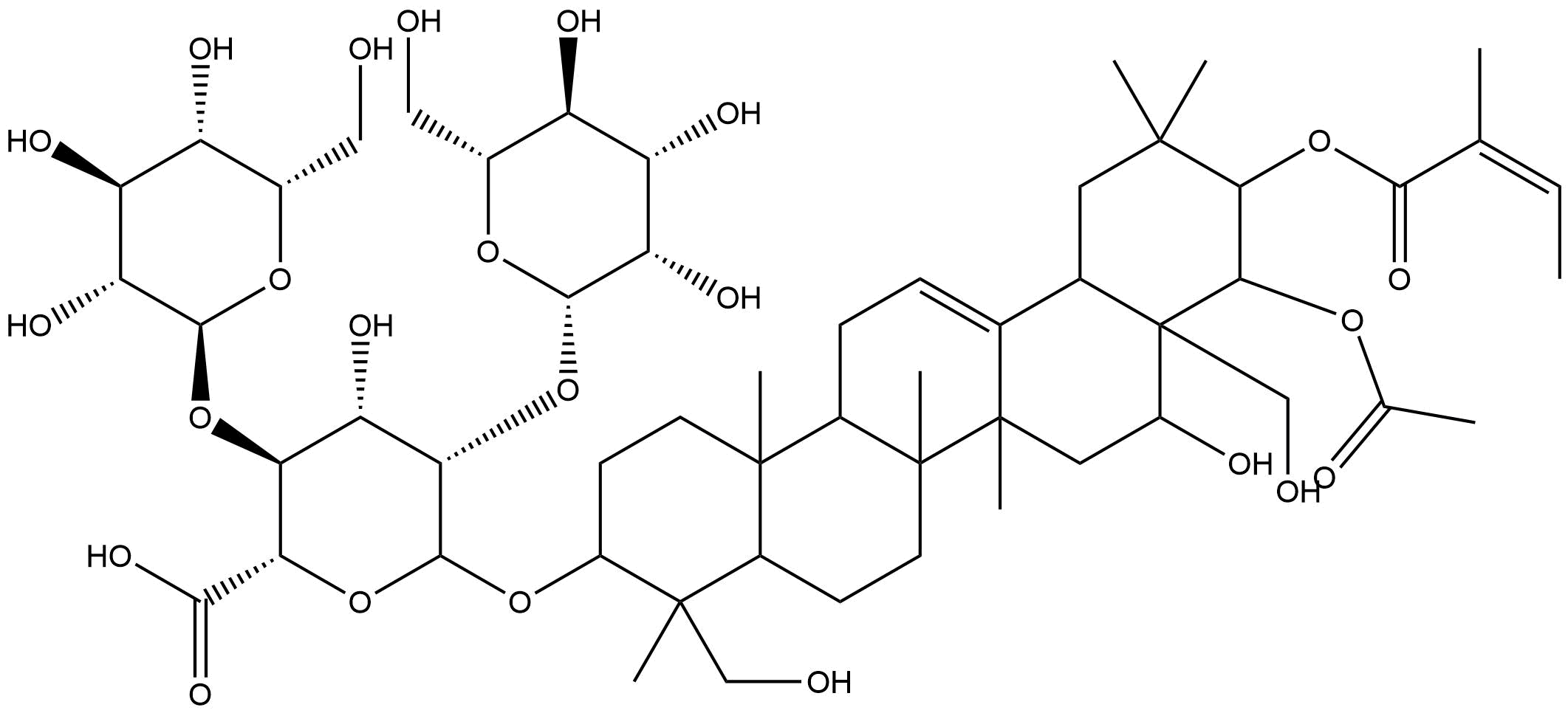
Aescine, with a CAS number of 6805-41-0, is a traditional medicinal plant derived from the Chinese medicinal plant, Saros chinensis (scientific name)Aesculus chinensis Natural triterpenoid saponins with important biological activity extracted from Horse Chestnut. Its molecular formula is C55H86O24, with a molecular weight of up to 1131.2600 g/mol and a complex structure. It is a representative "macromolecule" active ingredient in plant secondary metabolites. For a long time, Sophora flavescens has been used in traditional medicine in Europe and Asia to treat diseases such as varicose veins, chronic venous insufficiency, inflammation, and edema. Its core pharmacological substance is considered to be seven leaf saponins. Modern pharmacological research has confirmed that saponins from seven leaves have significant multiple activities such as anti-inflammatory, anti edema, enhancing venous tone, and antioxidant properties, making them a classic research object in the field of natural product drug development. This article will provide a systematic and professional popular science interpretation of this star molecule from its chemical structure, plant origin, pharmacological mechanism, medicinal evaluation, and research prospects.
The chemical structure of seven leaf saponins is the material basis for their biological activity. From the molecular formula C55H86O24, it can be seen that it is a behemoth composed of 55 carbon atoms, 86 hydrogen atoms, and 24 oxygen atoms. The complex structure described by its SMILES string reveals that it is a typical esterified triterpenoid saponin. Its structural skeleton is an oleane type pentacyclic triterpene, which is usually connected to multiple sugar groups (such as glucose, glucuronic acid, etc.) at positions C-3 and C-28, forming hydrophilic sugar chains. Hydrophobic groups such as acetyl and angelica contribute to its lipophilicity.
From the analysis of pharmacological parameters:
- Molecular weight (MW):1131.2690 Da, Far beyond the scope of conventional small molecule drugs (usually<500 Da), this poses the primary challenge for their oral absorption and transmembrane transport.
- Lipid water partition coefficient (LogP/LogD)The calculated LogP is 1.1897, indicating that the molecule as a whole exhibits weak lipophilicity; But at physiological pH, LogD is -1.3408, significantly negative. This strongly suggests the presence of ionizable acidic groups (such as carboxyl groups) in the molecule, which mainly exist in the form of dissociated ions in body fluids, leading to a significant decrease in their apparent lipophilicity and an increase in their hydrophilicity.
- Topological Polarity Surface Area (TPSA)Up to 388.0400 Å ², which is closely related to the presence of a large number of hydroxyl groups, sugar epoxy atoms, and carboxyl groups in its molecules. High TPSA is an important indicator of high molecular polarity and strong hydrophilicity, often associated with poor cell membrane permeability.
- Water solubility The calculated value is 0.3494 mg/mL, which belongs to the category of slight solubility. Its dissolution behavior is the result of the combined action of hydrophilic sugar chains and hydrophobic triterpenoid frameworks, which may need to be improved in practical formulations through salt formation or the use of solubilizers.
- Plasma protein binding rate (PPB)73.27%, belonging to the moderate to high level. This means that a considerable portion of saponins in the blood bind to plasma proteins (mainly albumin), which can affect their free drug concentration, distribution volume, and efficacy.
These physical and chemical properties parameters collectively describe that seven leaf saponins are a Natural products with high polarity, high molecular weight, limited water solubility, and certain plasma protein binding ability This directly determines its subsequent pharmacokinetic characteristics and route of administration selection.
Seven leaf saponins mainly come from the Sapindaceae plant Sapindaceae(Aesculus The seeds of the genus, namely the traditional Chinese medicine "Saros seed". Among them, European seven tree trees(Aesculus hippocastanum)And the unique Tianshi chestnut in China(Aesculus chinensis var. wilsonii)It is its main source.
The medicinal history of Saros has a long and rich history. In Europe, its usage records can be traced back to the 16th century, when it was used by the common people to treat fever, hemorrhoids, and venous related problems. In traditional Chinese medicine theory, Sarozi (also known as Su Luo Zi or Suoluo Zi) is warm in nature, sweet in taste, and belongs to the liver and stomach meridians. It has Soothing the liver and regulating qi, harmonizing the stomach and relieving pain, reducing swelling and dispersing nodules The efficacy. Commonly used to treat chest bloating, tightness, stomach pain, as well as malnutrition, dysentery, etc. caused by liver and stomach qi stagnation. It is worth noting that the efficacy description of "reducing swelling" in traditional Chinese medicine is highly consistent with the anti-inflammatory, anti exudative, and enhanced venous tone effects discovered by modern pharmacology, reflecting the scientific wisdom contained in traditional experience.
Traditional applications often use Suoluozi decoction for internal consumption or ground powder for external application. Modern extraction processes mainly use water or alcohol extraction, followed by separation and purification techniques such as macroporous resin, to obtain standardized extracts mainly composed of seven leaf saponins (often in the form of sodium salts, i.e. sodium seven leaf saponins), ensuring the stability of product quality and efficacy, laying the foundation for the development of modern formulations.
The most core and extensively studied pharmacological activity of seven leaf saponins is anti-inflammatory Its effect is not through a single target, but the result of the synergistic action of multiple targets and pathways, reflecting the complexity of the mechanism of action of natural products. Based on the provided target information, we can delve into the molecular mechanism of its anti-inflammatory effect:
Inhibition of pro-inflammatory cytokines (TNF, IL6, IL1B):
Inhibition of cyclooxygenase-2 (PTGS2/COX-2):
Stable NF - κ B inhibitory protein (NFKBIA/I κ B α):
Integration of mechanisms of action and related diseases:
Based on the above targets, the anti-inflammatory mechanism of seven leaf saponins is clearly presented as a coherent pathway:It stabilizes I κ B α, inhibits excessive activation of the NF - κ B signaling pathway, and downregulates the expression and release of various pro-inflammatory cytokines (TNF - α, IL-6, IL-1 β) and inflammatory enzymes (COX-2) downstream of it This multi-target intervention enables it to effectively curb the amplification of inflammatory cascade reactions and is suitable for the treatment of various inflammation related diseases.
In addition to its direct anti-inflammatory effect, seven leaf saponins can also Reduce capillary permeability Reduce plasma protein and fluid leakage, thereby exerting a powerful effect Anti edema effect; At the same time, it can Increase the tension of the venous wall and promote venous blood reflux Therefore, its core indications focus on Chronic venous insufficiency (CVI) and its associated lower limb edema, pain, heaviness, as well as trauma, postoperative edema, and cerebral edema Wait. The anti-inflammatory and anti edema effects, as well as the enhancement of venous tone, complement each other and together form the pharmacological basis for treating venous circulation disorders.
Based on the provided ADMET (absorption, distribution, metabolism, excretion, toxicity) parameters, combined with classical Lipinski's Five Rules Objective evaluation of the pharmacological potential of seven leaf saponins can be conducted:
Lipinski Five Rule Compliance Analysis (commonly used to predict oral activity):
1. Molecular weight<500 Da:not conform to(1131 >> 500)
2. The number of hydrogen bond donors (OH+NH) is less than 10:not conform to(From its structure, it can be inferred that there are numerous hydroxyl groups on the sugar and glycoside groups, far exceeding 10.)
3. Hydrogen bond acceptors (O, N)<10:not conform to(24 oxygen atoms, far exceeding 10)
4. LogP < 5:Comply with(Calculate LogP=1.19)
5. Number of rotatable keys: It is usually recommended to be less than 10, as its complex structure is bound to exceed it.
Conclusion: Seven leaf saponins seriously violate the three criteria of Lipinski rule (molecular weight, hydrogen bond donor acceptor), which strongly indicates their Oral bioavailability will be very low This is highly consistent with the database parameters:
- Caco-2 permeability 0.1888 (× 10 ⁻⁶ cm/s), a very low value, indicates extremely poor permeability of intestinal epithelial cells.
- Effective permeability coefficient (Peff)0.4783 cm/s × 10 ⁻⁴, belonging to low-permeability compounds.
- Blood-brain barrier (BBB) penetrability Clearly labeled as' low '. Its high TPSA, high molecular weight, and ionization properties make it difficult for it to passively diffuse through the tight BBB, which poses a challenge to its administration for treating central nervous system edema (such as cerebral edema) (usually requiring intravenous administration).
Analysis of other pharmacological parameters:
- safety The key toxicity indicators such as Ames test (0.0, indicating no mutagenicity), chromosomal aberration (none), and hERG inhibition (no) were all negative, indicating its Low risk of genetic toxicity and cardiac toxicity The security foundation is relatively good.
- Influence of liver enzymes The data shows that it may cause an increase in serum ALT, AST, and ALK, indicating the need for Pay attention to its potential liver effects Monitoring liver function is necessary in clinical applications and long-term medication.
- Other No skin or respiratory sensitization, no phototoxicity.
Comprehensive Assessment:
Seven leaf saponins are a Natural active molecules with clear activity, clear mechanism of action, and relatively good safety, but with poor oral absorption Its physicochemical properties make it difficult to become an ideal oral small molecule drug. This explains why currently successful seven leaf saponin drugs on the market, such as sodium seven leaf saponin, mainly use Injection administration route(Intravenous injection) to bypass absorption barriers and directly enter the systemic circulation to exert therapeutic effects. For oral formulations, advanced drug delivery technologies such as nanoliposomes, microemulsions, phospholipid complexes, etc. are needed to improve their absorption and bioavailability.
Research status:
At present, injections and topical preparations (such as gel and cream) with sodium aescinat as the main component have been listed in many countries (especially in Europe and China) worldwide, and are widely used in treatment Cerebral edema, swelling after trauma or surgery, chronic venous insufficiency Waiting for diseases with precise therapeutic effects is one of the exemplary examples of natural products successfully developed into modern drugs. In terms of basic research, in addition to the classic anti-inflammatory and anti edema mechanisms, recent studies have also expanded to include them Antioxidant, anti-tumor, protective of vascular endothelium, and improvement of microcirculation Waiting for a new field. For example, studies suggest that saponins from seven leaves may exert anti angiogenic effects by inhibiting factors such as VEGF, or induce apoptosis in certain tumor cells.
Application prospects and challenges:
1. Optimization of existing formulations Continue to improve the quality control standards of existing injections, increase purity, and reduce adverse reactions such as allergies caused by impurities. Meanwhile, developing more efficient and convenient new oral or transdermal delivery systems is the key to expanding their clinical application scope.
2. Structural modification and derivative development Reasonable structural modifications (such as simplifying sugar chains and preparing prodrugs) are important directions in the field of medicinal chemistry to address the drawbacks of high molecular weight and polarity, while preserving the core pharmacophore and improving its pharmacokinetic properties.
3. Exploration of new indications Based on its multi-target anti-inflammatory properties, exploring its therapeutic potential in other inflammation related diseases such as arthritis, acute lung injury, inflammatory bowel disease, etc. is worth further research.
4. Deep analysis of the mechanism of action By utilizing modern technologies such as proteomics and metabolomics, we aim to comprehensively and systematically elucidate the complex network pharmacological mechanisms, discover new targets, and provide a basis for precision medicine.
5. Examples of Modernization of Traditional Chinese Medicine The successful research on seven leaf saponins is an excellent case of "finding lead compounds from traditional Chinese medicine, elucidating mechanisms through modern scientific technology, and developing new drugs" model, providing valuable experience for the study of other active ingredients in traditional Chinese medicine.
In short, as a treasure that has emerged from traditional medicine, the clear anti-inflammatory pharmacological effects and proven clinical value of seven leaf saponins make them occupy a solid place in the field of natural product medicine. In the future, through the cross integration of multiple disciplines such as pharmacy, medicinal chemistry, and pharmacology, it is expected to overcome its drug weakness, further explore its therapeutic potential, and benefit more patients.
Batch can search by a CAS number,one per line
