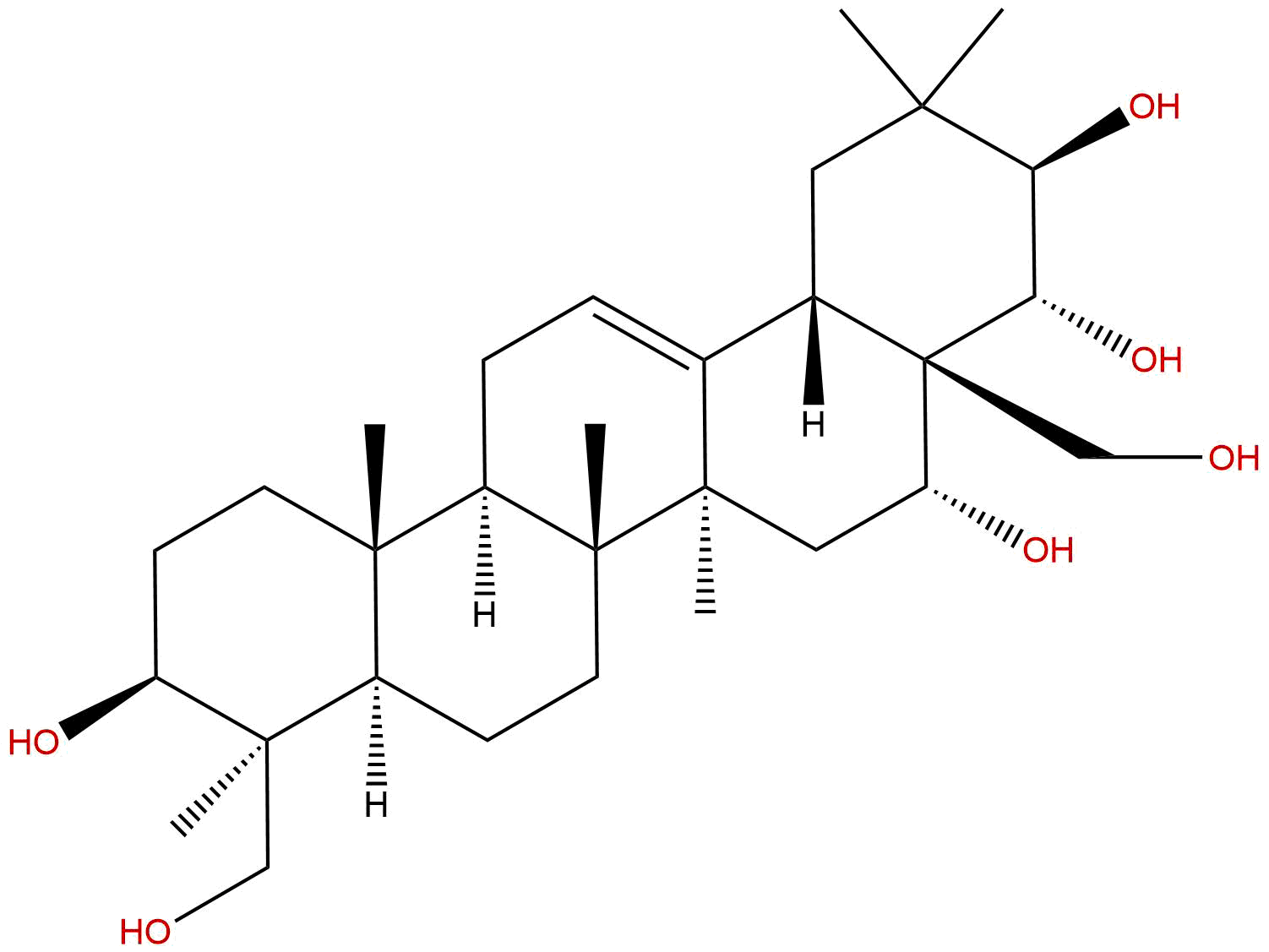


Synonym name: Protoaescigenin
Catalogue No.: BP1485
Cas No.: 20853-07-0
Formula: C30H50O6
Mol Weight: 506.724
Botanical Source: Xanthoceras spp. and Napoleonaea spp.
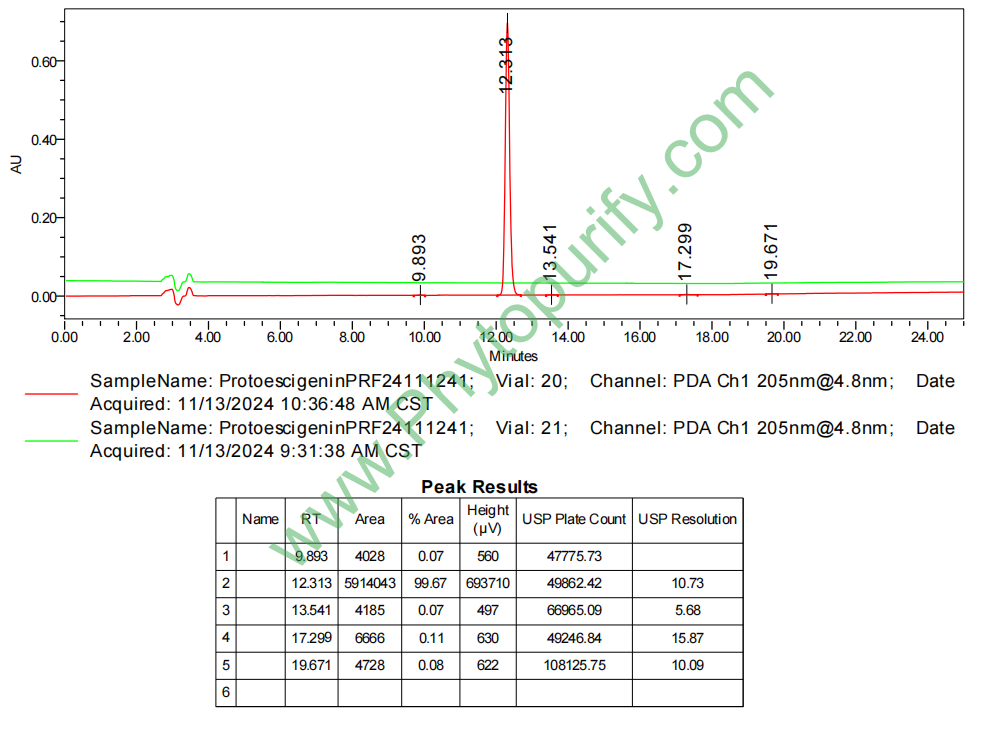
Purity: 95%~99%
Analysis Method: HPLC-DAD or/and HPLC-ELSD
Identification Method: Mass, NMR
Packing: Brown vial or HDPE plastic bottle
Can be supplied from milligrams to grams. Inquire for bulk scale.
For Reference Standard and R&D, Not for Human Use Directly.
HPLC of Protoescigenin
Storage conditions:Short-term storage at 2~8℃, long-term storage at -20 ~ -80℃
121.3800
2.9330
2.9331
.0085
1.6397
5.1222
Low
75.5896
5.2280
No
No
No
No
No
No
0.0
Yes
No
Yes
No
Triterpenoids, as important members of the natural product treasure trove, occupy a pivotal position in the history of drug discovery and development due to their structural diversity and extensive biological activity. Among them, seven leaf saponin compounds have been successfully applied in clinical practice due to their significant anti-inflammatory, anti edema, and vascular protective activities. Representative drugs such as sodium seven leaf saponin have proven to be effective in treating brain edema, traumatic swelling, and chronic venous insufficiency. Protoeschigenin, as the core glycoside of the mixture of seven leaf saponins, is the fundamental chemical skeleton for the pharmacological effects of such active ingredients. Compared to its glycosylated derivatives, the glycoside structure is more conducive to revealing structure-activity relationships and serving as a key intermediate for structural modification to optimize its drug properties and expand new therapeutic applications. In recent years, with the rapid development of molecular pharmacology and synthetic chemistry technology, research on the original seven leaf saponin has progressed from traditional activity observation to precise molecular mechanism analysis and rational structural modification. Especially as a substrate, it provides a highly promising lead compound for the development of new anti-inflammatory drugs with stronger targeting and fewer side effects by constructing novel triterpenoid sugar conjugates through modern synthetic strategies such as click chemistry. This article aims to systematically review the chemical properties, plant sources, pharmacological activities, molecular mechanisms of action, pharmacological evaluation, and clinical translation prospects of the original seven leaf saponin, in order to provide comprehensive scientific references for the deep development and utilization of this natural product.
Original seven leaf saponin glycoside, chemical name (3 β, 16 α, 21 β, 22 α) -21,22,23,24-tetrahydroxyolean-12-en-3-yl β - D-glucopyranoside, CAS number 20853-07-0. Its molecular formula is C30H50O6, with a molecular weight of 506.7240 g/mol.
Structurally, the original seven leaf saponin element belongs to the oleanane type pentacyclic triterpenoid compounds. Its core skeleton is composed of five fused rings (A/B/C/D/E), with a typical Δ 12 ene bond. The structural characteristic functional groups include: a β - D-glucuronic acid group attached to the C-3 position, which is a hallmark of its role as a "protoglycoside" (i.e., monoglycoside); A pair of cis ortho dihydroxy groups (often referred to as the "characteristic diol structure of aescin") are formed at positions C-21 and C-22, and together with the hydroxyl groups at positions C-23 and C-24, they form a highly oxidized region on the D/E ring. This unique hydroxylation mode has a decisive impact on its biological activity and water solubility.
Based on its chemical structure, the original seven leaf saponin exhibits specific physicochemical properties. The calculated lipid water partition coefficient (LogP) is 2.9330, indicating that the molecule has a certain degree of lipophilicity, but due to its presence of multiple hydroxyl groups and a hydrophilic uronic acid group, it exhibits overall amphiphilicity. The topologically polar surface area (TPSA) is as high as 121.38 Å ², mainly attributed to the abundant hydroxyl groups and oxygen atoms on the sugar ring in the molecule, indicating that it has more hydrogen bond donor and acceptor sites. The experimental value of water solubility is 0.0085 mg/mL, which belongs to the category of slight solubility, which limits its direct bioavailability. In the early development of drugs, these parameters are key to evaluating their potential for drug development. Its relatively high molecular weight and polar surface area may affect its cell membrane permeability, while moderate LogP values suggest that it may improve solubility and absorption through appropriate formulation methods.
The original seven leaf sapogenin mainly comes from the seeds of Aesculus plants in the Hippocastanaceae family, especially the European Aesculus hippocampanum L., also known as the traditional Chinese medicine "Borneo". In addition, plants belonging to the same genus, such as the Japanese seven leaved tree (Aesculus turbinata) and the Chinese endemic chestnut (Aesculus wilsonii), are also important resource plants. In these plants, the original seven leaf saponin is not present in large quantities in free form, but rather as a glycoside part of various seven leaf saponins (such as seven leaf saponins Ia, Ib, IIa, IIb, etc.), connected to different oligosaccharide chains through glycosidic bonds.
The extraction and transformation strategy of raw seven leaf saponin from plant materials is usually adopted in a step-by-step manner. The standard procedure is as follows:
1. Total saponin extraction After crushing the dried Borneo seeds, reflux extraction or ultrasound assisted extraction is performed using methanol, ethanol, or ethanol water mixed solvents. After the extraction solution is concentrated under reduced pressure, crude extract is obtained.
2. Separation and purification The crude extract can be purified by column chromatography using macroporous adsorption resins (such as D101, AB-8) and gradient elution with ethanol water solutions of different concentrations to enrich saponin sites. Further purification often uses techniques such as silica gel column chromatography, reverse phase silica gel (such as ODS) column chromatography, and high performance liquid chromatography (HPLC) to separate single or mixed seven leaf saponins.
3. Glycoside preparation To obtain the original seven leaf saponin element, selective hydrolysis of purified seven leaf saponins is required. The most commonly used method is acid hydrolysis, usually carried out by heating and refluxing in a methanol/water solution of dilute hydrochloric acid or sulfuric acid. This process can break glycosidic bonds and release aglycones. However, strong acid conditions may cause dehydration of the adjacent hydroxyl groups at positions C-21 and C-22 to form epoxides (such as aescin), or cause other structural changes. Therefore, in order to obtain the complete original seven leaf saponin, it is necessary to finely control the hydrolysis conditions (acid concentration, temperature, time), or explore milder methods such as enzymatic hydrolysis.
4. Purification and identification The hydrolysis product is extracted, washed, and dried with organic solvents such as ethyl acetate and n-butanol, and then purified by recrystallization or preparative HPLC. The structure of the final product was confirmed by spectroscopic techniques such as nuclear magnetic resonance (NMR, including 1H NMR and 13C NMR), mass spectrometry (MS), and infrared spectroscopy (IR).
In recent years, to meet the needs of chemical modification research, the original seven leaf saponin element has often been used as a synthetic starting point. Researchers utilize multiple hydroxyl groups in its structure to achieve targeted functionalization of specific sites through selective protection strategies (such as using silicon ether and ester protecting groups), and then efficiently construct a series of novel triterpenoid triazole linked conjugates through copper catalyzed azide alkyne cycloaddition reactions (CuAAC, click chemistry) with azide monosaccharides and other modules, greatly expanding its chemical space and biological activity research scope.
The original seven leaf saponin element, as the active core of seven leaf saponins, inherits and exhibits a wide range of pharmacological effects from its precursor compounds, among which the most prominent and extensively studied is its anti-inflammatory activity.
1. Anti inflammatory effect
Numerous in vitro and in vivo studies have confirmed that the original seven leaf saponin element and its derivatives have significant anti-inflammatory effects. In various animal models of acute and chronic inflammation, such as carrageenan or acetic acid-induced paw swelling in rats, cotton ball induced granuloma, and adjuvant arthritis models, the original seven leaf saponin can effectively inhibit swelling, reduce inflammatory cell infiltration, and tissue damage. Its anti-inflammatory strength is often comparable or superior to clinically positive drugs such as indomethacin and dexamethasone, and has shown a better safety window in some studies.
2. Anti edema and vascular protective effects
This activity is the cornerstone of clinical application of seven leaf saponin drugs. Original seven leaf saponin can reduce the permeability of capillaries, promote increased venous tone, improve venous return, and thus combat tissue edema caused by various reasons such as trauma, surgery, and venous insufficiency. Its mechanism and anti-inflammatory effect complement each other, involving protection of vascular endothelial cells and inhibition of the release of inflammatory mediators.
3. Other potential activities
In addition to its classic anti-inflammatory and anti edema effects, studies also suggest that the original seven leaf saponin may have other biological activities, including antioxidant stress, analgesic effects (possibly related to anti-inflammatory and ion channel effects), and potential anti-tumor adjuvant activities (by inhibiting tumor progression pathways associated with inflammation). However, research in these areas is still in its early stages and requires more evidence to support it.
The anti-inflammatory effect of the original seven leaf saponin is not achieved through a single pathway, but rather through the synergistic action of multiple targets and pathways. Modern molecular pharmacology research has preliminarily revealed its complex network of action, involving multiple key inflammation related targets and signaling pathways.
1. Regulation of the inflammatory cytokine network
Original seven leaf saponin can significantly inhibit the production of pro-inflammatory cytokines induced by stimuli such as lipopolysaccharide (LPS). Research has shown that it can downregulate immune cells such as macrophages and synovial cells Tumor necrosis factor alpha (TNF - α)、Interleukin-6 (IL-6) Waiting for the expression of core pro-inflammatory factors. The production of these cytokines is influenced by nuclear factor - κ B(NF-κB)Strict regulation of signaling pathways. Original seven leaf saponin can inhibit the degradation of I κ B α and p65 nuclear translocation, block the abnormal activation of NF - κ B pathway, and thus suppress the expression of downstream inflammatory mediators at the transcriptional level.
2. Inhibition of inflammation related enzyme activity
The original seven leaf saponin element has inhibitory effects on cyclooxygenase (COX) and inducible nitric oxide synthase (iNOS). It can inhibit COX-2(PTGS2) Reduce the expression and activity of inflammatory prostaglandins such as prostaglandin E2 (PGE2). At the same time, it can also be lowered iNOS(NOS2) The expression of nitric oxide (NO) reduces the production of excessive NO, thereby alleviating NO mediated vasodilation, cytotoxicity, and inflammatory amplification effects. Correct COX-1(PTGS1) The inhibitory effect is relatively weak, which may be one of the reasons why its gastrointestinal side effects are lower than those of nonsteroidal anti-inflammatory drugs.
3. Intervention in inflammatory signaling pathways
In addition to the NF - κ B pathway, the original seven leaf saponin can also affect the Janus kinase/signal transduction and transcriptional activator (JAK/STAT) pathway. Research shows that it can inhibit STAT3 The phosphorylation and activation of this transcription factor play a central role in chronic inflammation and immune regulation. Inhibition of STAT3 signaling helps break the vicious cycle of inflammation.
4. Regulation of inflammasomes and pain receptors
In recent years, studies have found that the original seven leaf saponin may reduce inflammation by inhibiting the activation of NLRP3 inflammasome caspase-1(CASP1) The activation of IL-1 β and IL-18 inhibits their maturation and release, which is an important mechanism for combating aseptic inflammation. In addition, its analgesic effect may be related to the regulation of transient receptor potential (TRP) channels, particularly TRPV1(Capsaicin receptor) and TRPA1(Mustard oil receptor), these two channels are crucial in the signal transmission of inflammatory pain.
In summary, the original seven leaf saponin acts on upstream regulatory factors such as IL-6, TNF, NFKB1, key effector enzymes such as PTGS2 and NOS2, signaling molecules such as STAT3 and CASP1, as well as membrane channels such as TRPV1 and TRPA1, forming a three-dimensional anti-inflammatory target network that inhibits the initiation, amplification, and maintenance of inflammatory responses from multiple links.
Based on the provided pharmacological parameters and existing research, a preliminary evaluation of the pharmacological potential of the original seven leaf saponin element is conducted
1. Physical and chemical properties and ADME properties
- Absorption and permeability The molecular weight (506.7) is slightly higher than the recommended upper limit of the "Five Rules for Class Drugs" (500), and the TPSA (121.4 Å ²) is relatively high, which may affect its passive transmembrane diffusion and lead to poor oral absorption. Its micro solubility (0.0085 mg/mL) is the main physical and chemical bottleneck that limits its bioavailability. The LogP value (2.93) is at the upper limit of the ideal range (1-3), indicating that it has some lipid solubility, but needs to be balanced with high TPSA.
- distribution: Predict it Low blood-brain barrier (BBB) permeability This is mainly attributed to its larger polarity and molecular size. This is an unfavorable factor for treating central nervous system inflammation related diseases, but it may also reduce potential central nervous system side effects. The distribution characteristics of its organization need to be clarified through in vivo research.
- Metabolism and excretion As a triterpenoid glycoside, the hydroxyl group in its structure may undergo II binding reactions such as glucuronidation and sulfation, and the glucuronic acid portion may also undergo metabolism. The excretion pathways of the prototype drug and its metabolites (bile or urine) still require experimental verification.
- Preliminary safety warning:HERG inhibitory prediction is negative This is a positive signal indicating a lower risk of potential cardiac toxicity (inducing long QT syndrome).The predicted value of Ames test is 0.0 It indicates that there may be no direct genetic toxicity risk. But these computer predictions need to be confirmed by subsequent in vitro and in vivo experiments.
2. Current status of pharmacokinetic research
At present, there are relatively few reports on systematic pharmacokinetic studies specifically targeting the original seven leaf saponin element. According to the research on its glycoside compounds (seven leaf saponins), it is known that these components have poor oral absorption and may undergo hydrolysis and conversion into aglycones under the action of intestinal microbiota. After absorption, the plasma protein binding rate of aglycones is high, widely distributed, and the elimination half-life is moderate. It can be speculated that if the original seven leaf saponin is directly administered, it may face problems such as low oral bioavailability and significant first pass effects. The key parameters such as drug time curve, absolute bioavailability, major metabolites, and elimination kinetics urgently need to be further studied by establishing sensitive and specific biological analysis methods (such as LC-MS/MS).
3. Optimization strategy for drug properties
The following strategies can be adopted to address the shortcomings of its medicinal properties:
- Prodrug modification Esterify its free hydroxyl groups, prepare amino acid esters, etc., to improve lipid solubility and membrane permeability, and hydrolyze and release the original drug in vivo.
- Formulation technology By utilizing novel drug delivery systems such as solid dispersions, nanocrystals, liposomes, and micelles, the solubility and dissolution rate of the drug can be significantly improved, thereby enhancing oral absorption.
- Simplification and Modification of Structure Using it as the parent nucleus, the structure is optimized through synthetic chemical methods while retaining the pharmacophore, such as simplifying sugar groups, introducing fluorine atoms, etc., to balance solubility, permeability, and metabolic stability.
The original seven leaf saponin and its derivatives have shown broad clinical application potential, but their transformation still needs to overcome challenges and seize new opportunities.
1. Potential therapeutic areas
- Venous diseases and traumatic edema This is the most direct application direction. Based on its clear anti-inflammatory, enhanced venous tone, and reduced capillary permeability effects, a new drug (oral or topical) has been developed for the treatment of chronic venous insufficiency, hemorrhoids, postoperative and post-traumatic edema.
- Inflammatory diseases Develop novel anti-inflammatory drugs targeting multiple inflammatory pathways for chronic inflammatory diseases such as rheumatoid arthritis, osteoarthritis, and inflammatory bowel disease. Its multi-target action characteristics may be superior to single target inhibitors, especially suitable for diseases with complex network regulation.
- pain management Based on its dual regulation of TRPV1/TRPA1 channels and inflammatory pathways, it is expected to develop novel analgesics for the treatment of inflammatory pain and neuropathic pain.
- Other Its activity in antioxidant and potential anti-tumor adjuvant therapy is also worth exploring in related disease models.
2. Challenges faced
- The issue of bioavailability As mentioned earlier, low solubility and low permeability are the main obstacles that restrict its oral administration.
- Depth of mechanism of action Although multiple targets are known, the precise molecular binding patterns of which are direct targets and which are downstream effects are not yet clear. Further research is required using chemical biology techniques such as photoaffinity labeled probes, molecular docking, and kinetic simulations.
- Structural optimization and patents Natural products themselves are often difficult to obtain strong patent protection. It is necessary to obtain novel derivatives with better activity and drug properties through systematic structural modification, and build a solid intellectual property barrier.
- Lack of preclinical and clinical research data Complete pharmacological, pharmacokinetic, and toxicological evaluation data are needed to support clinical trial applications.
3. Future prospects
- Target based rational drug design With the elucidation of its interaction mechanism with key targets such as STAT3 and NLRP3, more selective and highly effective inhibitors can be designed.
- Chemical modification and conjugate development Utilizing its properties as a synthetic block, the construction of triterpenoid sugar/peptide/other pharmacophore conjugates through click chemistry and other methods may result in synergistic effects, enabling targeted delivery or obtaining novel activities, which is a hot research topic in the future.
- Application of new drug delivery system Actively applying cutting-edge delivery strategies such as nanotechnology and biomaterials, breaking through their physical and chemical limitations, and achieving precise, controllable, and efficient drug delivery.
- Explore combination therapy Consider combining it with existing anti-inflammatory drugs to enhance efficacy, reduce individual doses and side effects.
The original seven leaf saponin element, as the active glycoside element of traditional Chinese medicine seven leaf saponins, is an important object in modern natural product medicinal chemistry and pharmacology research. It not only demonstrates a solid pharmacological foundation in traditional anti-inflammatory and anti edema fields, but its complex multi-target mechanism of action is more in line with the current concept of systemic treatment for complex diseases. Despite facing classic challenges such as bioavailability in drug development, this also provides optimization space and direction for medicinal chemists and pharmacologists. Through in-depth mechanism research, rational structural modification, and advanced formulation technology, the original seven leaf saponin is expected to be successfully transformed from an excellent natural lead compound into a new generation of anti-inflammatory drugs with clear molecular targets, better efficacy, and better safety. Its potential as a synthetic platform for constructing novel biological conjugates further expands its application boundaries in new drug development. Continuously deepening scientific research on the original seven leaf saponin element will not only help to explore the modern value of traditional medicines, but also inject new vitality into the discovery of innovative drugs.
