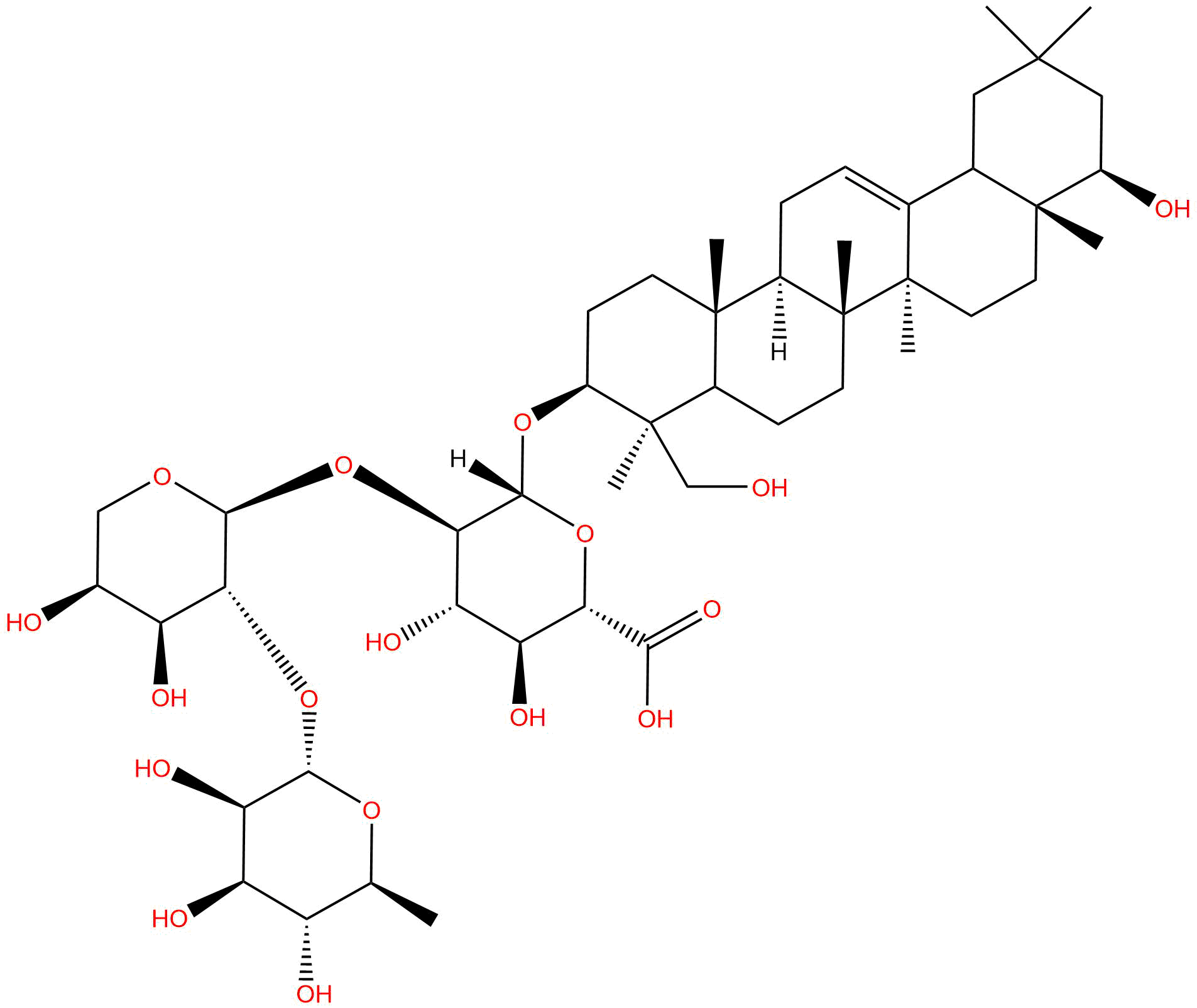


Product name: Soysaponin II
Synonym name:
Catalogue No.: BP4255
Cas No.: 55319-36-3
Formula: C47H76O17
Mol Weight: 913.108
Botanical Source: Glycine max
Type of Compound: Triterpenoids
Purity: 95%~99%
Analysis Method: HPLC-DAD or/and HPLC-ELSD
Identification Method: Mass, NMR
Packing: Brown vial or HDPE plastic bottle
Storage: Store in a well closed container, protected from air and light. Put into refrigerate or freeze for long term storage.
Whenever possible, you should prepare and use solutions on the same day. However, if you need to make up stock solutions in advance, we recommend that you store the solution as aliquots in tightly sealed vials at -20℃. Generally, these will be useable for up to two weeks.
The product could be supplied from milligrams to grams
Inquire for bulk scale.
For Reference Standard and R&D, Not for Human Use Directly.
Storage conditions:Short-term storage at 2~8℃, long-term storage at -20 ~ -80℃
274.7500
2.4298
-.2832
.1959
.5195
.1620
Low
82.6739
6.3673
No
No
Yes
No
No
No
0.0
Yes
No
Yes
No
Soybean saponin II, as a natural triterpenoid saponin derived from soybeans, has attracted widespread attention in the field of natural medicine research in recent years. Saponin compounds exhibit unique advantages in various pharmacological effects such as anti-inflammatory, anti-tumor, and antiviral due to their structural diversity and rich biological activity. Soybean saponin II not only possesses typical triterpenoid saponin structural characteristics, but also exhibits potential pharmacological activity in the prevention and treatment of viral infection related diseases, especially in regulating immune responses and inhibiting virus replication, showing good effects. This article provides a systematic review of the chemical structure and physicochemical properties, plant sources, and extraction methods of soybean saponin II. It delves into its pharmacological activity and mechanism of action, evaluates its pharmacological properties and pharmacokinetic characteristics, and looks forward to its clinical application prospects.
The chemical structure of soybean saponin II belongs to the triterpenoid saponin class, with a molecular formula of C45H-72O17 and a molecular weight of 913.1080. Its core skeleton is a pentacyclic triterpenoid structure, connecting multiple sugar residues to form a typical saponin structure. The LogP value of this compound is 2.4298, indicating moderate lipid solubility that facilitates its penetration into biological membranes in vivo. Its topological polar surface area (TPSA) is 274.75 Å ², indicating its high molecular polarity, which may affect its oral absorption and cell membrane permeability. The water solubility is 0.1959, which belongs to low solubility compounds, indicating the need to consider solubility enhancement strategies in formulation development. The low permeability of the blood-brain barrier suggests its limited distribution in the central nervous system. The negative result of hERG channel inhibition experiment indicates a low risk of cardiac toxicity. The Ames mutagenicity test result is 0, indicating a low risk of genotoxicity.
Soybean saponin II is mainly present in soybean (Glycine max) seeds and their processing by-products. Soybeans are an important global food and oil crop, with abundant saponin components and diverse structures. The extraction of soybean saponins usually uses organic solvent extraction combined with liquid-liquid distribution technology, with ethanol or methanol as the main extraction agent, supplemented by water phase adjustment to improve the dissolution rate of saponins. The extraction solution is concentrated, precipitated, and separated by column chromatography, and finally purified by high performance liquid chromatography (HPLC) to obtain soybean saponin II. In recent years, the application of ultrasound assisted extraction and microwave-assisted extraction technologies has improved extraction efficiency and purity, reduced the use of organic solvents, and is in line with the concept of green chemistry. During the purification process, silica gel column chromatography, reverse phase C18 column chromatography, and preparative HPLC are commonly used separation methods.
Soybean saponin II exhibits significant pharmacological activity in various pathological states, particularly in immune regulation and antiviral effects related to viral infections. In vitro and in vivo studies have shown that soybean saponin II can inhibit the replication of various viruses, including influenza virus, HIV, etc., and has broad-spectrum antiviral potential.
Its antiviral activity is mainly manifested as:
In addition, soybean saponin II also exhibits certain antioxidant and cell protective effects, which may promote tissue repair by reducing oxidative stress and cell apoptosis.
The multi-target mechanism of action of soybean saponin II is an important basis for its pharmacological activity. Its main targets include:
In addition, RRM1 (ribonucleotide reductase M1 subunit), as a key enzyme in nucleotide metabolism, may also be regulated by soybean saponin II, affecting the nucleotide supply required for virus replication.
In summary, soybean saponin II achieves antiviral and immune regulatory functions through multi-target and multi pathway synergistic effects, providing a theoretical basis for its development as an antiviral drug.
The pharmacological parameters of soybean saponin II indicate its potential for development. Its molecular weight is relatively large (913.1080 Da), exceeding the ideal range of traditional oral drugs (<500 Da), which may limit its oral bioavailability. The high TPSA value (274.75 Å ²) and low water solubility (0.1959 mg/mL) also indicate limited absorption, and drug formulation optimization is needed to improve solubility and membrane permeability.
The LogP value is 2.4298, indicating that its lipid solubility is moderate and beneficial for penetrating cell membranes, but combined with high polarity and high molecular weight, overall oral absorption may be poor. The low permeability of the blood-brain barrier limits its application in central nervous system diseases, but reduces the risk of central toxicity.
The hERG channel inhibition experiment was negative, indicating a low risk of cardiac toxicity and good safety. The Ames test result is 0, indicating no mutagenicity and meeting safety requirements.
There is currently limited research on pharmacokinetics. It is speculated that its oral absorption is limited, possibly through intestinal microbiota metabolism or enzymatic hydrolysis to produce active metabolites. The distribution in the body may mainly be concentrated in metabolic organs such as the liver and kidneys. The metabolic pathway may involve the liver cytochrome P450 enzyme system, but further research is needed on the specific enzyme species and metabolites. The main excretion pathways are speculated to be bile and feces.
To overcome the limitations of drug formation, strategies such as nanocarriers, liposome encapsulation, and prodrug design are worth exploring to improve their bioavailability and targeting.
As a natural triterpenoid saponin, soybean saponin II has dual functions of antiviral and immune regulation, and has broad clinical application potential. Its mechanism of action in viral infections, especially in viral diseases such as influenza and HIV, is clear, demonstrating its value as an antiviral adjuvant therapy.
The key to future clinical applications lies in:
In addition, with the development of natural product pharmacology and molecular biology techniques, optimizing the pharmacological and pharmacokinetic properties of soybean saponin II through structural modification and drug design will further promote its clinical translation.
Soybean saponin II, as a natural triterpenoid saponin with unique structure and multi-target mechanism of action, has shown broad research and application prospects in the fields of antiviral and immune regulation. Its ability to regulate virus replication and inflammatory response through multiple targets provides new ideas for the development of antiviral drugs. Although there are certain challenges in its pharmacological development, it is expected to overcome the limitations of bioavailability and pharmacokinetics through modern drug formulation technology and structural optimization. In the future, combined with systematic pharmacological research and clinical validation, soybean saponin II is expected to become an important candidate for natural antiviral drugs, contributing new strength to the prevention and treatment of viral infectious diseases.
