Introduction/Overview
Cardiovascular disease (CVD) is the leading cause of death and disability worldwide, with a complex pathogenesis involving multiple pathophysiological processes such as inflammation, oxidative stress, cell apoptosis, metabolic disorders, and endothelial dysfunction. Although modern medicine has made significant progress in the prevention and treatment of CVD, existing drugs still have limitations such as side effects, drug resistance, and insufficient multi-target regulation. Therefore, searching for new candidate drugs with high efficiency, low toxicity, and multi-target effects from natural products has always been an important direction in drug development. Sanqi(Panax notoginseng)As a precious traditional Chinese medicinal herb, it has the effects of promoting blood circulation, removing blood stasis, reducing swelling, and relieving pain. It has a long history of application in the prevention and treatment of cardiovascular and cerebrovascular diseases, and its pharmacological activity is mainly attributed to the abundant saponin components. Notoginsenoside S (CAS number: 575446-95-6) is a rare saponin monomer isolated and identified from Panax notoginseng in recent years. Compared to the more extensively studied total saponins of Panax notoginseng and ginsenosides Rg1, Rb1, etc., Panax notoginseng saponins S are gradually becoming a new focus of natural product pharmacology research due to their unique chemical structure and extensive and potent pharmacological activities. This article aims to systematically review the chemical properties, plant sources, pharmacological activities, molecular mechanisms of action, pharmacological evaluation, and clinical application prospects of Panax notoginseng saponins S, in order to provide comprehensive scientific references for the in-depth research and development of this compound.
Chemical structure and physicochemical properties
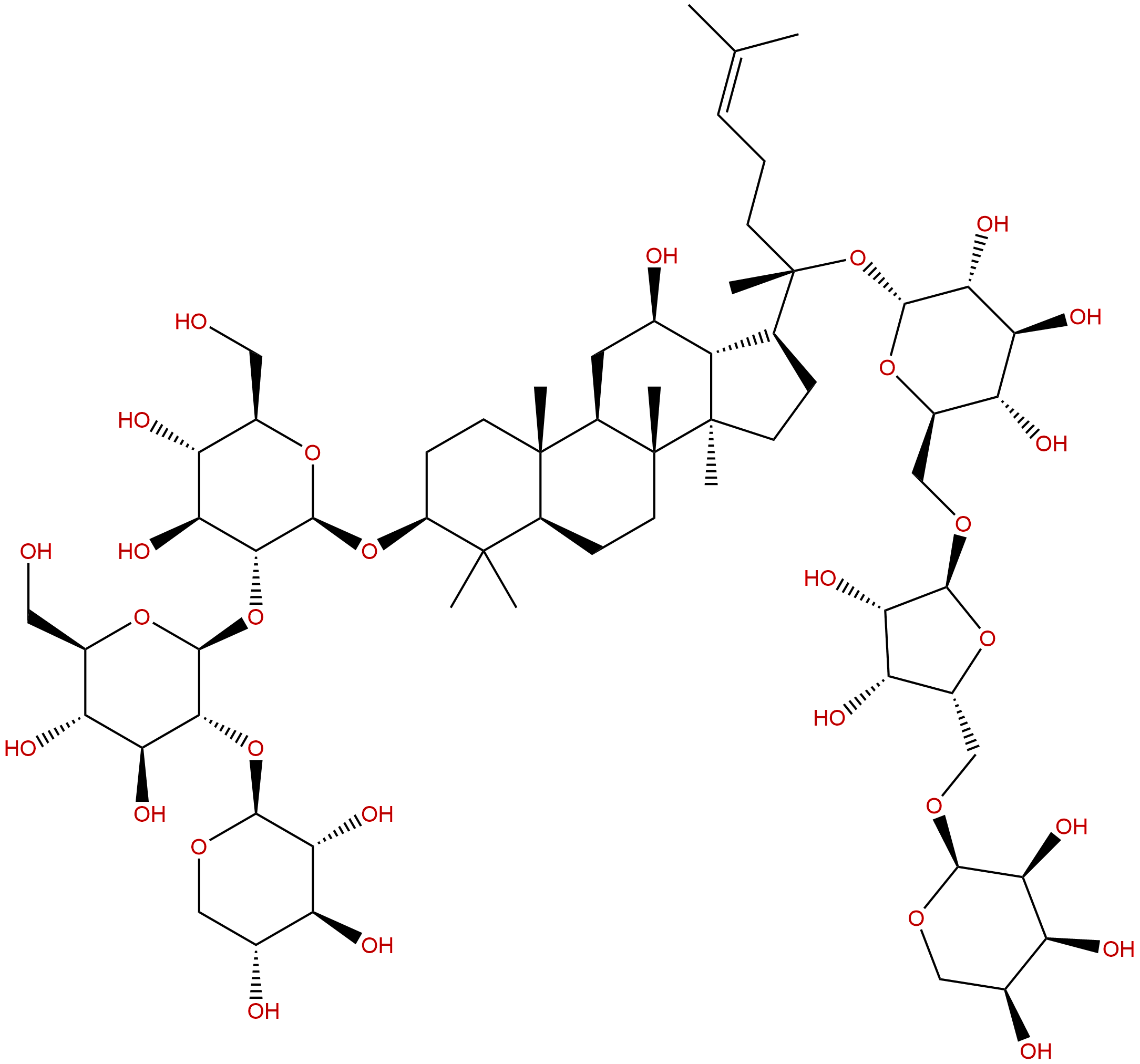
Sanqi saponin S is a type of dammarane tetracyclic triterpenoid saponin, with a molecular formula of C ₆₄ H ₁₁₀ O ∝₂ and a molecular weight of 1343.5110 Da. It is a highly polar and high molecular weight natural product. Its basic skeleton is composed of hydrophobic aglycones and hydrophilic multiple glycosyl side chains. Specifically, its aglycone is a derivative of Protopanaxadiol (PPD) or Protopanaxatriol (PPT) (to be determined based on specific literature, common ginsenosides are mostly PPT type), with complex oligosaccharide chains connected at C-3 and C-20 (or C-6) positions. These sugar groups typically include glucose, xylose, arabinose, etc., and their linking positions, order, and configuration determine the specificity of saponin S.
From the analysis of parameters related to medicinal properties, Sanqi saponin S exhibits typical polar saponin characteristics. Its topological polar surface area (TPSA) is as high as 474.9000 Å ², indicating the presence of a large number of hydrogen bond donors and acceptors (mainly from hydroxyl and glycosidic oxygen) on the molecular surface, which determines its strong hydrophilicity. The calculated lipid water partition coefficient (LogP) is 1.3831, indicating a certain degree of lipophilicity. However, combined with its high TPSA and large molecular weight, it still belongs to the category of compounds with good water solubility (water solubility value: 0.4468, usually indicating a slightly soluble to soluble range). However, its molecular weight of 1343 exceeds the conventional range of the Rule of Five for drugs (<500), and its high polarity limits its ability to cross biofilms. Preliminary computer simulations or in vitro experiments predict that the ability of Sanqi Saponin S to cross the blood-brain barrier (BBB) is "low", suggesting that its direct effect on the central nervous system is unlikely, but it may also reduce the risk of central side effects. In the preliminary safety screening, its hERG inhibitory activity was' no ', indicating a low risk of potential cardiac toxicity (QT interval prolongation); The Ames test result is 0.0, indicating no mutagenicity in this testing system, providing preliminary support for its safety. These physicochemical and pharmacological parameters provide key foundational data for subsequent formulation design and in vivo metabolic studies.
Plant sources and extraction methods
Sanqi saponin S mainly comes from the Panax ginseng plant in the Araliaceae family, Sanqi(Panax notoginseng Dry roots and rhizomes of Burk. F. H. Chen. Sanqi is mainly produced in Wenshan and other areas of Yunnan Province, China. The composition and content of its saponin components are significantly affected by the place of origin, cultivation period, harvest season, and processing methods. Sanqi saponin S is a rare saponin with relatively low content in Sanqi, and its proportion in the total saponins of Sanqi is usually not high, which increases the difficulty of its separation and purification.
At present, obtaining saponins S from Panax notoginseng mainly relies on modern extraction and separation techniques. Firstly, the crude extract is obtained using solvent extraction method. Common solvents include methanol, ethanol, or ethanol water systems with different ratios. Extraction efficiency can be improved through methods such as reflux extraction, ultrasound assisted extraction, or microwave-assisted extraction. After obtaining the crude extract of total saponins from Panax notoginseng, a series of refining steps are required. Macroporous adsorption resins (such as D101 and AB-8) are commonly used for enrichment and purification. By utilizing the adsorption desorption characteristics of saponins and resins, gradient elution is performed with water and different concentrations of ethanol to collect fractions rich in target saponins.
Subsequently, the monomer separation of Sanqi saponin S highly relies on efficient chromatographic techniques. Positive or reverse phase silica gel column chromatography is a commonly used method for preliminary separation. High performance liquid chromatography (HPLC), especially preparative HPLC and high-speed countercurrent chromatography (HSCCC), has become a key technology for separating high-purity Panax notoginseng saponins S. By optimizing the mobile phase (such as acetonitrile water system), chromatographic column (commonly used C18 column), and elution program, effective separation of Panax notoginseng saponins S from other structurally similar saponins can be achieved. Finally, the structure was confirmed by nuclear magnetic resonance (NMR, including ¹ H-NMR, ¹ ³ C-NMR, 2D-NMR), mass spectrometry (MS), and optical rotation determination. With the development of synthetic biology, utilizing microbial cell factories such as yeast to achieve targeted biosynthesis of Sanqi saponin S through heterologous expression of key enzyme genes in the Sanqi saponin biosynthesis pathway is a highly promising emerging strategy to solve the problem of limited natural sources.
Pharmacological activity research
Numerous in vitro and in vivo pharmacological studies have shown that Panax notoginseng saponins S exhibit multifaceted biological activities in the cardiovascular system, nervous system, and metabolic diseases.
1. Cardiovascular protective effect
This is the core pharmacological activity of Sanqi saponin S. Panax notoginseng saponin S showed significant protective effects in animal models of myocardial ischemia/reperfusion (I/R) injury, myocardial hypertrophy, atherosclerosis, etc.
* Anti myocardial ischemia/reperfusion injury In the rat or mouse myocardial I/R injury model induced by coronary artery ligation, pre-treatment with Sanqi saponin S can significantly reduce infarct size, improve cardiac function (such as increasing left ventricular ejection fraction), and reduce the levels of serum myocardial injury markers (such as creatine kinase CK-MB and lactate dehydrogenase LDH).
* Anti atherosclerosis: In ApoE ⁻/⁻ mice atherosclerosis model induced by high-fat diet, Panax notoginsenoside S intervention can reduce the aortic plaque load and stabilize the plaque, and its mechanism is related to regulating blood lipids, inhibiting vascular inflammation and oxidative stress.
* Improving vascular function and anti thrombotic properties Research has shown that Panax notoginseng saponins S can dilate isolated vascular rings pre contracted by norepinephrine or potassium chloride, with endothelial dependent or independent vasodilation effects. In addition, it can inhibit platelet aggregation, prolong clotting time, and demonstrate potential for anti thrombotic effects.
2. Neuroprotective effect
Despite its low BBB permeability, Sanqi saponin S exhibits indirect or direct neuroprotective activity in neurodegenerative disease models such as Alzheimer's disease (AD).
* Anti beta amyloid (A β) toxicity In the A β - induced PC12 cell or primary neuron injury model, Sanqi saponin S can increase cell survival rate and reduce apoptosis. Its effect is closely related to inhibiting BACE1 (β - secretase) activity and reducing A β production.
* Anti cerebral ischemic injury In the middle cerebral artery occlusion (MCAO) model rats, treatment with Panax notoginseng saponins S can reduce cerebral infarction volume and improve neurological deficit scores, with mechanisms involving anti-inflammatory, anti apoptotic, and antioxidant effects.
3. Anti inflammatory and immune regulatory effects
Inflammation is the common pathological basis of various chronic diseases. Sanqi saponin S can dose dependently inhibit the excessive production of pro-inflammatory factors such as nitric oxide (NO), prostaglandin E2 (PGE2), tumor necrosis factor - α (TNF - α), interleukin-6 (IL-6), etc. in a lipopolysaccharide (LPS) - induced macrophage (such as RAW264.7) inflammation model. This anti-inflammatory effect plays an important role in its cardiovascular and neuroprotective effects.
4. Anti diabetes and its complications activity
Diabetes and its vascular complications are important risk factors for CVD. Research has shown that Sanqi saponin S has a certain inhibitory effect on alpha glucosidase and aldose reductase (AKR1B1). AKR1B1 is a key rate limiting enzyme in the polyol pathway, and its over activation is closely related to diabetes cataract, neuropathy and angiopathy. Inhibition of AKR1B1 activity helps to reduce intracellular sorbitol accumulation and oxidative stress, thus alleviating the complications of diabetes.
5. Other activities
Preliminary studies also suggest that Panax notoginseng saponins S may have anti-tumor (by inducing apoptosis, inhibiting proliferation), anti liver fibrosis and other activities, but research in these fields is still in its infancy and requires more evidence to support it.
Mechanism of action and molecular targets
The multiple pharmacological activities of Panax notoginseng saponins S stem from their regulation of multiple signaling pathways within cells and their regulation of multiple key target proteins. Based on the provided target information, the mechanism of action network can be summarized as follows:
1. Regulating energy metabolism and cell survival: AMPK pathway
AMP activated protein kinase (AMPK) is a core sensor of cellular energy metabolism. Sanqi saponin S can activate AMPK (catalyzed by PRKAA1/2 subunit), thereby inhibiting mammalian rapamycin target protein (mTOR) signaling, promoting autophagy, and improving cellular energy homeostasis. In cardiomyocytes, AMPK activation helps to inhibit apoptosis and alleviate hypertrophy; In liver or muscle cells, it can promote glucose uptake and fatty acid oxidation, and improve insulin resistance.
2. Inhibition of cell apoptosis: BCL2 family and mitochondrial pathway
B-cell lymphoma 2 (BCL2) is an important anti apoptotic protein. Sanqi saponin S can upregulate the expression of BCL2 and possibly downregulate the expression of pro apoptotic protein Bax, thereby stabilizing mitochondrial membrane potential, reducing the release of cytochrome C, blocking the activation of caspase cascade reaction, and ultimately inhibiting the apoptosis process of various cells such as cardiomyocytes and neurons.
3. Intervention in neurodegeneration: targeting BACE1 and APEX1
β - site amyloid precursor protein lyase 1 (BACE1) is a key enzyme for generating A β. Sanqi saponin S can directly or indirectly inhibit the activity of BACE1 and reduce the production of A β, which is one of the core mechanisms of its anti AD effect. In addition, depurine/depyrimidine endonuclease 1 (APEX1) is a multifunctional protein involved in DNA repair and oxidative stress response. In AD pathology, abnormal APEX1 function may be associated with neuronal DNA damage and death. Sanqi saponin S may enhance the DNA repair ability of neurons and counteract oxidative stress damage by regulating the activity of APEX1.
4. Regulating inflammatory response: TLR4/NF - κ B signaling axis
Toll like receptor 4 (TLR4) is a key receptor that recognizes endogenous danger signals and exogenous pathogen associated molecular patterns (such as LPS), and its activation triggers inflammatory pathways such as nuclear factor kappa B (NF - κ B). Research has shown that Sanqi saponin S can inhibit the expression or activation of TLR4, thereby blocking the nuclear translocation of NF - κ B, downregulating the expression of inducible nitric oxide synthase (iNOS), cyclooxygenase-2 (COX-2), and various inflammatory cytokines, and exerting a strong anti-inflammatory effect.
5. Improve insulin signaling and metabolism: PTPN1, ESR2, and AKR1B1
Protein tyrosine phosphatase 1B (PTPN1) is a negative regulator of the insulin receptor signaling pathway. Inhibiting PTPN1 activity can enhance tyrosine phosphorylation of insulin receptors and improve insulin sensitivity. Sanqi saponin S may act as an inhibitor of PTPN1. The activation of estrogen receptor beta (ESR2) has also been shown to have a protective effect on cardiovascular and metabolic health, and may be involved in regulating vasodilation and glucose and lipid metabolism. As mentioned above, the inhibition of aldose reductase (AKR1B1) is an important mechanism for its prevention and treatment of diabetes complications.
6. Effects on coagulation and vascular function: SERPINE1 and PRKCA
The plasminogen activator inhibitor-1 (SERPINE1, PAI-1) is the main inhibitor of the fibrinolytic system, and high levels of PAI-1 are associated with an increased risk of thrombosis. Sanqi saponin S may downregulate the expression of SERPINE1, promote fibrinolysis, and inhibit thrombus formation. Protein kinase C alpha (PRKCA) is a member of the PKC family and is involved in various pathological processes such as vasoconstriction and myocardial hypertrophy. Sanqi saponin S may affect vascular tone and cardiac remodeling by regulating the activity of PRKCA.
In summary, Sanqi saponin S forms a complex "multi-target multi pathway" regulatory network by acting on targets such as AMPK, BCL2, BACE1, TLR4, PTPN1, ESR2, APEX1, SERPINE1, PRKCA, AKR1B1, etc., synergistically exerting a comprehensive effect of cardiovascular protection, neuroprotection, anti-inflammatory, and metabolic regulation.
Evaluation of drug properties and pharmacokinetics
Despite the significant pharmacological activity of Sanqi Saponin S, its drug like properties face challenges, mainly due to its large molecular weight and high polarity chemical nature.
Absorption, distribution, metabolism, and excretion (ADME) characteristics:
* absorb As a highly polar saponin, its oral bioavailability may be low. Hydrophilic sugar chains hinder their passive diffusion across the intestinal epithelial cell membrane. It may rely on transporters on intestinal epithelial cells, such as glucose transporters, for uptake, but the efficiency is limited. Under the action of gut microbiota, saponins may undergo deglycosylation and be converted into aglycones (such as PPT or PPD), which have increased lipophilicity and are more easily absorbed. However, the biological activity of Sanqi saponin S itself may be altered.
* distribution Due to its high hydrophilicity and high molecular weight, predicting its tissue distribution is limited, mainly distributed in organs with abundant blood flow such as blood, liver, and kidneys, making it difficult to enter brain tissue (BBB permeability is low), and the distribution of adipose tissue is also limited.
* Metabolism The metabolism of saponin compounds in the body mainly involves hydrolysis (catalyzed by glycosidases in gut microbiota or tissues), oxidation, binding, and other reactions. The liver may be the main site of phase II metabolism (such as glucuronidation and sulfation), and the polarity of metabolites further increases, which is conducive to excretion.
* excretion The prototype drug and its metabolites are mainly excreted through the kidneys via urine, and some may also be excreted through bile via feces.
Formulation strategy and structural modification:
In order to improve its pharmacological properties, current research strategies mainly include:
1. New drug delivery system: Develop liposomes, nanoparticles, microemulsions, self microemulsion drug delivery systems, etc., wrap Panax notoginseng saponins S in a carrier composed of lipids or surfactants, improve its membrane permeability, stability and targeting, so as to improve oral absorption or achieve targeted delivery of specific tissues (such as ischemic myocardium, atherosclerotic plaque).
2. Prodrug strategy Chemical modification of the hydroxyl group on its sugar group (such as esterification, preparation of phosphate ester prodrug) temporarily increases its lipophilicity, promotes absorption, and then releases the active drug through enzymatic interpretation in vivo.
3. Simplification and optimization of structure On the basis of clarifying its pharmacophore (such as specific glycoside structures and key sugar groups), attempt to synthesize derivatives or analogues with smaller molecular weight, more suitable LogP, and retained or enhanced activity.
At present, there are insufficient public reports on the pharmacokinetics of Panax notoginseng saponins S system, and its exact absolute bioavailability, major metabolites, in vivo half-life and other key parameters need to be clarified through more in-depth in vitro and in vivo ADME studies.
Clinical application prospects and prospects
Sanqi saponin S, as a natural active molecule with multi-target effects, has broad development prospects in the following fields:
1. Primary prevention and adjuvant treatment of cardiovascular and cerebrovascular diseases
Based on its powerful anti ischemia, anti-inflammatory, anti apoptosis and antithrombotic effects, Panax notoginseng saponin S is expected to be developed into a new drug for the prevention and treatment of coronary heart disease (angina pectoris, myocardial infarction), ischemic stroke, atherosclerosis and its complications. Especially suitable for complex cases that require multi link intervention, or as a supplement to existing standard treatments such as statins and antiplatelet drugs, to enhance efficacy and reduce side effects.
2. Prevention and treatment of vascular complications in diabetes
It inhibits the activities of AKR1B1 and PTPN1, suggesting that it has potential in the prevention and treatment of diabetes cardiomyopathy, nephropathy, retinopathy and peripheral neuropathy. It can be explored and developed as a special drug for microvascular and macrovascular complications of diabetes.
3. Preventive interventions for neurodegenerative diseases
Although BBB penetration is a barrier to its treatment of central nervous system diseases, its value in inhibiting BACE1 and anti-inflammatory and antioxidant effects cannot be ignored. By improving dosage forms (such as intranasal administration, nanoformulations carrying BBB penetrant carriers) or developing small molecule derivatives that can enter the central nervous system, it may open up a window of application in the prevention and early intervention of diseases such as Alzheimer's disease.
Challenges and future research directions:
1. In depth mechanism research It is necessary to use techniques such as gene knockout/knock in animals, molecular docking, and surface plasmon resonance to more accurately verify its direct interaction with the above-mentioned targets and elucidate its upstream signal sensing mechanism.
2. Optimization of drug properties in the system It is necessary to strengthen its ADME research and actively develop new delivery systems or carry out reasonable structural modifications to solve the fundamental problem of low bioavailability.
3. Preclinical and clinical evaluation It is necessary to conduct systematic safety and efficacy evaluations in animal models that are closer to human diseases, such as the miniature pig coronary heart disease model, and ultimately promote standardized clinical trials to verify its human efficacy and safety.
4. Quality Control and Sustainable Production Establish a high standard quality control system from raw materials of Panax notoginseng to finished products of Panax notoginseng saponins S. At the same time, we will vigorously develop synthetic biology technology to achieve green, sustainable, and large-scale production, freeing ourselves from complete dependence on plant resources.
Conclusion
Sanqi saponin S is a highly valuable natural saponin compound discovered from traditional Chinese medicine Sanqi. With its unique chemical structure, it exhibits excellent multiple pharmacological activities in cardiovascular protection, neuroprotection, anti-inflammatory, and metabolic regulation by acting on multiple key targets such as AMPK, BCL2, BACE1, TLR4, PTPN1, etc., fully reflecting the therapeutic concept of multi-component, multi-target, and holistic regulation of traditional Chinese medicine. Despite the challenges posed by its high molecular weight and high polarity in drug development, such as low bioavailability, the rapid development of modern pharmaceutical, medicinal chemistry, and synthetic biology technologies provides powerful tools to overcome these bottlenecks. In the future, through in-depth interdisciplinary cooperation and research, Panax notoginseng saponin S is expected to be successfully transformed from a potential lead compound into an innovative drug for the prevention and treatment of major chronic diseases such as cardio cerebrovascular diseases and diabetes complications, contributing to human health from the integration of ancient wisdom and modern science and technology.