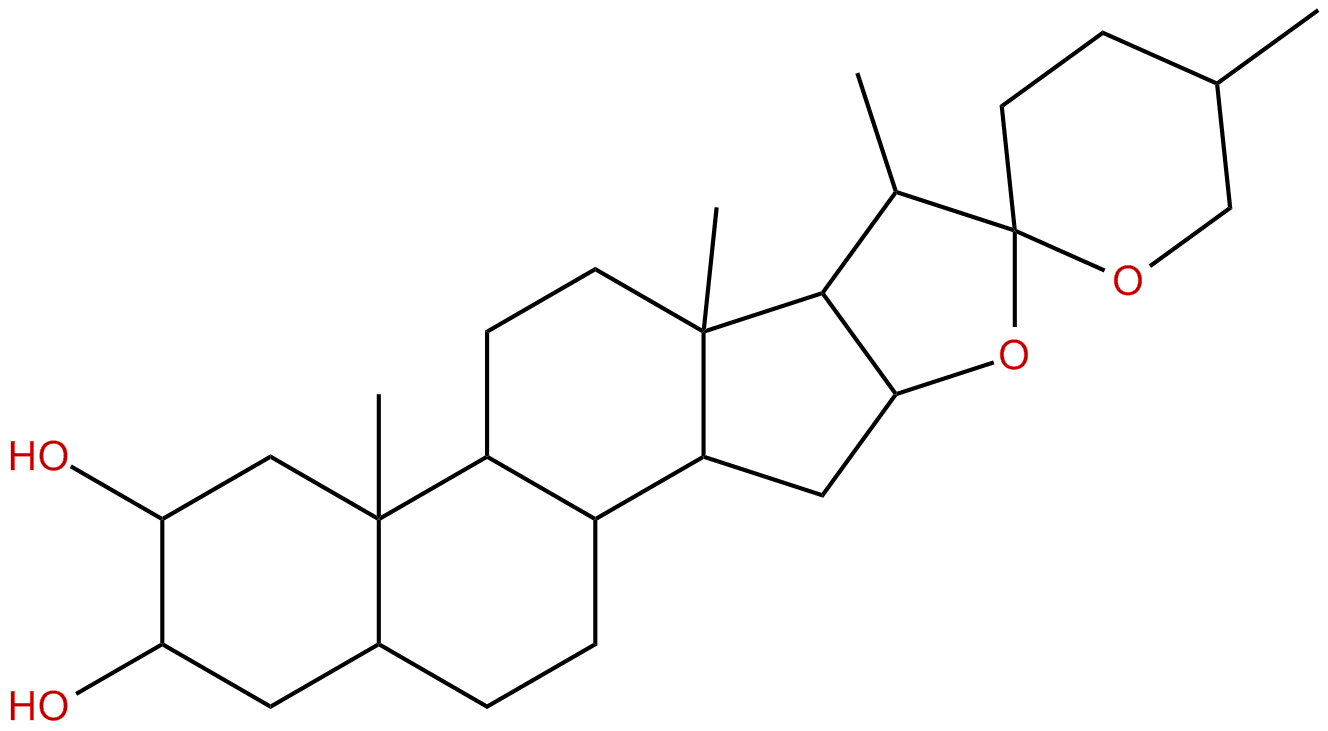


Product name: Gitogenin
Synonym name: (2alpha,3β,5alpha,25R)-Spirostan-2,3-diol; Digine
Catalogue No.: BP0672
Cas No.: 511-96-6
Formula: C27H44O4
Mol Weight: 432.645
Botanical Source: Tribulus terrestris L.
Physical Description:
Type of Compound: Steroids
Purity: 95%~99%
Analysis Method: HPLC-DAD or/and HPLC-ELSD
Identification Method: Mass, NMR
Packing: Brown vial or HDPE plastic bottle
Storage: Store in a well closed container, protected from air and light. Put into refrigerate or freeze for long term storage.
Whenever possible, you should prepare and use solutions on the same day. However, if you need to make up stock solutions in advance, we recommend that you store the solution as aliquots in tightly sealed vials at -20℃. Generally, these will be useable for up to two weeks.
The product could be supplied from milligrams to grams
Inquire for bulk scale.
Chengdu Biopurify Phytochemicals Ltd. is a leading company in the research, development, manufacture and marketing of High Quality Phytochemicals and Extracts(especially Active Ingredients from Traditional Chinese Medicine,TCM), Natural Active Pharmaceutical Ingredients worldwide.
The main services:
A. Supply active ingredients and reference standards of TCM, from mgs to kgs scale
B. Custom extraction and purification, target Herb Active Ingredients
C. Custom synthesis and semi-synthesis for Natural Active Ingredients
D. CR(contract research), CM(contract manufacture) and PD(process development) services from lab scale, pilot scale to commercial scale(GMP is also available)
E. TCM compounds library for drug screen,more than 3000 compounds available, many of them are rare and unique.
Storage conditions:Short-term storage at 2~8℃, long-term storage at -20 ~ -80℃
Gitogen (CAS number: 511-96-6) is an important natural steroid compound originally derived from plants Tribulus longipetalus Separated from the entire plant. As a class of steroidal sapogenins with multiple biological activities, Gidrosponin has attracted widespread attention in the field of natural product pharmacology in recent years due to its unique chemical structure and significant biological activity. Research has shown that ginsenosides can selectively inhibit UDP glucuronosyltransferase 1A4 (UGT1A4) and alpha glucosidase, exhibiting low and medium micromolar inhibitory activities, respectively. At the same time, they have no significant inhibitory effect on the main cytochrome P450 enzyme systems in the human body, demonstrating good safety and specificity.
As an important metabolic organ in the human body, liver dysfunction is closely related to various diseases. The potential regulatory role of ginsenosides in liver disease related targets, such as ABCB1, PRKCA, IDH1, NFE2L2, suggests that they may play an important role in the prevention and treatment of liver diseases. This article will provide a systematic review of the chemical structure, sources, pharmacological activities, mechanisms of action, pharmacological properties, and clinical application potential of ginsenosides, aiming to provide theoretical basis and reference for their subsequent drug development and clinical research.
Jituo saponin element belongs to natural steroid compounds, with a molecular formula of C27H42O5 and a molecular weight of 432.6450. Its structural core is a typical steroid skeleton with multiple hydroxyl and oxidative functional groups, endowing it with specific physicochemical properties. According to the calculated data, the LogP value of Jituo saponin is 4.3386, indicating strong lipid solubility and facilitating penetration of cell membranes and the blood-brain barrier (BBB). Its topological polar surface area (TPSA) is 58.92 Å ², making it a moderately polar compound that facilitates binding with biomolecules.
Very low water solubility (0.0006 mg/mL) suggests limited solubility in aqueous phase, which may affect oral bioavailability. It is worth noting that ginsenosides do not inhibit hERG channels, reducing the risk of cardiac toxicity, and the Ames mutagenicity test result is 0, indicating a low genetic toxicity risk. These physicochemical and safety parameters lay the foundation for further drug development.
Jituo saponin mainly comes from Tribulus longipetalus Separated from the entire plant. This plant belongs to the Zygophyllaceae family and is widely used in traditional medicine to enhance physical strength, improve liver and kidney function, and other aspects. During the extraction process, organic solvents such as methanol or ethanol are usually used for reflux extraction of dried plant powder, followed by multi-step separation and purification processes such as liquid-liquid distribution and silica gel column chromatography to obtain high-purity ginsenosides.
In recent years, the combination of supercritical CO2 extraction and high-performance liquid chromatography (HPLC) has also been used to improve extraction efficiency and purity. The purified ginsenosides can be structurally identified by mass spectrometry and nuclear magnetic resonance (NMR) techniques to ensure their chemical purity and structural integrity.
The pharmacological activity of ginsenosides mainly focuses on enzyme inhibition and cell protection. In vitro experiments have shown that ginsenosides have a significant selective inhibitory effect on UDP glucuronosyltransferase 1A4 (UGT1A4), with an IC50 value of 0.69 µ M (using triflurazine as substrate). UGT1A4 is an important phase II metabolic enzyme in the liver, involved in the glucuronidation metabolism of various drugs and endogenous substances. Regulating its activity helps to regulate drug metabolism kinetics and detoxification processes.
In addition, the inhibitory effect of gitosigenin on α - glucosidase is also obvious, IC50 is 37.2 µ M. α - glucosidase is a key enzyme in carbohydrate metabolism, inhibiting this enzyme helps to delay the decomposition and absorption of carbohydrates, and has a potential anti diabetes effect. It is worth mentioning that ginsenosides have no significant inhibition on the main cytochrome P450 enzyme system in the human body, reducing the risk of drug interactions.
In terms of liver protection, Gidrosponin exhibits multiple effects such as antioxidant, anti-inflammatory, and anti fibrotic effects by regulating multiple signaling pathways. Studies on related cells and animal models have shown that ginsenosides can alleviate liver damage, improve liver function indicators, inhibit liver cell apoptosis, and promote liver tissue repair.
The pharmacological mechanism of Jituo saponin involves multiple molecular targets, especially the regulatory effect on liver disease related targets, which has attracted much attention. Through molecular docking and bioinformatics analysis, it has been found that ginsenosides have potential binding ability to the following targets:
ABCB1 (P-glycoprotein)As an important drug efflux pump, ABCB1 regulates the excretion and metabolism of drugs in liver cells. Jituo saponin may affect the liver clearance and drug resistance of drugs by regulating ABCB1 activity.
PRKCA and PRKCD (protein kinase C subtypes)These two kinases are involved in cell signal transduction, inflammatory response, and cell apoptosis. Jituo saponin may exert anti-inflammatory and anti fibrotic effects by regulating the PRKCA/PRKCD signaling pathway.
IDH1 (isocitrate dehydrogenase 1)IDH1 plays a crucial role in cellular metabolism and redox homeostasis, and Giptosin may regulate liver cell metabolic status by affecting IDH1 activity.
NFE2L2 (Nrf2 transcription factor)Nrf2 is the core regulatory factor of cellular antioxidant response. Gintokinase activates the NFE2L2 signaling pathway, enhances antioxidant enzyme expression, and reduces oxidative stress damage.
CASP1 (caspase 1)Jituo saponin may alleviate liver inflammation and cell death by inhibiting CASP1, which is involved in inflammasome activation and cell apoptosis.
PIK3CG (Phosphatidylinositol 3-kinase gamma)Regulating cell proliferation and survival, Gidroside may promote liver cell repair by modulating the PI3K/AKT signaling pathway.
TRPV1 (Transient receptor potential vanillic acid receptor 1)Involved in pain and inflammatory responses, the regulation of TRPV1 by Gidroside may help alleviate symptoms related to liver inflammation.
SHBG (Sex Hormone Binding Globulin)and HIF1A (hypoxia inducible factor 1 alpha)The effects of ginsenosides on these targets, which are involved in hormone regulation and hypoxia response, suggest their potential regulatory roles in liver metabolism and hypoxic environments.
In summary, the synergistic effect of Jituo saponin through multiple targets and pathways provides a molecular basis for its liver protective and metabolic regulatory functions as a candidate drug for liver disease treatment.
The pharmacological evaluation of Jituo Saponin Element shows relatively ideal drug properties. Its molecular weight is 432.6450, which meets the molecular weight requirements for oral active drugs in Lipinski's rules. Although the LogP value of 4.3386 is relatively high, it is still within an acceptable range, indicating that it has good lipid solubility, which is beneficial for cell membrane penetration and blood-brain barrier passage, and predicts its potential application in central nervous system diseases.
The TPSA is 58.92 Å ², indicating that its polarity is moderate and beneficial for binding to the target protein. Very low water solubility may limit its oral absorption, and its bioavailability needs to be improved through formulation optimization or drug carrier technology. Jituo saponin has shown high blood-brain barrier penetration ability, expanding its potential applications in neurological related diseases.
In terms of safety, Jituo saponin does not inhibit hERG channels, reducing the risk of cardiac toxicity; The Ames test is negative, indicating no significant genetic toxicity. In addition, Jituo saponin has no significant inhibition on the main cytochrome P450 enzyme system in the human body, reducing the possibility of drug interactions.
At present, there is limited pharmacokinetic data on Giptosenoside, and preliminary in vivo studies suggest that it has a long half-life and good tissue distribution, especially at high concentrations in liver and brain tissues. Further systematic pharmacokinetic and toxicological studies are needed in the future to provide support for clinical development.
Jituo saponin, as a natural steroid compound with multi-target regulatory ability, has shown broad application prospects in the field of liver disease prevention and treatment. Its selective inhibition of UGT1A4 and α - glucosidase suggests that it has potential value in regulating drug metabolism and glucose metabolism, and may be used as an adjuvant treatment for liver metabolic abnormalities and diabetes related liver diseases.
By regulating key liver targets such as NFE2L2, PRKCA, CASP1, etc., ginsenosides can alleviate oxidative stress and inflammatory reactions, inhibit the progression of liver fibrosis, promote liver cell repair, and have the potential to be developed as anti hepatitis, anti liver fibrosis, and cirrhosis drugs. In addition, its good safety and low genetic toxicity risk provide assurance for clinical translation.
Future research should focus on the preclinical pharmacokinetics, toxicological evaluation, and determination of effective dose range of ginsenosides. At the same time, by combining modern pharmaceutical formulation technology, its water solubility and oral bioavailability can be improved. Multi center clinical trials will be a key step in verifying its efficacy and safety.
In addition, given the high blood-brain barrier permeability of ginsenosides, their potential for application in neurological diseases is also worth exploring, especially in the treatment of liver related neuropathological states such as hepatic encephalopathy, which may play a unique role.
Jituo saponins, as a source from Tribulus longipetalus Natural steroid compounds, with their unique chemical structure and significant biological activity, have shown broad application prospects in the research field of liver disease and related metabolic diseases. Its selective inhibition of UGT1A4 and α - glucosidase, as well as its ability to regulate multiple liver targets, reveal its potential pharmacological mechanisms and therapeutic value.
The evaluation of drug properties shows that Jituo saponin has good safety and blood-brain barrier penetration ability, making it suitable for further drug development. Future research should focus on its pharmacokinetic characteristics, formulation optimization, and clinical efficacy verification, in order to transform this natural product into a safe and effective new drug for liver disease treatment.
In summary, as an important object of pharmacological research on natural products, ginsenosides not only enrich the research system of steroid natural medicines, but also provide new ideas and candidate molecules for the treatment of liver and metabolic diseases, which is worthy of continuous attention and in-depth development.
