


Product name: Hecogenin
Synonym name: Hocogenin
Catalogue No.: BP0705
Cas No.: 467-55-0
Formula: C27H42O4
Mol Weight: 430.629
Botanical Source: Tribulus terrestris L.
Physical Description:
Type of Compound: Steroids
Purity: 95%~99%
Analysis Method: HPLC-DAD or/and HPLC-ELSD
Identification Method: Mass, NMR
Packing: Brown vial or HDPE plastic bottle
Storage: Store in a well closed container, protected from air and light. Put into refrigerate or freeze for long term storage.
Whenever possible, you should prepare and use solutions on the same day. However, if you need to make up stock solutions in advance, we recommend that you store the solution as aliquots in tightly sealed vials at -20℃. Generally, these will be useable for up to two weeks.
The product could be supplied from milligrams to grams
Inquire for bulk scale.
Chengdu Biopurify Phytochemicals Ltd. is a leading company in the research, development, manufacture and marketing of High Quality Phytochemicals and Extracts(especially Active Ingredients from Traditional Chinese Medicine,TCM), Natural Active Pharmaceutical Ingredients worldwide.
The main services:
A. Supply active ingredients and reference standards of TCM, from mgs to kgs scale
B. Custom extraction and purification, target Herb Active Ingredients
C. Custom synthesis and semi-synthesis for Natural Active Ingredients
D. CR(contract research), CM(contract manufacture) and PD(process development) services from lab scale, pilot scale to commercial scale(GMP is also available)
E. TCM compounds library for drug screen,more than 3000 compounds available, many of them are rare and unique.
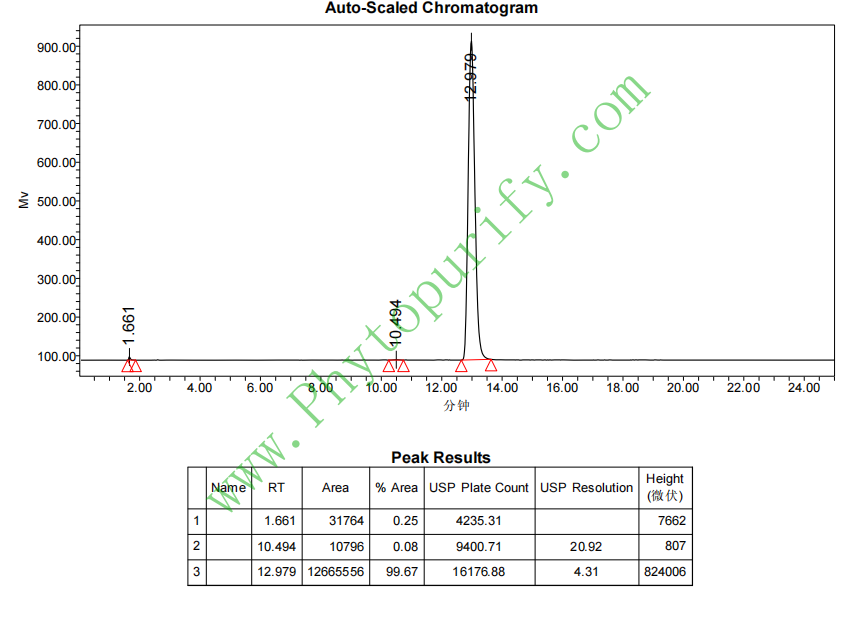
HPLC of Hecogenin
Storage conditions:Short-term storage at 2~8℃, long-term storage at -20 ~ -80℃
55.7600
4.1334
4.1334
.0017
5.9339
11.9699
High
82.7939
5.3918
No
No
No
No
Yes
No
0.0
No
No
No
No
Hetogenin (CAS number: 467-55-0) is a natural steroid sapogenin mainly derived from sisal(Agave sisalana)Separated from the middle. As a steroid compound with a unique chemical structure, hesperidin has attracted widespread attention due to its diverse biological activities. In recent years, with the deepening development of natural product pharmacology, the potential pharmacological effects of Haike saponin in anti-inflammatory, antifungal, and gastric mucosal protection have gradually been revealed, especially in the field of tumor treatment, showing significant research value. Its characteristics as a selective inhibitor of human UDP glucuronosyltransferase (UGT) provide new ideas for regulating drug metabolism and endogenous substance metabolism. In addition, the regulatory effect of Haike Saponin on multiple molecular targets related to prostate cancer suggests its potential in tumor targeted therapy. This article aims to provide a systematic review of the chemical structure, sources, pharmacological activity, mechanism of action, and pharmacological evaluation of Haike Saponin, and explore its clinical application prospects and future research directions.
Haike saponin element belongs to the typical steroid saponin element, with a molecular formula of C27H42O4 and a molecular weight of 430.6290. Its structural core is a steroid skeleton with a typical four ring structure, containing functional groups such as hydroxyl and ketone groups. The LogP value of Haike Saponin is 4.1334, indicating high lipid solubility and facilitating penetration of cell membranes and the blood-brain barrier (BBB). Its TPSA (topological polar surface area) is 55.76 Å ², indicating moderate polarity and facilitating the passage of biological membranes. Low water solubility (0.0017 mg/mL) suggests limited solubility in aqueous phase, which may affect oral bioavailability. The negative result of hERG channel inhibition experiment indicates a low risk of cardiac toxicity; The Ames mutagenicity test result was 0.0, indicating good genetic toxicity safety.
The chemical structural characteristics of Haike saponin give it the possibility of multi-target action, especially in regulating cell signaling pathways and metabolic enzyme activity, showing unique advantages.
Haike saponins are mainly derived from sisal(Agave sisalana)A succulent plant widely distributed in tropical and subtropical regions. Jianma is famous for its rich steroidal saponin compounds, among which Haike Saponin is an important steroidal saponin component.
Traditional extraction methods often use solvent extraction combined with column chromatography separation technology. The general process includes:
In recent years, the application of modern technologies such as ultrasound assisted extraction (UAE) and microwave-assisted extraction (MAE) has significantly improved the extraction efficiency and purity of hesperidin, reducing solvent usage and extraction time.
Haike saponins exhibit various pharmacological activities, including anti-inflammatory, antifungal, gastroprotective, and anti-tumor effects.
Haike saponin exerts significant anti-inflammatory effects by inhibiting the production and release of inflammatory mediators. In vitro experiments have shown that it can inhibit the expression of pro-inflammatory factors such as tumor necrosis factor - α (TNF - α), interleukin-6 (IL-6), and nitric oxide (NO) in macrophages. Mechanistically, Haike Saponin reduces the cascade amplification of inflammatory response and mitigates tissue damage by regulating the NF - κ B signaling pathway.
Haike saponin has inhibitory effects on various fungal pathogens, especially showing good efficacy against skin fungal infections. Its antifungal mechanism may involve disrupting the integrity of fungal cell membranes and inhibiting the activity of key fungal enzymes, blocking fungal growth and reproduction.
In terms of gastric mucosal protection, hesperidin can promote mucus secretion, enhance gastric mucosal barrier function, inhibit gastric acid secretion, and alleviate gastric mucosal inflammation and ulcer formation. Animal model studies have shown that saikosaponin has a significant protective effect on gastric ulcers induced by nonsteroidal anti-inflammatory drugs (NSAIDs).
In recent years, Haike Saponin has attracted much attention in anti-tumor research, especially in the study of prostate cancer. It regulates cell proliferation, apoptosis, and signaling pathways through multiple targets, inhibiting the growth and metastasis of tumor cells. Both in vitro cell experiments and in vivo tumor models have confirmed its anti-cancer potential.
The mechanism of action of Haike Saponin is complex, involving multiple signaling pathways and key molecular targets, especially in the treatment research of prostate cancer.
As a selective inhibitor of human UDP glucuronosyltransferase, hesperidin can regulate the metabolism of drugs and endogenous substances, affecting pharmacokinetics and toxicity in vivo. The UGT enzyme family is involved in the glucuronidation metabolism of various drugs, and the inhibitory effect of hesperidin may enhance the bioavailability and efficacy of certain drugs.
Haike saponin exerts anti-tumor effects by regulating various targets closely related to the occurrence and development of prostate cancer:
Haike saponin also exerts anti-inflammatory and antioxidant effects, reduces tissue damage, and promotes tissue repair by regulating signaling pathways such as NF - κ B, MAPK, and Nrf2.
The pharmacological evaluation of Haike Saponin Element shows that it has certain potential for drug development:
In terms of pharmacokinetics, existing research is relatively limited. Preliminary in vivo experiments have shown that the absorption of Haike saponin is slow and widely distributed after oral administration, mainly through liver metabolism. The excretion pathway still needs further clarification. Its UGT inhibitory effect may affect the pharmacokinetics of itself and other drugs, indicating the need to pay attention to drug interactions in combination therapy.
Haike saponin element has shown broad clinical application potential due to its multi-target and multi pathway pharmacological activities.
Research on prostate cancer is particularly prominent. Haike saponin can inhibit tumor growth and metastasis by regulating tumor cell proliferation, apoptosis, and hormone signaling pathways, and has the potential to be developed as a new anti prostate cancer drug. In the future, its in vivo pharmacodynamics and safety evaluation should be strengthened, and preclinical animal models and early clinical trials should be conducted.
Haike saponin has broad application prospects in inflammatory diseases, especially in chronic inflammation and immune-mediated diseases. Its regulatory effect on the NF - κ B and Nrf2 pathways provides a theoretical basis for the development of novel anti-inflammatory drugs.
As a natural antifungal agent and gastric mucosal protector, Haike saponin may become an adjuvant drug for treating skin fungal infections and gastric ulcers. Combining modern formulation technology can enhance its bioavailability and therapeutic efficacy.
Its selective inhibition of UGT enzyme provides a new strategy for regulating drug metabolism, improving the efficacy of certain drugs, and reducing toxicity. In the future, its application in drug combination therapy can be explored.
As a natural steroidal saponin derived from sisal, Haike saponin has become a hot topic in natural product pharmacology research due to its unique chemical structure and diverse pharmacological activities. It has shown broad application prospects in the fields of anti-inflammatory, antifungal, gastric protection, and anti-tumor, especially in the treatment of prostate cancer through multi-target regulation. The drug evaluation shows that it has good safety and blood-brain barrier penetration ability, but its water solubility is low and needs to be optimized through formulation technology. In the future, combined with modern drug research and development technology, Haike Saponin is expected to develop into a new type of drug with clinical value. In depth pharmacokinetic studies, analysis of multi-target mechanisms of action, and clinical validation will lay a solid foundation for its translational applications.
