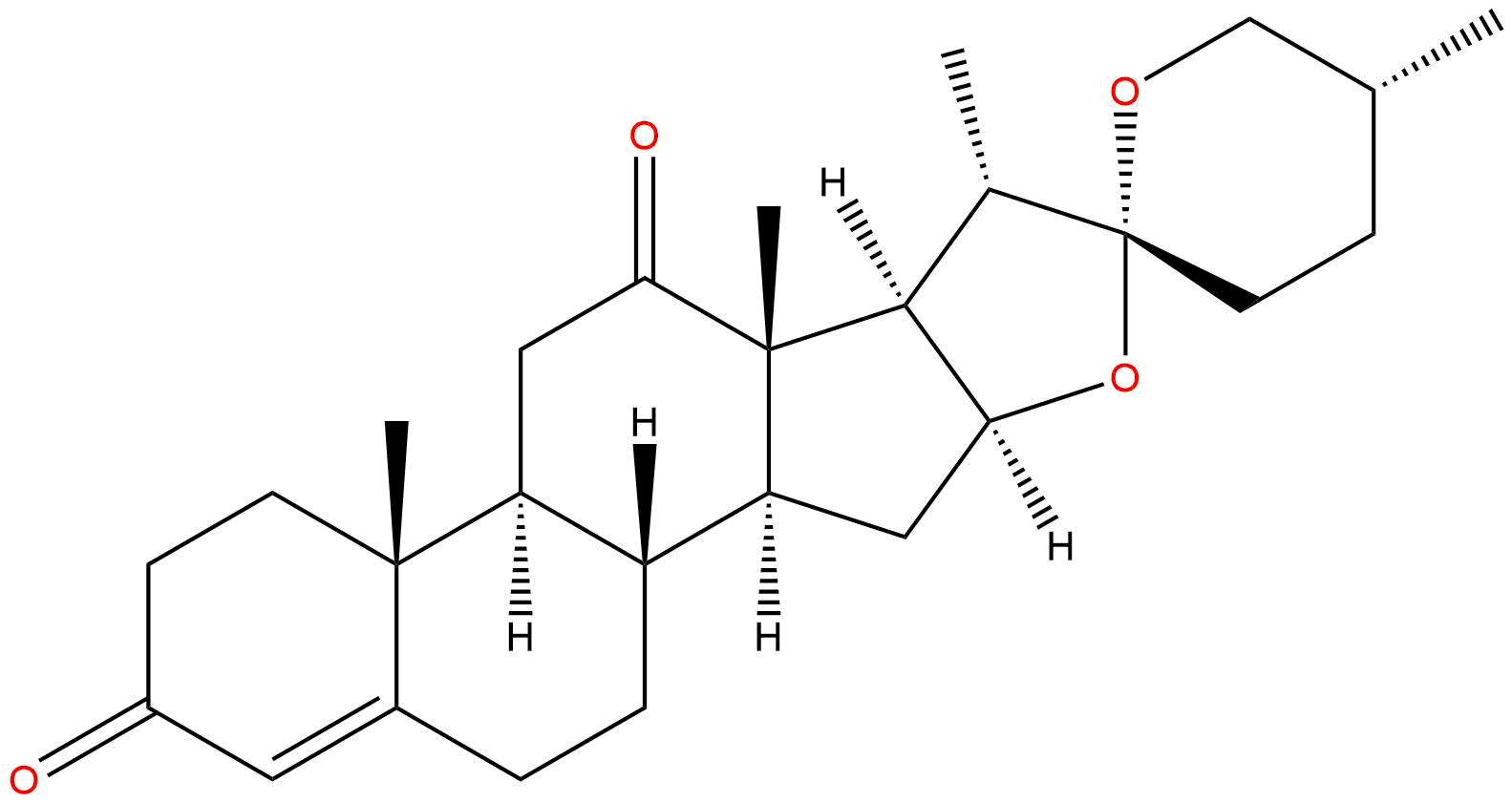


Product name: (25R)-Spirost-4-ene-3,12-dione
Synonym name:
Catalogue No.: BP4529
Cas No.: 6875-60-1
Formula: C27H38O4
Mol Weight: 426.597
Botanical Source:
Type of Compound: Steroids
Purity: 95%~99%
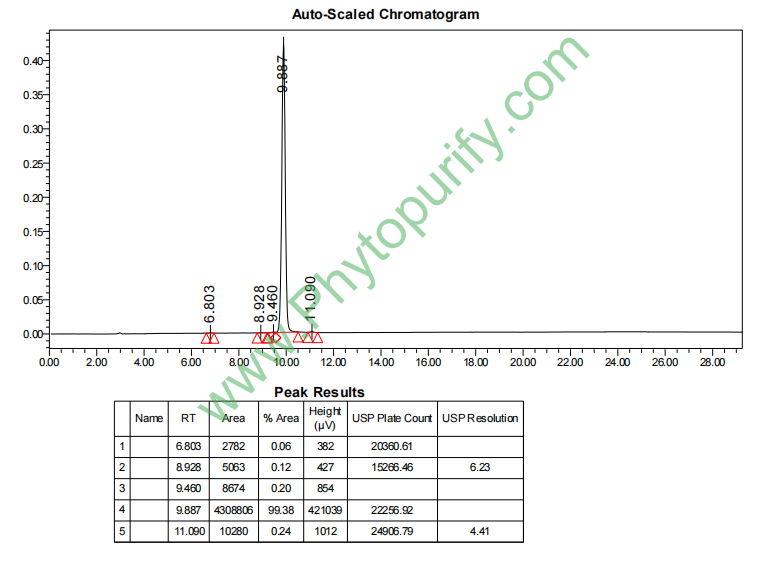
Analysis Method: HPLC-DAD or/and HPLC-ELSD
Identification Method: Mass, NMR
Packing: Brown vial or HDPE plastic bottle
Storage: Store in a well closed container, protected from air and light. Put into refrigerate or freeze for long term storage.
Whenever possible, you should prepare and use solutions on the same day. However, if you need to make up stock solutions in advance, we recommend that you store the solution as aliquots in tightly sealed vials at -20℃. Generally, these will be useable for up to two weeks.
The product could be supplied from milligrams to grams
Inquire for bulk scale.
For Reference Standard and R&D, Not for Human Use Directly.
HPLC of (25R)-Spirost-4-ene-3,12-dione
Storage conditions:Short-term storage at 2~8℃, long-term storage at -20 ~ -80℃
52.6000
3.9123
3.9123
.0022
7.6021
19.7899
High
81.6276
5.3168
No
No
No
No
Yes
No
0.3
No
No
No
Yes
Tribulus terrestris saponins, chemical name (25R) - Spirost-4-ene-3,12-dione, are an important class of steroidal saponins in the traditional Chinese medicine Tribulus terrestris L. Its CAS number is 6875-60-1 and its molecular formula is C27H38O4. Traditional Chinese medicine believes that Tribulus terrestris has the effects of calming the liver, relieving depression, promoting blood circulation, dispelling wind, improving vision, and relieving itching. It is commonly used to treat symptoms such as headache, dizziness, chest and rib pain, breast closure and abscess, blurred vision, and skin itching. Modern pharmacological research has revealed that saponins from Tribulus terrestris are one of the key substance bases for the various biological activities of Tribulus terrestris, especially in improving male sexual function, showing significant potential and becoming a hot topic in natural product research and development.
With the increase of social pressure and changes in lifestyle, Male Sexual Dysfunction (MSD), especially Erectile Dysfunction (ED) and low libido, has become a common problem affecting men's physical and mental health and quality of life. At present, although first-line treatment drugs such as PDE5 inhibitors (sildenafil, etc.) are effective, there are still some patients who are ineffective, have side effects (headaches, flushing, visual abnormalities), and cannot fundamentally improve sexual desire. Therefore, searching for new therapeutic drugs with multiple targets and high safety from traditional herbs has important scientific value and clinical significance. This article aims to systematically review the chemical properties, pharmacological activities, mechanisms of action, medicinal properties, and application prospects of saponins from Tribulus terrestris in improving male sexual function, in order to provide comprehensive academic references for the in-depth research and development of this compound.
Tribulus terrestris saponins belong to spirostanol compounds, with a core structure of cyclopentane and a fully hydrogenated phenanthrene skeleton, and a characteristic spiroketide structure (C22 position connected to an oxygen-containing hexagonal ring). Its specific structure is (25R) - Spirost-4-ene-3,12-dione, indicating that its C25 position is an R configuration, the C3 position of the A ring and the C12 position of the C ring are both ketone groups, and the C4-C5 positions of the A ring are double bonds. This unique structure is the chemical basis for its biological activity.
The parameters related to its medicinal properties are as follows:
- molecular weight 426.5970, belonging to medium molecular weight compounds, meets the basic requirements of the Rule of Five for generic drugs.
- Lipid water partition coefficient (LogP): 3.9123. This value indicates that saponins from Tribulus terrestris have good lipophilicity, which is beneficial for their penetration into cell membranes, but also suggests that their water solubility may be poor.
- Topological Polarity Surface Area (TPSA)52.6000 Å ². The relatively low TPSA value further supports its good membrane permeability.
- Water solubility The experimental or predicted value is about 0.0022 mg/mL, which belongs to insoluble compounds. This may be a major limiting factor for its oral bioavailability, and solubilization strategies need to be considered in formulation development (such as making solid dispersions, cyclodextrin inclusion complexes, or nano formulations).
- Blood-brain barrier permeability Predicted as' high '. This means that saponins from Tribulus terrestris may enter the central nervous system, which may be related to their role in regulating sexual function through central targets such as CNR1.
- HERG inhibition risk Predicted as' no '. The inhibition of hERG potassium channels is associated with the risk of prolonged QT interval and apical torsion ventricular tachycardia in the heart, and this negative prediction suggests a lower potential risk of cardiac toxicity associated with saponins from Tribulus terrestris.
- Ames test (mutagenicity)The reported value is 0.3 (usually expressed in response to the number of mutant colonies, which needs to be interpreted in conjunction with specific experimental backgrounds, but generally lower values indicate a lower risk of mutagenicity). This provides a preliminary basis for the genetic toxicity safety of its long-term use.
These physicochemical and pharmacological parameters outline a natural product profile with good membrane permeability, potential central activity, and low risk of cardiac toxicity, but poor water solubility is a key bottleneck that needs to be overcome.
Tribulus terrestris saponins are mainly derived from the dried and ripe fruits of the Tribulus terrestris L. plant in the family Tribulus. Tribulus terrestris is widely distributed in temperate regions around the world and is either wild or cultivated in various parts of China. Its active ingredients (saponins) are mainly enriched in fruits and rhizomes.
The usual process for extracting saponins from Tribulus terrestris is as follows:
1. Preprocessing Dry and crush the fruit of Tribulus terrestris to obtain coarse powder.
2. Solvent extraction Ethanol or methanol aqueous solutions are commonly used for heating reflux or ultrasound assisted extraction to dissolve saponin components from plant cells.
3. hydrolysis The initial presence in the extract is highly polar saponins (glycosylated sapogenins). In order to obtain sapogenins, total saponins need to be subjected to acid hydrolysis (usually hydrochloric acid or sulfuric acid) or enzymatic hydrolysis to break glycosidic bonds and release more hydrophobic sapogenins.
4. Separation and purification The hydrolyzed mixture is extracted with organic solvents (such as ethyl acetate, chloroform) to obtain crude sapogenin. Further purification is often carried out using methods such as silica gel column chromatography, reverse phase column chromatography, and preparative high-performance liquid chromatography (HPLC), ultimately obtaining high-purity monomers of saponins from Tribulus terrestris.
Modern extraction techniques such as supercritical CO2 fluid extraction and microwave-assisted extraction have also been explored to improve extraction efficiency and reduce solvent usage. Standardized and controllable extraction processes are key to ensuring the consistency of research materials for saponins in Tribulus terrestris and the quality of future products.
Numerous preclinical studies have confirmed that saponins from Tribulus terrestris have a wide range of pharmacological activities, with the most prominent and extensively studied direction being the improvement of male sexual function.
The effect of saponins from Tribulus terrestris on improving male sexual function is not through a single pathway, but involves a multi-target synergistic regulatory network of peripheral and central nervous system, mainly focusing on the following key targets:
Mechanism integration Tribulus terrestris saponins strongly enhance the "NO cGMP" pathway in the peripheral corpus cavernosum by inhibiting PDE5 and activating NOS1, promoting vasodilation and erection (symptomatic). At the same time, it enhances sexual desire and drive by regulating central CNR1 and AR (fundamental); And maintain sexual organ health through AR, protect vascular and neurological function through antioxidant and anti-inflammatory measures (fundamental). This "central peripheral" linkage and "multi-target multi pathway" synergistic mode of action theoretically gives it a comprehensive advantage over single target PDE5 inhibitors, especially suitable for complex functional disorders accompanied by low libido or psychological factors.
Based on its physicochemical properties, the pharmacological properties and pharmacokinetic characteristics of saponins from Tribulus terrestris are evaluated as follows:
Tribulus terrestris saponins show broad prospects in the field of men's health through translational medicine:
However, achieving its clinical translation still faces a series of challenges:
- The mechanism of action needs further precise explanation More conclusive evidence is needed at the molecular and cellular levels to determine whether the effects on targets such as CNR1 and AR are excitatory, antagonistic, or allosteric regulation.
- Lack of high-level clinical evidence At present, the vast majority of research is still at the animal and cellular levels, and there is an urgent need to design rigorous randomized double-blind placebo-controlled clinical trials to verify their effectiveness and safety in humans.
- Intellectual Property and Standardization How to build an effective patent protection network around its new uses, new formulations, and new compositions, and establish quality control standards for the entire process from raw materials to finished products, is the key to successful industrialization.
Tribulus terrestris saponins, as active steroidal saponins derived from traditional Chinese medicine Tribulus terrestris, exhibit excellent multi-target pharmacological activity in improving male sexual function due to their unique (25R) - spirostan-4-ene-3,12-dione chemical structure. It achieves comprehensive intervention from "erectile function" to "sexual drive" by synergistically regulating the peripheral PDE5/NOS1/cGMP pathway and the central CNR1/AR system, reflecting the therapeutic concept of multi-component, multi-target, and multi pathway synergistic effects of natural products. Although it faces challenges such as poor water solubility in drug development, it is expected to be overcome through modern formulation technology and in-depth pharmacokinetic research. In the future, with the in-depth analysis of its mechanism of action and the advancement of high-level clinical research, saponins from Tribulus terrestris are expected to develop from a promising lead compound into innovative drugs or high-end functional products for the treatment of male sexual dysfunction and other related diseases, providing new solutions for promoting the treasure trove of traditional Chinese medicine and meeting the unfinished clinical needs. Its research paradigm also provides important reference for discovering modern drugs with complex mechanisms of action from traditional herbs.
