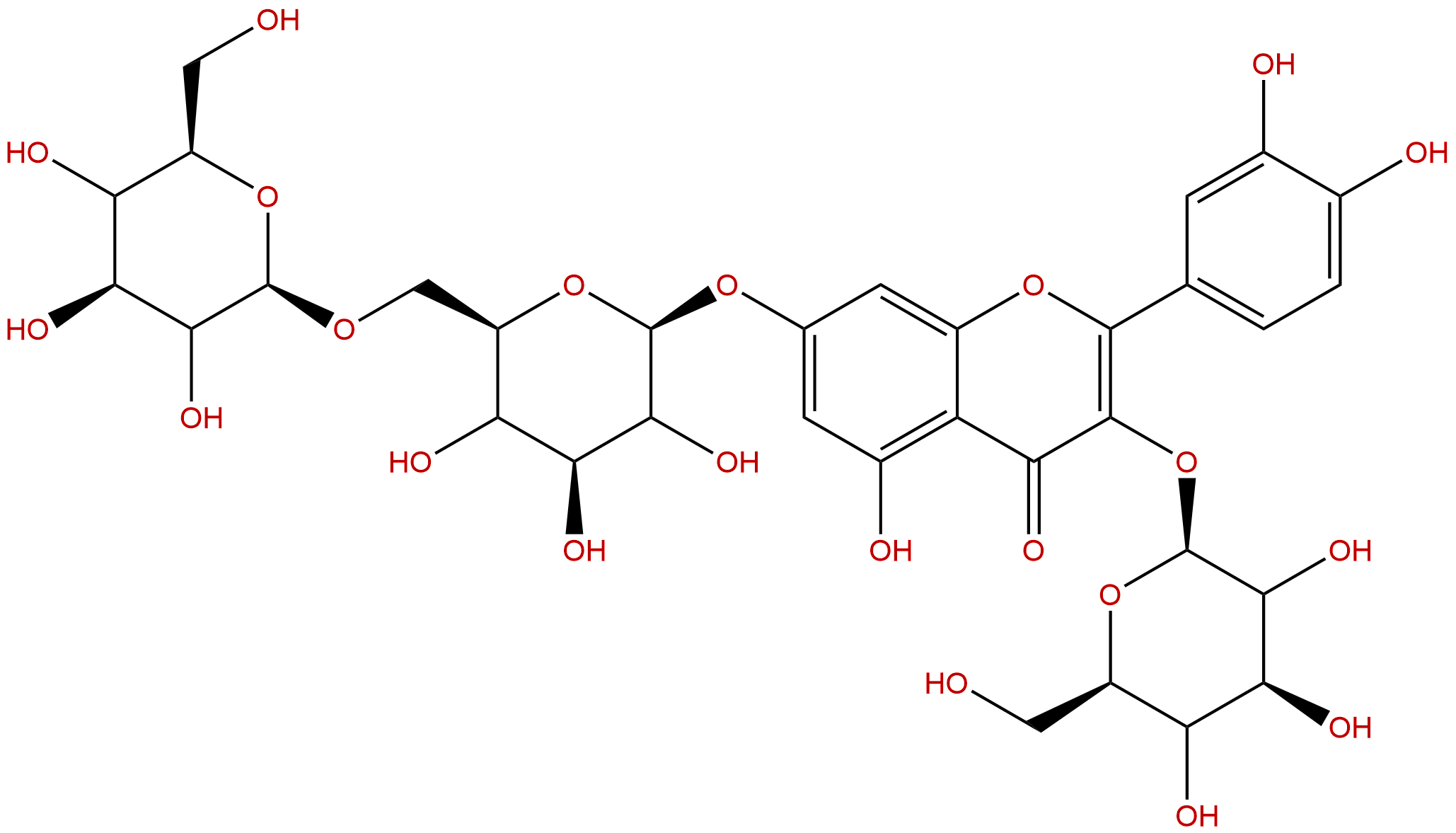


Product name: Quercetin 3-O-β-D-glucose-7-O-β-D-gentiobioside
Synonym name:
Catalogue No.: BP3339
Cas No.: 60778-02-1
Formula: C33H40O22
Mol Weight: 788.661
Botanical Source:
Physical Description:
Type of Compound: Flavonoids
Purity: 95%~99%
Analysis Method: HPLC-DAD or/and HPLC-ELSD
Identification Method: Mass, NMR
Packing: Brown vial or HDPE plastic bottle
The product could be supplied from milligrams to grams. Inquire for bulk scale.
We provide solution to improve the water-solubility of compounds, thereby facilitating the variety of activity tests and clinic uses.
For Reference Standard and R&D, Not for Human Use Directly.
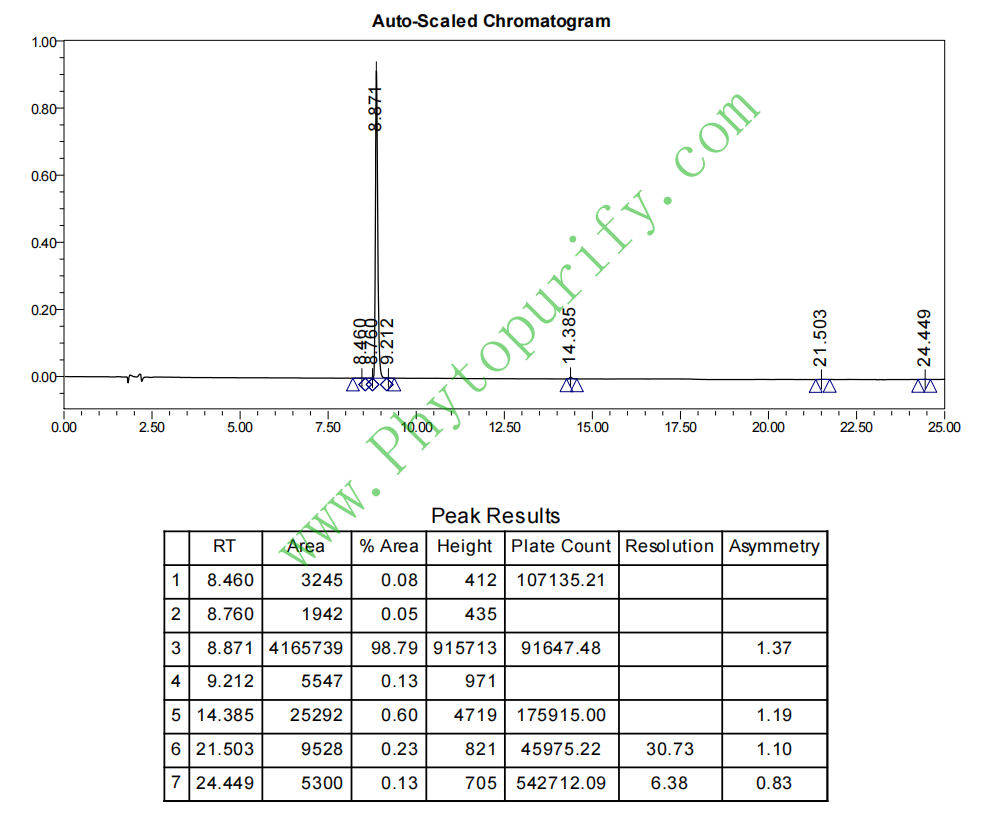
HPLC of Quercetin 3-O-β-D-glucose-7-O-β-D-gentiobioside
Storage conditions:Short-term storage at 2~8℃, long-term storage at -20 ~ -80℃
368.8100
-1.6346
-1.6542
7.2594
.4395
.1218
Low
70.2656
5.4090
Yes
No
No
No
Yes
No
0.6
Yes
No
Yes
Yes
Flavonoids, as one of the most widely distributed plant secondary metabolites in nature, have long attracted the attention of pharmacological researchers due to their diverse biological activities. Quercetin, as a typical representative of flavonol compounds, has been widely reported for its pharmacological effects such as antioxidant, anti-inflammatory, anti allergic, and anti-tumor effects. However, quercetin often exists in the form of glycosides in nature, and the introduction of glycosides not only changes its physicochemical properties, but may also significantly affect its biological activity, absorption, and metabolism. Quercetin 3-O - β - D-glucose-7-O - β - D-gentiopicroside (Q3G7G) is one of the structurally unique disaccharide derivatives of quercetin. This compound is linked to glucose and gentian disaccharide groups at the 3rd and 7th hydroxyl positions of quercetin, respectively (connected by a β -1,6 glycosidic bond between two glucose groups). This unique glycosylation pattern exhibits characteristics different from quercetin aglycones and other single glycosides in terms of solubility, bioavailability, and targeting. In recent years, with the advancement of natural product separation and identification technology and the deepening of molecular pharmacology research, the activity of Q3G7G in specific fields such as anti allergy has gradually become prominent. Its mechanism of action involves multi-target regulation of histamine receptors, interleukins, and key receptors of allergic mediators. This article aims to systematically review the chemical structure, plant origin, pharmacological activity, mechanism of action, and pharmacological properties of Q3G7G, in order to provide comprehensive scientific references for the in-depth research and potential drug development of this compound.
The chemical structure of quercetin-3-O - β - D-glucose-7-O - β - D-gentian glycoside is based on the flavonol parent nucleus quercetin (3,5,7,3 ', 4' - pentahydroxyflavone). Its structural feature is that the 7th hydroxyl group of the A ring and the 3rd hydroxyl group of the C ring of quercetin have undergone glycosylation substitution. Specifically, a D-glucose group is connected to the 3-oxygen atom through a β - glycosidic bond; A gentian disaccharide group is connected to the 7th oxygen atom through a β - glycosidic bond. Gentiobiose is a disaccharide formed by connecting two molecules of D-glucose through a β (1 → 6) glycosidic bond. Therefore, the compound is a tri glycoside, with a total glycosyl portion consisting of one glucose and one gentian disaccharide.
Its CAS number is 60778-02-1, molecular formula is C33H40O22, and molecular weight is 788.6610. This high degree of glycosylation (introducing three sugar units) has a decisive impact on its physicochemical properties. Firstly, the molecule is rich in multiple hydroxyl groups, resulting in a total polar surface area (TPSA) of 368.81 Å ², indicating strong polarity and hydrophilicity of the molecule. The calculated lipid water partition coefficient (LogP) is -1.6346, further confirming its highly hydrophilic properties. Correspondingly, its theoretical water solubility value is 7.2594 (usually expressed in log mol/L or related units), indicating that the compound has good solubility in water, which is consistent with its glycosidic properties. However, this high hydrophilicity and high molecular weight (>500) also pose a challenge to its ability to penetrate biofilms. Preliminary pharmacological predictions indicate that its ability to cross the blood-brain barrier is relatively low, mainly due to its larger polarity and molecular size. In terms of preliminary safety indicators, the inhibitory risk of this compound on hERG potassium channels is "no", indicating a low potential risk of arrhythmia. The Ames test result is 0.6 (usually a value less than 1.5 can be considered negative), indicating that it may not have direct mutagenicity, but further experimental verification is needed. In summary, Q3G7G is a highly hydrophilic and high molecular weight flavonoid glycoside. Its pharmacological properties may be limited by poor membrane permeability, but its good water solubility and preliminary safety signal provide a basis for its application research in specific fields, such as non central anti allergic effects.
The distribution of Q3G7G in nature is relatively limited, mainly found in some medicinal plants, especially some traditional herbs used for anti-inflammatory and anti allergic purposes. According to literature reports, the compound is urtica laetevirens One of the main flavonoid glycosides in the leaves of Urtica dioica L. Wide leaved nettle is commonly used in folk medicine to treat inflammatory diseases such as arthritis and allergic rhinitis, and the presence of Q3G7G may be related to its traditional therapeutic effects. In addition, there have been reports of the isolation of this compound or similar structural double glycosides in the flowers or leaves of some leguminous plants (such as certain Astragalus plants) and Rosaceae plants, but their content is usually low.
Extracting Q3G7G from plant materials usually follows the general extraction strategy for flavonoid glycosides. Due to its high polarity,Solvent extraction method It is the most commonly used method.Methanol, ethanol or their aqueous solutions(such as 70-80% ethanol) is an effective extraction solvent that can efficiently extract Q3G7G and other polar components from plant tissues. Extraction methods include hot reflux extraction, ultrasound assisted extraction, and microwave-assisted extraction, among which ultrasound assisted extraction is widely used due to its high efficiency, short time, and friendliness towards thermally unstable components.
After filtration and concentration, the crude extract needs to be further separated and purified to obtain high-purity Q3G7G. Given its strong hydrophilicity,Column chromatography technology It is the core purification method. Reverse phase silica gel column chromatography (such as C18 packing) is commonly used, with gradient elution using methanol water or acetonitrile water systems. In addition,Polyamide column chromatography The specific adsorption of flavonoids (through hydrogen bonding) is particularly suitable for enriching flavonoid glycosides from crude extracts rich in phenolic acids and tannins, and is an effective pretreatment step for purifying Q3G7G. For finer separation Preparation type high-performance liquid chromatography(Prep-HPLC), By using a reverse phase C18 column and a mild acidic water organic phase (such as 0.1% formic acid water acetonitrile) mobile phase, compounds with chromatographic purity can be obtained. During the extraction and purification process, attention should be paid to controlling the temperature and avoiding strong acid and alkali environments to prevent hydrolysis of glycosidic bonds. The structure of the final product was confirmed by nuclear magnetic resonance (NMR, including 1H, 13C, 2D NMR), mass spectrometry (MS), and comparison with literature data.
The existing pharmacological research mainly focuses on the anti allergic activity of Q3G7G, and other aspects of activity have also been preliminarily explored, but the depth and breadth are not as good as quercetin aglycone.
1. Anti allergic activity
This is the most prominent pharmacological effect of Q3G7G. Both in vitro and in vivo experiments have shown that it has significant anti allergic effects.
* In vitro research In the experiment of RBL-2H3 rat basophilic leukemia cells (a commonly used mast cell model), Q3G7G can dose dependently inhibit the release of β - hexosaminase (a marker of degranulation) stimulated by antigens (such as DNP IgE), with a stronger effect than quercetin. It can also inhibit the production of tumor necrosis factor - α (TNF - α) and interleukin-4 (IL-4) in mast cells.
* In vivo research In a passive cutaneous allergic reaction (PCA) mouse model, oral or local administration of Q3G7G can significantly inhibit IgE mediated increased vascular permeability and pigment exudation, and its inhibitory effect is comparable to some classic antihistamines. In a mouse model of allergic rhinitis induced by ovalbumin (OVA), administration of Q3G7G can reduce the frequency of nasal scratching, inhibit inflammatory cell infiltration in the nasal mucosa, and lower serum OVA specific IgE and histamine levels.
2. Anti inflammatory activity
Inflammation is closely related to allergic reactions. Research has shown that Q3G7G can inhibit the excessive production of nitric oxide (NO) and prostaglandin E2 (PGE2) in macrophages RAW264.7 stimulated by lipopolysaccharide (LPS). The mechanism is related to the inhibition of protein expression of inducible nitric oxide synthase (iNOS) and cyclooxygenase-2 (COX-2). In addition, it can downregulate the mRNA expression of pro-inflammatory cytokines such as IL-6 and IL-1 β.
3. Antioxidant activity
As a derivative of quercetin, Q3G7G retains the ability to scavenge free radicals. In vitro DPPH radical and ABTS radical cation scavenging experiments, as well as iron ion reducing power (FRAP) measurements, all showed that it has moderate to strong antioxidant activity. Although its ability to directly scavenge free radicals may be slightly lower than that of quercetin aglycone due to the steric hindrance effect of sugar groups, its good water solubility may play a more effective role in antioxidant protection in hydrophilic physiological environments.
4. Other potential activities
Sporadic studies suggest that Q3G7G may inhibit the activity of α - glucosidase, suggesting its potential anti diabetes application value. In addition, based on the extensive activity of quercetin skeleton, its anti-tumor and cardiovascular protective effects also need further exploration, but there is currently a lack of systematic research on Q3G7G.
The anti allergic effect of Q3G7G is not achieved through a single pathway, but involves multi-target intervention in multiple key links of allergic reactions. Its network of action covers allergy mediator receptors, cytokine signaling, and immunoglobulin receptors.
1. Targeting histamine H1 receptor (HRH1)
Histamine is one of the most important mediators in allergic reactions, mainly causing vasodilation, increased permeability, and isokinetic allergic symptoms through H1 receptors. Molecular docking and functional experiments have shown that Q3G7G can bind to the active pocket of HRH1 and may act as an antagonist to competitively inhibit the binding of histamine to its receptor, thereby blocking downstream signaling pathways. This is an important molecular basis for its rapid relief of allergic symptoms such as urticaria and rhinitis.
2. Regulating Th2 cytokines (IL4, IL5)
Allergic diseases are usually accompanied by Th1/Th2 immune imbalance, where Th2 cells are preferentially activated and secrete cytokines such as IL-4 and IL-5. IL-4 is a key factor in the conversion of B cell types to produce IgE; IL-5 dominates the activation, proliferation, and chemotaxis of eosinophils. Research has shown that Q3G7G can inhibit the production of IL-4 and IL-5 by T cells or mast cells under allergen stimulation. The mechanism may involve inhibiting the activation of transcription factors such as GATA-3 (Th2 specific transcription factor) and NF - κ B, thereby downregulating the expression of these cytokines at the gene transcription level, fundamentally reducing IgE synthesis and eosinophilic inflammation.
3. Inhibit the high affinity IgE receptor (FCER1A) signaling pathway
FCER1A is highly expressed on the surface of mast cells and eosinophils, and is the core receptor for IgE binding and triggering cell degranulation. Although Q3G7G does not directly bind to FCER1A, it can intervene in its downstream signal transduction. Research has shown that it can inhibit the phosphorylation of splenic tyrosine kinase (Syk) and linker for activation of T cells (LAT) caused by Fc ε RI cross-linking, thereby blocking PLC γ activation, calcium influx, and MAPK (such as ERK, JNK, p38) pathways, ultimately leading to suppressed expression of degranulation related genes and reduced release of inflammatory mediators.
4. Antagonistic thromboxane A2 receptor (TBXA2R)
Thromboxane A2 (TXA2) is an important lipid mediator in the arachidonic acid metabolism pathway, which can strongly constrict bronchial smooth muscle and promote platelet aggregation in allergies and inflammation. TBXA2R is its receptor. Q3G7G has been shown to antagonize TBXA2R and inhibit smooth muscle contraction induced by TXA2 analogs. This effect helps alleviate bronchospasm in allergic asthma.
Integration of mechanism of action In summary, Q3G7G has passed Antagonistic HRH1 and TBXA2R Directly inhibiting the action of allergic mediators; Through Suppress FCER1A Syk signal axis Reduce degranulation and mediator release of mast cells/eosinophils from the source; and pass through Downregulate Th2 cytokines such as IL-4 and IL-5 To regulate immune balance, reduce IgE production and eosinophil infiltration. This multi-target and multi link mode of action enables it to systematically regulate complex allergic reaction networks, which may have better efficacy and lower resistance risk than single target drugs.
Although Q3G7G exhibits good pharmacological activity, its drug affinity faces some challenges, mainly due to its highly glycosylated chemical structure.
1. Prediction and Challenges of Absorption, Distribution, Metabolism, and Excretion (ADME)
* absorb The high hydrophilicity (LogP-1.63) and high molecular weight (788.66) severely limit its ability to cross the lipid bilayer of intestinal epithelial cells through passive diffusion, indicating that its oral bioavailability may be extremely low. It may rely on oligopeptide transporters (such as PEPT1) or glucose transporters (such as SGLT1) on the intestinal mucosa for active transport, but the efficiency remains to be verified. Non oral routes (such as injection, local administration) may be a more realistic choice.
* distribution The larger TPSA and polarity may result in a lower plasma protein binding rate and difficulty in crossing the blood-brain barrier (predicted to be low), which limits its central role, but may avoid central side effects for peripheral anti allergy. Its distribution volume may be small, mainly limited to plasma and extracellular fluid.
* Metabolism As a glycoside compound, the main metabolic pathway of Q3G7G in the body is Hydrolysis of glycosidic bonds The abundant β - glucosidase and β - glucosidase in the gut microbiota may gradually hydrolyze it, first removing gentian disaccharides or glucose, and ultimately producing quercetin glycoside. The metabolism of its glycoside components (such as hydroxylation, methylation, and glucuronidation) by hepatic enzymes (such as CYP450) will become the main metabolic pathway in the future. The prototype drug may be unstable in the blood.
* excretion Its prototype and water-soluble metabolites (such as glucuronic acid conjugates) are expected to be primarily excreted through the kidneys via urine.
2. Current status of pharmacokinetic research
Currently, there is a significant lack of pharmacokinetic studies on the Q3G7G system. Limited studies based on extracts of Urticaceae have shown that quercetin glycosides and their metabolites can be detected in plasma after oral administration, but at low concentrations and with a late peak time, indirectly confirming its slow absorption and possible dependence on gut microbiota metabolism. In the future, detailed pharmacokinetic studies need to be conducted on pure Q3G7G to clarify its absolute bioavailability, half-life, major metabolites, and excretion pathways.
3. Preliminary evaluation of safety
The existing data suggests positive signals: hERG inhibition negative reduces the risk of cardiac toxicity; The initial negative Ames test indicates a low risk of genetic toxicity. However, comprehensive preclinical safety evaluations (such as acute toxicity, chronic toxicity, and reproductive toxicity) have not been reported yet. As a natural product, its long-term safety still needs to be rigorously evaluated.
Summary Q3G7G is a typical lead compound with strong activity but poor pharmacological properties. Its development strategy may need to focus on: 1)Prodrug modification Modify its sugar or phenolic hydroxyl groups through esterification to improve lipid solubility and membrane permeability, and hydrolyze back to the original drug in vivo; 2)New drug delivery system Develop delivery systems such as nanoliposomes, polymer micelles, and microemulsions to enhance their oral absorption or achieve local/targeted delivery; 3)Explore non oral administration routes For example, nasal sprays are used to treat allergic rhinitis, and topical preparations are used to treat allergic dermatitis.
As a natural product with a clear multi-target anti allergic mechanism, Q3G7G's clinical application prospects mainly focus on the field of allergic diseases, but achieving transformation requires overcoming existing bottlenecks.
1. Potential clinical application directions
* Allergic rhinitis and conjunctivitis: Its antihistamine, anti-inflammatory and immunomodulatory effects are very suitable for the development of nasal sprays or eye drops. Local administration can avoid the problem of poor oral absorption, directly act on target tissues, and quickly relieve nasal congestion, runny nose, itchy eyes and other symptoms.
* Allergic skin diseases (such as eczema, urticaria): It can be developed as cream, gel or liniment for external use. Its inhibition of mast cell degranulation and anti-inflammatory effects help alleviate skin itching, erythema, and edema.
* Mild allergic asthma As an adjuvant therapy drug, its TBXA2R antagonistic and anti-inflammatory effects may help alleviate bronchial constriction and airway allergic inflammation. However, the necessity and feasibility of systemic administration should be carefully evaluated.
* Functional food or health supplement additives Due to its natural origin and relative safety, it can be used as an ingredient in anti allergic health food to regulate allergic constitution, but its effective dosage and long-term consumption safety need to be clarified.
2. Future research prospects
* In depth mechanism research By utilizing CRISPR-Cas9 gene editing, molecular probes, and other technologies, we can more accurately verify its direct interaction sites and affinity with targets such as HRH1 and TBXA2R. Combining omics techniques (transcriptome, proteome) to comprehensively reveal the immune network regulated by it.
* Systematic pharmacokinetics and metabolism research Standardized animal and human pharmacokinetic tests must be conducted to clarify their absorption, distribution, biological activity of metabolites, and the respective contributions of prototypes and metabolites. This is the foundation of formulation development.
* Innovation in formulation technology This is the core of whether Q3G7G can enter clinical practice. We should focus on researching oral delivery systems based on nanotechnology (to improve bioavailability) or bioadhesive sustained-release formulations suitable for local administration.
* Structural optimization and screening of analogues Using it as the parent nucleus, structural modifications (such as glycosylation, partial hydroxyl protection, or derivatization) are carried out to improve the lipid water partition coefficient and metabolic stability while maintaining activity, and to screen for derivatives with better drug properties.
* Preclinical and clinical research After completing the toxicological evaluation of the system, advance clinical trials for specific indications (such as allergic rhinitis) to verify their effectiveness and safety.
Quercetin-3-O - β - D-glucose-7-O - β - D-gentian glycoside (Q3G7G) is a naturally occurring molecule with a delicate structure and unique mechanism that is endowed to us by nature as an anti allergic natural molecule. It inherits the active framework of quercetin mother nucleus and gains new physicochemical and biological properties due to its unique disaccharide modification. The current research has clearly outlined its molecular blueprint for synergistic anti allergic effects by antagonizing HRH1, TBXA2R, inhibiting Fc ε RI signaling pathway, and regulating Th2 cytokines, demonstrating potential advantages over single target drugs. However, its high hydrophilicity and inherent drug defects caused by high molecular weight, such as poor oral absorption and metabolic instability, constitute the main barrier for its conversion to drugs. Future research should not only focus on activity validation, but actively embrace interdisciplinary strategies such as pharmacy, medicinal chemistry, and metabolomics, and solve their delivery challenges through advanced delivery technologies, rational structural optimization, and in-depth in vivo process research. Only in this way can this multi-target anti allergic "weapon" hidden in plants be truly transformed into innovative drugs or functional products that can be used in clinical practice, providing a potential new treatment option for allergic disease patients that originates from nature and has a comprehensive mechanism of action.
