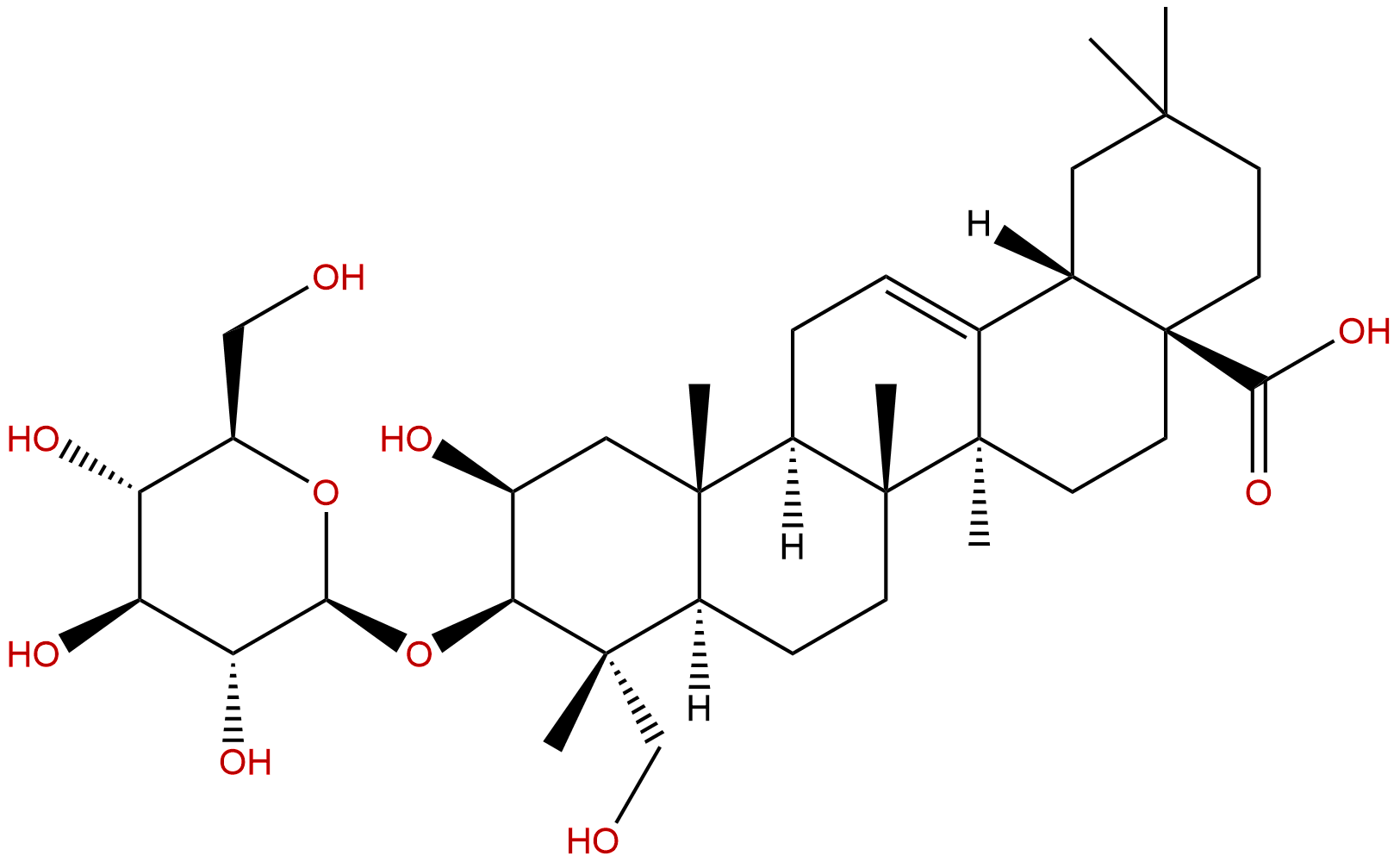
Bei'e sapogenin-3-O - β - D-glucopyranoside: a potential anti-tumor natural product derived from Tribulus terrestris
1. Overview
Bayogenin-3-O - β - D-glucopyranoside (CAS number: 104513-86-2) is a traditional medicinal plant derived from Tribulus terrestris(Tribulus terrestris)Five ring triterpenoid saponins isolated from the middle. Its molecular formula is C36H58O10 and its molecular weight is 650.85 g/mol. In the fields of natural product chemistry and drug discovery, this compound has attracted attention due to its unique chemical structure and potential biological activity. Existing research descriptions indicate that its glycoside Bayogen and its structural analogues (such as arjunolic acid) belong to glycogen phosphorylase inhibitors and exhibit moderate inhibitory activity. Glycogen phosphorylase is a key rate limiting enzyme in glycogen breakdown, and its inhibitors have potential value in regulating blood glucose metabolism. However, further research has revealed the compound's broad spectrum of biological activity, particularly its interactions with multiple key tumor associated targets, pointing to its potential applications in the field of anti-tumor therapy. This article will provide a systematic professional popularization of this natural product from the aspects of its chemical structure, plant origin, pharmacological mechanism, medicinal evaluation, and research prospects.
2. Chemical structure and physicochemical properties
Belongin-3-O - β - D-glucopyranoside belongs to the oleane type pentacyclic triterpenoid saponins. The core of its structure is baicalein (a type of oleanolic acid triterpenoid glycoside), which is connected to a D-glucopyranose group through a β - glycosidic bond on the C-3 hydroxyl group. This glycosylation modification is a common structural feature of natural saponin compounds, which typically has a decisive impact on their water solubility, bioavailability, and biological activity.
Analyze its physicochemical properties based on the provided pharmacological parameters:
- Molecular weight (MW):650.85 g/mol, Slightly higher than the standard for conventional small molecule drugs (usually<500 Da), but still within an acceptable range.
- Lipid water partition coefficient (LogP)2.92 indicates that the compound has moderate lipophilicity, which is beneficial for penetrating cell membranes.
- Topological Polarity Surface Area (TPSA)177.14 Å ², with a relatively high value, is mainly attributed to the presence of multiple hydroxyl, carboxyl, and oxygen atoms on the sugar ring in the molecule. High TPSA is usually unfavorable for passive transmembrane transport, especially through the blood-brain barrier (BBB).
- Water solubility 0.0516 (unit not specified, usually expressed in mg/mL or mol/L), a low value indicates that it is a poorly soluble compound, which may be one of the main limiting factors for its oral bioavailability.
- Apparent distribution coefficient (LogD)1.13 (possibly measured at a specific pH, such as pH 7.4), below LogP, indicates that under physiological pH conditions, the ionization of carboxyl and other functional groups in the molecule increases its hydrophilicity.
Overall, this compound is a medium molecular weight natural product with high polarity and poor water solubility. The glucose unit in its structure increases polarity, while the triterpenoid core provides necessary lipophilicity. This amphiphilic structure is the material basis for its potential surface activity and interaction with biofilms.
3. Plant sources and traditional applications
The main plant source of baicalein 3-O - β - D-glucopyranoside is Tribulus terrestris(Tribulus terrestris L.)It belongs to the Zygophyllaceae family. Tribulus terrestris is a herbaceous plant widely distributed in temperate and tropical regions around the world, with a long history of application in traditional Chinese medicine, Ayurvedic medicine, and other medical systems.
In traditional Chinese medicine, the Tribulus terrestris (fruit or whole plant) is known as the "thorn Tribulus terrestris". It has a mild nature, bitter and pungent taste, and belongs to the liver meridian. Its main functions are to calm the liver, relieve depression, promote blood circulation and dispel wind, improve vision and relieve itching. Commonly used to treat symptoms such as headache, dizziness, chest and rib pain, breast closure and abscess, blurred vision, rubella itching, etc. caused by liver yang hyperactivity. In Ayurvedic medicine, Tribulus terrestris is used as a tonic, diuretic, and aphrodisiac to enhance vitality, improve urinary system function, and strengthen sexual function.
Modern plant chemistry research has confirmed that Tribulus terrestris is rich in various bioactive components, including steroidal saponins (such as diosgenin derivatives), flavonoids, alkaloids, polysaccharides, and triterpenoid saponins. Bei'e sapogenin-3-O - β - D-glucopyranoside is one of the important triterpenoid saponin components. The effects of "promoting blood circulation" and "anti-inflammatory" in traditional applications may be partially attributed to the regulatory effects of such saponin components on cell signaling pathways and enzyme activity, which provides traditional basis and material basis for their modern pharmacological research, especially anti-tumor activity research.
4. Pharmacological activity and mechanism of action
The existing data clearly points to the disease-related properties of β - D-glucopyranoside with anti-tumor effects, and its mechanism of action may be achieved by regulating a series of key tumor related targets. The database information lists five key targets: TP53, CASP3, MYC, BAX, and CDKN1A. These targets do not exist in isolation, but form a complex and interconnected regulatory network that collectively affects the fate of tumor cells - proliferation, apoptosis, cell cycle arrest, and so on.
1. Core target network analysis:
- TP53 (tumor protein p53)The famous "genome guardian" is a tumor suppressor gene. During cellular stress (such as DNA damage), p53 protein is activated and acts as a transcription factor to regulate the expression of numerous downstream genes, inducing cell cycle arrest (such as through CDKN1A), DNA repair, or cell apoptosis (such as through BAX). Many tumor cells have TP53 gene mutations or functional inactivation. If this compound can stabilize or activate the p53 pathway, it will strongly inhibit tumor growth.
- CASP3 (cysteine protease-3)It is a key effector protease in the execution stage of cell apoptosis. Once activated by upstream signals such as the mitochondrial apoptosis pathway, CASP3 will cleave multiple cellular substrates, leading to irreversible cell death. Promoting the activation of CASP3 is one of the core mechanisms of many anti-tumor drugs.
- BAX (Bcl-2 related X protein)It is a pro apoptotic member of the Bcl-2 protein family. Under the stimulation of apoptotic signals, BAX will transfer to the outer membrane of mitochondria, leading to increased membrane permeability, release of cytochrome C, and activation of the CASP9/CASP3 cascade reaction, triggering apoptosis. BAX is one of the important pro apoptotic target genes downstream of p53.
- CDKN1A (cyclin dependent kinase inhibitor 1A, also known as p21)It is one of the important downstream target genes of p53. The p21 protein can inhibit the activity of various cyclin cyclin dependent kinase complexes, thereby blocking cells in the G1 phase, providing time for DNA repair, or guiding cells towards aging/apoptosis.
- MYC (oncogene c-Myc)It is a powerful transcription factor that can promote cell proliferation, metabolic reprogramming, and immutalization. MYC is overexpressed in various tumors. Inhibiting the transcriptional activity or protein stability of MYC can effectively suppress abnormal proliferation of tumor cells.
2. Integration of potential mechanisms of action:
Based on the above target analysis, it is possible that the triterpenoid 3-O - β - D-glucopyranoside of Bei'e saponins exerts anti-tumor effects through the following multi-target and multi pathway pathways:
- Activate the p53 tumor suppressor pathway Compounds may stabilize p53 protein directly or indirectly, or enhance its transcriptional activity.
- Inducing cell cycle arrest Activated p53 upregulates the expression of CDKN1A (p21), leading to cell cycle arrest (especially G1 phase) and inhibiting tumor cell proliferation.
- Activate mitochondrial apoptosis pathway On the one hand, p53 can upregulate the expression of BAX; On the other hand, compounds may directly affect the balance of BAX/Bcl-2 independently of p53. The activation of BAX leads to the loss of mitochondrial membrane potential and the release of cytochrome C, which in turn activates CASP9 and ultimately activates apoptosis executor CASP3, resulting in programmed cell death of tumor cells.
- Inhibition of oncogene MYC Compounds may inhibit the abnormal proliferation signals driven by MYC by interfering with its transcription, translation, or protein stability.
The ability to simultaneously act on multiple key nodes (tumor suppressor genes, pro apoptotic factors, cycle inhibitors, oncogenes) makes this compound potentially possess efficient and low resistance potential anti-tumor properties. Its initially reported glycogen phosphorylase inhibitory activity may also cut off the energy supply to tumors by interfering with the "Warburg effect" of tumor cells, which prioritizes glycolysis even under aerobic conditions, and produce synergistic anti-tumor effects with the regulation of the aforementioned signaling pathways.
5. Evaluation of drug properties
Drug efficacy assessment aims to predict the likelihood of an active compound developing into an oral medication. We combined Lipinski's Rule of Five (Ro5) with the provided ADMET (absorption, distribution, metabolism, excretion, toxicity) parameters for analysis.
Lipinski's Five Rules Compliance Analysis:
1. Molecular weight<500 Da:not conform to(650.85 > 500)。
2. LogP < 5:Comply with(2.92 < 5)。
3. Hydrogen bond donor number (HBD)<5: According to the structural formula (multiple OH, sugar groups), HBD > 5,May not comply。
4. Hydrogen bond acceptor number (HBA)<10: According to the structural formula (number of O atoms), HBA > 10,May not comply。
This compound clearly violates multiple Lipinski rules (molecular weight, HBD, HBA). Ro5 is mainly used to predict oral absorption, and violating multiple criteria usually suggests that its oral bioavailability may be low. This is consistent with the characteristics of its natural saponin compounds - high polarity and high molecular weight.
Specific ADMET parameter interpretation:
- absorb The permeability of Caco-2 cells is 0.481 (usually>1 for high permeability), and the Peff (effective permeability coefficient) is 0.6221, both at low levels, indicating poor intestinal absorption. BBB penetration is "low", which is consistent with its high TPSA characteristics, meaning that it may not easily enter the central nervous system. This may not be a disadvantage for treating peripheral tumors, but can actually reduce central side effects.
- distribution The plasma protein binding rate (PPB) is as high as 85.3%, which means that most of the drugs are bound to proteins in the blood, and the concentration of free drugs is low, which may affect their tissue distribution and efficacy, but may also prolong their half-life.
- Metabolism and toxicity The key toxicity indicators such as Ames test (0.0, usually negative), chromosomal aberration (none), and hERG inhibition (no) are all negative or do not show risk, indicating a low risk of genetic toxicity and cardiac toxicity. However, it should be noted that serum alanine aminotransferase (Ser_LT) is' no ', while serum aspartate aminotransferase (Ser_ST) is' yes', which may suggest the need for further in vivo evaluation of its potential liver cell effects.
- Other Skin sensitization, respiratory sensitization, and phototoxicity were all negative, with a SyneAccess score of 5.44 (higher values usually indicate more difficult synthesis), suggesting that extraction from plants may be a more feasible source.
Summary of potential drugs:
As a lead compound, the core advantage of baicalein 3-O - β - D-glucopyranoside is Clear multi-target mechanism of action involving core tumor pathways and low early toxicity risk However, its main challenge lies in Poor drug properties Especially oral absorption may be poor. This does not mean that its path to becoming a drug has been blocked, but rather points out the direction that future research and development needs to focus on breakthroughs: through Structural modification(such as preparing prodrugs, simplifying structures, modifying sugar or carboxyl groups to improve lipid solubility and permeability)Develop a new drug delivery system(such as nanomaterials, liposomes, phospholipid complexes to improve solubility and targeting) or exploration Non oral administration route(such as injection administration) to overcome its pharmaceutical deficiencies.
6. Research Status and Application Prospects
At present, there is relatively limited specialized research literature on the saponins 3-O - β - D-glucopyranoside of Platycodon grandiflorus, and its activity data is mostly included in studies on the total extract or saponin components of Tribulus terrestris. The existing database information associates it with key tumor targets, providing strong clues and directions for its in-depth research.
Current research status:
1. Basic research stage This compound is still in the early stages of activity discovery and mechanism exploration. Most of the research focuses on its isolation and identification, as well as preliminary in vitro cytotoxicity testing. There are still many gaps that need to be filled in terms of its direct interactions with specific targets such as TP53 and CASP3 (such as whether it directly binds to p53 protein), detailed signaling pathway maps, and in vivo anti-tumor pharmacological evaluations.
2. As one of the active ingredients of Tribulus terrestris In the material basis research of the anti-tumor, immune regulation, liver protection and other activities of Tribulus terrestris, this compound is often mentioned as an indicator component or one of the potential active ingredients, but its individual contribution rate and synergistic mechanism are not yet clear.
Future application prospects and research directions:
1. In depth mechanism elucidation Using techniques such as molecular docking, surface plasmon resonance (SPR), reporter gene system, and gene knockout/knockdown, confirm the specific mode of action (activation, antagonism, stabilization, etc.) of TP53, MYC, and other targets at the molecular and cellular levels, and draw a complete upstream and downstream signal network diagram.
2. Pharmacodynamic evaluation of the system Establish multiple tumor cell line models and animal models (such as nude mouse transplant tumor models), comprehensively evaluate their in vivo and in vitro anti-tumor activity, dose-response relationship, and toxicity window to normal cells.
3. Optimization of drug properties This is a crucial step in pushing it from a lead compound to a candidate drug. Pharmaceutical chemists can use it as a template to conduct systematic structure-activity relationship (SAR) studies, modifying glycosides, carboxyl groups, etc. while retaining the core pharmacophore (triterpenoid nucleus and key active sites) to improve solubility, permeability, and metabolic stability.
4. Pharmaceutical research Given the limitations of its physical and chemical properties, developing advanced drug delivery systems is of great value. For example, preparing it into nanocrystals, polymer micelles, or actively targeted nanoparticles can significantly improve its bioavailability and tumor targeting, while reducing systemic toxicity.
5. Exploring the potential of combination therapy Based on its multi-target characteristics, studying its combined application with existing chemotherapy drugs, targeted drugs, or immune checkpoint inhibitors may result in synergistic effects and reversal of drug resistance.
In summary, Bei'e sapogenin-3-O - β - D-glucopyranoside is a natural compound with multi-target anti-tumor potential discovered from the traditional medicinal herb Tribulus terrestris. Although its current pharmacological parameters face challenges, this is common and not insurmountable in the development of natural products. With a deeper understanding of its mechanism of action and the application of novel drug design strategies, it is expected to be developed into a novel anti-tumor candidate drug or lead compound, providing new options for tumor treatment. At the same time, research on it will further interpret the modern connotation of the traditional efficacy of "promoting blood circulation and dispersing knots" of Tribulus terrestris from a scientific perspective.