


Product name: Prosapogenin A
Synonym name: Saponin Ta; Progenin III; Ophiopogonin C′; Prosapogenin D′1;
Catalogue No.: BP1151
Cas No.: 19057-67-1
Formula: C39H62O12
Mol Weight: 722.913
Botanical Source: Dioscoreae Nipponicae Rhizoma
Physical Description:
Type of Compound: Steroids
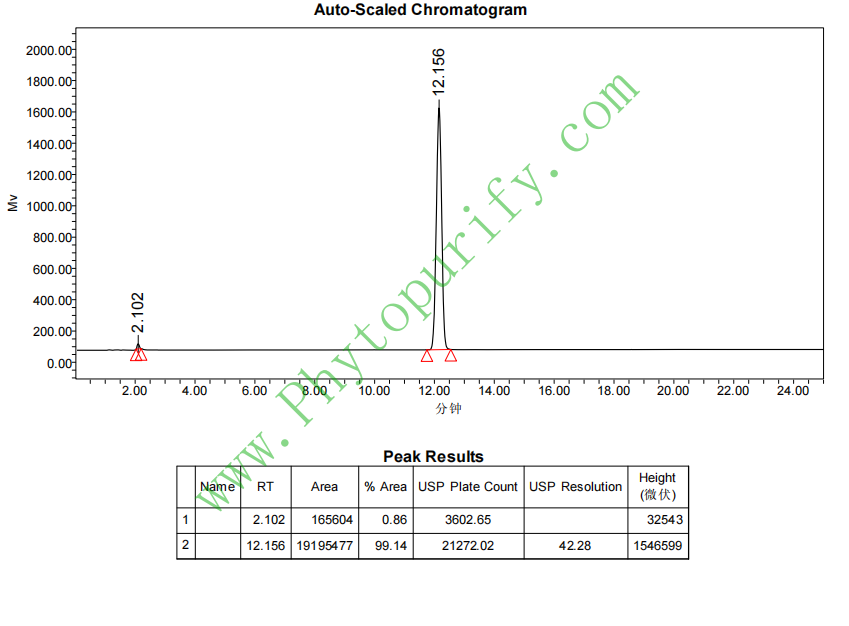
Purity: 95%~99%
Analysis Method: HPLC-DAD or/and HPLC-ELSD
Identification Method: Mass, NMR
Packing: Brown vial or HDPE plastic bottle
Storage: Store in a well closed container, protected from air and light. Put into refrigerate or freeze for long term storage.
Whenever possible, you should prepare and use solutions on the same day. However, if you need to make up stock solutions in advance, we recommend that you store the solution as aliquots in tightly sealed vials at -20℃. Generally, these will be useable for up to two weeks.
The product could be supplied from milligrams to grams
Inquire for bulk scale.
Chengdu Biopurify Phytochemicals Ltd. is a leading company in the research, development, manufacture and marketing of High Quality Phytochemicals and Extracts(especially Active Ingredients from Traditional Chinese Medicine,TCM), Natural Active Pharmaceutical Ingredients worldwide.
The main services:
A. Supply active ingredients and reference standards of TCM, from mgs to kgs scale
B. Custom extraction and purification, target Herb Active Ingredients
C. Custom synthesis and semi-synthesis for Natural Active Ingredients
D. CR(contract research), CM(contract manufacture) and PD(process development) services from lab scale, pilot scale to commercial scale(GMP is also available)
E. TCM compounds library for drug screen,more than 3000 compounds available, many of them are rare and unique.
HPLC of Prosapogenin A
Storage conditions:Short-term storage at 2~8℃, long-term storage at -20 ~ -80℃
176.7600
2.7431
2.7431
.0194
.6399
.4171
Low
72.4628
6.2048
No
No
No
No
No
No
0.0
Yes
No
No
Yes
Malignant tumors are a major disease that seriously threatens human health, and their occurrence and development involve complex molecular network regulation. Traditional chemotherapy drugs often come with serious toxic side effects and resistance issues while achieving therapeutic effects. Therefore, searching for efficient and low toxicity anti-tumor lead compounds from natural products has always been an important direction in drug development. Prosapogenin A (CAS number: 19057-67-1), as a steroid saponin compound isolated from the traditional medicinal plant resveratrol, has attracted much attention in recent years due to its significant pro apoptotic activity in various human cancer cell models. Research has shown that its anti-tumor effect is closely related to the inhibition of key STAT3 signaling pathways and tumor cell glycolysis processes. This article aims to provide a systematic review of the chemical structure, plant origin, pharmacological activity, multi-target mechanism of action, and pharmacological characteristics of Dioscin A, in order to provide comprehensive scientific references for the in-depth research and development of this natural product.
Dioscin A belongs to the class of steroidal saponins, with a molecular formula of C39H62O12 and a molecular weight of 722.9130. Its basic skeleton is composed of hydrophobic spirostanol steroid mother core and hydrophilic oligosaccharide chains connected by glycosidic bonds. This unique structure gives it amphiphilicity, which is the structural basis for its interaction with biofilms and regulation of intracellular signaling pathways.
From the analysis of physical and chemical properties, the lipid water partition coefficient (LogP) of Dioscin A is 2.7431, indicating that it has a certain lipophilicity, but not highly lipophilic. Its topological polar surface area (TPSA) is as high as 176.7600 Å ², mainly attributed to the multiple hydroxyl groups and oxygen atoms on the sugar ring in the molecule, which enable it to form abundant hydrogen bonds. The calculated water solubility value is relatively low, about 0.0194 mg/mL, indicating poor solubility in water, which may be one of the challenges that most saponin compounds need to overcome in formulation development. Based on its molecular weight, LogP, and TPSA values, this compound basically conforms to the Rule of Five, indicating its potential for oral absorption, but solubility and permeability may be limiting factors.
Dioscin A mainly comes from plants of the genus Veratrum in the family Liliaceae, such as Veratrum nigrum L. Although this plant has been used in traditional Chinese medicine, it needs to be used with caution due to its strong toxicity. Modern research focuses on the isolation of its active ingredients and the exploration of its pharmacological effects.
Its extraction and separation usually use organic solvent extraction combined with various chromatographic techniques. The classic process is as follows: first, the dried plant roots and stems are crushed, and then subjected to reflux extraction or ultrasound assisted extraction using polar solvents such as methanol or ethanol. Combine the extracts and concentrate under reduced pressure to obtain the total extract. Subsequently, macroporous adsorption resin column chromatography was used for preliminary enrichment, often using gradient elution with different concentrations of ethanol water system. Saponins were mainly concentrated in the elution sites of medium to high concentrations of ethanol. Further refinement and separation require the use of modern separation methods such as silica gel column chromatography, reverse phase ODS column chromatography, and high-performance liquid chromatography (HPLC). The identification of dioscin A mainly relies on spectroscopic techniques such as nuclear magnetic resonance (NMR, including 1H-NMR and 13C-NMR) and mass spectrometry (MS), and is confirmed by comparing with literature reported data. In recent years, preparative separation techniques such as high-speed countercurrent chromatography have also been applied to the efficient preparation of such saponins.
The core pharmacological activity of Dioscin A is its broad-spectrum anti-tumor effect. A large number of in vitro studies have confirmed that it has significant proliferation inhibitory and apoptosis inducing activities on a variety of human cancer cell lines, including but not limited to breast cancer, liver cancer, lung cancer, colon cancer and ovarian cancer cells.
Its anti-tumor effect is concentration - and time-dependent. Research has shown that treatment with dioscin A can significantly reduce the survival rate of cancer cells and induce typical morphological changes of apoptosis, such as cell shrinkage, chromatin agglutination, and nuclear fragmentation. Flow cytometry analysis often reveals a significant increase in the proportion of sub-G1 phase cells (apoptotic peak). In addition, the compound can also inhibit the migration and invasion ability of cancer cells, suggesting its potential for anti-tumor metastasis. In addition to its direct cytotoxic effect, studies have suggested that dioscin A may also have inhibitory effects on certain tumor stem cell like cell populations, which is of great significance for preventing tumor recurrence.
It is worth noting that some studies have compared the toxicity differences of dioscin A on cancer cells and normal cells, and found that its toxicity on certain normal cells is relatively low at effective anti-tumor concentrations, demonstrating a certain degree of selectivity. This provides a favorable basis for its subsequent development.
The anti-tumor effect of Dioscin A is not achieved through a single target, but through the synergistic effect of multiple targets and pathways, which reflects the complexity advantage of the mechanism of action of natural products. The core mechanism revolves around inhibiting the STAT3 signaling pathway and reprogramming of tumor cell energy metabolism (glycolysis).
Inhibition of STAT3 signaling pathway Signal transducer and activator of transcription factor 3 (STAT3) is an important oncogenic transcription factor that is continuously activated in most tumors, regulating the expression of downstream genes related to proliferation, apoptosis, invasion, and immune escape. Dioscin A can effectively inhibit the tyrosine phosphorylation activation of STAT3, prevent its nuclear translocation and binding to DNA, thereby downregulating the expression of its target genes such as MCL1 and BCL2. MCL1 and BCL2 are key anti apoptotic proteins, and their downregulation directly weakens the survival ability of cancer cells, thus activating the mitochondrial apoptosis pathway.
Interference with tumor cell glycolysis (Warburg effect)Even under aerobic conditions, tumor cells tend to rapidly acquire energy through glycolysis, which is regulated by hypoxia inducible factor 1 alpha (HIF1A) and other factors. Dioscin A can inhibit the activity or expression of HIF1A, thereby downregulating the expression of key glycolytic enzymes, reducing lactate production and glucose consumption, cutting off the energy and biosynthetic raw material supply of tumor cells, leading to cellular metabolic stress and death.
Acting on other key targets:
These targets are interrelated and form a complex regulatory network. Dioscin A exerts synergistic anti-tumor effects by simultaneously acting on multiple nodes in the network, which may help overcome the problem of resistance to single target drugs.
Based on the provided pharmacological parameters and existing research, the preliminary evaluation of the pharmacological properties of Dioscin A is as follows:
Dioscin A, as a multi-target anti-tumor natural lead compound, has shown promising development prospects, but it still needs to overcome many challenges before it can be clinically applied.
potential advantages:
1. Multi-target effect May be beneficial for overcoming tumor heterogeneity and drug resistance.
2. Dual mechanism Simultaneously inhibiting STAT3 signaling and glycolysis, targeting tumors from two core levels: signal transduction and energy metabolism.
3. Selective potential Preliminary studies have shown that it has low toxicity to some normal cells and may have a wider therapeutic window.
4. Preliminary positive safety signals No hERG inhibition and Ames mutagenicity alert.
Challenges and Future Research Directions:
1. In depth preclinical research It is urgent to conduct a comprehensive in vivo pharmacological evaluation to verify its anti-tumor effect and dose-response in animal models such as xenografts and human tumor xenografts (PDX). Systematic toxicology research (acute toxicity, long-term toxicity, reproductive toxicity, etc.) is a necessary step in evaluating its safety.
2. Pharmacokinetic optimization The key is to address the issues of poor water solubility and potential poor oral absorption. We need to develop a new delivery system using modern pharmaceutical technology and provide a detailed explanation of its in vivo ADME process.
3. Deepening the mechanism of action At present, there is still a need to deepen our understanding of the synergistic relationship between multiple targets and the existence of the most critical direct target (protein). Using chemical biology methods such as affinity fishing and molecular probes to search for direct target proteins will help to more accurately understand their nature of action.
4. Structural modification and structure-activity relationship Optimizing the structure using it as the parent nucleus and improving its solubility, metabolic stability, and potency through chemical modification is an important task for medicinal chemists. Elucidating the contributions of the sugar moiety and steroidal nucleus to its activity can guide rational design.
5. Exploration of Combination Therapy Exploring the combined use of Dioscin A with existing chemotherapy drugs, targeted drugs, or immune checkpoint inhibitors, which may produce synergistic therapeutic effects and reduce toxic side effects.
Dioscin A is a steroid saponin compound with significant anti-tumor activity discovered from the traditional medicinal plant resveratrol. It effectively induces apoptosis in various cancer cells in vitro by inhibiting the STAT3 signaling pathway and multi-target mechanisms such as tumor cell glycolysis. Although it exhibits some positive characteristics in terms of drug development (such as no hERG inhibition), it also faces challenges such as poor water solubility and unclear pharmacokinetics in vivo. Future research needs to focus on in vivo efficacy confirmation, safety systematic evaluation, in-depth analysis of the mechanism of action, and structure based pharmaceutical and chemical optimization. With the continuous deepening of research, dioscin A is expected to develop into a new type of anti-tumor drug or lead compound, providing new strategies and choices for the treatment of malignant tumors.
