


Product name: Ruscogenin
Synonym name: (25RS)-Ruscogenin; 874485-32-2
Catalogue No.: BP1231
Cas No.: 472-11-7
Formula: C27H42O4
Mol Weight: 430.629
Botanical Source: Ophiopogonis Radix
Physical Description:
Type of Compound: Steroids
Purity: 95%~99%
Analysis Method: HPLC-DAD or/and HPLC-ELSD
Identification Method: Mass, NMR
Packing: Brown vial or HDPE plastic bottle
Storage: Store in a well closed container, protected from air and light. Put into refrigerate or freeze for long term storage.
Whenever possible, you should prepare and use solutions on the same day. However, if you need to make up stock solutions in advance, we recommend that you store the solution as aliquots in tightly sealed vials at -20℃. Generally, these will be useable for up to two weeks.
The product could be supplied from milligrams to grams
Inquire for bulk scale.
Description:
Ruscogenin exerts significant anti-inflammatory and anti-thrombotic activities.Ruscogenin significantly attenuates LPS-induced acute lung injury (ALI )via inhibiting expressions of TF and iNOS and NF-κB p65 activation, it inhibits activation of neutrophil through cPLA 2 , PAK, Akt, MAPKs, cAMP, and PKA signaling pathways.
References:
J Pharmacol Sci. 2008 Oct;108(2):198-205.
Possible mechanism of the anti-inflammatory activity of ruscogenin: role of intercellular adhesion molecule-1 and nuclear factor-kappaB.
Ruscogenin (RUS), first isolated from Ruscus aculeatus, also a major steroidal sapogenin of traditional Chinese herb Radix Ophiopogon japonicus, has been found to exert significant anti-inflammatory and anti-thrombotic activities.
METHODS AND RESULTS:
Our previous studies suggested that Ruscogenin remarkably inhibited adhesion of leukocytes to a human umbilical vein endothelial cell line (ECV304) injured by tumor necrosis factor-alpha (TNF-alpha) in a concentration-dependent manner. Yet the underlying mechanisms remain unclear. In this study, the in vivo effects of Ruscogenin on leukocyte migration and celiac prostaglandin E(2) (PGE(2)) level induced by zymosan A were studied in mice. Furthermore, the effects of Ruscogenin on TNF-alpha-induced intercellular adhesion molecule-1 (ICAM-1) expression and nuclear factor-kappaB (NF-kappaB) activation were also investigated under consideration of their key roles in leukocyte recruitment. The results showed that Ruscogenin significantly suppressed zymosan A-evoked peritoneal total leukocyte migration in mice in a dose-dependent manner, while it had no obvious effect on PGE(2) content in peritoneal exudant. Ruscogenin also inhibited TNF-alpha-induced over expression of ICAM-1 both at the mRNA and protein levels and suppressed NF-kappaB activation considerably by decreasing NF-kappaB p65 translocation and DNA binding activity.
CONCLUSIONS:
These findings provide some new insights that may explain the possible molecular mechanism of Ruscogenin and Radix Ophiopogon japonicus for the inhibition of endothelial responses to cytokines during inflammatory and vascular disorders.
Biomed Res Int. 2014;2014:652680.
Ruscogenin ameliorates experimental nonalcoholic steatohepatitis via suppressing lipogenesis and inflammatory pathway.
The aim of the study was to investigate the protective effects of Ruscogenin, a major steroid sapogenin in Ophiopogon japonicus, on experimental models of nonalcoholic steatohepatitis.
METHODS AND RESULTS:
HepG2 cells were exposed to 300 μmol/l palmitic acid (PA) for 24 h with the preincubation of Ruscogenin for another 24 h. Ruscogenin (10.0 μmol/l) had inhibitory effects on PA-induced triglyceride accumulation and inflammatory markers in HepG2 cells. Male golden hamsters were randomly divided into five groups fed a normal diet, a high-fat diet (HFD), or a HFD supplemented with Ruscogenin (0.3, 1.0, or 3.0 mg/kg/day) by gavage once daily for 8 weeks. Ruscogenin alleviated dyslipidemia, liver steatosis, and necroinflammation and reversed plasma markers of metabolic syndrome in HFD-fed hamsters. Hepatic mRNA levels involved in fatty acid oxidation were increased in Ruscogenin-treated HFD-fed hamsters. Conversely, Ruscogenin decreased expression of genes involved in hepatic lipogenesis. Gene expression of inflammatory cytokines, chemoattractive mediator, nuclear transcription factor-(NF-) κB, and α-smooth muscle actin were increased in the HFD group, which were attenuated by Ruscogenin.
CONCLUSIONS:
Ruscogenin may attenuate HFD-induced steatohepatitis through downregulation of NF-κB-mediated inflammatory responses, reducing hepatic lipogenic gene expression, and upregulating proteins in β-oxidation pathway.
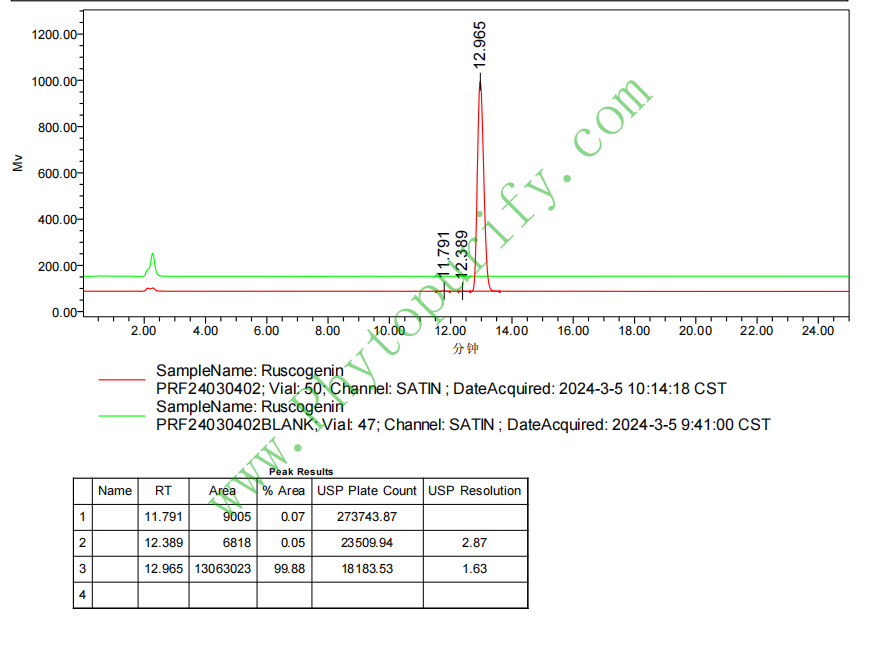
HPLC of Ruscogenin
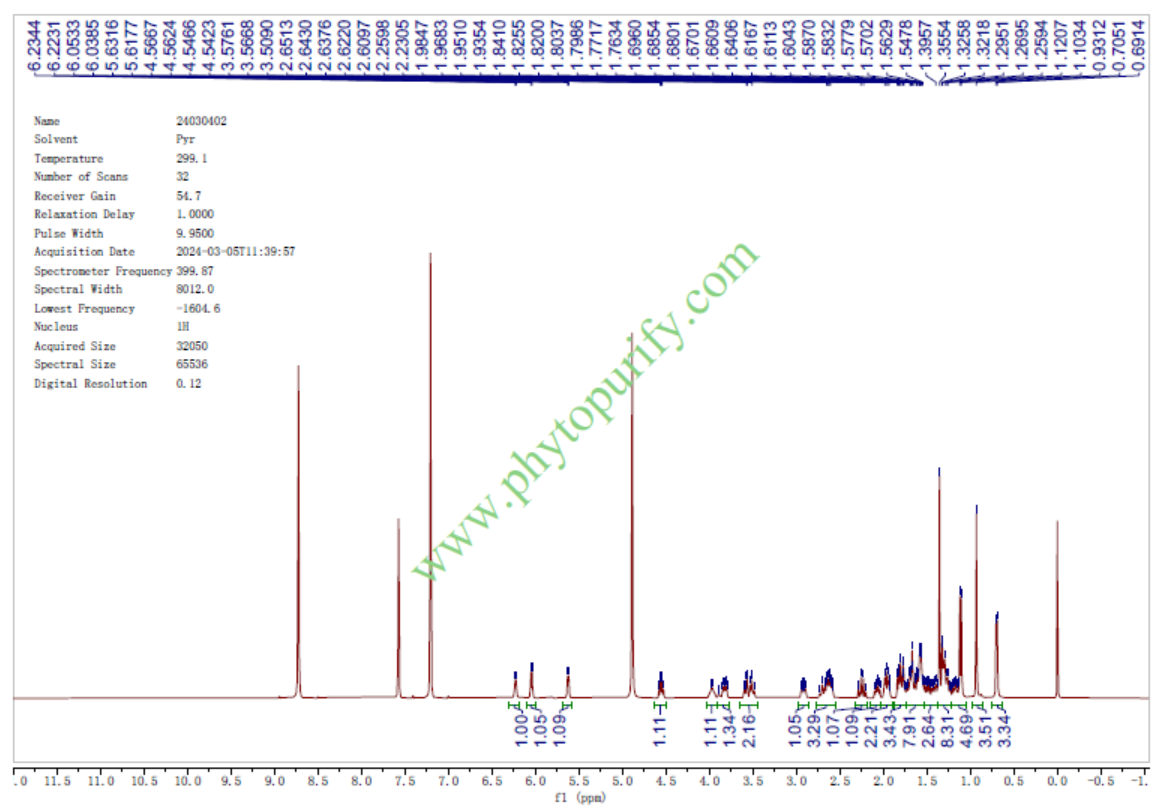
HNMR of Ruscogenin
Storage conditions:Short-term storage at 2~8℃, long-term storage at -20 ~ -80℃
58.9200
4.3121
4.3121
.0011
4.4419
5.2332
High
84.0601
5.4529
No
No
No
No
No
No
0.0
Yes
No
No
No
Cardiovascular and cerebrovascular diseases, inflammatory diseases, and malignant tumors are the main categories of diseases that seriously threaten human health worldwide today. In the current bottleneck of traditional drug development, searching for efficient and low toxicity lead compounds from natural products has become an important approach for new drug discovery. Ruscogenin (CAS number: 472-11-7), as a traditional medicinal plant derived from Ophiopogon japonicus(Ophiopogon japonicus)In recent years, steroidal saponins isolated from Chinese medicine have become a hot topic in the field of natural product pharmacology due to their extensive and significant pharmacological activities, especially anti-inflammatory, antithrombotic, endothelial protective, and potential anti-tumor effects. Early research mainly focused on its cardiovascular protective effect. With the deepening of molecular biological technology, its targets and signal pathway network were gradually revealed, especially in regulating TXNIP/NLRP3 inflammasome, MAPK pathway and other aspects, showing a core role, providing a solid scientific basis for its treatment of ischemic stroke, atherosclerosis and other diseases. Recent studies have expanded its activity to the field of solid tumors such as prostate cancer, revealing its potential for multi-target intervention in tumor progression. This article aims to systematically review the chemical properties, plant sources, pharmacological activities, molecular mechanisms of action, medicinal properties, and clinical application prospects of roscurogenin, in order to provide comprehensive academic references for the in-depth development and transformation research of this natural product.
Ruskosaponin belongs to the class of spirostanol steroidal sapogenins, and its chemical name is (25R) - spirostane-5-ene-1 β, 3 β - diol. Its molecular formula is C27H42O4 and its molecular weight is 430.6290. Its basic skeleton is composed of cyclopentane and tetrahydrophenanthrene (steroid nucleus) and furan ring (F ring) connected by screw atoms, which is a typical feature of spirosteroidal saponins. The 1 β and 3 β positions in its structure are each connected to a hydroxyl group, which is the key pharmacophore for its various biological activities.
From the analysis of physical and chemical properties, the lipid water partition coefficient (LogP) of roscurogenin is 4.3121, indicating its strong lipophilicity. Its topological polar surface area (TPSA) is 58.92 Å ², which is relatively small. These parameters collectively determine its poor water solubility, approximately 0.0011 mg/mL, which to some extent limits its formulation development. However, its high lipophilicity also indicates good membrane permeability. The key pharmacological prediction shows that roscurogenin has a high blood-brain barrier permeability, which is highly consistent with its pharmacological report of effectively reducing blood-brain barrier dysfunction in cerebral ischemia models, and is its unique advantage in treating central nervous system diseases. In addition, preliminary toxicity predictions indicate that it has no significant inhibitory effect on hERG potassium channels (suggesting a low potential risk of cardiac toxicity), and the Ames test result is negative (0.0), indicating that it has no significant genetic toxicity mutagenic risk, providing favorable early data for its safety evaluation.
The main source of Lusco saponin is Ophiopogon japonicus, a plant belonging to the Liliaceae family and the Cyperaceae genus(Ophiopogon japonicus Dried tubers of (L. f.) Ker Gawl. As a traditional Chinese medicine, Ophiopogon japonicus has the effects of nourishing yin, generating fluids, moistening the lungs, and clearing the heart. It is commonly used to treat symptoms such as dry cough, restlessness, and insomnia. Lusco saponin is one of the main active ingredients in Ophiopogon japonicus that exert cardiovascular protective effects, often coexisting with its glycoside forms such as Lusco saponins.
The extraction of roscurogenin is usually carried out using organic solvent extraction combined with modern separation and purification techniques. The classic process is as follows: first, the dried Ophiopogon japonicus root is crushed, and then heated and refluxed with ethanol or methanol for extraction. After concentration, the total extract is obtained. Subsequently, gradient extraction was performed using solvents such as petroleum ether and ethyl acetate, and roscurogenin was mainly enriched in the ethyl acetate fraction. Further purification is often carried out using silica gel column chromatography, gradient elution with mixed solvents such as chloroform methanol, and tracking detection with thin layer chromatography (TLC) or high-performance liquid chromatography (HPLC). In recent years, preparation chromatography techniques such as high-speed countercurrent chromatography (HSCCC) have also been applied to the high-purity preparation of roscurogenin due to their high efficiency and avoidance of irreversible adsorption by silica gel. The extracted roscurogenin is a white needle shaped crystal or powder, which can be structurally confirmed by nuclear magnetic resonance (NMR), mass spectrometry (MS), and comparison with standard samples.
A large number of preclinical studies have shown that roscurogenin has multiple pharmacological activities, and its application prospects far exceed its traditional uses.
Anti inflammatory and immune regulatory activity This is one of the core activities of roscurogenin. In various acute and chronic inflammation models (such as LPS induced macrophage inflammation model, mouse acute lung injury model, colitis model), roscurogenin can significantly inhibit the production and release of pro-inflammatory factors (such as TNF - α, IL-1 β, IL-6), alleviate tissue inflammation infiltration and damage. Its anti-inflammatory effect is different from the mechanism of action of classical nonsteroidal anti-inflammatory drugs, and is more targeted and regulatory.
Antithrombotic and Improving Microcirculation Lusco saponin can effectively inhibit platelet aggregation, reduce blood viscosity, and enhance fibrinolysis activity, thereby exhibiting clear anti thrombotic effects. In models of cerebral ischemia, myocardial ischemia, etc., it can improve local microcirculation and increase blood perfusion in ischemic tissues.
Protecting vascular endothelium and blood-brain barrier Endothelial dysfunction is the initiating link of various cardiovascular and cerebrovascular diseases. Lusco saponin can protect the integrity and function of vascular endothelial cells by antioxidant stress, inhibiting inflammatory reactions. Of particular note is that in the model of cerebral ischemia-reperfusion injury, it can significantly reduce the increase in blood-brain barrier permeability and inhibit brain edema, which is crucial for the treatment of stroke.
Antitumor activity (especially in prostate cancer)Recent studies have revealed the potential of roscurogenin in the field of anti-tumor. In prostate cancer cell lines and animal models, roscurogenin exhibits multiple effects such as inhibiting cell proliferation, inducing cell apoptosis, and inhibiting migration and invasion. Its function involves regulating the cell cycle, activating apoptotic pathways, inhibiting epithelial mesenchymal transition (EMT), and exhibiting multi-target anti-tumor properties.
Other activities In addition, the study also reported that Lusikosigenin has anti fibrosis (such as pulmonary fibrosis, liver fibrosis), anti diabetes nephropathy, analgesic and other activities, suggesting the universality of its pharmacological effects.
The various pharmacological activities of roscurogenin stem from its precise regulation of complex cellular signaling networks. Its core mechanism of action and key molecular targets have gradually become clear.
Inhibition of TXNIP/NLRP3 inflammasome activation This is the core mechanism of its anti-inflammatory effect. Under oxidative stress or inflammatory stimulation, roscurogenin can downregulate the expression of thioredoxin interacting protein (TXNIP), thereby preventing the binding of TXNIP to NLRP3 and inhibiting the assembly and activation of NLRP3 inflammasomes. This in turn leads to the inhibition of caspase-1 (CASP1) activation, reducing the maturation and release of IL-1 β and IL-18, and curbing excessive inflammatory response from upstream sources. This pathway plays a key role in the pathological process of cerebral ischemia, atherosclerosis and other diseases.
Regulating the MAPK signaling pathway The mitogen activated protein kinase (MAPK) pathway (including ERK, JNK, p38) is an important pathway that regulates cell proliferation, apoptosis, and inflammatory response. Rusco saponin has been shown to inhibit the phosphorylation activation of key proteins in the MAPK pathway (such as p38, JNK) under ischemia, inflammation, or tumor stimulation, thereby mediating its anti-inflammatory, anti apoptotic (in neuronal protection), or pro apoptotic (in tumor cells) effects.
Multi target intervention for prostate cancer Regarding prostate cancer, the action of roscurogenin exhibits multi-target characteristics
Antioxidant activity and activation of Nrf2/HO-1 pathway Lusco saponin can activate the key pathway of Nrf2/HO-1, which is responsible for cellular defense against oxidative stress, upregulate the expression of antioxidant enzymes such as heme oxygenase-1 (HO-1), clear reactive oxygen species (ROS), and protect cells from oxidative damage.
Although the pharmacological activity of roscurogenin is significant, its pharmacological properties still require systematic evaluation. As mentioned earlier, its advantages lie in good membrane permeability and blood-brain barrier permeability, as well as lower early toxicity risk prediction. Its oral activity has been confirmed in multiple animal models.
However, its poor performance Water solubility It is the main bottleneck that restricts its bioavailability and formulation development. Currently, researchers are working to improve this deficiency through formulation strategies, such as preparing phospholipid complexes, cyclodextrin inclusion complexes, nanoparticles (such as liposomes, solid lipid nanoparticles), or self microemulsion delivery systems. These novel delivery systems can significantly improve the solubility and dissolution rate of roscurogenin, potentially enhancing its oral bioavailability.
In terms of pharmacokinetics, existing animal studies (mainly conducted in rats) have shown that roscurogenin is rapidly absorbed orally, but its absolute bioavailability is not high, which is related to its low solubility and possible first pass effects. It is widely distributed in the body and can enter brain tissue, which is consistent with pharmacological observations. Metabolic studies suggest that it is mainly metabolized in the liver through hydroxylation, binding reactions, and other pathways, and excreted through bile and urine. The human pharmacokinetic data of the system is still blank and is a key link that must be filled before future clinical translation.
Lusco saponin has shown broad clinical application prospects, and its development direction can focus on the following areas:
Future research priorities should include:
* In depth mechanism exploration By utilizing proteomics, chemical proteomics, and other technologies, we can identify its direct target and create a more accurate signal network diagram.
* Optimization of drug properties in the system Strengthen the research and development of new drug delivery systems, conduct preclinical pharmacokinetic and toxicological studies of the system, and clarify its safety window.
* Conduct clinical research On the basis of completing sufficient preclinical research, initiating clinical trials for advantageous indications (such as ischemic stroke) as soon as possible is the final step in promoting their transformation.
* Structural modification and derivative development Using it as the parent nucleus, reasonable structural modifications are carried out with the aim of improving water solubility, activity, or targeting, and discovering better candidate drugs.
As a steroidal sapogenin derived from traditional Chinese medicine Ophiopogon japonicus, Lusco saponin is a successful example of modern natural product drug research. The in-depth explanation of the research process from traditional uses to modern pharmacological mechanisms reflects the core path of "modernization of traditional Chinese medicine". The current evidence fully demonstrates that roscurogenin exerts multiple beneficial effects in anti-inflammatory, antithrombotic, vascular protective, and anti-tumor (especially prostate cancer) aspects by inhibiting TXNIP/NLRP3 inflammasome, regulating MAPK and other signaling pathways. Although its physical and chemical properties such as water solubility pose certain development challenges, it is expected to be overcome through modern pharmaceutical and medicinal chemistry methods. With the continuous deepening of understanding of its molecular mechanism and the continuous advancement of formulation technology, roscurogenin is expected to develop from a potential natural lead compound into an innovative drug for the treatment of cardiovascular and cerebrovascular diseases, chronic inflammation, and malignant tumors, contributing important value to human health. Subsequent research, especially high-quality clinical translational studies, deserves sustained attention and investment from both academia and industry.
