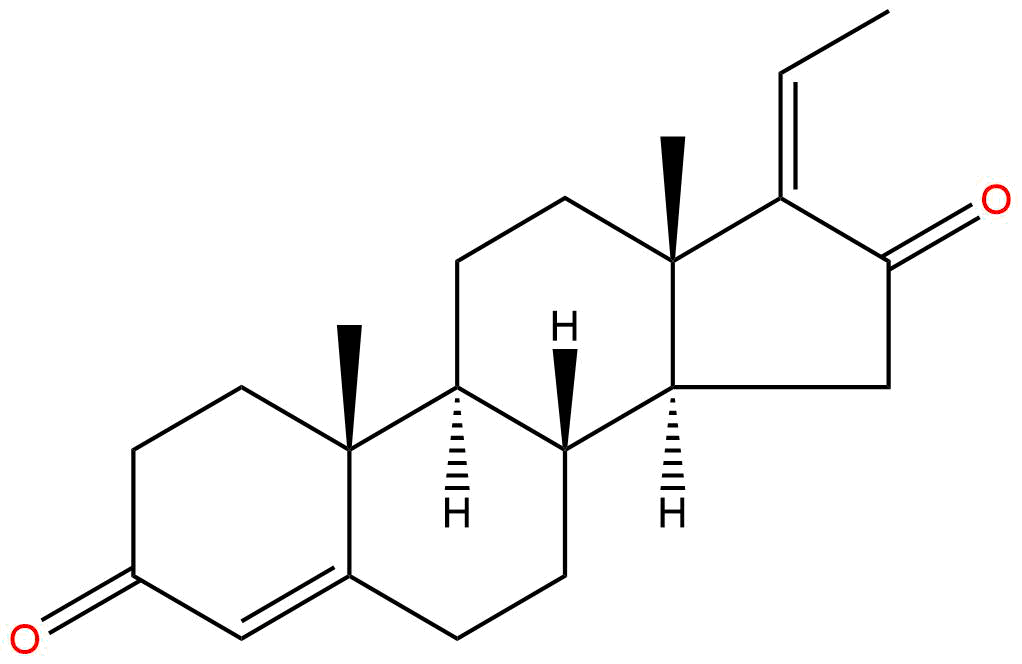


Product Name: Z-Guggulsterone
Synonym name: Z-Guggulsterone; cis-Guggulsterone; (Z)-Guggulsterone
Catalogue No.: BP0368
Cas No.: 39025-23-5
Formula: C21H28O2
Mol Weight: 312.453
Botanical Source: Commiphora mukul and Ailanthus grandis
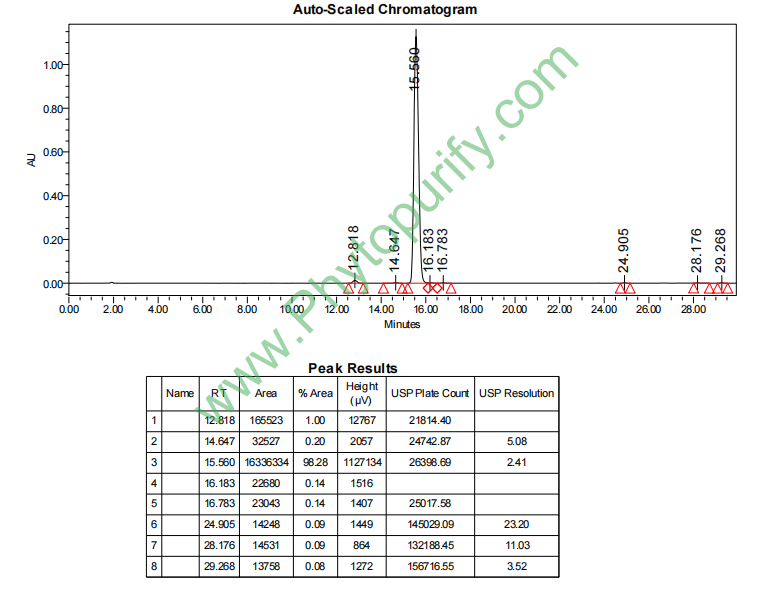
Purity: 95%~99%
Analysis Method: HPLC-DAD or/and HPLC-ELSD
Identification Method: Mass, NMR
Packing: Brown vial or HDPE plastic bottle
Can be supplied from milligrams to grams.
For Reference Standard and R&D, Not for Human Use Directly.
Inquire for bulk scale.
HPLC of Z-Guggulsterone
Storage conditions:Short-term storage at 2~8℃, long-term storage at -20 ~ -80℃
(Z) - Muggulsterone is a naturally occurring 3-hydroxysteroid compound, mainly extracted from the resin of the traditional Indian medicinal plant, Commiphora wightii. As a cis isomer of myrrh steroid ketone, cis myrrh steroid ketone has attracted widespread attention in the field of natural product pharmacology in recent years due to its unique chemical structure and biological activity. Research has shown that cis bisoprolol has significant anti-inflammatory effects and exhibits regulatory capabilities on various inflammation related molecular targets. In addition, its androgen like activity provides a theoretical basis for its potential applications in endocrine regulation and metabolic diseases. This article will provide a systematic review of the chemical structure and physicochemical properties, plant sources and extraction methods, pharmacological activity and mechanism of action, pharmacological evaluation and pharmacokinetic characteristics of cis bisoprolol, and explore its clinical application prospects and research prospects. The aim is to provide theoretical support and research directions for the deep development and application of this natural product.
The molecular formula of cis myrrh ketone is C21H28O2, with a molecular weight of 312.4530. Its chemical structure belongs to 3-hydroxysteroids and has a typical steroid skeleton structure. What distinguishes it from trans isomers is its cis configuration (Z configuration) of double bonds in the steroid skeleton. This cis configuration endows it with a unique spatial conformation, which in turn affects its binding affinity and biological activity with biological targets.
In terms of physical and chemical properties, the LogP value of cis bisoprolol is 3.5189, indicating its good lipid solubility, which is beneficial for penetrating cell membranes and the blood-brain barrier (BBB permeability is high). Its topological polar surface area (TPSA) is 34.14 Å ², indicating low molecular polarity, further supporting its good membrane permeability. Low water solubility (0.0151 mg/mL) suggests limited solubility in aqueous phase, which may affect oral bioavailability. It is worth noting that the compound does not exhibit hERG channel inhibitory activity, indicating a low risk of cardiac toxicity; The Ames mutagenicity test result was 0.0, indicating a low risk of genotoxicity, which provides a positive basis for its safety evaluation.
Cis - myrrh ketone mainly comes from the resin of the myrrh tree (Comiphora wightii), which is a small tree or shrub widely distributed in the Indian subcontinent and some parts of the Middle East. Myrrh tree resin has always been used in traditional medicine as a natural source of anti-inflammatory, analgesic, and lipid-lowering drugs. As one of the active ingredients in myrrh resin, cis myrrh ketone has a relatively low content and needs to be obtained through efficient extraction and separation techniques.
The extraction method usually uses organic solvents for extraction, and commonly used solvents include ethanol, methanol, and ethyl acetate. The extraction steps generally include resin crushing, solvent soaking, filtration, and concentration. To improve purity, column chromatography (such as silica gel column chromatography) or high-performance liquid chromatography (HPLC) are commonly used for separation and purification. In recent years, supercritical CO2 extraction technology has also been applied to the extraction of myrrh steroids, as it is environmentally friendly and can effectively protect the active ingredients from thermal degradation. In addition, the separation of isomers of cis bisoprolol typically relies on chiral chromatography techniques to ensure the acquisition of high-purity cis configurations.
The most significant pharmacological activity of cis myrrh steroid ketone is its anti-inflammatory effect. Numerous in vitro and in vivo experiments have shown that this compound can effectively inhibit the production of inflammatory mediators and the activation of inflammatory signaling pathways. In a mouse inflammatory model, cis bisoprolol significantly reduced the expression levels of pro-inflammatory cytokines such as tumor necrosis factor alpha (TNF - α), interleukin-6 (IL-6), and nitric oxide synthase 2 (NOS2), alleviating tissue inflammatory response.
In addition, the inhibitory effect of cis bisoprolol on inflammation related enzymes such as cyclooxygenase-1 (PTGS1) and cyclooxygenase-2 (PTGS2) further blocks prostaglandin synthesis and reduces the release of inflammatory mediators. Its regulation of inflammasome associated protein CASP1 suggests that it may alleviate cell apoptosis and inflammatory cascade reactions by inhibiting inflammasome activation.
Cis - Bisterone has certain androgen like activity, which can bind to androgen receptors and activate related signaling pathways. This characteristic makes it potentially valuable in regulating endocrine function and promoting metabolic balance. Some studies have shown that cis myrrhosterone can affect lipid metabolism, reduce blood lipid levels, and has anti atherosclerosis effect.
Cis - Bisterone has a regulatory effect on pain receptors such as TRPV1 and TRPA1, demonstrating analgesic potential. It reduces neuroinflammation and pain transmission by inhibiting the excessive activation of these ion channels, indicating its potential application in chronic pain and neuroinflammatory diseases.
The anti-inflammatory mechanism of cis bisoprolol involves multiple signaling pathways and key molecular targets. Its main targets include:
In summary, cis bisoprolol exerts its broad-spectrum anti-inflammatory and analgesic effects through multi-target and multi pathway synergistic regulation.
The pharmacological parameters of cis bisoprolol demonstrate its promising potential for drug development. Its molecular weight is 312.4530, which conforms to Lipinski's rule, and its LogP is 3.5189, indicating moderate lipid solubility, which is conducive to oral absorption and cell membrane penetration. The TPSA is 34.14 Å ², and low polarity helps to penetrate the blood-brain barrier, indicating its potential application in central nervous system diseases.
Low water solubility (0.0151 mg/mL) may limit its oral bioavailability, and solubility needs to be improved through formulation technology. Cis - Bisterone did not exhibit hERG channel inhibition, reducing the risk of cardiac toxicity. The Ames test showed a negative result, indicating a low risk of genotoxicity and good safety.
Pharmacokinetic studies have shown that cis bisoprolol has good distribution ability in the body, especially in effectively penetrating the blood-brain barrier. Its metabolism is mainly carried out through the liver enzyme system, and the metabolites and excretion pathways still need further research. Preliminary pharmacokinetic data in vivo indicate that its half-life is moderate and suitable for development as an oral administration formulation.
Due to its significant anti-inflammatory and androgen like activities, cis bisoprolol has shown broad clinical application prospects in various disease fields. Its potential therapeutic role in chronic inflammatory diseases such as rheumatoid arthritis, inflammatory bowel disease, and neuroinflammation deserves further investigation. In addition, the regulatory effect of cis myristone on lipid metabolism suggests its potential application in metabolic syndrome, atherosclerosis and non-alcoholic fatty liver disease.
In terms of neurological diseases, cis bisoprolol has analgesic and neuroprotective effects by regulating the TRPV1/TRPA1 channel, and may become a novel therapeutic drug for chronic pain and neurodegenerative diseases.
Future research should focus on the preclinical safety evaluation, pharmacokinetic optimization, and formulation development of cis bisoprolol. At the same time, combining modern molecular biology techniques, further elucidating its molecular mechanism and target network provides a solid foundation for clinical translation. The development of multicenter, randomized controlled clinical trials will be a key step in verifying their clinical efficacy and safety.
As a natural 3-hydroxysteroid with androgenic like activity and multi-target anti-inflammatory effects, cis myrrh steroid exhibits excellent pharmacological activity and drug properties. Its unique chemical structure endows it with diverse biological functions, particularly outstanding in inflammation regulation and pain relief. Although the research on its pharmacokinetics and clinical application is still in its early stages, its safety and multi-target mechanism of action have laid a solid foundation for subsequent drug development. In the future, cis bisoprolol is expected to become an important natural drug candidate molecule for the treatment of inflammation related and metabolic diseases, promoting the translation of natural product pharmacology research into clinical applications.
