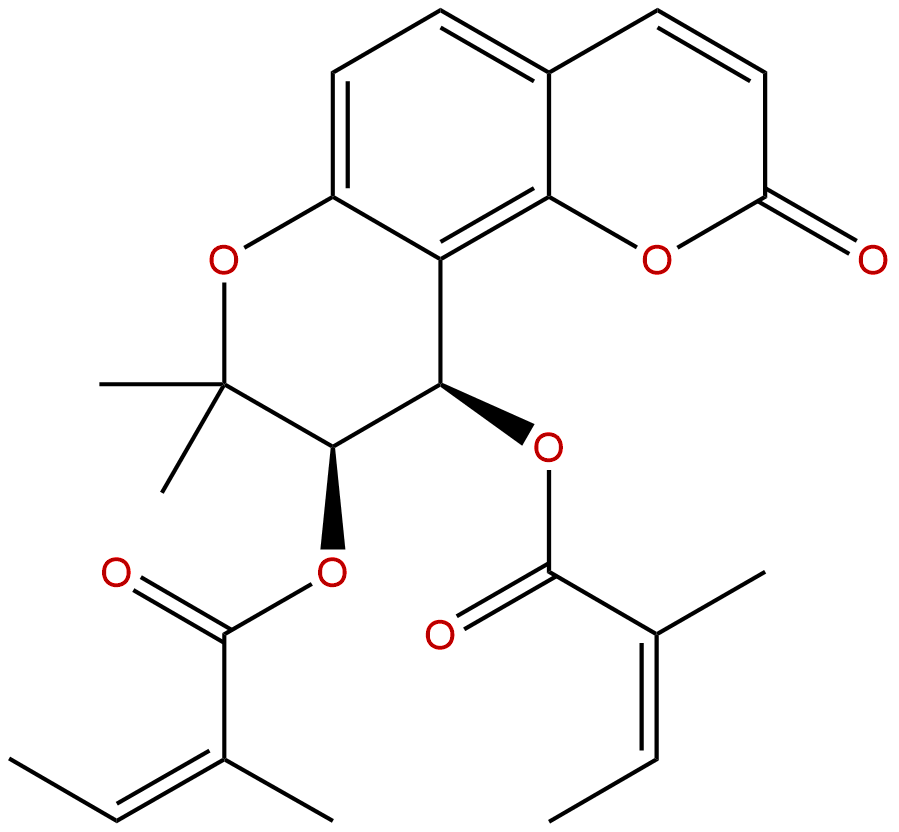


Product name: (-)-Praeruptorin B
Synonym name:
Catalogue No.: SBP03293
Cas No.: 4970-26-7
Formula: C24H26O7
Mol Weight: 426.465
Botanical Source:
Physical Description:
Type of Compound: Coumarins
Purity: 95%~99%
Analysis Method: HPLC-DAD or/and HPLC-ELSD
Identification Method: Mass, NMR
Packing: Brown vial or HDPE plastic bottle
The product could be supplied from milligrams to grams. Inquire for bulk scale.
We provide solution to improve the water-solubility of compounds, thereby facilitating the variety of activity tests and clinic uses.
For Reference Standard and R&D, Not for Human Use Directly.
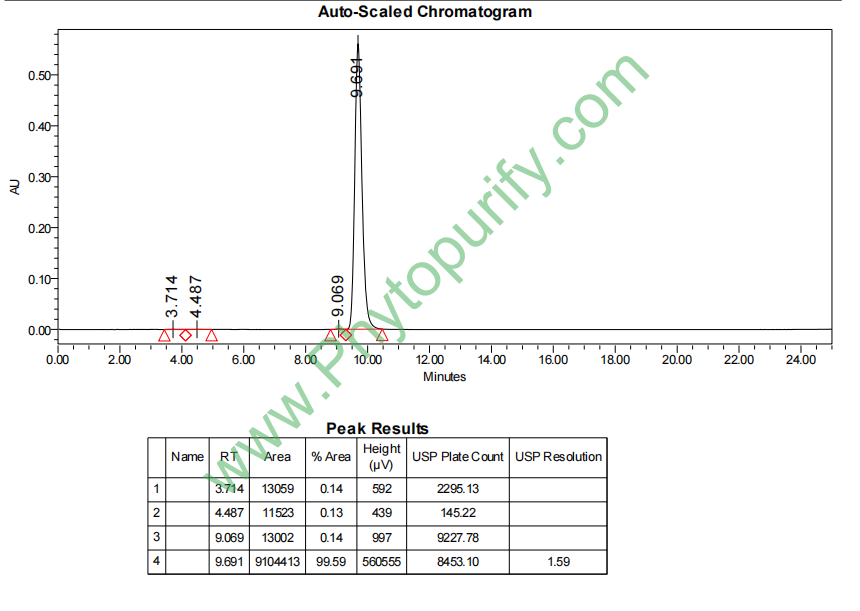
HPLC of (-)-Praeruptorin B
Storage conditions:Short-term storage at 2~8℃, long-term storage at -20 ~ -80℃
92.0400
4.1228
4.1228
.0079
2.9677
6.6977
High
87.3457
3.9324
Yes
Yes
No
No
No
Yes
0.0
No
Yes
Yes
Yes
Natural products have always been an important source of drug discovery and development, especially in the treatment of complex diseases such as cardiovascular disease, inflammation, and tumors. Active ingredients derived from plants exhibit unique chemical diversity and biological activity. In traditional Chinese medicine, the plant of the Umbelliferae family, Peucedanum praeruptorum(Peucedanum praeruptorum The root of Dunn is widely used as a medicine for removing phlegm, stopping cough, relieving asthma, and relieving fever and pain, with a long history of medicinal use. Modern pharmacological research has revealed that the main active ingredient of Peucedanum praeruptorum is a class of angular pyranocoumarin compounds with a benzopyranone skeleton. Among them, (-) - Peucedanum praeruptorin B (Pra-B) has attracted much attention due to its significant calcium ion antagonistic effect and extensive biological activity.
(-) - Peucedanum praeruptorum ethyl, CAS number 4970-26-7, is one of the main active ingredients with high content in Peucedanum praeruptorum, and is an isomer of (-) - Peucedanum praeruptorum methyl (Pra-A). Since Japanese scholars first separated and determined its structure in the 1970s, global research on Pra-B has been ongoing for nearly half a century. Early research mainly focused on its cardiovascular protective effects as an L-type calcium channel blocker, confirming its antihypertensive, anti myocardial ischemia, and anti arrhythmic effects similar to those of verapamil or nifedipine. However, with the deepening of research, the pharmacological spectrum of Pra-B has been continuously expanded, and it has shown remarkable potential in multiple fields such as anti-inflammatory, antioxidant, anti-tumor, anti fibrotic, and neuroprotective effects.
Of particular importance is that the various pharmacological activities of Pra-B are often closely related to their mechanisms of regulating intracellular calcium homeostasis, inhibiting oxidative stress, regulating inflammatory signaling pathways (such as NF - κ B, MAPK), and inducing tumor cell apoptosis and autophagy. This multi-target and multi pathway action characteristic gives it unique advantages in dealing with complex diseases such as cardiovascular disease complicated with metabolic syndrome, tumor microenvironment regulation, etc. However, despite Pra-B's strong biological activity, its development as a candidate drug faces severe challenges. According to the pharmacokinetic parameters, Pra-B has high lipid solubility (LogP 4.12), low water solubility (0.0079 mg/mL), and high blood-brain barrier permeability. At the same time, its Ames test result is negative, and the risk of hERG inhibition is low, indicating that it has a certain safety basis. However, its poor water solubility and potential metabolic instability are key bottlenecks limiting its clinical application.
This article aims to provide a systematic review of the research progress on (-) - Peucedanum praeruptorum, including its chemical structure and physicochemical properties, plant sources and extraction processes, pharmacological activity, mechanism of action, evaluation of drug properties and pharmacokinetic characteristics, as well as its clinical application prospects and prospects. A comprehensive and in-depth analysis will be conducted to provide scientific basis for the further development and transformation of this natural product.
(-) - Peucedanum praeruptorum belongs to the angular pyranocoumarin family, whose core skeleton consists of a coumarin mother nucleus (benzo α - pyranone) and a 2,2-dimethylpyran ring linearly fused at positions C-7 and C-8. There are substituents attached to the C-3 'and C-4' positions, respectively. Specifically, the chemical name of Pra-B is (-) -3 '- angeloyloxy-4' - senecoyloxy-3 ', 4' - dihydroxyseselin. Its structural feature is that the C-3 'position is connected to an angeloyloxy group, and the C-4' position is connected to a senecioyloxy group. The stereoisomeric configuration of these two ester groups (both in the S configuration) and the optical rotation of the entire molecule (left-handed) are the key factors that distinguish them from their isomers Pra-A (C-3 'is the senalioyloxy group, C-4' is the angelioyloxy group).
From the perspective of physical and chemical properties, the molecular formula of Pra-B is C ₂₄ H ₂₆ O ₇, with a molecular weight of 426.4650. Its lipid solubility is relatively high, with a calculated LogP value of 4.1228, indicating that it is highly soluble in organic solvents such as methanol, ethanol, chloroform, ethyl acetate, etc., while its solubility in water is extremely low (about 0.0079 mg/mL). This high lipophilicity determines that its oral absorption may be limited by dissolution and easily penetrate biofilms. The topological polar surface area (TPSA) is 92.04 Å ², which is at a moderate level, due to the presence of multiple ester bonds and oxygen atoms in its structure. It is worth noting that its blood-brain barrier (BBB) permeability has been evaluated as "high", suggesting that Pra-B may have potential value in the treatment of central nervous system diseases, but may also bring central related side effects.
In terms of stability, the two ester bonds in Pra-B molecule (Angelica sinensis acyl group and Senecio group) are prone to hydrolysis under acidic or alkaline conditions, producing the corresponding alcohol (Peucedanol) and acid. In addition, under light or high temperature conditions, the coumarin parent nucleus may undergo photodimerization or ring opening reactions. Therefore, in the process of extraction, separation, storage, and formulation development, it is necessary to strictly control the pH value, temperature, and light avoidance conditions.
(-) - White flowered Peucedanum mainly comes from the genus Peucedanum in the Umbelliferae family(Peucedanum praeruptorum Dunn's dry roots. In addition, in the purple flowered Qianhu(Peucedanum decursivum Maxim. and other plants of the same genus have also been found in small quantities, but white flowered Peucedanum is its most abundant and classic source. Baihua Qianhu is mainly distributed in East China, Central China, and Southwest China, such as Zhejiang, Anhui, Hunan, Sichuan, and other places. The quality of medicinal herbs is influenced by their place of origin, harvesting season (usually autumn), and processing method (sun drying or oven drying), among which the total coumarin content and Pra-B/Pra-A ratio are important indicators for evaluating the quality of medicinal herbs.
Traditional extraction methods often use organic solvent extraction or percolation methods. Given the high lipid solubility of Pra-B, commonly used solvents include ethanol, methanol, or ethyl acetate. The specific process is usually as follows: after crushing the roots of Peucedanum praeruptorum, extract 2-3 times with 70% -95% ethanol reflux, combine the extracts, and concentrate under reduced pressure to obtain the extract. After dispersing the extract in water, it was extracted sequentially with petroleum ether, ethyl acetate, and n-butanol. Due to its moderate polarity, Pra-B is mainly enriched in the ethyl acetate extraction layer. The ethyl acetate layer was subjected to silica gel column chromatography, and gradient elution was performed using petroleum ether ethyl acetate or chloroform methanol systems. Combined with thin-layer chromatography (TLC) monitoring, a fraction rich in Pra-B was obtained. Further high-purity monomer compounds can be obtained through preparative high-performance liquid chromatography (Pre HPLC) or recrystallization techniques.
In recent years, some modern extraction techniques have been applied to the preparation of Pra-B in order to improve extraction efficiency and environmental friendliness. For example, ultrasound assisted extraction (UAE) utilizes the cavitation effect of ultrasound to destroy cell walls, accelerate solvent penetration, and achieve higher extraction rates in a shorter period of time. Microwave assisted extraction (MAE) generates internal heat through the rapid vibration of polar molecules in a microwave field, which can significantly shorten the extraction time. In addition, supercritical fluid extraction (SFE), especially using carbon dioxide as a solvent, has unique advantages in extracting thermosensitive coumarin components due to its non-toxic, residue free, and low operating temperature. By adding a small amount of ethanol as an entrainer, the extraction efficiency of SFE for Pra-B can be significantly improved. These modern methods not only improve yield, but also reduce the use of organic solvents, which is in line with the concept of green chemistry.
The pharmacological activity research of (-) - Peucedanum praeruptorum has undergone a process of expanding from classical cardiovascular effects to multi system and multi-target effects.
1. Protective effect on cardiovascular system
This is the earliest confirmed and most extensively studied function of Pra-B. As a classic calcium ion antagonist, Pra-B can selectively block L-type calcium channels in vascular smooth muscle and myocardial cells, inhibit calcium ion influx, and thus produce the following effects:
- Hypotensive effect By dilating peripheral blood vessels and reducing peripheral resistance, it has shown significant antihypertensive effects on spontaneously hypertensive rats and renal hypertension models, and the effect is long-lasting.
- Anti myocardial ischemia/reperfusion injury In ex vivo cardiac perfusion and in vivo myocardial infarction models, Pra-B can reduce the infarct area and improve cardiac function. Its mechanism is not only related to calcium antagonism, but also involves inhibiting the production of oxygen free radicals and reducing intracellular calcium overload.
- Antiarrhythmic treatment It has a protective effect on various experimental arrhythmias (such as aconitine and calcium chloride induction), can prolong the effective refractory period, and increase the threshold of ventricular fibrillation.
- Anti atherosclerosis By inhibiting the proliferation and migration of vascular smooth muscle cells, reducing the formation of foam cells, and improving vascular endothelial function, it can delay the progress of atherosclerosis.
2. Anti inflammatory and antioxidant effects
Pra-B exhibits strong anti-inflammatory activity. In a macrophage model stimulated by lipopolysaccharide (LPS), Pra-B significantly inhibits the release of pro-inflammatory factors such as tumor necrosis factor - α (TNF - α), interleukin-6 (IL-6), and interleukin-1 β (IL-1 β). Meanwhile, it can inhibit the expression of inducible nitric oxide synthase (iNOS) and cyclooxygenase-2 (COX-2), thereby reducing the production of nitric oxide (NO) and prostaglandin E2 (PGE2). In terms of antioxidant properties, Pra-B can directly scavenge various free radicals (such as DPPH, ABTS+) and upregulate the activity of intracellular antioxidant enzymes (such as superoxide dismutase (SOD) and glutathione peroxidase (GSH Px)), reducing oxidative stress damage to cells.
3. Antitumor activity
In recent years, the anti-tumor effect of Pra-B has become a research hotspot. In vitro experiments have shown that Pra-B can inhibit the proliferation of many tumor cell lines (such as human breast cancer MCF-7, lung cancer A549, liver cancer HepG2, colon cancer HT-29, cervical cancer HeLa, etc.). Its mechanism of action is complex, mainly including:
- Inducing apoptosis Inducing tumor cell apoptosis by activating mitochondrial pathways (upregulating Bax/Bcl-2 ratio, releasing cytochrome c, activating Caspase-3/9) or death receptor pathways (upregulating Fas/FasL).
- Inducing autophagic death In certain tumor cells, Pra-B can induce the expression of autophagy markers such as LC3-II and Beclin-1, leading to cell death through the autophagy pathway.
- cell cycle arrest Block tumor cells in G0/G1 or G2/M phase and inhibit their proliferation.
- Angiogenesis inhibition Inhibit the secretion of vascular endothelial growth factor (VEGF) and the formation of endothelial cell lumens, cutting off tumor nutrient supply.
- Reverse multidrug resistance In drug-resistant tumor cells, Pra-B can downregulate the expression of P-glycoprotein (P-gp), increase intracellular chemotherapy drug concentration, and thus reverse drug resistance.
4. Organ protection and metabolic regulation
- Liver protection Pra-B can reduce serum transaminase (ALT, AST) levels, alleviate hepatic steatosis and necrosis in liver injury models induced by carbon tetrachloride (CCl ₄) or alcohol, and its mechanism is related to antioxidant and anti-inflammatory effects.
- Kidney protection In the model of diabetes nephropathy, Pra-B can alleviate glomerulosclerosis, tubulointerstitial fibrosis, and inhibit TGF - β 1/Smad signaling pathway in renal tissue.
- neuroprotection Given its high BBB permeability, Pra-B shows potential in neurodegenerative disease models. It can alleviate the neurotoxicity induced by β - amyloid protein (A β), inhibit tau protein hyperphosphorylation, and improve cognitive function in Alzheimer's disease model mice. In addition, in the cerebral ischemia-reperfusion model, Pra-B can reduce the volume of cerebral infarction and alleviate neurological deficits.
- anti-fibrotic In models of pulmonary fibrosis and myocardial fibrosis, Pra-B exerts anti fibrotic effects by inhibiting fibroblast activation and reducing collagen deposition.
The pharmacological effects of (-) - Peucedanum praeruptorum are not driven by a single target, but are achieved through a network regulation of multiple targets and signaling pathways. The core mechanism can be summarized as follows:
1. Calcium ion channel regulation
Pra-B is a classic L-type calcium channel blocker. It directly binds to the alpha 1 subunit of L-type calcium channels on vascular smooth muscle and myocardial cell membranes, blocking the influx of calcium ions and leading to a decrease in intracellular calcium concentration. This mechanism is the basis for its antihypertensive, anti myocardial ischemia, and anti arrhythmic effects. In addition, the decrease in intracellular calcium concentration can also affect downstream calcium dependent signaling pathways, such as the activity of calmodulin (CaM) and calmodulin dependent protein kinase (CaMKII), thereby regulating gene expression and cellular function.
2. Inhibition of inflammatory signaling pathways
Pra-B exerts anti-inflammatory effects by inhibiting multiple pro-inflammatory signaling pathways:
- NF - κ B pathway Inhibiting the phosphorylation and degradation of I κ B α, preventing the translocation of NF - κ B p65 subunit into the nucleus, thereby downregulating the transcription of downstream target genes such as TNF - α, IL-6, iNOS, COX-2.
- MAPK pathway Inhibit the phosphorylation of p38 MAPK, JNK, and ERK1/2, and block the inflammatory cascade mediated by these kinases.
- NLRP3 inflammasome Research has shown that Pra-B can inhibit the assembly and activation of NLRP3 inflammasomes, reduce the maturation and secretion of IL-1 β and IL-18.
3. Oxidative stress and antioxidant defense
Pra-B not only directly scavenges free radicals, but more importantly, it upregulates the expression of a series of antioxidant enzymes (such as HO-1, NQO1, SOD, CAT) by activating the nuclear factor E2 related factor 2 (Nrf2)/antioxidant response element (ARE) pathway, enhancing the intracellular antioxidant defense ability. This' indirect antioxidant 'mechanism is the key to its long-lasting protective effect.
4. Apoptosis and autophagy regulation
Pra-B induces cell death in tumor cells through various pathways:
- Mitochondrial apoptosis pathway Upregulation of pro apoptotic protein Bax and downregulation of anti apoptotic protein Bcl-2 lead to loss of mitochondrial membrane potential, release of cytochrome c and apoptosis inducing factor (AIF), and activation of Caspase cascade reaction.
- Endoplasmic reticulum stress pathway Activate the PERK/eIF2 α/ATF4/CHOP signaling pathway to induce endoplasmic reticulum stress-related apoptosis.
- Autophagy pathway By inhibiting the PI3K/Akt/mTOR signaling pathway and activating AMPK, autophagy is induced. In some cases, autophagy serves as a cellular protective mechanism; In other cases, excessive autophagy leads to autophagic cell death.
5. Other molecular targets
Pra-B can also regulate the TGF - β 1/Smad signaling pathway (anti fibrosis), Wnt/β - catenin pathway (affecting cell proliferation and differentiation), and epigenetic modifications (such as the activity of histone deacetylase HDAC). These diverse targets together form the complex pharmacological network of Pra-B.
Although (-) - Peucedanum praeruptorum has strong pharmacological activity, its medicinal properties face significant challenges. According to the provided parameters, its pharmacological characteristics are as follows:
1. Physical and chemical properties and drug like properties
- Molecular weight and lipid solubility Molecular weight 426.5 Da (slightly higher than the upper limit of 500 Da in the "Five Rules"), LogP 4.12 (higher than the upper limit of 5 in the "Five Rules" but close to the boundary). High LogP means high lipid solubility, which is beneficial for transmembrane absorption, but may also lead to poor water solubility, fast metabolism, and non-specific binding.
- Water solubility:0.0079 mg/mL, It belongs to extremely insoluble compounds. This is the main obstacle to its low oral bioavailability. According to the Biopharmaceutical Classification System (BCS), Pra-B is likely to belong to Class II (low solubility, high permeability) drugs.
- TPSA 92.04 Å ² indicates moderate polarity and may be absorbed through passive diffusion and transporter mediated pathways.
2. Safety evaluation
- HERG inhibition: No. This is a positive signal indicating that Pra-B has a lower risk of causing QT interval prolongation and apical torsion ventricular tachycardia at therapeutic concentrations.
- Ames test: 0.0 (negative). Indicating that it has no direct mutagenicity and low risk of genetic toxicity.
3. Pharmacokinetic characteristics (based on literature reports)
- absorb Poor oral absorption and extremely low absolute bioavailability (usually below 5%). The main reason is limited solubility due to poor water solubility and strong first pass effect. In the intestine and liver, the ester bonds of Pra-B are easily hydrolyzed by esterases, producing the metabolite Praeruptorin A alcohol, whose activity is significantly reduced or lost.
- distribution Due to its high lipid solubility, Pra-B is widely distributed in the body, particularly prone to accumulation in adipose tissue, liver, and lungs. Its high BBB permeability allows it to enter the central nervous system, which is both an advantage in treating central diseases and may also bring central side effects such as sedation and dizziness.
- Metabolism Mainly metabolized by the cytochrome P450 enzyme system (CYP3A4 as the main subtype) and esterase in the liver. The main metabolic pathways include: ① hydrolysis of ester bonds to produce resveratrol and corresponding acids; ② Oxidative ring opening of pyran ring; ③ Hydroxylation of coumarin mother nucleus. Metabolites usually have increased polarity and decreased activity.
- excretion Metabolites are mainly excreted through bile and urine. The prototype drug is almost undetectable in urine.
4. Challenges and strategies for drug development
The core bottleneck of Pra-B's medicinal properties lies in:Extremely low water solubility, strong first pass metabolism, and low oral bioavailability The current research strategies for addressing these issues include:
- Formulation technology Adopting technologies such as solid dispersions, liposomes, nanoparticles, phospholipid complexes, and self microemulsifying drug delivery systems (SMEDS) to improve its dissolution and oral absorption.
- Prodrug design Introducing hydrophilic groups (such as phosphate esters, amino acid esters, and sugar groups) into the hydroxyl or carboxyl sites of Pra-B to produce prodrugs, which are released in vivo after enzymatic hydrolysis.
- Structural modification On the premise of maintaining the activity of the core skeleton, ester groups are modified by introducing more metabolically stable groups (such as ether bonds, amide bonds) or hydrophilic groups (such as hydroxyl, carboxyl, amino groups) to improve water solubility and metabolic stability.
- Optimization of administration route Given the poor oral absorption, it may be considered to develop injections (such as lipid microspheres, cyclodextrin inclusion complexes), transdermal patches, or nasal delivery formulations to bypass first pass effects.
As a natural product with multi-target activity, (-) - Baihua Qianhuyi has broad clinical application prospects, but also faces huge transformation challenges.
1. Cardiovascular disease field
This is the field closest to clinical application. Based on its calcium antagonistic, anti-inflammatory, antioxidant and antiatherosclerotic effects, Pra-B or its derivatives are expected to be developed as new drugs to treat hypertension, coronary heart disease, heart failure and arrhythmia. Especially for hypertensive patients with metabolic syndrome or inflammatory status, the pleiotropy of Pra-B may be superior to traditional single target calcium antagonists. However, its low oral bioavailability is the biggest obstacle to the development of oral formulations. If this problem can be solved through formulation technology or structural modification, its potential as a cardiovascular drug will be greatly unleashed.
2. In the field of tumor treatment
Pra-B has a wide spectrum of anti-tumor activity and has the ability to reverse multidrug resistance, which makes it potentially valuable in tumor combination chemotherapy. For example, when used in combination with chemotherapy drugs such as paclitaxel and doxorubicin, it may enhance efficacy and reduce drug resistance by inhibiting P-gp and inducing apoptosis. In addition, its ability to induce autophagy also provides ideas for the development of novel autophagy regulators. However, tumor treatment typically requires long-term medication, and the metabolic instability and potential accumulation toxicity of Pra-B (especially tissue accumulation caused by high lipid solubility) need to be carefully evaluated.
3. In the field of neurodegenerative diseases
The high BBB permeability of Pra-B is its unique advantage. In Alzheimer's disease (AD) and Parkinson's disease (PD) models, its anti-inflammatory, antioxidant, and anti A β aggregation effects have shown neuroprotective potential. Especially, the pathogenesis of AD involves calcium homeostasis imbalance, oxidative stress, and neuroinflammation, which is highly consistent with the mechanism of action of Pra-B. Therefore, Pra-B may become a candidate compound for the treatment of AD. However, the safety of long-term central exposure (such as toxicity to normal neurons) needs to be further studied.
4. Anti fibrotic disease field
Liver, kidney, and lung fibrosis are the terminal stages of many chronic diseases, and there is currently a lack of effective therapeutic drugs. Pra-B has shown therapeutic effects in various fibrosis models by inhibiting the TGF - β 1/Smad signaling pathway and anti-inflammatory effects. This provides a basis for its application in the treatment of organ fibrosis.
Future Prospects:
- Research on Structural Optimization and Structure Performance Relationship Systematically study the effects of various functional groups (especially ester groups at C-3 'and C-4' positions) in Pra-B molecules on activity, selectivity, and metabolic stability, design and synthesize a series of derivatives, and search for candidate compounds with stronger activity, more stable metabolism, and better water solubility.
- Development of a new drug delivery system Focus on tackling the problem of low oral bioavailability. Utilizing nanotechnology (such as polymer nanoparticles, lipid nanoparticles), phospholipid complexes, prodrug strategies, etc., to achieve efficient delivery of Pra-B.
- Target confirmation and deepening of mechanism of action Using techniques such as chemical biology and proteomics, accurately identify the direct protein targets of Pra-B, elucidate its molecular network of multi-target effects, and provide a basis for precision therapy.
- safety evaluation Conduct long-term toxicity, reproductive toxicity, genetic toxicity, and central nervous system safety evaluations of the system, especially conducting in-depth research on the central side effects that may be caused by its high BBB permeability.
- Combination therapy research Explore the synergistic effects of Pra-B with existing clinical drugs such as chemotherapy drugs, antihypertensive drugs, and anti-inflammatory drugs, and develop combination therapy plans.
As an important active coumarin component in Peucedanum praeruptorum, (-) - Peucedanum praeruptorum ethyl has undergone nearly half a century of research, and its pharmacological activity spectrum has expanded from its initial cardiovascular calcium antagonistic effect to multiple fields such as anti-inflammatory, antioxidant, anti-tumor, anti fibrotic, and neuroprotective effects. Its mechanism of action exhibits typical "multi-target, multi pathway" characteristics, involving multiple key signaling pathways such as calcium channels, NF - κ B, MAPK, Nrf2, TGF - β 1/Smad, PI3K/Akt/mTOR, etc. This multifunctionality gives it a unique advantage in treating complex diseases.
However, the journey from natural active molecules to clinical drugs for Pra-B is still long and bumpy. Its extremely low water solubility, strong first pass metabolism, and resulting extremely low oral bioavailability constitute the biggest bottleneck for its drug development. Although the results of Ames test and hERG inhibition test provide preliminary safety assurance, the cumulative toxicity, central side effects, and activity and toxicity of metabolites of long-term medication still need to be systematically evaluated.
Future research should focus on breaking through pharmacokinetic bottlenecks through structural modifications or advanced formulation technologies; Using modern molecular biology techniques to further elucidate its direct targets and action networks; Conduct systematic and standardized preclinical safety evaluations. Only in this way can this precious gem in ancient Chinese medicine truly be transformed into a modern medicine that benefits human health. The research process of (-) - Baihua Qianhuyi is not only an exploration of a natural product, but also a microcosm of the modernization of traditional Chinese medicine and the discovery of innovative drugs. Its success or failure will provide valuable experience and inspiration for the development of similar natural products.
