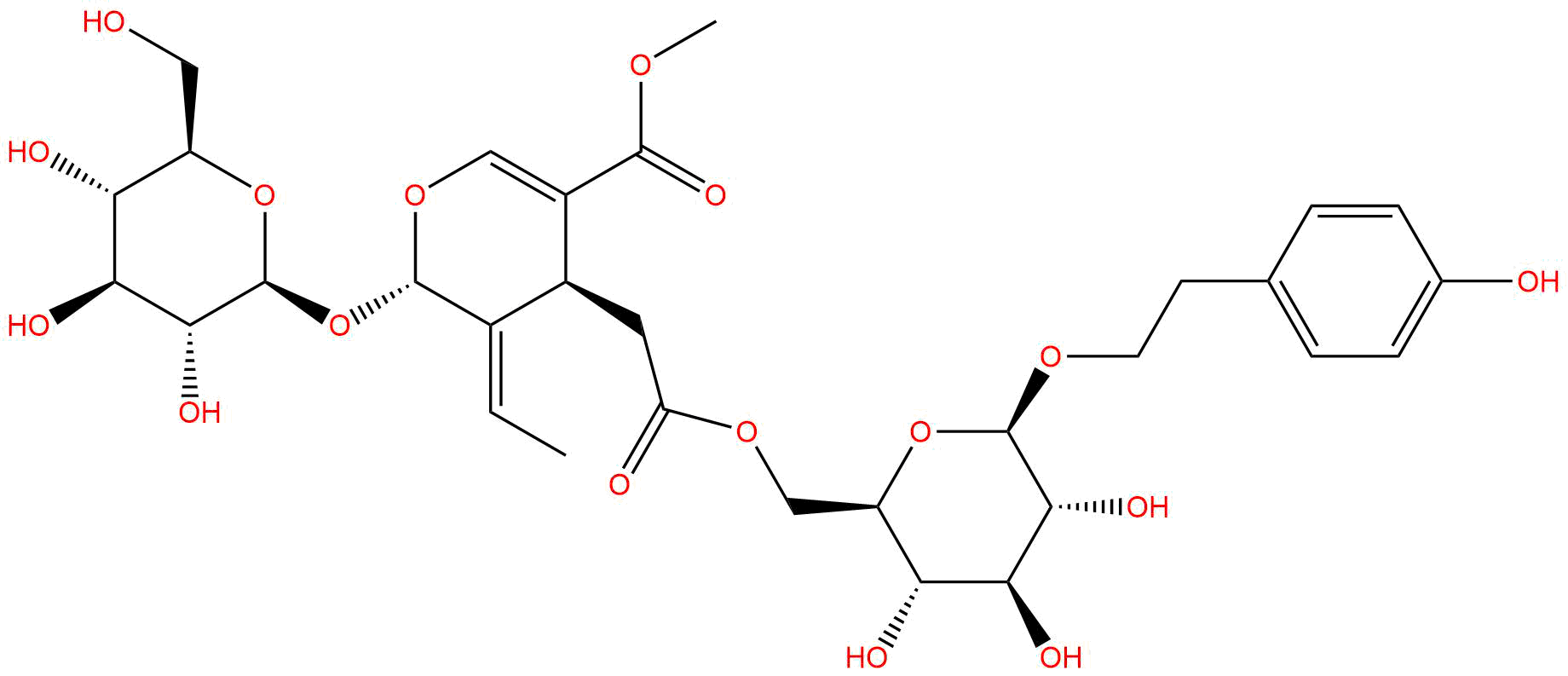


Product name: Specnuezhenide
Synonym name: (8E)-Nuezhenide;449733-84-0
Catalogue No.: BP1334
Cas No.: 39011-92-2
Formula: C31H42O17
Mol Weight: 686.66
Botanical Source: Ligustrum lucidum Ait.
Physical Description:
Type of Compound: Terpenoids
Purity: 95%~99%
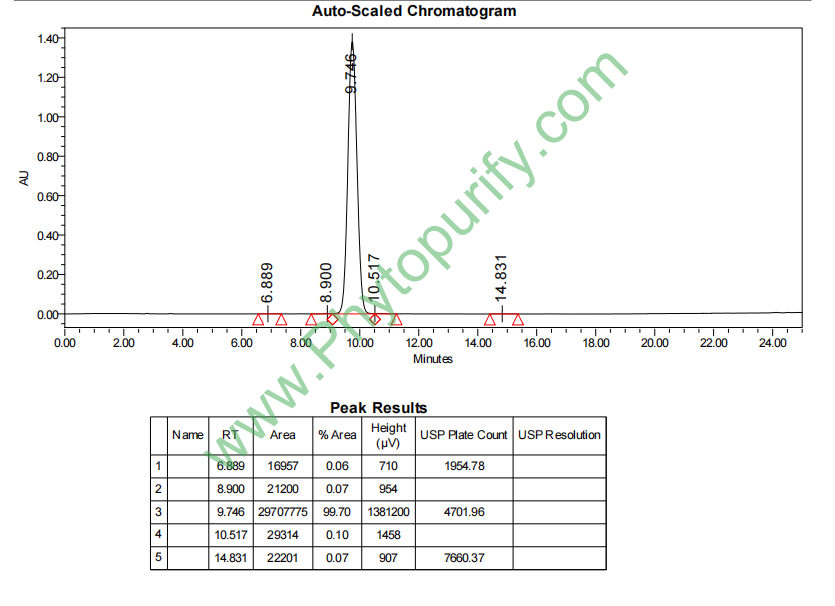
Analysis Method: HPLC-DAD or/and HPLC-ELSD
Identification Method: Mass, NMR
Packing: Brown vial or HDPE plastic bottle
Storage: Store in a well closed container, protected from air and light. Put into refrigerate or freeze for long term storage.
Whenever possible, you should prepare and use solutions on the same day. However, if you need to make up stock solutions in advance, we recommend that you store the solution as aliquots in tightly sealed vials at -20℃. Generally, these will be useable for up to two weeks.
The product could be supplied from milligrams to grams
Inquire for bulk scale.
Chengdu Biopurify Phytochemicals Ltd. is a leading company in the research, development, manufacture and marketing of High Quality Phytochemicals and Extracts(especially Active Ingredients from Traditional Chinese Medicine,TCM), Natural Active Pharmaceutical Ingredients worldwide.
The main services:
A. Supply active ingredients and reference standards of TCM, from mgs to kgs scale
B. Custom extraction and purification, target Herb Active Ingredients
C. Custom synthesis and semi-synthesis for Natural Active Ingredients
D. CR(contract research), CM(contract manufacture) and PD(process development) services from lab scale, pilot scale to commercial scale(GMP is also available)
E. TCM compounds library for drug screen,more than 3000 compounds available, many of them are rare and unique.
HPLC of Specnuezhenide
Storage conditions:Short-term storage at 2~8℃, long-term storage at -20 ~ -80℃
Specnuezhenide (CAS number: 39011-92-2) is an active natural product isolated from the fruit of Ligustrum Lucidum Ait. It belongs to a complex class of phenolic glycosides. As a traditional Chinese medicinal herb, Ligustrum lucidum has always been used for nourishing the liver and kidneys, improving eyesight, and anti-aging effects. In recent years, its main active ingredient, Ligustrum lucidum glycoside, has attracted much attention due to its significant anti-inflammatory, antioxidant, and regulatory effects on cellular signaling pathways. A large number of studies have shown that resveratrol has good therapeutic potential in chronic inflammatory diseases such as osteoarthritis (OA), especially by inhibiting the NF - κ B and Wnt/β - catenin signaling pathways, reducing IL-1 β - induced chondrocyte inflammatory response. In addition, the role of ligustilide in antioxidant damage has gradually been revealed, as it enhances cellular antioxidant defense ability by regulating key antioxidant targets such as NFE2L2/NRF2. This article provides a systematic review of the chemical structure and physicochemical properties, plant sources and extraction methods, pharmacological activity and mechanism of action, pharmacological evaluation, and clinical application prospects of Ligustrum lucidum glycoside, aiming to provide theoretical basis and research direction for its subsequent drug development and clinical application.
The chemical name of Ligustrum lucidum glycoside is (8E) - Nuezhenide, with a molecular formula of C34H42O21 and a molecular weight of 686.6600. Its structure belongs to complex phenolic glycosides, containing multiple phenolic hydroxyl groups and glycosidic bonds, and has high polarity. Its molecular structure contains multiple aromatic rings and sugar groups, endowing it with abundant hydrogen bond donors and acceptors, promoting its binding with biomolecules. In terms of physical and chemical properties, the LogP value of Ligustrum lucidum glycoside is -0.7217, indicating its strong hydrophilicity and good water solubility (value of 8.6555), which is beneficial for its absorption and distribution in vivo. Its topological polar surface area (TPSA) is 260.5900, and a higher TPSA indicates limited ability to pass through cell membranes and low blood-brain barrier permeability, suggesting that its main target or distribution area is in peripheral tissues. The negative result of hERG channel inhibition experiment indicates a low risk of cardiac toxicity. The Ames mutagenicity test result is 0.0, indicating a low risk of genotoxicity and good safety.
The main source of Ligustrum Lucidum Ait. is the mature fruit of Ligustrum Lucidum Ait. Ligustrum Lucidum is a plant species in the Oleaceae family, widely distributed in southern China and East Asia. In traditional Chinese medicine, Ligustrum lucidum is used to nourish the liver and kidneys, benefit essence and improve vision. Modern pharmacological research has confirmed that it contains various active ingredients, including flavonoids, phenolic glycosides, and triterpenoid saponins.
The extraction of Ligustrum lucidum glycoside is usually carried out using ethanol or methanol aqueous solutions as extractants, and crude extracts are obtained through reflux extraction or ultrasound assisted extraction methods. Subsequently, liquid-liquid distribution and column chromatography (including silica gel columns and reverse phase C18 columns) were used for separation and purification. High performance liquid chromatography (HPLC) and mass spectrometry (MS) techniques are widely used for qualitative and quantitative analysis of ligustilide. In recent years, the application of supercritical fluid extraction and membrane separation technology has improved the extraction efficiency and purity of ligustilide, laying the foundation for its large-scale production.
Ligustrum lucidum glycoside exhibits significant anti-inflammatory activity in various inflammatory models. In particular, in the osteoarthritis (OA) model, resveratrol reduces the destruction and inflammatory infiltration of articular cartilage by inhibiting IL-1 β - induced chondrocyte inflammatory response. In vivo studies have shown that resveratrol can significantly reduce the levels of pro-inflammatory cytokines (such as TNF - α, IL-6, IL-1 β) in the joint fluid of OA rats, and alleviate pathological damage to cartilage tissue. Its anti-inflammatory effect is closely related to its inhibition of the activation of the nuclear factor NF - κ B signaling pathway. NF - κ B, as the core transcription factor of inflammatory response, regulates the expression of various inflammatory mediators.
Ligustrum lucidum glycoside has good antioxidant properties, which can eliminate free radicals and alleviate cell damage caused by oxidative stress. It enhances the cellular antioxidant defense system by activating the NFE2L2 (also known as NRF2) signaling pathway, inducing the expression of downstream antioxidant enzymes such as superoxide dismutase (SOD1, SOD2), catalase (CAT), glutathione peroxidase (GPX1), and heme oxygenase 1 (HMOX1). Both in vitro cell models and in vivo animal experiments have confirmed that ligustilide can effectively alleviate tissue damage related to oxidative stress, indicating its potential application value in the prevention and treatment of oxidative stress-related diseases.
In addition to anti-inflammatory and antioxidant effects, some studies have also reported that resveratrol has immunomodulatory, anti-tumor, and neuroprotective effects, but related research is still in the preliminary stage and the mechanism needs further clarification.
The pharmacological mechanism of action of Ligustrum lucidum glycoside mainly involves the regulation of multiple cellular signaling pathways:
Inhibition of NF - κ B signaling pathway
NF - κ B is a key regulatory factor in inflammatory response, and pro-inflammatory factors such as IL-1 β can activate NF - κ B and promote the expression of inflammatory mediators. Tewuzhen glycoside achieves anti-inflammatory effects by inhibiting the phosphorylation and degradation of I κ B α, preventing nuclear translocation of NF - κ B, and reducing the transcription of inflammatory genes.
Regulation of Wnt/β - catenin signaling pathway
The Wnt/β - catenin signaling pathway plays an important role in the proliferation, differentiation, and inflammatory response of chondrocytes. Ligustrum lucidum glycoside can inhibit the abnormal activation of this pathway, alleviate the inflammatory state of chondrocytes, and protect the integrity of cartilage tissue structure.
NFE2L2/NRF2 antioxidant signaling activation
By promoting the translocation of NRF2 from the cytoplasm to the nucleus, ligustilide enhances the expression of antioxidant enzyme genes, improves the cell's resistance to oxidative stress, and reduces oxidative damage.
Enhancement of antioxidant enzyme activity
Ligustrum lucidum glycoside can directly or indirectly activate antioxidant enzymes such as SOD1, SOD2, CAT, GPX1, and HMOX1, clear excess reactive oxygen species (ROS), and maintain cellular redox balance.
In summary, Ligustrum lucidum glycoside exerts its comprehensive pharmacological effects of anti-inflammatory and antioxidant through multi-target and multi pathway synergistic effects, and has good therapeutic potential.
The molecular weight of Ligustrum lucidum glycoside is relatively large (686.66 Da), with a LogP of -0.72, indicating strong hydrophilicity. Its TPSA is as high as 260.59, suggesting poor membrane permeability, especially low blood-brain barrier permeability, which limits the role of the central nervous system. It has good water solubility, which is beneficial for oral absorption, but its high polarity may affect its bioavailability.
In terms of safety, ligustilide does not inhibit hERG channels, reducing the risk of cardiac toxicity; Ames test negative, low risk of genotoxicity, indicating a good safety foundation.
At present, there is limited research on the pharmacokinetics of Ligustrum lucidum glycoside. Preliminary data indicate that its oral absorption is slow, and its distribution in the body is mainly limited to peripheral tissues. The metabolic pathway may involve the liver enzyme system, but the specific metabolites and excretion methods still need to be further studied. In the future, a combination of in vitro and in vivo pharmacokinetics and pharmacodynamics research is needed to optimize the dosing regimen, improve its bioavailability and therapeutic efficacy.
Based on the significant anti-inflammatory and antioxidant effects of Ligustrum lucidum glycoside, it has shown broad application prospects in the treatment of chronic inflammatory diseases such as osteoarthritis. Especially for degenerative cartilage diseases such as OA, ligustilide can alleviate chondrocyte inflammation, protect cartilage tissue, and delay disease progression. In addition, its antioxidant effect also provides potential for the prevention and treatment of cardiovascular and neurodegenerative diseases related to oxidative stress.
Future clinical translational research should focus on the following aspects:
Formulation development and optimization of administration routes
Due to its molecular structure characteristics, developing suitable dosage forms (such as nanomaterials, liposomes, etc.) to improve bioavailability and targeting is the key to achieving clinical applications.
Pharmacokinetic and safety evaluation of the system
Comprehensive pharmacokinetic data and long-term toxicology studies provide scientific basis for clinical trials.
Multi center, large sample clinical trials
Verify its efficacy and safety in osteoarthritis and other inflammation related diseases, clarify indications and medication regimens.
Exploration of Combination Medication Strategy
Combining with existing anti-inflammatory drugs or antioxidants to explore synergistic effects and enhance treatment efficacy.
In depth analysis of molecular mechanisms
By combining modern molecular biology techniques, we aim to further uncover its targets and signaling pathways, and promote the development of precision therapy.
As an important active ingredient in Ligustrum lucidum, Ligustrum lucidum glycoside exhibits significant anti-inflammatory and antioxidant potential due to its unique chemical structure and multi-target pharmacological effects. It reduces inflammation and oxidative damage by regulating key pathways such as NF - κ B, Wnt/β - catenin, and NFE2L2/NRF2, providing new ideas for the treatment of chronic diseases such as osteoarthritis. Although there are still certain challenges in pharmacokinetics and clinical applications, with the advancement of extraction and purification technology and optimization of drug delivery systems, Terdesidine is expected to become an important candidate molecule for the development of natural product drugs. In the future, it is necessary to strengthen its mechanism research and clinical translation, promote its application in modern medicine, and bring new treatment options for patients with related diseases.
