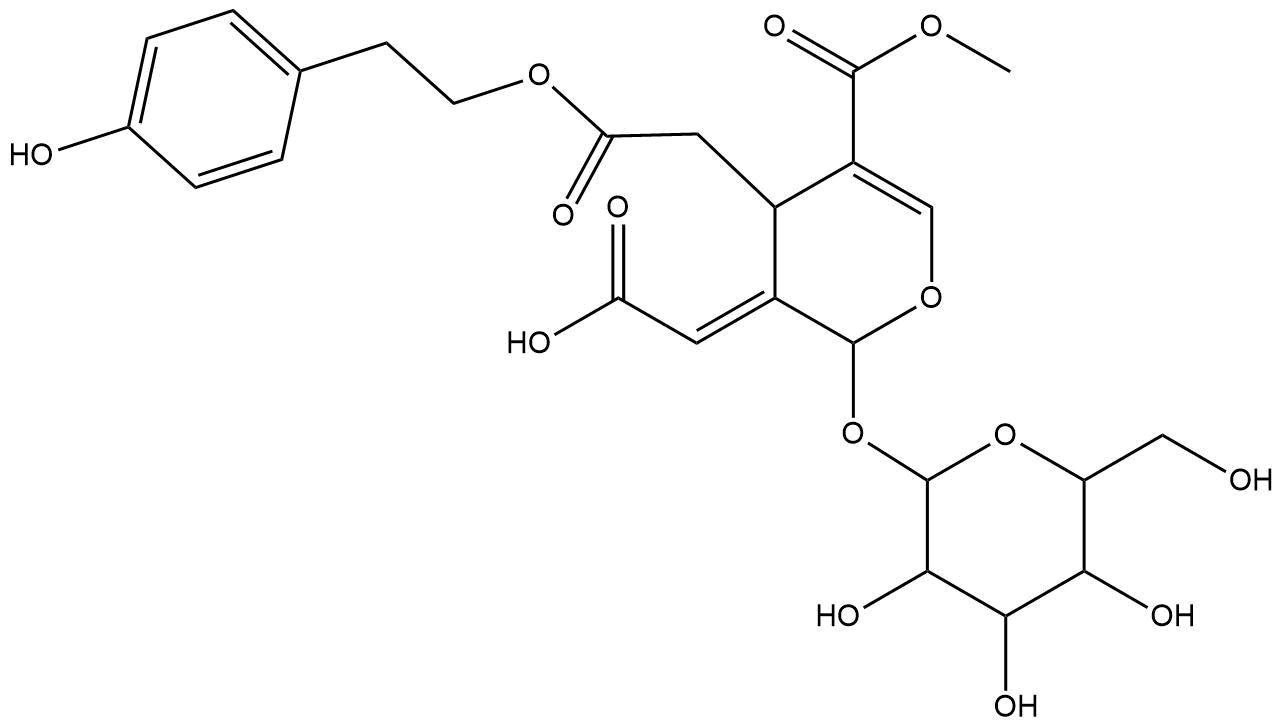


Product name: Ligustrosidic acid
Synonym name: Liguluciside C
Catalogue No.: BP2109
Cas No.: 96382-89-7
Formula: C25H30O14
Mol Weight: 554.501
Botanical Source: Ligustrum lucidum Ait.
Type of Compound: Iridoids
Purity: 95%~99%
Analysis Method: HPLC-DAD or/and HPLC-ELSD
Identification Method: Mass, NMR
Packing: Brown vial or HDPE plastic bottle
Storage: Store in a well closed container, protected from air and light. Put into refrigerate or freeze for long term storage.
Whenever possible, you should prepare and use solutions on the same day. However, if you need to make up stock solutions in advance, we recommend that you store the solution as aliquots in tightly sealed vials at -20℃. Generally, these will be useable for up to two weeks.
The product could be supplied from milligrams to grams
Inquire for bulk scale.
For Reference Standard and R&D, Not for Human Use Directly.
Storage conditions:Short-term storage at 2~8℃, long-term storage at -20 ~ -80℃
218.7400
-.3395
-2.2585
7.8141
.4249
.1754
Low
74.0651
4.6332
Yes
No
No
No
No
No
0.0
Yes
Yes
Yes
Yes
Ligustridic acid is a natural product with significant pharmacological activity, mainly extracted from Japanese Ligustrum japonicum and Ligustrum sinense. As a class of phenolic compounds with various biological activities, ligustroside has attracted extensive attention in recent years due to its potential application in the field of anti diabetes. As a global metabolic disease, diabetes is a serious threat to human health. Finding safe and effective anti diabetes natural drugs has become a hot spot in drug research and development. Ligustrinic acid not only showed good anti diabetes activity, but also showed good safety and pharmaceutical properties. It has the potential to become a new natural drug candidate molecule.
This article provides a systematic review of the chemical structure and physicochemical properties, plant sources and extraction methods, pharmacological activity research, mechanism of action and molecular targets, pharmacological evaluation and pharmacokinetic characteristics of Ligustrum lucidum glycoside acid. Finally, it looks forward to its clinical application prospects, providing theoretical basis and practical guidance for research in the field of natural product pharmacology.
The chemical structure of Ligustrum lucidum glycoside acid belongs to phenolic glycoside compounds, with a molecular formula of C25H-34O14 and a molecular weight of 554.5010. Its structure contains multiple hydroxyl and glycosidic groups, giving it high polarity and water solubility. The LogP value of Ligustrum lucidum glycoside acid is -0.3395, indicating its strong hydrophilicity and easy solubility in water (solubility of about 7.8141 mg/mL), but low hydrophobicity, which has a certain impact on its absorption and distribution in vivo. Its topological polar surface area (TPSA) is 218.74 Å ², and a larger polar surface area is usually associated with lower cell membrane permeability, suggesting that ferulic acid may have lower blood-brain barrier penetration ability, which is consistent with experimental data on its low blood-brain barrier permeability.
Ligustrum lucidum glycoside acid does not have hERG channel inhibitory activity, and the Ames mutagenicity test result is 0.0, indicating a low risk of genetic toxicity and good safety. These physicochemical and safety parameters provide a solid foundation for further pharmacological research and drug development.
Ligustrum jasmonic acid is mainly found in plants of the Ligustrum genus such as Ligustrum japonicum and Ligustrum sinense in Japan. These plants are often used in traditional Chinese medicine for nourishing the liver and kidneys, improving eyesight, and anti-aging purposes. Ligustrum lucidum glycoside acid, as one of its main active ingredients, has significant biological activity.
The extraction method usually uses organic solvent extraction combined with column chromatography separation and purification technology. The specific steps include: crushing the dried leaves or fruits of Ligustrum lucidum, reflux extraction with methanol or ethanol, concentration of the filtrate, and separation and purification by silica gel column chromatography or high-performance liquid chromatography (HPLC). The purified Ligustrum lucidum glycoside acid was structurally identified by mass spectrometry (MS), nuclear magnetic resonance (NMR) and other methods. In recent years, the application of ultrasound assisted extraction and microwave-assisted extraction technologies has improved extraction efficiency and purity, reduced extraction time and solvent usage, and is in line with the concept of green chemistry.
Ligustrinic acid showed significant anti diabetes activity in many in vitro and in vivo experiments. Its main functions include improving insulin resistance, promoting glucose uptake and metabolism, inhibiting gluconeogenesis, and regulating lipid metabolism.
In vitro experiments have shown that ligustilide can activate the AMPK signaling pathway, promote the expression and transport of intracellular glucose transporters (such as SLC2A4/GLUT4), and enhance the glucose uptake capacity of muscle and adipocytes. In vivo diabetes models (such as high-fat diet induced type 2 diabetes mice), ligustroside significantly reduces fasting blood glucose, improves glucose tolerance, and alleviates islet β cell damage.
In addition to the anti diabetes effect, ligustroside acid also showed a variety of pharmacological effects such as antioxidant, anti-inflammatory and liver protection. Its antioxidant effect is mainly achieved by clearing free radicals and regulating the endogenous antioxidant enzyme system, reducing the damage of oxidative stress to cells. The anti-inflammatory effect is closely related to its inhibition of the NF - κ B signaling pathway and downregulation of pro-inflammatory cytokine expression.
The anti diabetes effect of ligustroside involves multiple key molecular targets and signal pathways, mainly including:
Through the synergistic effect of multiple targets and pathways, ligustroside can effectively regulate glucose metabolism and improve the pathological status of diabetes.
The pharmacological parameters of Ligustrum lucidum glycoside acid show that it has good safety and suitable drug properties. Although the molecular weight of 554.5 is slightly higher than the recommended upper limit of 500 Da by Lipinski's rule, its good water solubility and low fat solubility (LogP-0.3395) are beneficial for in vivo distribution and excretion. A higher TPSA value (218.74 Å ²) suggests lower cell membrane permeability, which may limit oral absorption, but also reduces the risk of blood-brain barrier penetration and central nervous system toxicity.
In toxicology assessment, Ligustrum lucidum acid did not show hERG channel inhibition, reducing the risk of cardiac toxicity; Ames test negative, low risk of genetic toxicity, meets the requirements for safe medication. Preliminary pharmacokinetic studies have shown that ligustilide has good stability and metabolic characteristics in vivo, mainly cleared by the liver metabolic enzyme system, with a moderate half-life, making it suitable for further development.
Future research needs to delve into its in vivo absorption, distribution, metabolism, and excretion (ADME) characteristics, optimize administration routes and formulation design, and improve bioavailability.
As a natural anti diabetes active ingredient, ligustroside has the potential to become a new oral hypoglycemic drug. Its multi target mechanism of action is in line with the treatment needs of the complex pathology of diabetes, and is expected to overcome the limitations of single target drugs. In addition, its good safety and low toxicity lay the foundation for clinical application.
Future clinical research should focus on:
In addition, the potential applications of Ligustrum lucidum glycoside acid in antioxidant, anti-inflammatory, and other metabolic diseases are also worth exploring and expanding its medicinal value.
As a natural product from Japanese Ligustrum lucidum and Ligustrum acuminatum, ligustrum lucidum glycoside acid shows a broad medicinal prospect with its unique chemical structure and multi-target anti diabetes effect. Its good safety and pharmacological parameters provide a solid foundation for subsequent drug development. Although preliminary results have been achieved in current research, systematic pharmacokinetic, toxicological, and clinical trials are still needed to promote its transition from laboratory to clinical application. With the continuous progress of natural product pharmacology and modern drug development technology, ligustroside is expected to become a new effective drug for the treatment of diabetes and related metabolic diseases, bringing good news to patients.
