Introduction/Overview
Natural products have long been an important source of innovative drug discovery, among which curcumin, as the main active ingredient of turmeric, has attracted much attention due to its extensive anti-inflammatory, antioxidant, and anticancer activities. However, curcumin itself has limitations such as poor chemical stability, low oral bioavailability, and rapid metabolism in vivo, which seriously restrict its clinical translation. To overcome these shortcomings, a series of curcumin structural analogues have been designed and synthesized. Tetramethylcurcumin, also known as FLLL31, is a key synthetic derivative obtained by methylating all four phenolic hydroxyl groups on the benzene ring of curcumin (CAS number: 52328-97-9). This structural modification not only significantly improves the stability and cell permeability of the compound, but also makes its pharmacological targets more focused and clear compared to the parent compound. Research has shown that tetramethylcurcumin can selectively bind to the Src homology 2 domain of Janus kinase 2 and STAT3, specifically inhibiting the phosphorylation of signal transduction and transcriptional activation factor 3, thereby demonstrating strong anti-inflammatory and anticancer potential in various disease models. This article aims to systematically review the chemical properties, pharmacological activities, molecular mechanisms of action, pharmacological properties, and clinical application prospects of tetramethylcurcumin, in order to provide comprehensive academic references for the in-depth research and development of this compound.
Chemical structure and physicochemical properties
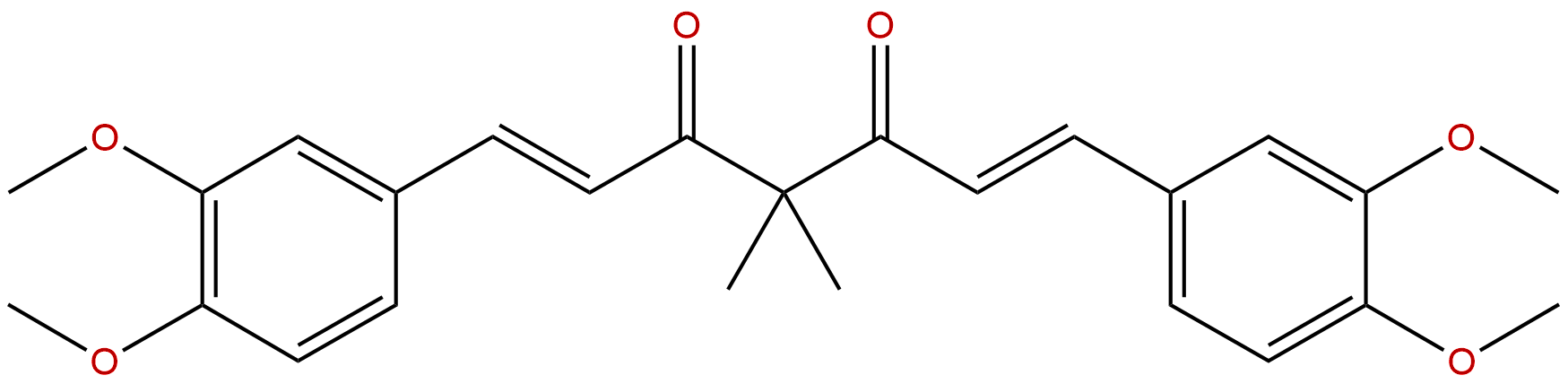
Tetramethylcurcumin is a synthetic compound chemically modified based on the curcumin skeleton. Its core structure retains the typical 1,6-heptadiene-3,5-dione (diarylheptane) skeleton of curcumin, where two aromatic rings are connected by a seven carbon chain containing a β - diketone structure. The most significant difference from curcumin is that all four phenolic hydroxyl groups on its two benzene rings are replaced by methoxy groups. This structural change has brought about significant changes in its physicochemical properties.
Its molecular formula is C25H28O5 and its molecular weight is 424.4930. The methylation of phenolic hydroxyl greatly enhances the hydrophobicity of the molecule, with a calculated lipid water partition coefficient of 3.9388, indicating its high lipophilicity. Consistent with this, its water solubility is extremely low, only 0.0032 mg/mL, indicating the need for appropriate solubilization strategies in formulation development, such as cyclodextrin inclusion, nano formulations, or liposomes. The topological polarity surface area of the molecule is relatively low, at 71.0600 Å ², which is consistent with its high lipophilicity and facilitates its penetration through the cell membrane. The preliminary pharmacological prediction model shows that tetramethylcurcumin has a high blood-brain barrier permeability potential, which provides the possibility for its application in central nervous system related diseases such as glioma. In addition, the preliminary assessment of key toxicity risks shows that it has no significant inhibitory effect on hERG potassium channels, and the Ames test result is negative (0.0), indicating that its potential risk of arrhythmia and genetic toxicity is low, laying the foundation for further safety evaluation.
Plant sources and extraction methods
It should be clearly pointed out that tetramethylcurcumin is not a natural product directly extracted from plants in nature, but a derivative prepared by semi synthetic methods using natural curcumin as raw material or template. Its precursor, curcumin, mainly comes from the dried rhizomes of turmeric, a plant in the ginger family. The traditional extraction methods for curcumin include organic solvent extraction (such as ethanol, acetone), followed by separation and purification through column chromatography and other methods.
The synthesis of tetramethylcurcumin usually starts from purified curcumin. The key synthesis step is to selectively or completely methylate the four phenolic hydroxyl groups on curcumin molecules under alkaline conditions (such as potassium carbonate, potassium hydroxide) using methylation reagents (such as iodomethane, dimethyl sulfate). After the reaction is completed, high-purity tetramethylcurcumin can be obtained through a series of purification steps such as extraction, washing, column chromatography, and recrystallization. This chemical synthesis pathway ensures a large and stable supply of compounds, and allows for further optimization and modification of their structures to meet different pharmacological and pharmacokinetic needs. Therefore, although its inspiration comes from nature, tetramethylcurcumin is essentially a synthetic compound based on natural product lead structures for rational drug design.
Pharmacological activity research
Tetramethylcurcumin exhibits extensive and potent pharmacological activity, particularly in the field of anti-tumor research where it has been extensively studied.
1. Antitumor activity:
Numerous in vitro and in vivo studies have confirmed that tetramethylcurcumin has significant inhibitory and pro apoptotic effects on various human cancer cell lines, and its efficacy is usually much stronger than curcumin. Its anti-tumor effect involves multiple targets and pathways:
- Inducing cell apoptosis: Tetramethylcurcumin can effectively downregulate the expression of anti apoptotic proteins MCL1 and BCL2, disrupt mitochondrial membrane potential, promote cytochrome C release, activate caspase cascade reaction, and induce tumor cell apoptosis.
- Inhibition of invasion and metastasis: This compound can significantly inhibit the expression and activity of matrix metalloproteinase 2, thereby weakening the ability of tumor cells to degrade extracellular matrix, invade and metastasize.
- Affects DNA topology: Research suggests that tetramethylcurcumin may act as an inhibitor of topoisomerase I and topoisomerase A, interfering with DNA replication and transcription, leading to DNA damage and cell death.
- Inhibition of tumor angiogenesis: By downregulating the expression of hypoxia inducible factor 1 α, tetramethylcurcumin can inhibit the transcription of angiogenic factors such as vascular endothelial growth factor, thereby suppressing the formation of tumor neovascularization.
- Regulating hormone related pathways: It has inhibitory effect on estrogen receptor and aromatase, suggesting that it has potential therapeutic value in hormone dependent tumors such as breast cancer.
2. Anti inflammatory activity:
In addition to its direct anti-cancer effect, the strong anti-inflammatory activity of tetramethylcurcumin also provides support for its use in cancer prevention and treatment. It can reduce the production of pro-inflammatory cytokines (such as IL-6, TNF - α) by inhibiting key inflammatory signaling pathways such as STAT3, thereby suppressing chronic inflammation in the tumor microenvironment, which is an important factor in promoting tumor occurrence and development.
Mechanism of action and molecular targets
The core mechanism of action of tetramethylcurcumin is Specific inhibition of STAT3 signaling pathway STAT3 is a key protein that connects cytokine signaling with nuclear gene transcription, and is continuously abnormally activated in various cancers, promoting cell proliferation, survival, invasion, and immune escape.
Its mode of action is highly selective:
1. Direct targeted binding: Tetramethylcurcumin can directly bind to the SH2 domain of STAT3 protein. The SH2 domain is crucial for the dimerization and nuclear translocation of STAT3 after phosphorylation by upstream kinases such as JAK2. Tetramethylcurcumin competitively inhibits STAT3 phosphorylation (especially Tyr705 site) and dimerization by occupying the SH2 domain.
2. Inhibition of upstream kinases: At the same time, it can selectively bind and inhibit the activity of Janus kinase 2. JAK2 is an important upstream activating kinase of STAT3. By double inhibiting JAK2 and STAT3, tetramethylcurcumin effectively blocks the entire JAK/STAT3 signaling pathway.
3. Downstream effects: After the inhibition of STAT3 signaling, a series of downstream tumor related target genes (such as MCL1, BCL2, MMP2, HIF1A, Cyclin D1, Survivor, etc.) are down regulated, ultimately leading to multiple anti-tumor effects such as cell cycle arrest, apoptosis, decreased invasion ability, and angiogenesis inhibition.
In addition, studies have also found that tetramethylcurcumin can affect other signaling pathways, such as regulating cell growth and stress response by inhibiting the activity of MAPK1. Its inhibitory effects on ESR1 and CYP19A1 reveal its potential in intervening in the estrogen signaling pathway. These multi-target effects together constitute the powerful anti-tumor pharmacological basis of tetramethylcurcumin.
Evaluation of drug properties and pharmacokinetics
Although tetramethylcurcumin has shown excellent biological activity in vitro, its pharmacological development still faces challenges, which is currently one of the research focuses.
Advantage:
- Stability improvement: Methylation protects the phenolic hydroxyl groups that are easily oxidized and metabolized, making them more stable than curcumin at physiological pH and in the environment.
- Enhanced cell permeability: A higher LogP value and lower TPSA make it easier to penetrate the cell membrane and increase intracellular drug concentration.
- High target selectivity: Selective inhibition of the STAT3/JAK2 pathway may lead to better therapeutic efficacy and lower off target toxicity.
- Preliminary safety is good: HERG inhibition negative and Ames test negative are important positive signals for advancing its preclinical development.
Challenges and research directions:
- Poor water solubility: The extremely low water solubility is the main obstacle to its oral and systemic administration. The current research is dedicated to developing novel delivery systems, such as nanoparticles, micelles, phospholipid complexes, and solid dispersions, to improve their solubility and bioavailability.
- Pharmacokinetic data is limited: There are relatively few detailed studies available on its absorption, distribution, metabolism, and excretion in the body. It is necessary to systematically evaluate its oral bioavailability, plasma half-life, tissue distribution characteristics, and main metabolic pathways.
- In vivo efficacy verification: It is necessary to validate the efficacy of monotherapy or combination therapy in more complex animal tumor models, such as patient derived xenograft models.
- Comprehensive toxicological evaluation: Although the initial genetic toxicity risk is low, systematic preclinical safety evaluations such as acute toxicity, chronic toxicity, and reproductive toxicity still need to be completed.
Clinical application prospects and prospects
As a promising STAT3 targeted inhibitor, the clinical application development of tetramethylcurcumin may focus on the following directions:
- Tumor treatment: It is especially suitable for malignant tumors with abnormal activation of STAT3 signaling pathway, such as multiple myeloma, lymphoma, head and neck cancer, lung cancer, breast cancer, prostate cancer and glioblastoma. It may be used as a monotherapy or in combination with chemotherapy, radiotherapy, immunotherapy, and other targeted drugs to overcome drug resistance and improve efficacy.
- Inflammatory diseases: Given the crucial role of STAT3 in chronic inflammatory diseases such as rheumatoid arthritis and inflammatory bowel disease, tetramethylcurcumin also has the potential to be developed for the treatment of such diseases.
- Combination therapy strategy: Due to its clear mechanism of action, the combination with PD-1/PD-L1 inhibitors may have a synergistic effect, as STAT3 pathway inhibition can improve the tumor immune microenvironment and enhance T cell function.
- Structure based optimization: Using tetramethylcurcumin as the lead compound, further pharmacological modifications were carried out to optimize its solubility, metabolic stability, and target affinity, resulting in the development of a new generation of derivatives with better drug properties (such as FLLL62).
- Advanced formulation development: The development of targeted delivery systems using nanotechnology to enhance drug accumulation at tumor sites and reduce potential toxicity from systemic exposure is a key step in promoting their clinical application.
Conclusion
Tetramethylcurcumin, as a structurally optimized derivative of curcumin, successfully focused the pleiotropic activity of traditional natural products on the specific inhibition of STAT3, a key oncogenic signaling pathway. Its clear molecular mechanism of action, potent in vitro and in vivo anti-tumor activity, and preliminary good toxicity risk characteristics make it an extremely attractive lead compound for anti-cancer drugs. Although there are still challenges in drug formulation, particularly in terms of water solubility and systemic pharmacokinetics, these obstacles are expected to be overcome through a comprehensive strategy of modern medicinal chemistry, pharmacology, and nanotechnology. In the future, in-depth systematic preclinical research and rational clinical trial design will ultimately reveal the true potential of tetramethylcurcumin or its optimized derivatives in the treatment of human diseases, providing important examples for the development of innovative drugs derived from natural products.