Introduction/Overview
Natural products have always been an important source of innovative drug discovery, among which flavonoids have attracted much attention due to their wide range of biological activities. Sciadopitysin, as a unique flavonoid compound, initially entered the research field due to its special plant source. With the deepening of modern pharmacological research, Jin Song Shuang Huang exhibits diverse biological activities beyond its identity as a "plant marker", especially in the fields of bone metabolism diseases, oxidative stress-related diseases, and other areas, demonstrating potential therapeutic value. Its mechanism of action involves the regulation of the nuclear factor kappa B (NF - κ B) signaling pathway and the activation of the antioxidant defense system mediated by nuclear factor E2 related factor 2 (NRF2), which lays a scientific foundation for its development from a plant chemical to a candidate drug molecule. This article aims to systematically review the chemical properties, plant sources, pharmacological activities, molecular mechanisms of action, pharmacological evaluation, and clinical application prospects of Jin Song Shuang Huang, in order to provide comprehensive academic references for the in-depth research and development of this compound.
Chemical structure and physicochemical properties
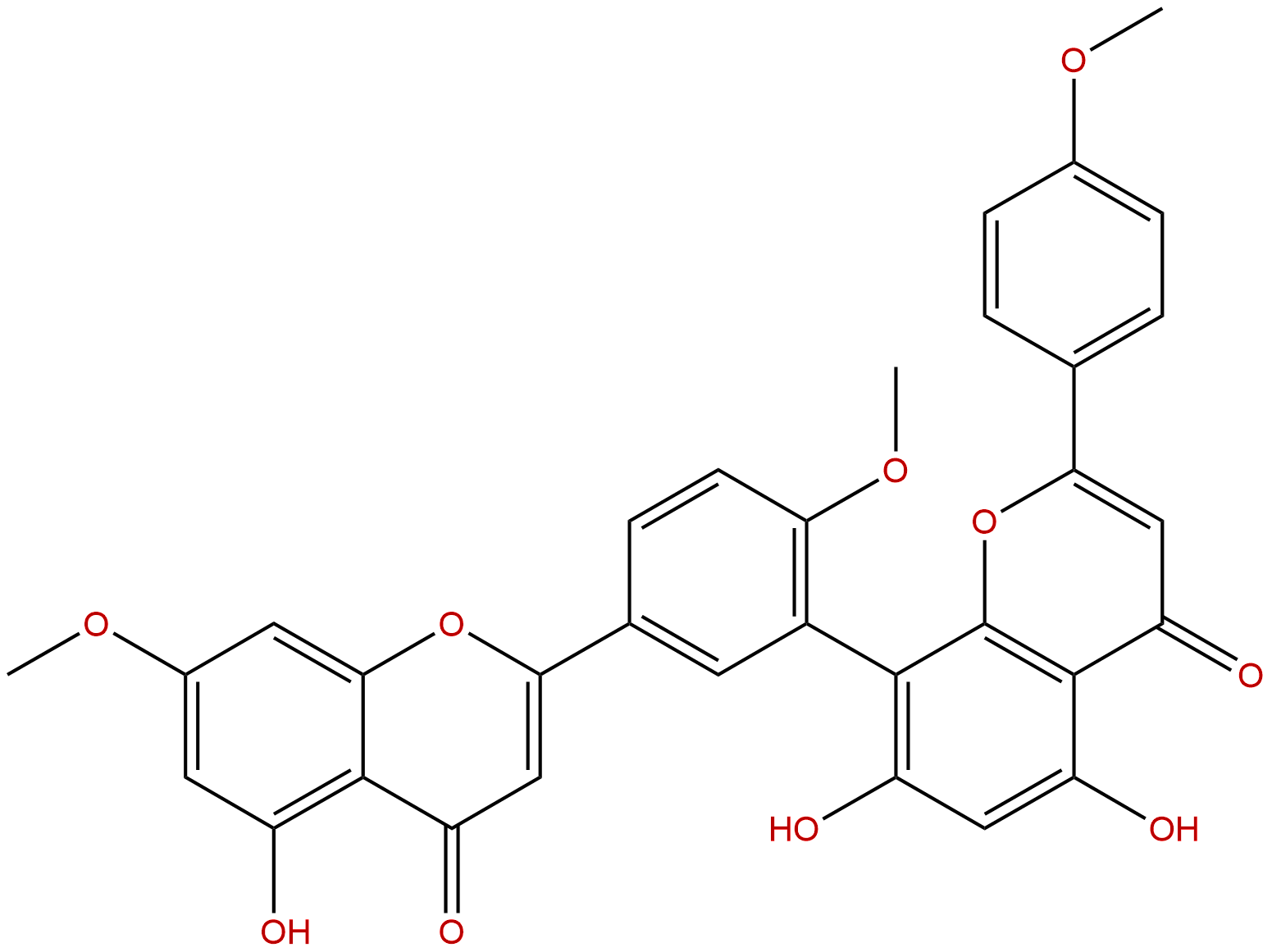
Sciadopitysin, also known as 5,5 ″, 7,7 ″ - tetrahydroxy-4 ′, 4 ‴ - dimethoxy-3 ′, 8 ″ - flavonoids, has a CAS number of 521-34-6. Its molecular formula is C33H24O10, with a molecular weight of 580.5450 Da. Structurally, Jinsong flavonoids belong to the class of flavonoids, consisting of two flavonoid units (apigenin derivatives) connected by a C-C bond (3 ′ -8 ″ position). Its structural features include: both flavonoid mother nuclei have 5,7-dihydroxy substitution, with one A ring having a methoxy group at the 4 'position and the other A ring also having a methoxy group at the 4 ‴ position. This unique biphenyl linkage and methoxy substitution mode are the key differences between it and other flavonoids in Ginkgo biloba leaves (such as Ginkgo biloba flavonoids and Iso Ginkgo biloba flavonoids), and deeply affect its physicochemical properties and biological activity.
In terms of physical and chemical properties, the lipid water partition coefficient (LogP) of Jinsong flavonoids is 4.6043, indicating its strong lipophilicity. Its topological polar surface area (TPSA) is 148.8000 Å ², which is relatively large, mainly due to multiple hydroxyl and ether oxygen atoms in the molecule. Its water solubility is extremely low, about 0.0009 mg/mL, which poses a challenge to its formulation development and in vivo bioavailability. These parameters collectively determine the basic behavior of Jin Song Shuang Huang in organisms: it is easy to penetrate cell membranes, but not easily soluble in aqueous body fluids, and oral absorption may be limited. Its molecular weight is close to 600, belonging to the boundary range of the Rule of Five.
Plant sources and extraction methods
Golden pine flavonoids were originally derived from Japanese golden pine(Sciadopitys verticillata)It was separated and named after it. However, the source that has gained wider attention in natural product research is ginkgo biloba(Ginkgo biloba L. Leaves. In Ginkgo biloba leaves, Jin Song Shuang Huang, together with Ginkgo Biloba Shuang Huang, Yi Ginkgo Biloba Shuang Huang, and others, constitute its characteristic flavonoids, which are one of the iconic compounds of Ginkgo biloba leaf extract (EGb 761), but their content is usually lower than that of Ginkgo Biloba Shuang Huang.
The extraction of flavonoids from plant materials mainly uses organic solvent extraction method. The common process includes crushing dried ginkgo leaves and using methanol, ethanol, or acetone water mixed solvents for heating reflux or ultrasound assisted extraction. After the crude extract is concentrated under reduced pressure, its lipophilicity is utilized for liquid-liquid extraction enrichment using ethyl acetate or water saturated n-butanol. Further purification relies on various chromatographic techniques, such as silica gel column chromatography (eluted with chloroform methanol gradient), polyamide column chromatography, and high-performance liquid chromatography (HPLC, often using C18 reverse phase column with methanol water or acetonitrile water system as mobile phase). In recent years, preparation chromatography techniques such as high-speed counter current chromatography (HSCCC) have also been applied to the high-purity preparation of flavonoids from Pinus massoniana due to their high recovery rate and separation efficiency. The optimization goal of the extraction process is to improve yield, maintain compound stability, and reduce costs.
Pharmacological activity research
A large number of in vitro and in vivo studies have revealed the multifaceted pharmacological activities of Jin Song Shuang Huang, which revolve around anti-inflammatory, antioxidant, and bone protective effects.
-
Anti osteoporosis and bone protection effects This is the most in-depth field of research on Jin Song flavonoids. In the osteoclast differentiation model induced by receptor activator of nuclear factor kappa B ligand (RANKL), Jin Song Shuang Huang can significantly inhibit the differentiation of osteoclast precursor cells into mature osteoclasts and suppress the bone resorption function of mature osteoclasts. In the postmenopausal osteoporosis mouse model induced by ovariectomy (OVX) and the bone resorption model induced by titanium particles, administration of Jin Song Shuang Huang can effectively reduce bone loss, maintain the microstructure of bone trabeculae, and increase bone density. Its strength of action is dose-dependent and demonstrates good safety.
-
Antioxidant damage effect Golden pine flavonoids are effective free radical scavengers. It can directly scavenge free radicals such as DPPH and ABTS, and exhibits significant iron ion reduction ability. In cell models, it can counteract oxidative stress induced by hydrogen peroxide (H ₂ O ₂), lipopolysaccharides (LPS), or chemotherapy drugs, increase cell survival rate, reduce intracellular reactive oxygen species (ROS) levels, decrease the production of lipid peroxidation product malondialdehyde (MDA), and enhance the activity of endogenous antioxidant enzymes such as superoxide dismutase (SOD), catalase (CAT), and glutathione peroxidase (GPX).
-
anti-inflammatory effect Golden pine flavonoids exhibit inhibitory effects on both acute and chronic inflammation models. It can inhibit the excessive production of pro-inflammatory factors such as nitric oxide (NO), prostaglandin E2 (PGE2), tumor necrosis factor - α (TNF - α), interleukin-6 (IL-6), etc. in macrophages stimulated by LPS. Its anti-inflammatory effect is closely related to the regulation of key inflammatory signaling pathways.
-
Other potential activities Preliminary studies also suggest that Jin Song Shuang Huang may have anti-tumor (such as inhibiting the proliferation of certain cancer cells, inducing apoptosis), neuroprotective (against beta amyloid toxicity), antiviral, and cardiovascular protective activities. However, research in these fields is still in its infancy and requires more evidence to support it.
Mechanism of action and molecular targets
The pharmacological effects of Jinsong flavonoids stem from their precise regulation of multiple cellular signaling pathways, and their molecular target network is gradually becoming clearer.
-
The core mechanism of inhibiting osteoclastogenesis The core of the anti osteoporosis effect of Jinsong flavonoids is the inhibition of the RANKL/RANK signaling axis. After binding to RANK on osteoclast precursor cells, RANKL activates downstream pathways such as NF - κ B and MAPK. Golden pine flavonoids can effectively inhibit the phosphorylation and degradation of I κ B α, thereby preventing the nuclear translocation of NF - κ B p65 subunit and weakening its transcriptional activity. Meanwhile, it also inhibits the phosphorylation of JNK and p38 MAPK. The inhibition of these pathways resulted in significant downregulation of the expression of two key osteoclast specific transcription factors - c-Fos and activated T cell nuclear factor c1 (NFATc1). NFATc1 is the main regulator of osteoclast differentiation, and the expression of downstream target genes such as protease K and tartrate resistant acid phosphatase is also inhibited, ultimately blocking the differentiation and function of osteoclasts.
-
Activate the antioxidant defense system (NRF2/ARE pathway)In terms of antioxidant damage, Jin Song Shuang Huang is an effective activator of the NRF2 signaling pathway. In the resting state, NRF2 binds to KEAP1 in the cytoplasm and is degraded by ubiquitination. Golden pine flavonoids may promote the dissociation of NRF2 and KEAP1 by modifying the cysteine residues of KEAP1. Free NRF2 translocates to the nucleus and binds to antioxidant response elements (ARE), initiating the transcriptional expression of a series of phase II detoxifying enzymes and antioxidant proteins. This includes:SOD1(Intracellular Cu/Zn SOD)SOD2(Mitochondrial Mn SOD)CAT、GPX1 and HMOX1(Heme oxygenase-1). The induction of HMOX1 not only degrades heme that promotes oxidation, but its products biliverdin and CO also have anti-inflammatory and cell protective effects. Through this core pathway, Jinsong flavonoids systematically enhance the ability of cells to resist oxidative stress.
-
Multi target synergistic effect In addition to the core pathways mentioned above, Jin Song Shuang Huang may also exert its anti-inflammatory and anti apoptotic effects by regulating signaling pathways such as PI3K/Akt and STAT3, as well as directly interacting with certain enzymes or receptors. This multi-target action characteristic may give it an advantage in treating complex diseases such as osteoporosis, which is often accompanied by chronic inflammation and oxidative stress.
Evaluation of drug properties and pharmacokinetics
Although the pharmacological activity of Jin Song Shuang Huang is clear, there are certain challenges in its drug likeness, and systematic pharmacokinetic (PK) optimization is needed.
-
Basic pharmacological parameters As mentioned earlier, its molecular weight (580.5) is slightly higher, with high LogP value (4.6) and low water solubility (0.0009 mg/mL) being its main drawbacks, indicating that its oral bioavailability may be lower. Its larger TPSA (148.8 Å ²) also has a certain impact on membrane permeability. Preliminary safety assessment shows that it has a low risk of mutagenicity in Ames test (result 0.6, usually considered negative if<1.5), and does not significantly inhibit hERG potassium channels, indicating a low risk of cardiac toxicity. Its blood-brain barrier (BBB) permeability is predicted to be "low", which is an unfavorable factor for the treatment of central nervous system diseases, but may also reduce the risk of central side effects.
-
Current status of pharmacokinetic research Currently, there is relatively limited research on the pharmacokinetics of the Jin Song dual flavonoid system. Existing animal experiments (mainly conducted in rats) have shown poor oral absorption and low absolute bioavailability. This is mainly attributed to its extremely low water solubility and possible first pass metabolism in the intestine. Golden pine flavonoids are mainly metabolized by the liver in the body, and undergo II combined reactions such as glucuronidation and sulfation to generate more polar metabolites, which are excreted through bile and urine. Its plasma protein binding rate is expected to be high, which is consistent with its lipophilic properties. The half-life data is not yet complete and further research is needed.
-
Formulation strategy and structural optimization In order to improve its medicinal properties, future research can focus on: ① Formulation technology The use of nanocrystals, solid dispersions, liposomes, cyclodextrin inclusion complexes and other formulation methods significantly improves its solubility and dissolution rate. ② Prodrug design Introducing hydrolyzable hydrophilic groups at phenolic hydroxyl and other sites to produce prodrugs, improving water solubility and absorption, and releasing the original drug through enzymatic interpretation in vivo. ③ Structural modification Reasonably modify the molecule while maintaining the core pharmacophore, such as introducing polar groups to reduce LogP, optimizing molecular size, and achieving the best balance between activity and drug formation.
Clinical application prospects and prospects
The diverse pharmacological activities of Jin Song Shuang Huang provide potential application scenarios for its prevention and treatment of various diseases.
-
Main application directions:
- osteoporosis As a potent inhibitor of RANKL induced osteoclastogenesis, Jin Song Shuang Huang is expected to be developed as a novel anti osteoporosis drug, especially for the prevention and treatment of postmenopausal osteoporosis, secondary bone loss in rheumatoid arthritis, and periprosthetic bone resorption. Its multi-target (anti-inflammatory, antioxidant) properties may bring comprehensive benefits.
- Oxidative stress-related diseases: By activating the NRF2 pathway, Jinsong biflavone can be used to treat or assist in the treatment of chronic obstructive pulmonary disease (COPD), non-alcoholic fatty liver disease (NAFLD), diabetes complications, neurodegenerative diseases (such as Alzheimer's disease, Parkinson's disease) and other diseases closely related to oxidative damage.
- Inflammatory diseases Its anti-inflammatory effect makes it have potential value for arthritis, colitis, atherosclerosis and other chronic inflammatory diseases.
-
Development Strategy and Challenges:
- combination therapy Can be used in combination with existing drugs such as bisphosphonates and SERMs to enhance efficacy or reduce side effects.
- Functional food/health products As one of the active ingredients of Ginkgo biloba leaf extract, its contribution in standardized Ginkgo biloba preparations can be further clarified, and high-end health products targeting bone health or antioxidant can be developed.
- Main challenges The biggest bottleneck currently lies in its poor pharmacokinetic properties. Future research must prioritize addressing its solubility, permeability, and oral bioavailability issues. In addition, more systematic preclinical safety evaluations (long-term toxicity, reproductive toxicity, etc.) and rigorously designed clinical trials are needed to verify its human efficacy and safety.
-
Future research prospects:
- Thoroughly elucidate its interaction with other signaling pathways such as autophagy and cell pyroptosis.
- Using computer-aided drug design and structure based medicinal chemistry methods for targeted structural optimization.
- Explore advanced targeted delivery systems, such as bone targeted nanomaterials, to achieve precise drug delivery to disease sites.
- Conduct clinical research based on biomarkers to accurately target the beneficiary population.
Conclusion
Golden pine flavonoids, as a natural product of flavonoids derived from Ginkgo biloba, have shown remarkable potential in the treatment of bone metabolism and oxidative stress-related diseases due to their dual core mechanisms of inhibiting osteoclastogenesis and activating the body's antioxidant defense system. The research from chemical structure to pharmacological mechanism has laid a solid theoretical foundation for its drug development. However, the inherent physical and chemical property defects pose a key obstacle to the development of drugs, bridging the gap between laboratory research and clinical applications. Future research should strive to optimize its drug properties through interdisciplinary strategies, including advanced formulation studies, rational prodrug design, precise structural modifications, and in-depth pharmacokinetic/toxicological studies. With the breakthrough of these bottlenecks, Jinsong flavonoids are expected to be successfully transformed from a promising natural active molecule into a novel therapeutic drug with clear clinical value, contributing unique strength to human health.