


Product name: Wilforlide A
Synonym name: Abruslactone A; Regelide
Catalogue No.: BP1452
Cas No.: 84104-71-2
Formula: C30H46O3
Mol Weight: 454.695
Botanical Source: Tripterygium wilfordii Hook.f.
Physical Description:
Type of Compound: Triterpenoids
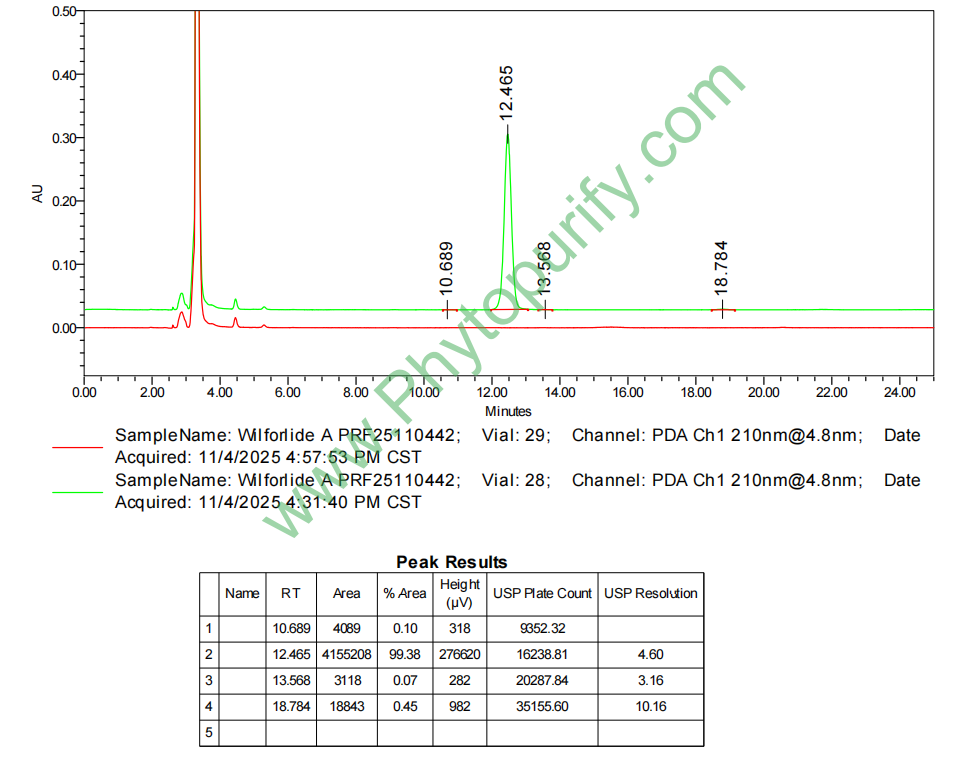
Purity: 95%~99%
Analysis Method: HPLC-DAD or/and HPLC-ELSD
Identification Method: Mass, NMR
Packing: Brown vial or HDPE plastic bottle
Storage: Store in a well closed container, protected from air and light. Put into refrigerate or freeze for long term storage.
Whenever possible, you should prepare and use solutions on the same day. However, if you need to make up stock solutions in advance, we recommend that you store the solution as aliquots in tightly sealed vials at -20℃. Generally, these will be useable for up to two weeks.
The product could be supplied from milligrams to grams
Inquire for bulk scale.
Description:
Wilforlide A is a quality control standard of Tripterygium Glycosides that be listed in Drug Standard of Ministry of Public Health of the People's Republic of China. Wilforlide A has obvious anti-inflammatory effects.
References:
Fitoterapia. 2010 Dec;81(8):1109-12.
Comparative study on the anti-inflammatory and immune suppressive effect of Wilforlide A.
Tripterygium Glycosides (TG) is effective in the treatment of patients with a variety of inflammatory and autoimmune diseases, especially rheumatoid arthritis (RA) in clinical. Wilforlide A (T(1)) serves as a quality control standard of TG that be listed in Drug Standard of Ministry of Public Health of the People's Republic of China. The pharmacologic actions of T(1) remain to be unidentified.
METHODS AND RESULTS:
In this paper, we studied the anti-inflammatory and immune suppressive effect of T(1), and compared it with Triptolide (TP), which believed to be the major active component of TG. Carrageenan-induced rat pedal swelling, tampon-induced rat granulation, and mice ear inhibition rate of swelling trail results show that high-dose T(1) has obvious anti-inflammatory effect. Colorimetric detection contents of hemolysin, carbon elimination from plasma of mice, mice delayed hypersensitivity immune, and organ index were measured.
CONCLUSIONS:
The results show that T(1) has no significant immune suppressive activity, and there has a significant difference with TP and TG. Therefore, we think the content of TP also should be controlled as a supplement standard in order to ensure safe and effective medication.
HPLC of Wilforlide A
Storage conditions:Short-term storage at 2~8℃, long-term storage at -20 ~ -80℃
Wilforide A is a bioactive triterpenoid compound isolated from the traditional Chinese medicine Tripterygium wilfordii Hook. f. As an important anti-inflammatory and immune regulating herb in traditional Chinese medicine, Tripterygium wilfordii has attracted much attention due to its significant pharmacological activity. Triptolide, as one of its main active ingredients, exhibits significant anti-inflammatory and immunosuppressive effects, making it a hot topic in natural product pharmacology research. In recent years, with the development of molecular biology and pharmacology techniques, the mechanism of action and molecular targets of Triptolide A have gradually been elucidated, providing a theoretical basis for its clinical application and new drug development.
This article will provide a systematic review of the chemical structure and physicochemical properties, plant sources and extraction methods, pharmacological activity and mechanism of action, pharmacological evaluation and pharmacokinetic characteristics of Triptolide A, combined with its potential applications in immunosuppressive related diseases, to explore its clinical development prospects and future research directions.
Wilforelide A (CAS number: 84104-71-2) is a triterpenoid compound with the molecular formula C30H46O4 and a molecular weight of 454.6950. Its structure contains a typical triterpenoid skeleton, with multiple cyclic structures and functional groups, endowing it with unique biological activity. The LogP value of Triptolide A is 6.6454, indicating its strong lipophilicity. The TPSA (topological polar surface area) is 46.53, indicating its moderate polarity, which is conducive to membrane penetration. The extremely low water solubility (0.0004) suggests poor solubility in vivo, which may affect its bioavailability.
In addition, Triptolide A can effectively penetrate the blood-brain barrier (BBB), which provides the possibility for its potential application in central nervous system related diseases. The hERG channel inhibition experiment showed a negative result, indicating a low risk of cardiac toxicity. The Ames mutagenicity test showed a value of 0.0, indicating a low risk of genotoxicity and high safety.
Tripterygium wilfordii Hook. f., a traditional Chinese medicinal herb widely distributed in China and East Asia, is the main source of Tripterygium wilfordii lactone. Thunder God Vine is known for its significant anti-inflammatory, immune regulatory, and anti-tumor activities, and has been used to treat immune related diseases such as rheumatoid arthritis and systemic lupus erythematosus.
The commonly used methods for extracting Triptolide include solvent extraction, column chromatography separation, and high-performance liquid chromatography (HPLC) purification. The specific process is usually as follows:
In recent years, new technologies such as supercritical fluid extraction and microwave-assisted extraction have also been attempted to be applied to the extraction of Triptolide methyl, aiming to improve extraction efficiency and purity, reduce solvent usage, and promote the development of green pharmaceutical processes.
Triptolide A, as an important active ingredient in Tripterygium wilfordii, exhibits multiple pharmacological activities, with anti-inflammatory and immunosuppressive effects being the most significant.
Both in vitro and in vivo experiments have shown that Triptolide A can significantly inhibit the production and release of inflammatory mediators. For example, in macrophage and monocyte models, Triptolide A inhibits the expression of pro-inflammatory cytokines such as tumor necrosis factor alpha (TNF - α) and interleukin-6 (IL-6), reducing the inflammatory response. In addition, it exerts anti-inflammatory effects by inhibiting the activation of the nuclear factor kappa B (NF - κ B) signaling pathway, reducing the transcription levels of inflammatory genes.
Triptolide A has a regulatory effect on the immune system, particularly exhibiting inhibitory effects in T cell-mediated immune responses. It can inhibit T cell proliferation and activation, reduce the secretion of pro-inflammatory cytokines such as interferon - γ (IFN - γ) and interleukin-2 (IL-2), and promote the expression of regulatory T cell (Treg) related factors such as FOXP3, maintaining immune homeostasis.
In addition, the regulation of calcium regulated phosphatase (PPP3CA) and nuclear factor activated T cell (NFATC1) signaling pathways by Triptolide A helps to suppress excessive activation of immune cells and alleviate the pathological process of autoimmune diseases.
Some studies have shown that Triptolide also has certain anti-tumor activity, which may be achieved by inducing tumor cell apoptosis and inhibiting inflammatory reactions in the tumor microenvironment. In addition, it has a certain impact on the central nervous system, which may be related to its high blood-brain barrier permeability, but related research is still in the preliminary stage.
The mechanism of action of Triptolide A mainly involves multiple signaling pathways and key molecular targets, reflecting its multi-target and multi pathway regulation characteristics.
Signal transducer and activator of transcription factor 3 (STAT3) is a key regulatory factor in various immune and inflammatory responses. Triptolide can inhibit the phosphorylation and nuclear translocation of STAT3, block its mediated pro-inflammatory gene expression, alleviate inflammatory response and immune cell activation.
NF - κ B is a core transcription factor that regulates immune and inflammatory responses. Triptolide A exerts anti-inflammatory and immunosuppressive effects by inhibiting the degradation of I κ B α, preventing NF - κ B from entering the nucleus, reducing the expression of pro-inflammatory cytokines.
Triptolide regulates the expression of various cytokines, including:
Triptolide promotes the expression of FOXP3, enhances the function of regulatory T cells, helps maintain immune balance, and prevents excessive activation of autoimmune reactions.
By regulating the calcium binding protein CALN1 and calcium regulated phosphatase PPP3CA, Triptolide affects the activity of NFATC1, inhibits T cell activation, and cytokine production.
In summary, Triptolide A exhibits excellent immunomodulatory potential by synergistically regulating immune and inflammatory signaling pathways through multiple targets.
The pharmacological evaluation of Triptolide A shows that it has certain advantages and challenges.
The high lipid solubility of Triptolide A (LogP=6.6454) facilitates membrane penetration and tissue distribution, especially in penetrating the blood-brain barrier, expanding its potential applications in central nervous system diseases. However, its extremely low water solubility (0.0004) limits its oral absorption and bioavailability, and requires formulation improvements (such as nanocarriers, liposomes, etc.) to enhance its in vivo release and absorption efficiency.
The hERG channel inhibition experiment result was negative, indicating a low risk of cardiac toxicity from Triptolide A. A negative Ames test indicates a low risk of genotoxicity and good safety, providing strong support for clinical development.
Existing research indicates that Triptolide is widely distributed in the body, especially enriched in immune related tissues. Its metabolic pathway is mainly through the liver enzyme system, and the activity and toxicity of metabolites need further research. Moderate half-life, suitable for multiple administrations to maintain therapeutic concentration.
In the future, it is necessary to strengthen systematic research on its pharmacokinetic parameters, including absorption, distribution, metabolism, excretion (ADME), and drug interactions, to provide a basis for clinical dose design and safety evaluation.
Triptolide methyl, as a natural triterpenoid immunomodulatory agent, has broad clinical application prospects. Its significant anti-inflammatory and immunosuppressive effects make it potentially valuable in various immune related diseases, especially in areas such as rheumatoid arthritis, systemic lupus erythematosus, and transplant rejection.
Triptolide A can effectively alleviate joint inflammation and tissue damage by regulating multiple immune signaling pathways, inhibiting inflammatory cytokines and immune cell activation. In the future, combined with modern drug delivery technology, it is expected to be developed into a safe and effective new type of immunosuppressant.
Its promoting effect on regulatory T cells and enhancement of immune tolerance suggest that Triptolide A has potential in immune suppression and rejection prevention in organ transplantation.
With its high blood-brain barrier penetration ability, Triptolide may play a role in central nervous system immune related diseases such as multiple sclerosis and neuropathy, and is worthy of further research.
Although Triptolide A has good pharmacological activity and safety advantages, its poor water solubility and low bioavailability are the main bottlenecks in clinical application. In the future, the focus should be on developing new formulation technologies, such as liposome encapsulation and nanoparticle delivery systems, to improve their pharmacokinetic properties and targeting.
In addition, in-depth analysis of the activity and safety of its metabolites and systematic preclinical and clinical research are key to promoting its translational applications.
Triptolide methyl, as an important triterpenoid active ingredient in Tripterygium wilfordii, has become a research hotspot in the field of natural product pharmacology due to its significant anti-inflammatory and immunosuppressive effects. Its multi-target and multi pathway mechanism of action provides new ideas and strategies for the treatment of immune related diseases. Despite the challenges of water solubility and bioavailability, Triptolide A still demonstrates good potential and safety as a drug.
In the future, by combining modern pharmaceutical chemistry, formulation, and molecular biology technologies, in-depth pharmacokinetic, pharmacodynamic, and clinical research on Triptolide will help promote the clinical translation of Triptolide and benefit patients with immune related diseases. As an important representative of natural product pharmacology, the study of Triptolide not only enriches natural drug resources, but also provides valuable molecular templates and theoretical basis for new drug development.
