


Product name: Isoginkgetin
Synonym name:
Catalogue No.: BP0784
Cas No.: 548-19-6
Formula: C32H22O10
Mol Weight: 566.518
Botanical Source: Ginkgo biloba L.
Physical Description:
Type of Compound: Flavonoids
Purity: 95%~99%
Analysis Method: HPLC-DAD or/and HPLC-ELSD
Identification Method: Mass, NMR
Packing: Brown vial or HDPE plastic bottle
Storage: Store in a well closed container, protected from air and light. Put into refrigerate or freeze for long term storage.
The product could be supplied from milligrams to grams
Inquire for bulk scale.
Description:
Isoginkgetin is a MMP-9 inhibitor, also a pre-mRNA splicing inhibitor with IC 50 of 30 uM. Isoginkgetin can up-regulate adiponectin secretion with potency comparable to that of rosiglitazone, a known modulator of adiponectin production. Isoginkgetin has anti-tumor activity, it can inhibit tumor cell invasion by regulating phosphatidylinositol 3-kinase/Akt-dependent matrix metalloproteinase-9 expression.
References:
J Biol Chem. 2008 Nov 28;283(48):33147-54.
The biflavonoid isoginkgetin is a general inhibitor of Pre-mRNA splicing.
Membrane-permeable compounds that reversibly inhibit a particular step in gene expression are highly useful tools for cell biological and biochemical/structural studies. In comparison with other gene expression steps where multiple small molecule effectors are available, very few compounds have been described that act as general inhibitors of pre-mRNA splicing.
METHODS AND RESULTS:
Here we report construction and validation of a set of mammalian cell lines suitable for the identification of small molecule inhibitors of pre-mRNA splicing. Using these cell lines, we identified the natural product Isoginkgetin as a general inhibitor of both the major and minor spliceosomes. Isoginkgetin inhibits splicing both in vivo and in vitro at similar micromolar concentrations. It appears to do so by preventing stable recruitment of the U4/U5/U6 tri-small nuclear ribonucleoprotein, resulting in accumulation of the prespliceosomal A complex. Like two other recently reported general pre-mRNA splicing inhibitors, Isoginkgetin has been previously described as an anti-tumor agent.
CONCLUSIONS:
Our results suggest that splicing inhibition is the mechanistic basis of the anti-tumor activity of Isoginkgetin. Thus, pre-mRNA splicing inhibitors may represent a novel avenue for development of new anti-cancer agents.
Traditional Chinese Drug Research & Clinical Pharmacology, 1993(2):12-4.
Effect of Isoginkgetin on Scavenge of Oxygen Free Radical in Anoxic Rats.
METHODS AND RESULTS:
Chemiluminescence method and modified nitrous acid method were applied to determine the concentration of superoxide anion radical in plasma and erythrocyte of rats and the activity of superoxide dismutase(SOD) respectively. The results showed that Isoginkgetin (0.3mg/kg ip for 3d) could reduce the level of O2·- in plasma and erythroeyte (p<0.01) and sometimes increase the activity of SOD in anoxic rats, the action being stronger than aspirin.
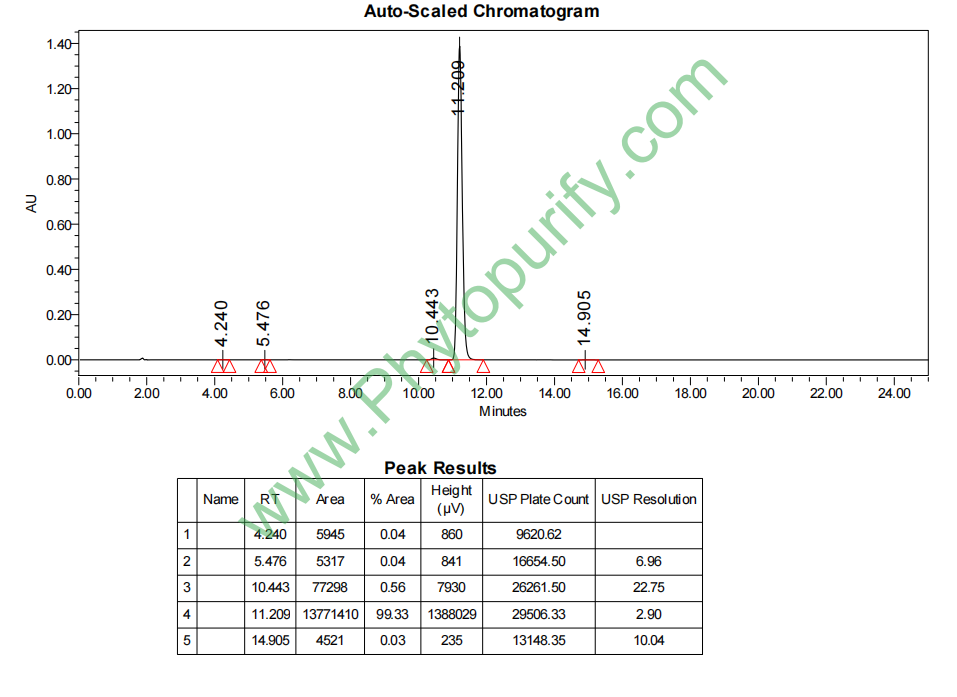
HPLC of Isoginkgetin
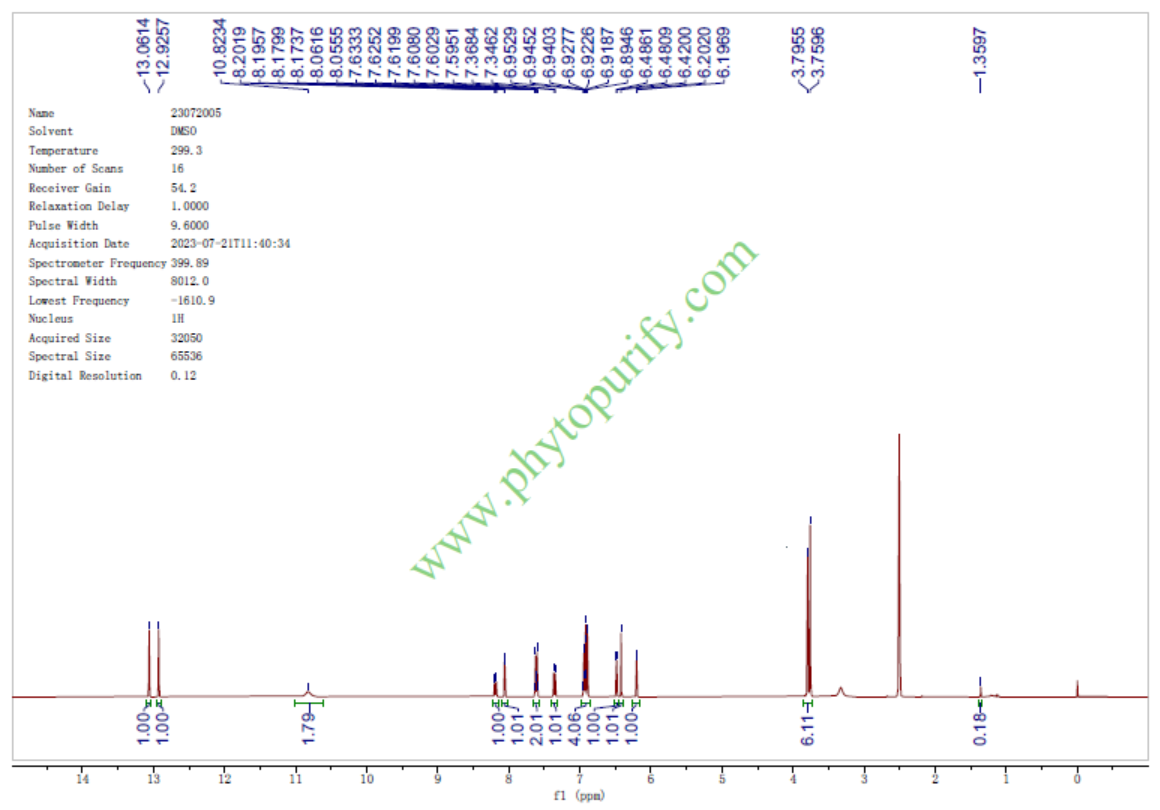
HNMR of Isoginkgetin
Storage conditions:Short-term storage at 2~8℃, long-term storage at -20 ~ -80℃
159.8000
4.2563
3.5068
.0016
2.0458
14.8248
Low
92.7039
2.9658
Yes
No
No
No
Yes
No
0.6
No
No
Yes
No
Isoginkgetin (CAS number: 548-19-6) is a natural flavonoid compound isolated and identified for the first time from Ginkgo biloba leaves. As a natural product with multi-target regulatory ability, Ginkgo biloba flavonoids have attracted widespread attention in recent years due to their unique biological activities, especially in RNA splicing regulation, signal pathway inhibition, and cell fate regulation. This compound not only exhibits inhibitory activity on pre mRNA splicing, but also regulates multiple key intracellular signaling pathways, including Akt, NF - κ B, and matrix metalloproteinase-9 (MMP-9), and induces cell apoptosis and activates autophagy by inhibiting 20S proteasome activity.
In the field of neuroprotection, Ginkgo biloba flavonoids have shown potential therapeutic value, with related targets involving key proteins such as BCL2, APP, BACE1, MAPT, SIRT1, MAPK1, ACHE, CASP3, SNCA, and NRF2, suggesting that they may regulate the pathological process of neurodegenerative diseases through multi-target synergistic effects. This article will provide a systematic review of the chemical structure and physicochemical properties, plant sources and extraction methods, pharmacological activity and mechanism of action, pharmacological evaluation and pharmacokinetic characteristics of Ginkgo biloba flavonoids, and explore their potential and future development directions in clinical applications.
Ginkgo biloba flavonoids are a type of flavonoid compound with a molecular formula of C30H22O12 and a molecular weight of 566.5180. Its structure is formed by two flavonoid units connected by carbon carbon bonds, possessing a typical dual flavonoid skeleton. The LogP value of this compound is 4.2563, indicating strong hydrophobicity. The TPSA (topological polar surface area) is 159.8 Å ², indicating a high number of polar groups. The extremely low water solubility (0.0016 mg/mL) suggests limited solubility in the aqueous phase, which may affect its bioavailability.
The structure of Ginkgo biloba flavonoids contains multiple hydroxyl and ketone groups, which endow them with multiple hydrogen bond donor and acceptor sites, facilitating their binding with various biomolecules. Its high polarity and molecular weight pose certain obstacles to penetrating the blood-brain barrier (BBB), and experiments have shown that its blood-brain barrier permeability is relatively low. In addition, isoflavones from Ginkgo biloba did not exhibit hERG channel inhibitory activity, with an Ames test result of 0.6, indicating a low risk of genetic toxicity and good safety.
The main source of isoflavones in Ginkgo biloba is Ginkgo biloba, which is widely used as a traditional Chinese medicinal herb and functional food. Ginkgo biloba leaves are rich in flavonoids, with a small amount of isoflavones from Ginkgo biloba being present in relatively low amounts. They typically require efficient extraction and separation techniques to obtain.
Common extraction methods include organic solvent extraction, ultrasound assisted extraction, and supercritical fluid extraction. Ethanol or methanol are generally used as extraction solvents, combined with ultrasonic treatment to improve extraction efficiency. The extraction solution was purified through multiple steps such as liquid-liquid distribution, silica gel column chromatography, and reverse phase high performance liquid chromatography (RP-HPLC) to obtain high-purity Ginkgo biloba flavonoids.
In recent years, with the development of separation technology, rapid qualitative and quantitative analysis of Ginkgo biloba flavonoids has been achieved using high-performance liquid chromatography-mass spectrometry (HPLC-MS/MS) technology, providing technical support for their quality control and pharmacological research.
Ginkgo biloba flavonoids exhibit significant activity in various biological functions, including pre mRNA splicing inhibition, signaling pathway regulation, proteasome inhibition, induction of cell apoptosis, and activation of autophagy.
Ginkgo biloba flavonoids have been identified as an effective pre mRNA splicing inhibitor, which can interfere with spliceosome assembly, block splicing processes, and lead to the accumulation of precursor mRNA. This mechanism of action provides an important tool for studying RNA splicing regulation and related diseases, as well as potential targets for the treatment of tumors and other diseases.
The Akt signaling pathway is involved in cell proliferation, survival, and metabolic regulation, NF - κ B is a key inflammatory and immune regulatory factor, and MMP-9 is involved in extracellular matrix degradation and tumor invasion. Ginkgo biloba flavonoids exhibit anti-inflammatory, anti-tumor, and anti metastatic potential by inhibiting these signaling pathways and enzyme activities.
Ginkgo biloba flavonoids can inhibit the activity of 20S proteasome, leading to abnormal protein accumulation in cells, inducing cellular stress response, and initiating the apoptosis program. This mechanism is particularly important in anti-cancer research, indicating its potential as a proteasome inhibitor for tumor treatment.
Autophagy, as an intracellular degradation and recycling mechanism, is crucial for maintaining cellular homeostasis and responding to environmental stress. Ginkgo biloba flavonoids can activate the autophagy pathway, promote the clearance of damaged components in cells, and further affect cell fate and function.
The research on the neuroprotective effects of Ginkgo biloba flavonoids is gradually increasing, with related targets including BCL2, APP, BACE1, MAPT, SIRT1, MAPK1, ACHE, CASP3, SNCA, and NRF2. By regulating these key proteins, isoflavones from Ginkgo biloba may slow down neurodegenerative diseases, alleviate oxidative stress and inflammatory responses, and protect neuronal survival.
The multi-target mechanism of action of Ginkgo biloba flavonoids is the basis for their diverse pharmacological activities. Its main mechanism of action includes:
Ginkgo biloba flavonoids block the assembly and function of spliceosomes by interacting with key splicing proteins, inhibiting pre mRNA splicing and leading to the accumulation and dysregulation of abnormal mRNA expression. This mechanism not only affects gene expression regulation, but also provides new ideas for anti-tumor and neurological disease treatment.
Isoflavones from Ginkgo biloba directly or indirectly act on the core complex of the 20S proteasome, inhibiting its proteolytic activity, leading to abnormal protein accumulation in cells, inducing cellular stress and apoptosis.
By regulating apoptosis related proteins such as BCL2 family proteins and CASP3, Ginkgo biloba flavonoids promote programmed cell death. At the same time, activating autophagy related signaling pathways promotes the clearance of damaged components within cells and maintains cellular homeostasis.
By coordinating and regulating the above targets, Ginkgo biloba flavonoids exhibit multidimensional neuroprotective potential.
The pharmacological evaluation of Ginkgo biloba flavonoids presents certain challenges, mainly reflected in their physicochemical properties and pharmacokinetic characteristics.
Due to its low water solubility and blood-brain barrier penetration rate, the development of formulations of Ginkgo biloba flavonoids faces certain challenges. New drug delivery systems such as nanocarriers, liposomes, and solid dispersions may effectively enhance their bioavailability and targeting.
As a multi-target natural product, Ginkgo biloba flavonoids have a wide range of pharmacological activities, especially in the fields of neuroprotection and anti-tumor, showing great potential for application.
For neurodegenerative diseases such as Alzheimer's disease and Parkinson's disease, isoflavones from Ginkgo biloba can regulate key proteins such as APP, BACE1, MAPT, and SNCA, inhibit β - amyloid deposition and neurofibrillary tangles, alleviate neuroinflammation and oxidative stress, protect neuronal survival, and have potential disease modifying effects. In the future, drug delivery technology can be combined to increase its brain concentration and achieve more effective neuroprotection.
Ginkgo biloba flavonoids induce tumor cell apoptosis and autophagy, inhibit tumor growth and metastasis by inhibiting pre mRNA splicing, proteasome activity, and multiple signaling pathways. Its multi-target mechanism helps overcome single target drug resistance and becomes an important candidate for the development of new anti-tumor drugs.
By inhibiting the NF - κ B signaling pathway, isoflavones from Ginkgo biloba have anti-inflammatory effects and may be applied in the treatment of chronic inflammatory diseases.
Ginkgo biloba flavonoids, as a natural flavonoid compound with unique biological activity, have shown broad research and application prospects due to their multi-target regulatory ability and diverse pharmacological effects. Its role in pre mRNA splicing inhibition, signaling pathway regulation, proteasome inhibition, and cell fate regulation provides new ideas and strategies for neuroprotection, tumor therapy, and inflammation regulation. Although there are certain limitations to its medicinal properties, with the assistance of modern drug design and delivery technologies, Ginkgo biloba flavonoids are expected to become an important candidate for future natural product drug development. Future in-depth research will further reveal its mechanism of action, optimize drug properties, and promote its clinical application process.
