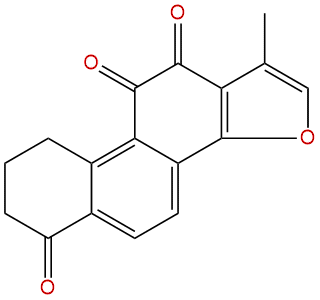


Product name: Nortanshinone
Synonym name: 8,9-Dihydro-1-methylphenanthro[1,2-b]furan-6,10,11(7H)-trione
Catalogue No.: BP2043
Cas No.: 97399-70-7
Formula: C17H12O4
Mol Weight: 280.279
Botanical Source: Salvia miltiorrhiza
Physical Description:
Type of Compound: terpenoid
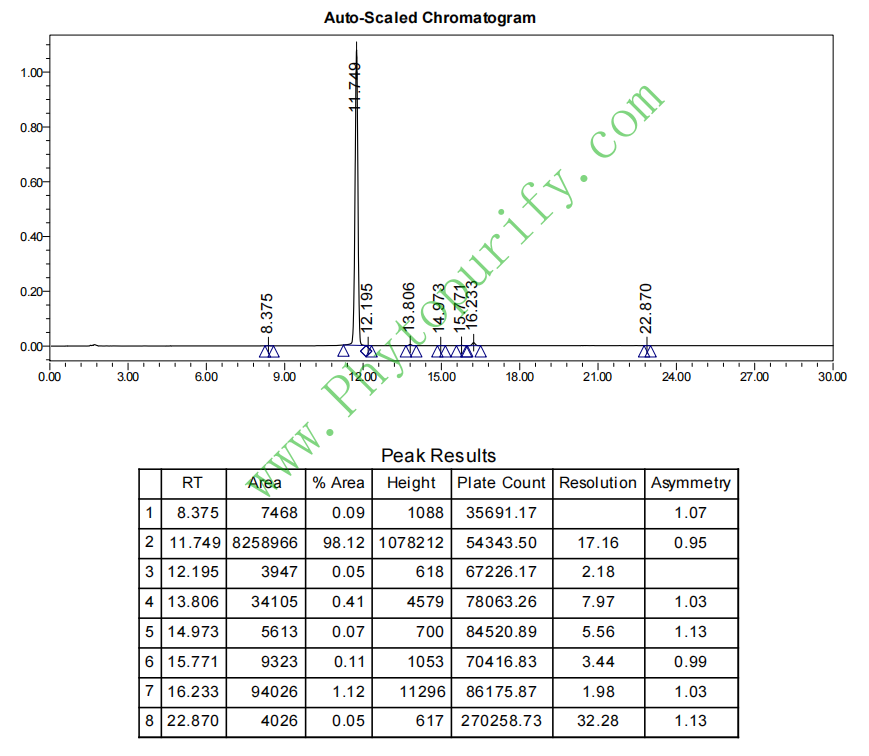
Purity: 95%~99%
Analysis Method: HPLC-DAD or/and HPLC-ELSD
Identification Method: Mass, NMR
Packing: Brown vial or HDPE plastic bottle
Storage: Store in a well closed container, protected from air and light. Put into refrigerate or freeze for long term storage.
Whenever possible, you should prepare and use solutions on the same day. However, if you need to make up stock solutions in advance, we recommend that you store the solution as aliquots in tightly sealed vials at -20℃. Generally, these will be useable for up to two weeks.
The product could be supplied from milligrams to grams
Inquire for bulk scale.
For Reference Standard and R&D, Not for Human Use Directly.
HPLC of Nortanshinone
Storage conditions:Short-term storage at 2~8℃, long-term storage at -20 ~ -80℃
Nortanshinone (CAS number: 97399-70-7) is a natural pigment compound extracted from the traditional Chinese medicine Salvia miltiorrhiza, and is an important member of the tanshinone component. Danshen, as a medicinal herb widely used in the clinical treatment of cardiovascular and cerebrovascular diseases in traditional Chinese medicine, has attracted much attention for its active ingredients, tanshinone compounds, due to their various biological activities. Danshen ketone, as one of the representative compounds, has gradually shown unique potential in the pharmacological research of myocardial ischemia, inflammation regulation, and antioxidant effects in recent years. This article provides a systematic review of the chemical structure and physicochemical properties, plant sources and extraction methods, pharmacological activity, mechanism of action and molecular targets, pharmacological evaluation and pharmacokinetic characteristics of Danshen ketone. Combined with its clinical application prospects, it aims to provide a theoretical basis and reference for further research and development of this natural product.
The molecular formula of Danshen ketone is C18H16O3, with a molecular weight of 280.2790. Its structure belongs to the tanshinone terpenoid class, with a typical terpenoid quinone skeleton containing two phenolic hydroxyl groups and one quinone group, endowing it with strong biological activity. The LogP value of Danshen ketone is 2.6492, indicating its moderate lipid solubility, which is beneficial for cell membrane penetration and in vivo distribution. The polar surface area (TPSA) is 64.3500, indicating that its polarity is moderate and may affect its absorption and metabolic processes. The extremely low water solubility (0.0012 mg/mL) suggests limited solubility in vivo and may require pharmaceutical improvements to enhance bioavailability. The high permeability of the blood-brain barrier indicates that Danshensu has the potential to enter the central nervous system. The hERG channel inhibition experiment showed a negative result, indicating a low risk of cardiac toxicity. The Ames mutagenicity test value is 2.4, indicating a low risk of genotoxicity and meeting the preliminary safety requirements.
Danshenketone mainly exists in the roots and underground parts of Danshen, and is an important member of Danshenketone compounds. Salvia miltiorrhiza is the dried root of Salvia miliotrhiza Bunge, a plant in the family Lamiaceae, widely distributed in northern and northwestern China. Traditional extraction methods typically use organic solvents such as ethanol, methanol, or ethyl acetate for reflux extraction of Danshen powder, followed by separation and purification steps such as liquid-liquid distribution and column chromatography to obtain Danshen ketone. In recent years, the application of new technologies such as ultrasound assisted extraction and microwave-assisted extraction has improved extraction efficiency and purity. During the purification process, commonly used methods such as silica gel column chromatography and reverse phase high-performance liquid chromatography (RP-HPLC) are used to separate and identify tanshinone. Structural identification mainly relies on modern analytical techniques such as nuclear magnetic resonance (NMR), mass spectrometry (MS), and infrared spectroscopy (IR).
Danshen ketone has shown significant pharmacological activity in various in vitro and in vivo models, particularly in the field of cardiovascular protection. Its main pharmacological effects include:
Protective effect of myocardial ischemia
Danshen ketone can significantly improve myocardial ischemia-reperfusion injury, reduce myocardial cell apoptosis, and alleviate myocardial tissue inflammation. In vivo experiments have shown that Danshen ketone can regulate multiple signaling pathways, reduce inflammatory factors and oxidative stress levels in myocardial ischemia models, and improve cardiac function indicators.
anti-inflammatory effect
Danshen ketone can inhibit the expression of pro-inflammatory cytokines such as IL-6 and alleviate inflammatory reactions. Its anti-inflammatory mechanism involves inhibiting the nuclear factor kappa B (NF - κ B) pathway and MAPK signaling pathway, reducing the release of inflammatory mediators.
Antioxidant effect
By activating SIRT1 and regulating HIF1A expression, Danshen ketone can enhance the antioxidant defense ability of cells, reduce reactive oxygen species (ROS) generation, and protect cells from oxidative damage.
Anti apoptotic effect
Danshen ketone regulates the expression of BCL2 family proteins, inhibits CASP3 activation, and prevents cardiomyocyte apoptosis, thereby maintaining the survival and function of cardiomyocytes.
Regulating vascular function
Danshen ketone promotes the activity of nitric oxide synthase (NOS3), enhances endothelial function, improves vasodilation ability, and reduces vascular resistance. In addition, its inhibitory effect on ACE helps regulate blood pressure and cardiovascular load.
The multi-target mechanism of action of Danshen ketone is the basis for its diverse pharmacological activities. Mainly involving the following molecular targets:
The synergistic regulation of these targets enables Danshen ketone to exert a protective effect in myocardial ischemia and related cardiovascular diseases, reflecting its multi-target and multi pathway pharmacological characteristics.
The pharmacological parameters of Danshen ketone indicate that it has good potential for drug development. The molecular weight of 280.2790 conforms to the ideal range of Lipinski rule, with a LogP of 2.6492, indicating moderate lipid solubility, which is beneficial for oral absorption and cell membrane penetration. The TPSA is 64.3500, indicating that its polarity is moderate and contributes to the bioavailability of the drug. The extremely low water solubility (0.0012 mg/mL) is a major challenge in the development of its formulations, requiring the use of nanocarriers, solid dispersions, and other technologies to improve solubility and stability.
The high permeability of the blood-brain barrier suggests that tanshinone has the potential to be used for the treatment of central nervous system related diseases, but its safety in the central system also needs to be considered. HERG channel inhibition is negative, indicating a low risk of cardiac toxicity and meeting safety requirements. The Ames test results show that its genotoxicity risk is low, supporting its safety evaluation.
At present, there is limited research on the pharmacokinetics of Danshen ketone. Preliminary data indicate that its metabolism in vivo is mainly through the liver enzyme system, and the metabolites are mostly hydroxylated and glucuronic acid conjugates. The main excretion pathways are bile and urine. Moderate half-life and good in vivo exposure time.
As one of the active ingredients of tanshinones, tanshinone has shown broad clinical application prospects due to its significant myocardial protection, anti-inflammatory, and antioxidant effects. Especially in the adjuvant treatment of myocardial ischemia, ischemia-reperfusion injury, and related cardiovascular diseases, Danshentong is expected to become a new natural drug candidate.
Future research should focus on the following aspects:
Pharmacokinetic and Toxicological System Research
Improve the in vivo metabolic kinetics, long-term toxicity, and safety evaluation of Danshen ketone to provide data support for clinical trials.
Formulation development and improvement of bioavailability
To address the issue of poor water solubility, new dosage forms such as nanoparticles and liposomes have been developed to improve oral absorption rate and in vivo stability.
In depth analysis of multi-target mechanism of action
Using systems biology and molecular pharmacology techniques, further elucidate the multi-target regulatory network of tanshinone in cardiovascular disease.
Clinical trial validation
Conduct preclinical and clinical studies on Danshentong, evaluate its efficacy and safety, and promote its clinical application.
Expand indication research
Explore the potential therapeutic value of tanshinone in the fields of neurodegenerative diseases, metabolic syndrome, and other diseases.
Danshen ketone, as an important natural active ingredient in Danshen, has shown great potential in the prevention and treatment of myocardial ischemia and related cardiovascular diseases due to its unique chemical structure and multi-target pharmacological effects. Its good pharmacokinetic parameters and safety evaluation have laid the foundation for the development of new drugs. In the future, through in-depth pharmacological mechanism research, pharmacokinetic optimization, and clinical validation, Danshen ketone is expected to become an important representative of natural product drug development, bringing new treatment options for cardiovascular disease patients. With the continuous advancement of modern technology, the research and application of Danshen ketone will usher in a broader development prospect.
