| Catalog No | Package | Original Price | Price | Inventory | Quantity | Operating |
|---|---|---|---|---|---|---|
| BP3889-5mg | 5mg | $196.00 | Sign in |
|


Storage conditions:Short-term storage at 2~8℃, long-term storage at -20 ~ -80℃
267.0400
3.0473
.4623
.1224
1.3156
.1616
Low
92.5440
4.5757
Yes
No
No
No
Yes
No
0.0
Yes
Yes
Yes
Yes
Natural products, as an important source of drug discovery, play an irreplaceable role in the long history of human fight against diseases. Danshen (Salvia miltiorrhiza)(Salvia miltiorrhiza Bunge), As a traditional Chinese medicine for promoting blood circulation and removing blood stasis, its active ingredients - salvianolic acid compounds, especially salvianolic acid B (Sal B), have attracted much attention for their excellent cardiovascular and cerebrovascular protective activities. Danshensu acid B is the most abundant water-soluble phenolic acid component in Danshen, with significant pharmacological effects such as antioxidant, anti-inflammatory, anti fibrotic, and anti apoptotic. However, the bioavailability of salvianolic acid B in the body is low and its metabolism is rapid, which to some extent limits its clinical translational potential. To improve its pharmacokinetic properties or discover more active lead compounds, structural modification of salvianolic acid B has become one of the research hotspots.
9 '' '- Salvianolate B, also known as 9' '- Methyl Sal B, is an important natural or semi synthetic product derived from this idea. Its structural feature is that the carboxyl group at a specific position (9 '' 'position) in the molecule of salvianolic acid B is methylated. This seemingly small chemical modification may significantly alter the lipid solubility, spatial configuration, and interaction mode with biological targets of molecules, resulting in differential pharmacological activity and pharmacokinetic behavior. In recent years, with the advancement of separation and analysis techniques and the in-depth exploration of the complex composition spectrum of Danshen, the unique biological activity of Methyl Sal B, as a natural derivative or metabolite present in trace amounts in Danshen, has gradually been revealed.
This article aims to provide a systematic professional review of 9 '' '- Danshensu B monomethyl ester. Starting from its chemical structure and physicochemical properties, we will sort out its sources and extraction methods in plants, focusing on its reported pharmacological activities, and deeply explore its mechanism of action and molecular targets. At the same time, based on the pharmacokinetic parameters, the pharmacokinetic characteristics and development potential of the drug are evaluated, and finally, the clinical application prospects in the fields of cardiovascular and cerebrovascular diseases, organ fibrosis, etc. are discussed. Through this review, it is expected to provide a comprehensive theoretical basis and reference ideas for the subsequent research of this natural product derivative with potential development value.
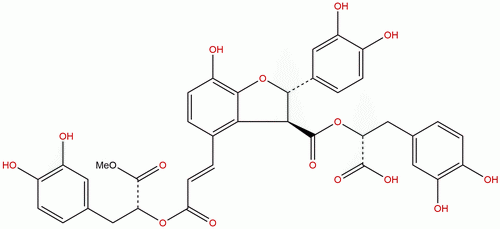
The chemical essence of 9 '' '- Danshensu B monomethyl ester is a methylated derivative of Danshensu B. Danshensu B itself is a complex phenolic acid compound formed by the condensation of three molecules of Danshensu and one molecule of caffeic acid. Its structure contains multiple phenolic hydroxyl and carboxyl groups, endowing it with strong antioxidant capacity. The specific modification site of Methyl Sal B is located at the terminal carboxyl group of a malonic acid group attached to the benzofuran ring in the molecule of salvianolic acid B. This carboxyl group is methylated to form a methyl ester structure.
From the molecular formula, the molecular formula of salvianolic acid B is C ∝₆ H ∝₀ O ₁₆, while the molecular formula of Methyl Sal B is C ∝₇ H ∝₂ O ₁₆, with a molecular weight of 732.6470 Da. This molecular weight is slightly higher than that of salvianolic acid B (718.62 Da), and the difference comes from the introduction of a methyl group (- CH3). From a chemical structure perspective, the methylation reaction seals the carboxyl group at this site, reducing the number of ionizable acidic groups in the molecule and thus lowering its polarity. This structural change is directly reflected in its physicochemical property parameters.
According to the provided pharmacological parameters, the lipid water partition coefficient (LogP) of Methyl Sal B is 3.0473, significantly higher than that of salvianolic acid B (usually reported LogP values between 1.0-2.0). The increase in LogP value indicates that methylation significantly enhances the lipid solubility of the molecule, which facilitates its penetration into biofilms and may improve oral absorption or cellular uptake efficiency. Its topological polar surface area (TPSA) is 267.0400 Å ², which is still at a relatively high level (generally considered unfavorable for oral absorption if TPSA>140 Å ²), but slightly lower compared to salvianolic acid B (TPSA about 280 Å ²), reflecting the effect of polar groups being blocked. The water solubility parameter is 0.1224 mg/mL, which is a poorly soluble compound, consistent with a higher LogP value. It is worth noting that its blood-brain barrier (BBB) penetration ability was evaluated as "low", indicating that Methyl-SalB mainly acts on peripheral tissues rather than the central nervous system, which is consistent with its potential cardiovascular protection target localization. In addition, the hERG inhibition assessment was negative, and the Ames test result was 0.0, indicating a low risk of cardiac and genetic toxicity, which is an important safety advantage as a candidate drug.
Overall, Methyl Sal B has optimized its lipophilicity through simple methylation modification, while retaining the core pharmacophores of salvianolic acid B (such as multiple ortho dihydroxy groups), providing a structural basis for improving its bioavailability. However, its high molecular weight and TPSA remain challenges for oral administration, which may need to be overcome through specific formulation techniques such as nanoparticles and phospholipid complexes.
9 '' '- Danshensu B Monomethyl Ester was originally derived from Danshen(Salvia miltiorrhiza)Trace natural products obtained through separation and identification. Danshen, as a plant of the Salvia genus in the family Lamiaceae, has roots and rhizomes that are commonly used in traditional Chinese medicine. The chemical composition of Danshen is complex, mainly consisting of two types of active ingredients: lipophilic tanshinones (such as tanshinone IIA, cryptotanshinone) and water-soluble salvianolic acids (such as salvianolic acids A, B, C, D, etc.). Methyl Sal B belongs to water-soluble salvianolic acids, but its content in Danshen is much lower than its main component salvianolic acid B, and it usually exists as a trace component.
In addition to being naturally occurring, Methyl Sal B can also be obtained through semi synthetic methods. Due to the abundant content of salvianolic acid B in Danshen (up to 3% -8%), it is a feasible approach to prepare Methyl Sal B through selective methylation reaction using it as raw material. However, the molecule of salvianolic acid B contains multiple carboxyl and phenolic hydroxyl groups, and achieving regioselective methylation of the 9 '' - carboxyl group requires sophisticated organic synthesis strategies, such as the use of protective groups or specific catalysts.
In terms of extraction and separation, the following process is usually used for the enrichment and purification of trace Methyl Sal B in Danshen:
Extract After crushing the dried Danshen medicinal herb, polar solvents such as water, methanol, ethanol, or their mixed solvents are commonly used for extraction. In order to improve the extraction rate of salvianolic acid components, heating reflux or ultrasound assisted extraction is often used. Due to the slightly stronger lipid solubility of Methyl Sal B compared to salvianolic acid B, using a higher proportion of alcohol (such as 70% -80% methanol or ethanol) may be more advantageous for its dissolution.
Preliminary purification After concentration, the extract is subjected to preliminary separation using macroporous adsorption resins such as HPD-100 and D101. Through different concentrations of ethanol water gradient elution, the phenolic acid components are mainly enriched in the 30% -60% ethanol elution site. Methyl Sal B may be eluted at slightly higher concentrations of ethanol elution sites (such as 50% -60%) due to its slightly lower polarity.
Fine separation The crude extract after initial purification needs to be finely separated using various chromatographic techniques. High performance liquid chromatography (HPLC) is the core method for separating such compounds. Usually, a reverse phase C18 chromatographic column is used, with acetonitrile water (containing 0.1% -0.5% formic acid or acetic acid) as the mobile phase for gradient elution. Due to the similarity in structure between Methyl Sal B and salvianolic acid B, the separation difficulty is high, and it is necessary to optimize the gradient program to achieve baseline separation. In addition, high-speed countercurrent chromatography (HSCCC), as a liquid-liquid distribution chromatography technique, has been successfully applied to the separation of salvianolic acid homologues due to its advantages of irreversible adsorption and high sample recovery rate.
Structural Identification The isolated pure product was structurally confirmed by ultraviolet spectroscopy (UV), mass spectrometry (MS), and nuclear magnetic resonance spectroscopy (NMR, including 1H-NMR, 13C-NMR, HMBC, HSQC, etc.). In mass spectrometry, the molecular ion peak [M-H] - of Methyl Sal B is usually at m/z 731.6, which is 14 Da higher than that of salvianolic acid B. In secondary mass spectrometry, there may be characteristic neutral loss (such as loss of methanol molecule CH3 OH, 32 Da), which helps to distinguish methylation sites. In NMR spectra, the proton signal (- OCH ∝) of the methyl ester group usually appears at δ H 3.6-3.7 ppm, and the carbon signal appears at δ C 51-53 ppm, and its connection to the carboxyl carbon at the 9 '' position can be determined by HMBC correlation spectroscopy.
Although the research history of 9 '' - Danshensu B monomethyl ester is relatively short, previous studies have revealed its pharmacological activity in multiple disease models, exhibiting similar but different characteristics of action as Danshensu B.
1. Cardiovascular protective effect
Cardiovascular protection is the core pharmacological action of salvianolic acid compounds. Research has shown that Methyl Sal B also exhibits significant cardioprotective activity. In the myocardial ischemia-reperfusion injury (I/R) model, Methyl Sal B can significantly reduce myocardial infarction area, decrease the release of myocardial enzymes (such as CK-MB, LDH), and improve cardiac function indicators. Its protective effect may be related to inhibiting oxidative stress and reducing endoplasmic reticulum stress. Compared with salvianolic acid B, Methyl Sal B exhibits stronger cell protective effects in certain models, which may be attributed to its enhanced lipophilicity making it easier to enter myocardial cells, thereby more effectively clearing intracellular reactive oxygen species (ROS).
2. Anti fibrotic effect
Organ fibrosis is a common pathological feature of various chronic diseases. Danshensu acid B has been proven to be a potent anti liver fibrosis ingredient. Preliminary studies have shown that Methyl Sal B can effectively inhibit TGF - β 1-induced proliferation and activation of hepatic stellate cells (HSCs) in an activated model, downregulating the expression of α - smooth muscle actin (α - SMA) and type I collagen. In the rat model of liver fibrosis induced by bile duct ligation, the Methyl Sal B treatment group showed the effect of reducing the degree of liver fibrosis and decreasing the content of liver hydroxyproline. In addition, it also exhibits the potential to inhibit epithelial mesenchymal transition (EMT) in renal fibrosis models, suggesting that it may have broad-spectrum anti fibrotic activity.
3. Anti inflammatory and antioxidant activity
Methyl Sal B retains the powerful antioxidant backbone of salvianolic acid B. The multiple adjacent hydroxyl groups in its molecule are highly efficient free radical scavengers. In vitro experiments have confirmed that Methyl Sal B can directly scavenge DPPH free radicals, ABTS cationic free radicals, and inhibit lipid peroxidation. At the cellular level, it can significantly reduce intracellular ROS levels induced by lipopolysaccharides (LPS) or hydrogen peroxide (H ₂ O ₂). Meanwhile, Methyl Sal B can also exhibit anti-inflammatory activity by inhibiting the NF - κ B signaling pathway, reducing the production of pro-inflammatory cytokines such as TNF - α, IL-1 β, and IL-6. The synergistic effect of antioxidant and anti-inflammatory is an important basis for its multi organ protection.
4. Anti apoptotic effect
Apoptosis plays a crucial role in ischemic injury and fibrosis processes. Methyl Sal B has been shown to exert anti apoptotic effects by regulating the mitochondrial apoptosis pathway. In myocardial cells with hypoxia/reoxygenation injury, treatment with Methyl-SalB can upregulate the expression of anti apoptotic protein Bcl-2, downregulate the expression of pro apoptotic protein Bax, inhibit the loss of mitochondrial membrane potential, thereby reducing the release of cytochrome c and activation of caspase-3. This mechanism is similar to salvianolic acid B, but the potency of Methyl Sal B may vary depending on cell type and injury model.
5. Other potential activities
Preliminary studies also suggest that Methyl Sal B may have anti platelet aggregation, improve microcirculation, and protect endothelial function. In view of its structural characteristics, future research may also explore its potential applications in metabolic diseases (such as diabetes complications) and neurodegenerative diseases (although BBB penetration is low, it can be indirectly affected by peripheral mechanisms).
The pharmacological mechanism of Methyl Sal B is multi-target and multi pathway, mainly focusing on its core functions of antioxidant, anti-inflammatory, and anti fibrotic.
1. Direct antioxidant and Nrf2/ARE pathway activation
The phenolic hydroxyl group in Methyl Sal B molecule can directly supply hydrogen, neutralize free radicals, and block the chain reaction of lipid peroxidation. More importantly, it can activate the nuclear factor E2 related factor 2 (Nrf2)/antioxidant response element (ARE) signaling pathway. Methyl Sal B may modify key cysteine residues on Keap1 protein, causing Nrf2 to dissociate and translocate into the nucleus, bind to ARE, and initiate transcription of downstream antioxidant enzyme genes such as heme oxygenase-1 (HO-1), quinone oxidoreductase 1 (NQO1), superoxide dismutase (SOD), and glutathione peroxidase (GPx). The activation of this endogenous antioxidant defense system is a key mechanism for its long-lasting cellular protective effect.
2. Inhibit the TGF - β 1/Smad signaling pathway
TGF - β 1 is a recognized core factor that promotes fibrosis. Methyl Sal B can effectively inhibit the binding of TGF - β 1 to its receptor or directly interfere with the phosphorylation of downstream Smad proteins. Specifically, it can inhibit the phosphorylation of Smad2 and Smad3, and promote the expression of inhibitory Smad7, thereby blocking the intracellular transduction of TGF - β 1 signaling. This directly leads to the inhibition of transcription of pro fibrotic genes (such as α - SMA, collagen I/III, fibronectin), which is the core molecular mechanism by which Methyl-SalB exerts anti fibrotic effects.
3. Regulating the NF - κ B and MAPK inflammatory pathways
The anti-inflammatory effect of Methyl Sal B is mainly achieved by inhibiting the nuclear factor kappa B (NF - κ B) and mitogen activated protein kinase (MAPK) signaling pathways. Under LPS or inflammatory cytokine stimulation, Methyl Sal B can inhibit the phosphorylation and degradation of I κ B α, prevent nuclear translocation of NF - κ B p65 subunit, and thus reduce the transcription of inflammatory cytokine genes. Meanwhile, it can also inhibit the phosphorylation of p38 MAPK, JNK, and ERK1/2, further weakening the cascade amplification effect of inflammatory signals. This cross regulation of multiple inflammatory signaling pathways enables it to effectively inhibit various inflammatory mediators.
4. Regulating mitochondrial function and apoptotic proteins
Methyl Sal B can directly act on mitochondria, protecting the integrity of mitochondrial structure and function. It can maintain mitochondrial membrane potential and inhibit the opening of mitochondrial permeability transition pore (mPTP) by reducing the production of mitochondrial ROS. In terms of apoptosis regulation, it upregulates the Bcl-2/Bax ratio, inhibits mitochondrial release of cytochrome c and apoptosis inducing factor (AIF), thereby blocking caspase dependent and caspase independent apoptosis pathways. In addition, studies suggest that it may enhance anti apoptotic ability by activating the PI3K/Akt survival signaling pathway.
5. Potential direct targets
Although the above signaling pathway is the main link in the action of Methyl-SalB, its direct molecular targets are not yet fully understood. Given its high similarity to salvianolic acid B, it is speculated that it may directly act on certain enzymes or receptors. For example, it may directly bind to and inhibit the kinase activity of TGF - β 1 receptor (T β RI/II), or interact directly with integrin, interfering with cell matrix adhesion. In addition, as a polyphenolic compound, it may also exert allosteric regulatory effects by non covalent interactions with specific amino acid residues on membrane receptors or transcription factors. In the future, it is expected to identify the direct target of Methyl Sal B through techniques such as Drug Affinity Reaction Target Stability (DARTS), Cell Thermal Transition Analysis (CETSA), and Activity Based Proteomic Analysis (ABPP).
Based on the provided pharmacological parameters and existing research, a comprehensive evaluation of the pharmacological properties of Methyl Sal B is conducted.
1. Analysis of drug properties
According to Lipinski's Five Rules (Ro5), the molecular weight of Methyl Sal B (732.6 Da) far exceeds 500 Da, and LogP (3.05) meets the requirement of less than 5. However, TPSA (267 Å ²) is much higher than 140 Å ², and there are numerous hydrogen bond donors (phenolic hydroxyl) and acceptors (carbonyl, ether oxygen), which seriously violates Ro5. This indicates that its oral bioavailability may face significant challenges. However, many successful drugs in natural products, such as cyclosporine A, also violate Ro5, indicating that Ro5 is not an absolute standard for such complex molecules. Its high molecular weight and polarity are mainly due to its large polyphenol skeleton, which is both its advantage in exerting strong antioxidant effects and an obstacle to its oral absorption.
2. Pharmacokinetic characteristics (prediction and inference)
3. Safety evaluation
The preliminary safety data is encouraging. The hERG inhibition assessment is' no ', indicating a low risk of cardiac toxicity. The Ames test result is 0.0, indicating that it has no mutagenicity. This is consistent with the good safety record of salvianolic acid B. However, data on long-term toxicity, reproductive toxicity, and carcinogenicity are still blank and require further evaluation. High doses of polyphenolic compounds can sometimes cause liver toxicity or gastrointestinal discomfort, which is also an area that needs to be addressed in future research.
4. Strategies for enhancing drug properties
Given the inherent limitation of low oral bioavailability of Methyl Sal B, its development as an oral drug faces significant challenges. The future strategy for enhancing drug efficacy should focus on:
- Prodrug design Since Methyl Sal B itself may be a prodrug of salvianolic acid B, better prodrugs can be further designed, such as acetylating or phosphorylating multiple phenolic hydroxyl groups to improve membrane permeability and release active ingredients in vivo.
- Optimization of administration route For acute cardiovascular and cerebrovascular events, injections (such as freeze-dried powder injections) can be developed and administered directly intravenously to bypass absorption barriers and provide rapid treatment.
- New formulation technology By using technologies such as nanoliposomes, polymer micelles, phospholipid complexes, and self microemulsifying drug delivery systems (SMEDS), the solubility, dissolution rate, and oral bioavailability of Methyl Sal B can be significantly improved.
- Simplified structure Retaining the core pharmacophore, simplifying its complex polyphenol skeleton through medicinal chemistry, and searching for smaller molecular weight, Ro5 compliant analogues are the more fundamental ways to push it into clinical practice.
9 '' '- Danshensu B monomethyl ester, as a natural derivative of Danshensu B, exhibits potent pharmacological activity and preliminary good safety, demonstrating potential clinical application prospects in the following fields.
1. Cardiovascular and cerebrovascular diseases
This is the most direct application area of Methyl Sal B. Its powerful myocardial protection, antiplatelet aggregation and vascular endothelial protection make it a potential candidate drug for the treatment of acute myocardial infarction, ischemic stroke (through peripheral mechanisms) and atherosclerosis. Especially as an injectable form, it may play an important organ protective role in clinical scenarios of acute ischemia-reperfusion injury. In the future, large-scale preclinical studies are needed to clarify its superiority over salvianolic acid B.
2. Organ fibrosis diseases
There is currently a lack of effective therapeutic drugs for diseases such as liver fibrosis, kidney fibrosis, and pulmonary fibrosis. Methyl Sal B exhibits anti fibrotic activity by inhibiting the TGF - β 1/Smad pathway, making it a highly promising anti fibrotic lead compound. Given that liver fibrosis is a classic indication for salvianolic acid B, Methyl Sal B is expected to make breakthroughs in this field. Preclinical research should focus on its long-term efficacy and safety in chronic liver disease models.
3. Metabolic diseases and their complications
Oxidative stress and fibrosis are closely related to the occurrence and development of diabetes nephropathy, diabetes cardiomyopathy and other diabetes complications. The dual effects of methyl Sal B on antioxidation and anti fibrosis make it potentially valuable in the prevention and treatment of complications of diabetes. In addition, its anti-inflammatory effect may also be beneficial for metabolic inflammatory diseases such as non-alcoholic steatohepatitis (NASH).
4. Future research directions
As a natural derivative derived from the traditional Chinese medicine Danshen, 9 '' - Danshensu B monomethyl ester has been optimized for its lipid solubility through a simple methylation modification while retaining the core pharmacological activity of Danshensu B, demonstrating unique research value. This article systematically reviews its chemical structure, plant origin, pharmacological activity, mechanism of action, and medicinal characteristics. Although its low oral bioavailability is the main development bottleneck, its strong antioxidant, anti-inflammatory, anti fibrotic, and anti apoptotic activities, as well as its potential in myocardial protection and organ fibrosis treatment, make it a lead compound worthy of further research.
Future research should focus on elucidating its direct molecular targets, optimizing the route of administration (especially in the development of injectable formulations), and exploring its exact efficacy in complex disease models. With the advancement of modern medicinal chemistry, formulation, and chemical biology technologies, Methyl Sal B and its analogues are expected to provide new candidate drugs for the treatment of cardiovascular and fibrotic diseases, promoting the modernization development process of traditional Chinese medicine active ingredients. The exploration from salvianolic acid B to Methyl Sal B once again confirms that precise structural modification of natural products is an important way to discover innovative drugs.
Batch can search by a CAS number,one per line
