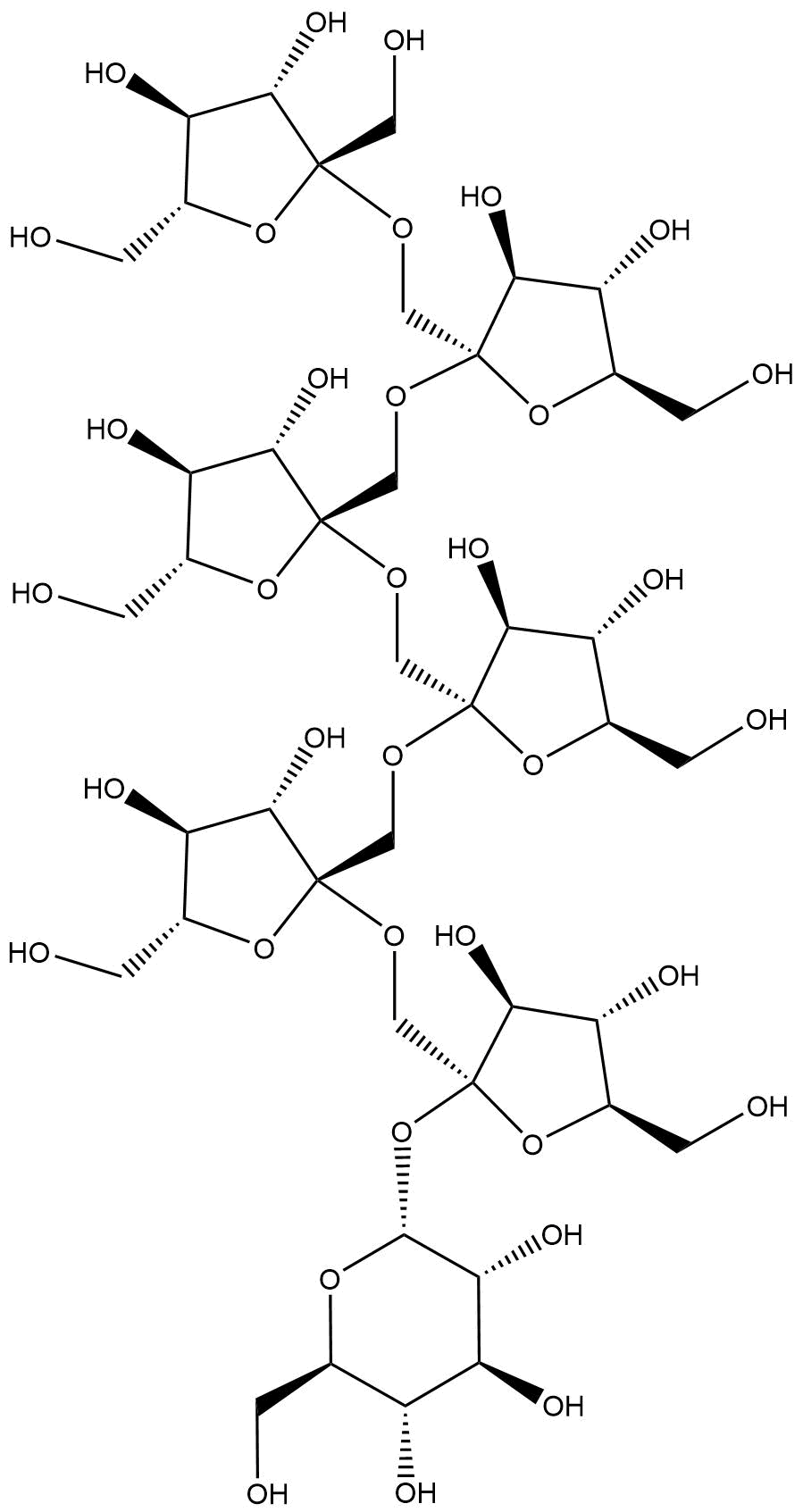


Product name: Fructoheptasaccharide
Synonym name: Fructo-oligosaccharide DP7 / GF6
Catalogue No.: BP4064
Cas No.: 62512-20-3
Formula: C42H72O36
Mol Weight: 1153
Botanical Source:
Physical Description: White powder
Type of Compound: Oligose
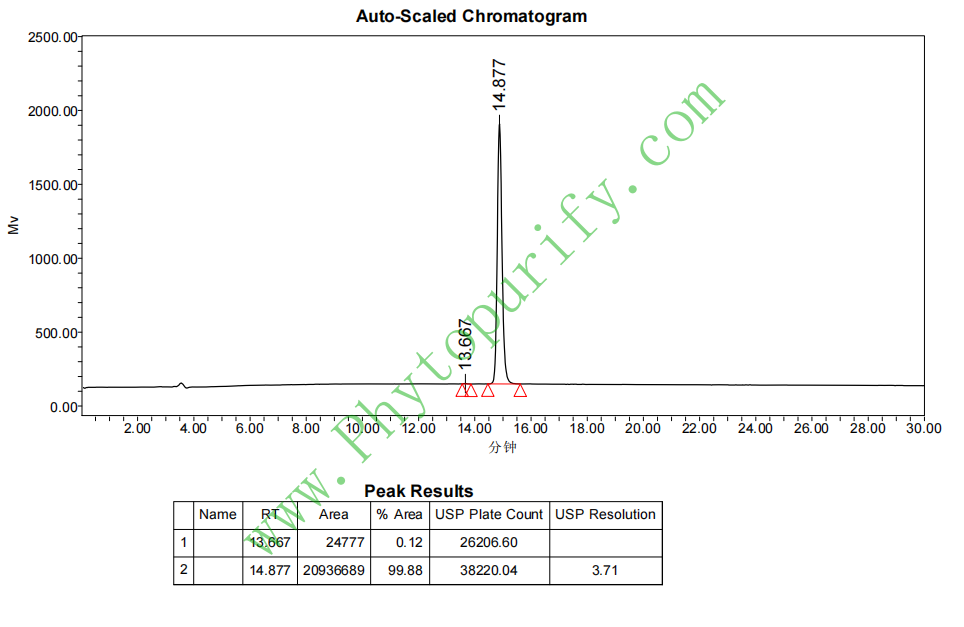
Purity: 95%~99%
Analysis Method: HPLC-DAD or/and HPLC-ELSD
Identification Method: Mass, NMR
Packing: Brown vial or HDPE plastic bottle
Storage: Store in a well closed container, protected from air and light. Put into refrigerate or freeze for long term storage.
Whenever possible, you should prepare and use solutions on the same day. However, if you need to make up stock solutions in advance, we recommend that you store the solution as aliquots in tightly sealed vials at -20℃. Generally, these will be useable for up to two weeks.
The product could be supplied from milligrams to grams
Inquire for bulk scale.
For Reference Standard and R&D, Not for Human Use Directly.
HPLC of Fructoheptasaccharide
Storage conditions:Short-term storage at 2~8℃, long-term storage at -20 ~ -80℃
With the deepening of human understanding of the gut microbiota and its impact on health, prebiotics, as important functional substances for regulating gut microbiota, have received widespread attention. Fructoheptsaccharide (FOS7), as a natural product of oligofructose with significant prebiotic activity, has become one of the hotspots in current natural product pharmacology research due to its excellent multiple biological effects such as regulating gut microbiota, enhancing immune function, and improving intestinal barrier function. This article provides a systematic review of the chemical structure and physicochemical properties, plant sources and extraction methods, pharmacological activity and mechanism of action, pharmacological evaluation and pharmacokinetic characteristics of FOS7, combined with its clinical application prospects, aiming to provide theoretical basis and reference for the in-depth research and development of this natural product.
Fructoheptsaccharide is an oligofructose formed by connecting seven fructose units through β - (2 → 1) glycosidic bonds. Its molecular formula is C42H70O35 and its molecular weight is 1153.0020. Its structural characteristics include a linear chain like fructose polymer, usually connected to a glucose unit at the end to form a sucrose based structure. The LogP value of FOS7 is -4.7851, indicating its high hydrophilicity, and its extremely high polar surface area (TPSA) is 585.2800, further proving its good water solubility (32.9116 mg/mL). This high water solubility makes it stable in the gastrointestinal tract, not easily degraded by stomach acid and digestive enzymes, and can effectively reach the colon to exert prebiotic effects.
From a pharmacological safety perspective, FOS7 does not possess hERG channel inhibitory activity, with an Ames test result of 0.9, indicating no significant genetic toxicity risk. In addition, its blood-brain barrier permeability is low, indicating that its biological activity is mainly limited to the local intestinal environment, reducing the possibility of central nervous system side effects.
FOS7 is mainly found in various natural plants, especially in plant roots, stems, and fruits rich in pectin, such as chicory (Cichorium intybus), onion (Allium cepa), garlic (Allium sativum), banana (Musa spp.), and sugarcane (Saccharum officinalum). Its content is greatly influenced by factors such as plant variety, growth environment, and harvesting time.
The traditional extraction methods mainly include water extraction and enzymatic hydrolysis. The water extraction method uses hot water to extract plant materials, combined with ultrafiltration or nanofiltration technology, to enrich oligofructose components. The enzymatic hydrolysis method utilizes fructooligosaccharides to partially hydrolyze high degree of polymerization fructooligosaccharides, obtaining oligofructose with a specific degree of polymerization, such as FOS7. In recent years, the application of ultrasound assisted extraction and microwave-assisted extraction technologies has improved extraction efficiency and purity. In addition, column chromatography techniques such as silica gel columns and ion exchange columns are widely used for the separation and purification of FOS7.
FOS7, as a prebiotic, mainly exerts its biological functions by regulating the balance of intestinal microbiota. Numerous in vitro and animal model studies have shown that FOS7 can selectively promote the growth of beneficial bacteria such as Bifidobacterium spp. and Lactobacillus spp., inhibit the proliferation of potential pathogenic bacteria, and maintain the stability of gut microbiota structure.
In addition, FOS7 has a regulatory effect on the intestinal immune system. Research has shown that FOS7 can promote the expression of intestinal mucosal immune factors such as IL-22, enhance intestinal barrier function, and alleviate intestinal inflammatory reactions. It can also upregulate the expression of tight junction proteins (such as OCLN, ZO1, CLDN1), enhance the barrier integrity between intestinal epithelial cells, and prevent the invasion of harmful substances and pathogens.
In metabolic disease models, FOS7 exhibits the potential to improve lipid metabolism and regulate energy balance, partially attributed to its activation of intestinal short chain fatty acid receptors GPR41 and GPR43, promoting the production and signaling of short chain fatty acids.
The prebiotic effect of FOS7 is mainly achieved through the following molecular targets:
TLR4 and TLR2 (Toll like receptors 4 and 2)FOS7 indirectly affects the activation status of TLR4 and TLR2 by regulating the gut microbiota, reducing inflammatory signals caused by pathogens, and maintaining intestinal immune homeostasis.
MUC2 (Mucin 2)FOS7 promotes the secretion of MUC2 by intestinal epithelial cells, enhances the thickness and protective function of the intestinal mucus layer, and prevents pathogen adhesion and invasion.
IL-22 (interleukin 22)FOS7 induces the expression of IL-22, which serves as a key immune regulatory factor, promoting intestinal epithelial repair and the production of antimicrobial peptides.
OCLN (closing protein), ZO1 (tight junction protein 1), CLDN1 (tight junction protein 1)FOS7 enhances the integrity of the intestinal barrier and prevents increased intestinal permeability by upregulating the expression of these tight junction proteins.
GPR43 and GPR41 (short chain fatty acid receptors)FOS7 promotes the binding of short chain fatty acids (SCFAs) produced by gut microbiota to GPR43 and GPR41, regulating gut immune and metabolic functions.
BIFIDO (Bifidobacterium)FOS7, as a high-quality substrate for bifidobacteria, promotes its proliferation and enhances the dominant position of the gut probiotic community.
In summary, FOS7 exerts a wide range of biological effects by synergistically regulating the gut microbiota and immune environment through multiple targets and pathways.
The pharmacological evaluation of FOS7 shows that it has good safety and drug compatibility. Due to its high molecular weight and polarity, it is mainly limited to the gastrointestinal tract after oral administration and is not easily absorbed into the systemic circulation, which conforms to the pharmacokinetic characteristics of prebiotics. Its low blood-brain barrier permeability reduces the risk of central nervous system side effects.
Pharmacokinetic studies in vivo have shown that FOS7 is stable in the gastrointestinal tract and is not significantly degraded by gastric acid and digestive enzymes. It can reach the colon and be fermented and utilized by gut microbiota, producing metabolites such as short chain fatty acids. It has fewer adverse reactions and no significant genetic or cardiac toxicity risks, making it suitable for long-term oral use.
However, the high polarity and high molecular weight of FOS7 limit its systemic bioavailability, and in the future, its biological activity and targeting can be enhanced through structural modification or formulation optimization.
Based on the significant role of FOS7 in regulating gut microbiota, enhancing intestinal barrier, and immune regulation, it has broad application prospects in the prevention and adjuvant therapy of various diseases. Specifically, it includes:
Intestinal diseases FOS7 can alleviate symptoms and promote intestinal repair by restoring gut microbiota balance and strengthening the intestinal barrier, such as inflammatory bowel disease (IBD), irritable bowel syndrome (IBS), and infectious diarrhea.
metabolic diseases: Obesity, type 2 diabetes, non-alcoholic fatty liver, etc. FOS7 can regulate energy metabolism and inflammatory reaction and improve metabolic status by promoting the generation of short chain fatty acids.
immunomodulation FOS7 can enhance the body's immune defense ability, reduce the risk of allergic reactions and infections, and has potential value especially in children and immunocompromised populations.
neoadjuvant therapy By improving the gut microbiota, reducing the risk of chemotherapy induced intestinal toxicity and infection, and enhancing the quality of life for patients.
In the future, by combining modern biotechnology with drug delivery systems, the functional expansion and clinical translation of FOS7 will be further deepened. The implementation of multi center and large sample clinical trials will provide stronger evidence support for its safety and effectiveness. In addition, the synergistic application of FOS7 with probiotics and the development of compound formulations with other natural products are also research hotspots.
Sugarcane seven sugar, as a natural oligofructose, has demonstrated extensive pharmacological activity and clinical application potential due to its excellent prebiotic properties and good safety. It provides new ideas for the prevention and treatment of intestinal and metabolic diseases by regulating the gut microbiota and immune function through multiple targets. In the future, with the advancement of extraction and purification technology and the in-depth elucidation of its mechanism of action, FOS7 is expected to become an important component in functional foods and adjuvant therapy for intestinal diseases. Continuous basic and clinical research will lay a solid foundation for its industrialization and clinical application, promoting the development of the field of natural product pharmacology.
