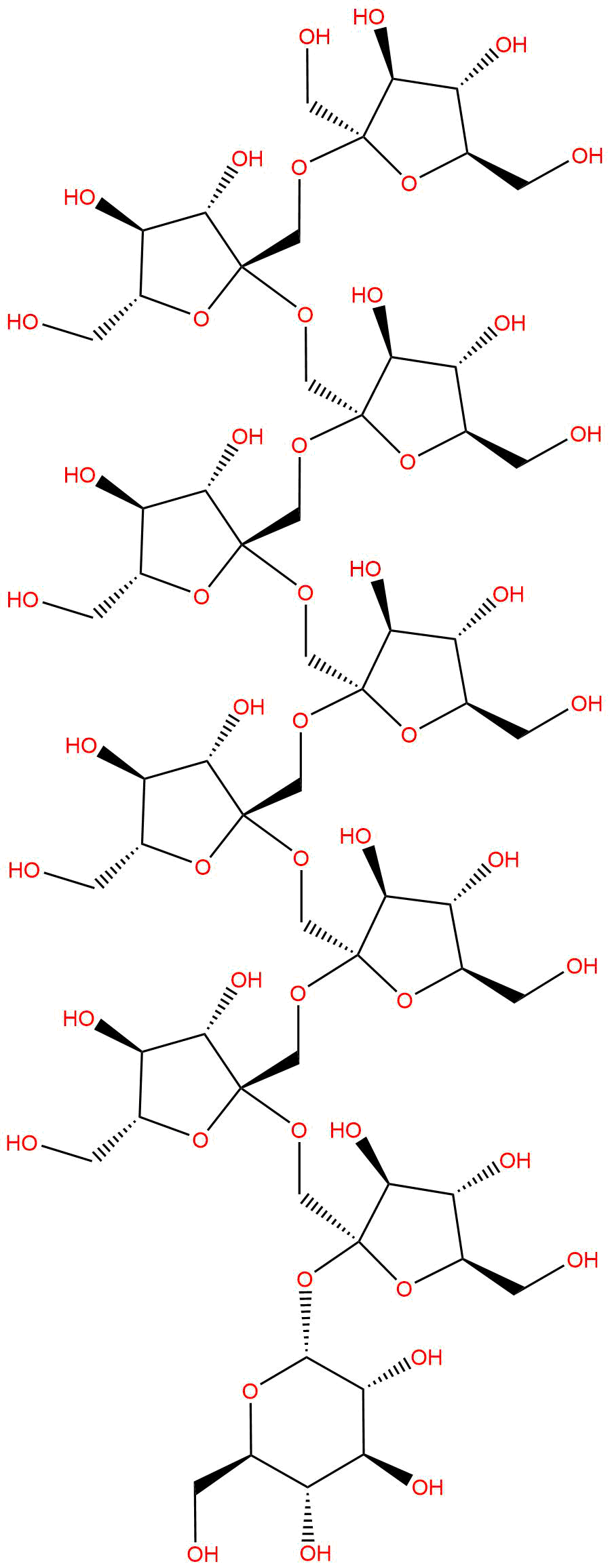


Product name: Fructo-oligosaccharide DP10/GF9
Synonym name:
Catalogue No.: BP4067
Cas No.: 118150-64-4
Formula: C60H102O51
Mol Weight: 1639.43
Botanical Source:
Physical Description: White powder
Type of Compound: Oligose
Purity: 95%~99%
Analysis Method: HPLC-DAD or/and HPLC-ELSD
Identification Method: Mass, NMR
Packing: Brown vial or HDPE plastic bottle
Storage: Store in a well closed container, protected from air and light. Put into refrigerate or freeze for long term storage.
Whenever possible, you should prepare and use solutions on the same day. However, if you need to make up stock solutions in advance, we recommend that you store the solution as aliquots in tightly sealed vials at -20℃. Generally, these will be useable for up to two weeks.
The product could be supplied from milligrams to grams
Inquire for bulk scale.
For Reference Standard and R&D, Not for Human Use Directly.
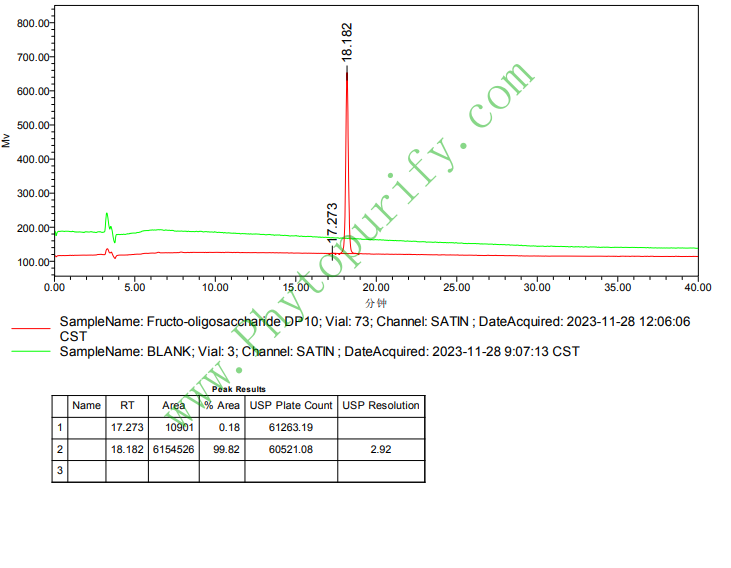
HPLC of Fructo-oligosaccharide DP10
Storage conditions:Short-term storage at 2~8℃, long-term storage at -20 ~ -80℃
822.7300
-5.4185
-5.4174
28.8734
.4330
.1791
Low
18.4754
6.5523
Yes
No
No
No
Yes
No
0.9
Yes
Yes
Yes
Yes
Fructo oligosaccharides DP10 (FOS DP10 or GF9, CAS number 118150-64-4) is a type of oligofructose formed by the connection of fructose units through β - (2 → 1) glycosidic bonds, and belongs to the natural product of oligosaccharides. As a typical prebiotic, cane sugar has received widespread attention in the fields of gut microbiota regulation, immune regulation, and prevention and treatment of metabolic diseases in recent years due to its unique structure and biological activity. Its molecular weight is approximately 1639.4 Da, and it has good water solubility and low fat solubility (LogP-5.4185), making it exhibit excellent bioavailability and safety in the intestinal environment.
As an important regulatory factor for human health, the balance of gut microbiota directly affects the occurrence and development of various chronic diseases. Sugar from sugarcane fruit selectively promotes the growth of beneficial bacteria such as bifidobacteria and lactobacilli, regulates the intestinal microbiota environment, and thus affects the host's immune response and metabolic function. In recent years, relevant studies have revealed that cane sugar can participate in regulating intestinal barrier function, inflammatory response, and metabolic homeostasis through various molecular targets such as AMPK, TLR4, TLR2, NOD2, NFKB1, IL10, MYD88, DEFB1, MUC2, and PPAR γ, demonstrating its potential value in the prevention and treatment of intestinal related diseases.
This article will provide a systematic review of the chemical structure and physicochemical properties, plant sources, and extraction methods of cane fruit sugar, with a focus on its pharmacological activity and mechanism of action. Combined with drug evaluation and pharmacokinetic characteristics, it will explore its clinical application prospects and future research directions, aiming to provide theoretical basis and reference for the development and utilization of this natural product.
Sucrose belongs to the fructooligosaccharides (FOS) family, consisting mainly of 9 to 10 fructose residues linearly connected by β - (2 → 1) glycosidic bonds, typically ending with a glucose residue. Its chemical formula is C60H-102O51, with a molecular weight of approximately 1639.4250 Da. Structurally, the high degree of polymerization of cane fruit decaose endows it with a large molecular weight and complex three-dimensional conformation, which affects its stability and functional performance in vivo.
In terms of physical and chemical properties, cane fruit ten sugar exhibits strong hydrophilicity, with a TPSA (topological polar surface area) of up to 822.73 Å ², indicating the presence of a large number of polar groups on its molecular surface, which is conducive to water solubility and interaction with biomolecules. Its LogP value is -5.4185, indicating extremely low lipid solubility, which limits its passive diffusion through lipid membranes, consistent with its main functional localization in the intestinal lumen. The water solubility is 28.8734 mg/mL, suitable for preparation as a water-soluble formulation. The blood-brain barrier has extremely low permeability, indicating that it is difficult to enter the central nervous system and reduces the risk of central toxicity.
In terms of safety, cane fruit ten sugar did not show hERG channel inhibitory activity, indicating a low risk of cardiac toxicity. The Ames test result is 0.9, indicating that it has no significant mutagenicity and meets the good safety characteristics of natural products.
Sucrose is mainly found in various plants, especially in the roots, stems, and fruits of sugarcane (Saccharum officinarum), onion (Allium cepa), chicory (Cichorium intybus), and other plants. Sugarcane juice is rich in a variety of fructooligosaccharides, which is the main source of raw materials for industrial production of cane fructose.
Traditional extraction methods include water extraction, alcohol precipitation, ion exchange, and membrane separation techniques. The specific process is usually as follows: first, plant raw materials are extracted by hot water or warm water, and pectin is dissolved out using the advantage of water solubility; Subsequently, alcohol (such as ethanol) precipitation is used to remove high molecular impurities and proteins; Removing charged impurities and pigments through ion exchange resin; Finally, ultrafiltration membrane technology was used to separate fructooligosaccharides with different degrees of polymerization, obtaining high-purity cane fruit decasaccharides.
In recent years, the introduction of ultrasound assisted extraction and enzymatic hydrolysis has significantly improved extraction efficiency and purity. Enzymatic hydrolysis utilizes specific fructosyltransferases to catalyze the synthesis or modification of oligofructose, which can accurately control the degree of polymerization and obtain structurally uniform cane sugar products.
As a prebiotic, the most significant pharmacological activity of cane fruit sugar is reflected in the regulation of gut microbiota and improvement of immune function. Numerous in vitro and in vivo studies have shown that cane sugar can selectively promote the proliferation of beneficial bacteria such as bifidobacteria and lactobacilli, inhibit the growth of pathogenic bacteria, optimize the intestinal microbiota structure, and enhance intestinal barrier function.
In animal models, the intake of cane sugar significantly reduces intestinal inflammation indicators, alleviates intestinal mucosal damage, and improves intestinal permeability. It promotes energy metabolism and repair of intestinal epithelial cells by regulating the levels of metabolites such as short chain fatty acids (SCFAs) in the gut microbiota. Cane fructose also has the effects of regulating lipid metabolism, antioxidation and anti-inflammatory, which is helpful to prevent obesity, diabetes and metabolic syndrome.
Preliminary clinical studies have confirmed that cane fruit sugar, as a dietary supplement, can improve symptoms of intestinal dysfunction such as constipation and diarrhea, enhance immune tolerance, and reduce the risk of infection. Its good safety and tolerability make it an important ingredient in functional foods and intestinal health products.
The biological effects of cane sugar are mainly achieved by regulating the gut microbiota and its metabolites, thereby affecting host immunity and metabolic signaling pathways. Its key molecular targets include:
AMPK(5' AMP-activated protein kinase)Sugar from sugarcane fruit promotes the production of short chain fatty acids, activates the AMPK signaling pathway in intestinal epithelial cells, regulates energy metabolism, promotes cell repair and anti-inflammatory response.
TLR4 and TLR2 (Toll like receptors 4 and 2)Sugar from sugarcane fruit regulates the composition of intestinal microbiota, reduces the activation of TLR4/2 by pathogen associated molecular patterns (PAMPs), alleviates inflammatory responses, and maintains intestinal immune homeostasis.
NOD2(Nucleotide-binding oligomerization domain-containing protein 2)As an intestinal immune sensor, NOD2 is involved in recognizing bacterial components. Sucrose can indirectly affect NOD2 mediated immune responses and promote intestinal barrier repair by regulating microbial balance.
NFKB1 (nuclear factor kappa B1)Sugar from sugarcane fruit can reduce the expression of pro-inflammatory cytokines and alleviate inflammatory damage by inhibiting the overactivation of the NFKB signaling pathway.
IL10 (interleukin-10)Sugar from sugarcane fruit promotes the expression of anti-inflammatory cytokine IL10, enhances immune regulatory function, and prevents excessive inflammatory response.
MYD88 (myeloid differentiation factor 88)As a key adapter protein for TLR signaling, cane sugar regulates the MYD88-dependent signaling pathway, balancing immune activation and tolerance.
DEFB1 (β - Defense Factor 1)Sucrose promotes the expression of intestinal antimicrobial peptide DEFB1 and enhances the natural immune barrier of the intestine.
MUC2 (Mucin 2)Sucrose stimulates intestinal epithelial cells to secrete MUC2, strengthens the mucosal barrier, and prevents pathogenic bacteria from invading.
PPAR γ (Peroxisome proliferator activated receptor gamma)Sugar cane fruit ten sugar participates in the regulation of lipid metabolism and inflammatory response by regulating PPAR γ signaling, improving metabolic disorders.
In summary, cane fruit sugar exerts a wide range of biological effects through multi-target and multi pathway synergistic effects, regulating intestinal microbiota and host immune metabolism.
As a natural oligosaccharide, the evaluation of the medicinal properties of cane fruit ten sugar shows multiple advantages. Firstly, its large molecular weight and extremely high polarity (TPSA 822.73 Å ²) result in its oral action being mainly limited to the intestine, avoiding systemic exposure and potential toxic side effects. Low fat solubility (LogP-5.4185) and low blood-brain barrier permeability reduce the risk of central nervous system toxicity.
In terms of safety, cane fruit ten sugar has no hERG channel inhibition and a negative Ames test, indicating extremely low risk of cardiac toxicity and mutagenicity, making it suitable for long-term dietary supplementation.
Pharmacokinetic studies have shown that cane fruit sugar is not broken down by human digestive enzymes after oral administration, but is mainly fermented and utilized by gut microbiota, producing metabolic products such as short chain fatty acids and exerting physiological functions. Its bioavailability is mainly reflected in the intestinal lumen, with minimal systemic absorption, consistent with the characteristics of prebiotics.
In terms of formulation development, cane fruit sugar has good water solubility and is suitable for preparation as oral liquids, powders, and functional food additives. It has high stability and is easy to industrialize production and storage.
With the deepening of research on gut microbiota, the potential of cane fruit polysaccharides as prebiotics in clinical applications is becoming increasingly prominent. It has shown good effects in improving intestinal dysfunction (such as constipation, diarrhea, irritable bowel syndrome), regulating immune function, preventing and auxiliary treatment of inflammatory bowel disease (IBD), metabolic syndrome (obesity, diabetes), etc.
Future clinical research needs to further clarify its dose-response relationship, long-term safety, and synergistic effects when combined with probiotics. In addition, the potential role of cane sugar in tumor immune regulation and neurological diseases is also worth exploring, especially through the study of gut brain axis regulation mechanisms.
At the technical level, utilizing genomics, metabolomics, and microbiome techniques, we will delve into the molecular mechanisms by which cane sugar regulates the gut microbiota, providing theoretical support for its precision medical applications. New formulation technologies such as microcapsule embedding and targeted release will enhance their biological activity and clinical efficacy.
In summary, as a safe and effective natural prebiotic, cane sugar has broad clinical application prospects and market potential, and is an important direction for the development of functional foods and intestinal health products in the future.
As a type of oligofructose with clear structure and diverse functions, cane fruit ten sugar has become a hot topic in natural product pharmacology research due to its excellent ability to regulate gut microbiota and immune regulation. It exhibits a wide range of pharmacological activities and good safety by regulating the gut microbiota and host immune metabolism through multiple targets and pathways.
In the future, systematic research on its mechanism of action should be strengthened, combined with modern omics technology and clinical trials, to promote the transformation of cane fruit sugar from laboratory research to clinical application. By optimizing the extraction process and formulation technology, enhancing its stability and biological activity, it will further expand its application value in the prevention and treatment of intestinal diseases and metabolic diseases.
Overall, cane fruit ten sugar, as a safe and effective natural prebiotic, has important potential to become a functional food and a new type of intestinal regulator, and is worthy of continuous scientific exploration and clinical development.
