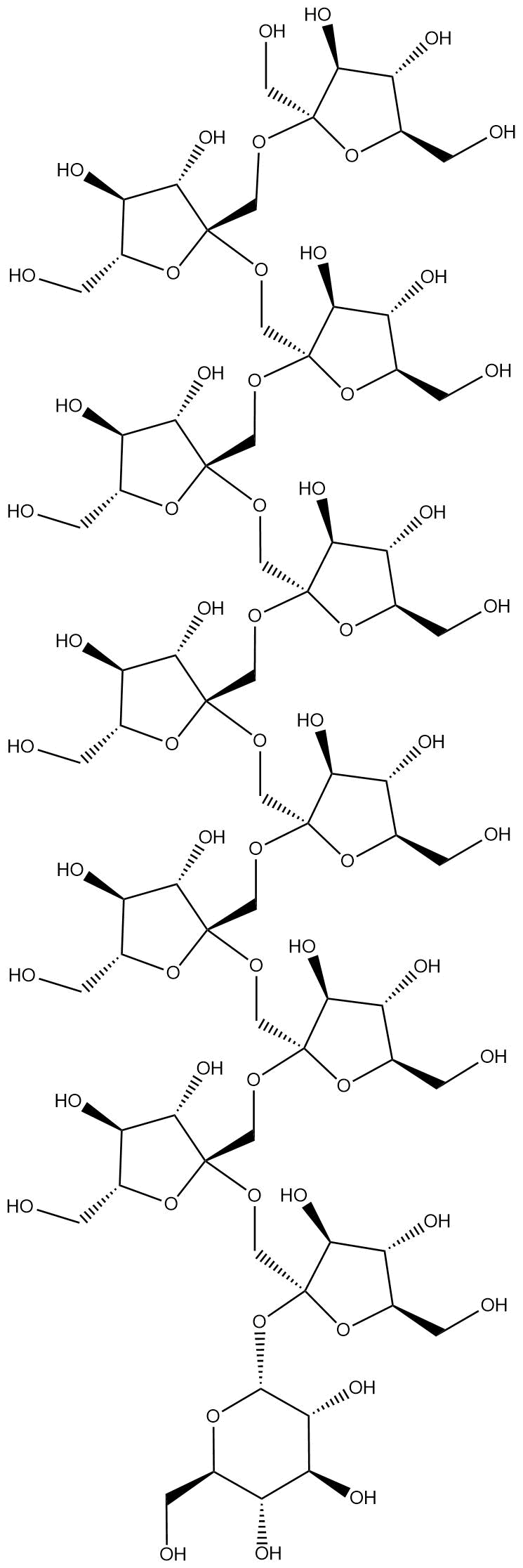


Product name: Fructo-oligosaccharide DP12/GF11
Synonym name: α-D-Glucopyranoside, [O-β-D-fructofuranosyl-(2-1)]10-β-D-fructofuranosyl
Catalogue No.: BP4070
Cas No.: 137405-40-4
Formula: C72H122O61
Mol Weight: 1963.71
Botanical Source:
Physical Description: White powder
Type of Compound: Oligoses
Purity: 95%~99%
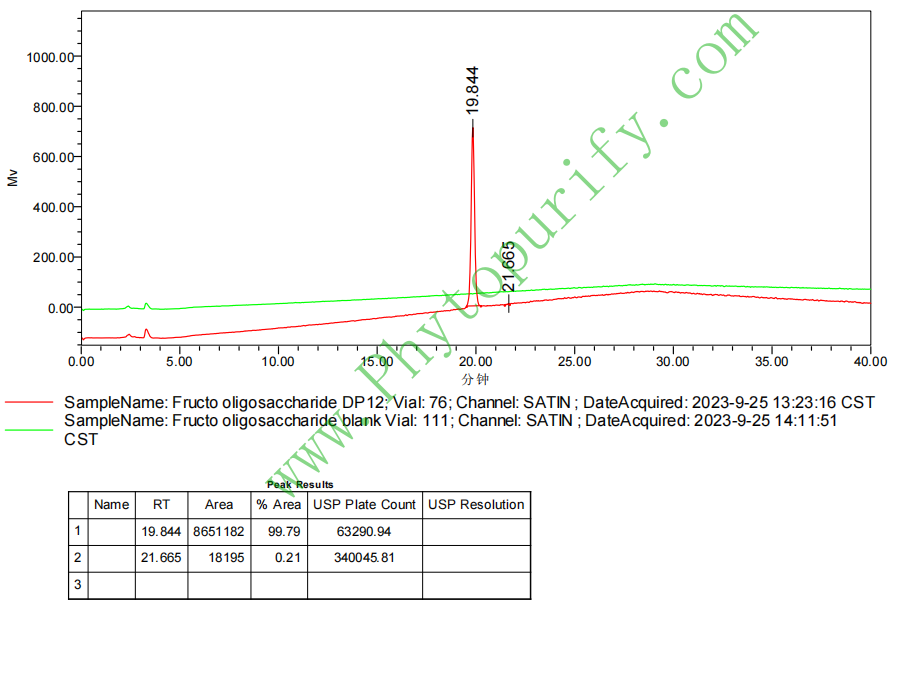
Analysis Method: HPLC-ELSD
Identification Method: Mass, NMR
Packing: Brown vial or HDPE plastic bottle
Storage: Store in a well closed container, protected from air and light. Put into refrigerate or freeze for long term storage.
Whenever possible, you should prepare and use solutions on the same day. However, if you need to make up stock solutions in advance, we recommend that you store the solution as aliquots in tightly sealed vials at -20℃. Generally, these will be useable for up to two weeks.
The product could be supplied from milligrams to grams
Inquire for bulk scale.
For Reference Standard and R&D, Not for Human Use Directly.
HPLC of Fructo-oligosaccharide DP12/GF11
Storage conditions:Short-term storage at 2~8℃, long-term storage at -20 ~ -80℃
981.0300
-5.6873
-5.6862
27.7161
.4379
.1788
Low
18.5821
8.1233
Yes
No
No
No
Yes
No
1.2
Yes
Yes
Yes
Yes
Fructo oligosaccharides DP12 (FOS DP12 or GF11, CAS number: 137405-40-4), as a type of oligofructose, has attracted widespread attention in the field of natural product pharmacology in recent years. Oligofructose is a non digestible carbohydrate polymer formed by the connection of fructose units through β - (2 → 1) glycosidic bonds, with unique prebiotic functions. Due to its specific degree of polymerization (DP of 12), cane fruit twelve sugar exhibits significant biological activity in regulating intestinal microbiota, enhancing host immune function, and maintaining intestinal barrier integrity. It cannot be broken down by host digestive enzymes, but can be utilized by specific intestinal probiotics such as Bifidobacterium, promoting the proliferation of beneficial bacteria and improving the intestinal microenvironment.
This article provides a systematic review of the chemical structure and physicochemical properties, plant sources and extraction processes, pharmacological activities and mechanisms of action of cane fruit twelve sugar. The focus is on exploring its molecular targets and signaling pathways, and conducting a comprehensive evaluation based on its pharmacological parameters. The potential and challenges of its clinical application are also discussed, aiming to provide theoretical basis and practical guidance for natural product pharmacology research and functional food development.
Sugar cane twelve sugar belongs to the Fructo oligosaccharides (FOS) family, whose molecular structure consists of 12 fructose units linearly connected by β - (2 → 1) glycosidic bonds, with one glucose unit usually connected at the end, forming the GF11 structure. Its molecular weight is 1963.7070 Da, belonging to the category of medium molecular weight oligosaccharides. The physicochemical properties of cane fruit twelve sugar are highly hydrophilic, with a water solubility of 27.7161 mg/mL and good water solubility, which is beneficial for its dispersion and utilization in the gastrointestinal tract.
The LogP value is -5.6873, indicating its strong hydrophilicity and low fat solubility, which limits its transmembrane passive diffusion ability and is consistent with its characteristics as a local acting substance in the intestine. The extremely high polar surface area (TPSA) of 981.0300 Å ² further confirms its water solubility and low fat solubility properties. The permeability of the blood-brain barrier is extremely low, indicating that its main function is limited to the gastrointestinal tract and it is not easy to enter the central nervous system.
In terms of safety, cane fruit twelve sugar has no hERG channel inhibitory effect, reducing the risk of cardiac toxicity. The Ames test result is 1.2, indicating no significant mutagenicity and a good safety basis.
Sugarcane twelve sugar mainly comes from the precursors of fruit polysaccharides in natural plants, especially from plants rich in fruit polysaccharides such as sugarcane (Saccharum officinarum) and chicory (Cichorium intybus). Sugarcane juice is rich in sucrose and fructooligosaccharides. High purity fructose can be obtained by biological enzyme or physical and chemical methods.
Common extraction methods include:
Enzymatic hydrolysis Using Fructanase to hydrolyze high degree of polymerization fructooligosaccharides and controlling reaction conditions to obtain oligofructose with specific DP. This method has the advantages of strong selectivity and uniform product.
membrane separation technology Separation of oligofructose with different molecular weights through ultrafiltration and nanofiltration techniques, combined with chromatographic purification process to achieve the preparation of high-purity cane twelve sugar.
chromatographic separation High performance liquid chromatography (HPLC) or ion exchange chromatography is used for fine separation and purification to ensure the structural and functional consistency of the product.
Drying process: spray drying or freeze drying technology is used to obtain stable powder morphology, which is convenient for storage and application.
The optimization of extraction process not only affects the yield and purity, but also relates to the biological activity and functional performance of cane twelve sugars.
As an important member of prebiotics, the pharmacological activity of cane fruit twelve sugar mainly manifests in regulating intestinal microbiota, enhancing intestinal barrier function, and immune regulation.
Sucrose cannot be broken down by host digestive enzymes, but can be utilized by specific probiotics in the gut such as Bifidobacterium and Lactobacillus, promoting their growth and reproduction, inhibiting harmful bacteria, and maintaining gut microbiota balance. Multiple in vitro and animal experiments have shown that cane sugar can significantly increase the number of bifidobacteria and promote the production of short chain fatty acids (SCFAs) such as acetic acid, propionic acid, and butyric acid, which have important protective effects on intestinal health.
Sucrose can enhance the connectivity between intestinal epithelial cells, reduce intestinal permeability, and prevent the invasion of harmful substances and pathogens by regulating the expression of tight junction proteins such as OCTN, ZO1, and CLDN1. Animal models show that cane sugar can alleviate symptoms of enteritis and promote intestinal mucosal repair.
Sucrose can activate the intestinal immune system and regulate the expression of inflammatory factors. It regulates the TLR2 and TLR4 signaling pathways, promotes the secretion of anti-inflammatory cytokine IL-22, enhances the expression of mucin MUC2, and improves intestinal defense ability. In addition, cane fruit twelve sugar activates GPR41 and GPR43 receptors, participating in the regulation of immune cell function and metabolic homeostasis.
By promoting the generation of SCFAs, cane sugar indirectly affects host energy metabolism and lipid metabolism, and has potential anti obesity and metabolic syndrome improvement effects.
The biological effects of cane fruit twelve sugar depend on its interactions with the gut microbiota and host cells, mainly involving the following molecular targets and signaling pathways:
TLR2 and TLR4 serve as key pattern recognition receptors in the gut immune system, recognizing microbial associated molecular patterns (MAMPs) and regulating immune responses. Sugar cane twelve sugar promotes the growth of probiotics, indirectly regulates the TLR signaling pathway, induces the expression of anti-inflammatory cytokines, and inhibits excessive inflammatory reactions.
MUC2 is the main component of the intestinal mucus layer, forming a physical barrier to prevent pathogen invasion. Sucrose promotes the expression and secretion of MUC2 gene, enhances the thickness and function of mucus layer, and protects intestinal epithelial cells.
Tight junction proteins maintain the barrier function between intestinal epithelial cells. Sucrose can enhance the integrity of the intestinal barrier and reduce intestinal leakage by regulating the expression and localization of these proteins.
GPR41 and GPR43 are receptors for short chain fatty acids, involved in regulating immune responses, inflammatory responses, and energy metabolism. Sucrose promotes the production of SCFAs, activates these two receptors, and regulates host metabolism and immune homeostasis.
As a high-quality substrate for bifidobacteria, cane fruit twelve sugar promotes their proliferation, enhances the stability of gut probiotic communities, and exerts prebiotic effects.
IL-22 plays an important role in intestinal mucosal immunity, promoting epithelial cell repair and antimicrobial peptide production. Sugar cane twelve sugar promotes the secretion of IL-22 and enhances the intestinal immune barrier by regulating gut microbiota and TLR signaling.
The pharmacological evaluation of cane fruit twelve sugar is mainly based on its physicochemical properties, safety, and in vivo kinetic characteristics.
The molecular weight of cane fruit twelve sugar is relatively large, with high water solubility, strong polarity, and extremely low LogP value. As a result, its oral effects are mainly limited to the gastrointestinal tract and difficult to be absorbed by intestinal epithelial cells into the systemic circulation. Its high TPSA value further limits its transmembrane absorption capacity.
Sugar cane twelve sugar has no hERG channel inhibitory effect, and Ames test shows no mutagenicity, demonstrating good safety. As a dietary fiber substance, it has high safety for long-term intake and is suitable for the development of functional foods and pharmaceutical excipients.
Due to the fact that cane sugar cannot be broken down by host digestive enzymes, it is mainly fermented and utilized by probiotics in the colon after oral administration, producing short chain fatty acids and exerting local effects. The system absorbs very little, with low blood-brain barrier permeability, reducing potential central nervous system side effects.
As a polysaccharide substance, cane fruit twelve sugar has low oral bioavailability and is difficult to be used as a systemic drug molecule. Its main application is targeted at local regulation of the intestine and prebiotic functions, making it suitable for development as functional foods, nutritional supplements, and adjuvant therapies related to intestinal health.
Due to its significant prebiotic effects and intestinal barrier protection function, cane fruit twelve sugar has shown broad application prospects in various clinical fields.
Sugarcane twelve sugar is expected to be used as an adjuvant therapy for intestinal diseases such as inflammatory bowel disease (IBD) and irritable bowel syndrome (IBS) by regulating gut microbiota and enhancing barrier function, reducing inflammatory reactions and promoting mucosal repair.
By activating the TLR signaling pathway and promoting the secretion of anti-inflammatory cytokines, cane sugar can enhance the intestinal immune barrier, prevent intestinal infections, and reduce the risk of pathogen colonization.
Sucrose promotes the generation of SCFAs, regulates energy metabolism, and has potential anti obesity, insulin resistance improvement, and dyslipidemia functions, making it suitable for nutritional intervention in patients with metabolic syndrome.
As a highly safe prebiotic, cane fruit twelve sugar is suitable for infants, young children, and the elderly, promoting the maturation and stability of gut microbiota and enhancing immune defense capabilities.
Sucrose can be used as a functional food ingredient and is widely used in dairy products, beverages, and nutritional supplements to meet consumers' needs for intestinal health.
Future research should focus on the precise mechanism of action of cane fruit twelve sugar, especially its regulation of intestinal microbiota diversity and host immune network; Meanwhile, by combining modern biotechnology to optimize the extraction process, the yield and purity can be improved; Conduct more clinical trials to verify its safety and effectiveness, and promote its clinical application and transformation in intestinal and metabolic diseases.
As a natural source of oligofructose, cane fruit twelve sugar has become an important research object in the field of intestinal health due to its unique probiotic function and good safety. It exhibits a wide range of pharmacological activities and clinical application potential by regulating the structure of intestinal microbiota, enhancing intestinal barrier function, and immune regulation. Although its pharmacological properties are limited by molecular structure and bioavailability, it has broad prospects as a functional food and adjuvant therapy for intestinal diseases. In the future, combining interdisciplinary research will further reveal its mechanism of action, optimize application strategies, and promote the in-depth development of cane fruit twelve sugar in the fields of natural product pharmacology and clinical nutrition.
