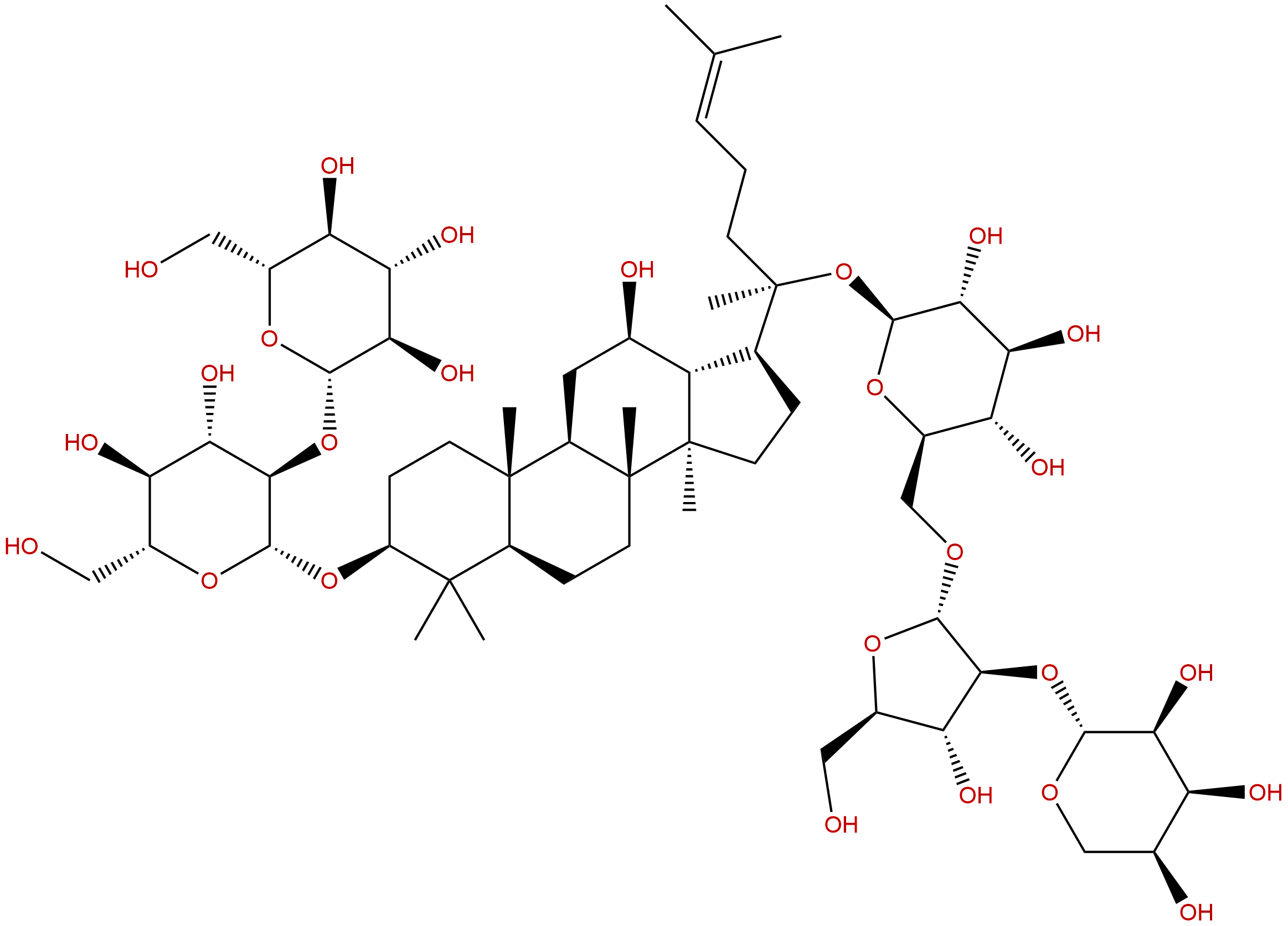


Product name: Ginsenoside Ra2
Synonym name:
Catalogue No.: BP3457
Cas No.: 83459-42-1
Formula: C58H98O26
Mol Weight: 1211.4
Botanical Source: Panax ginseng
Physical Description: Powder
Type of Compound:
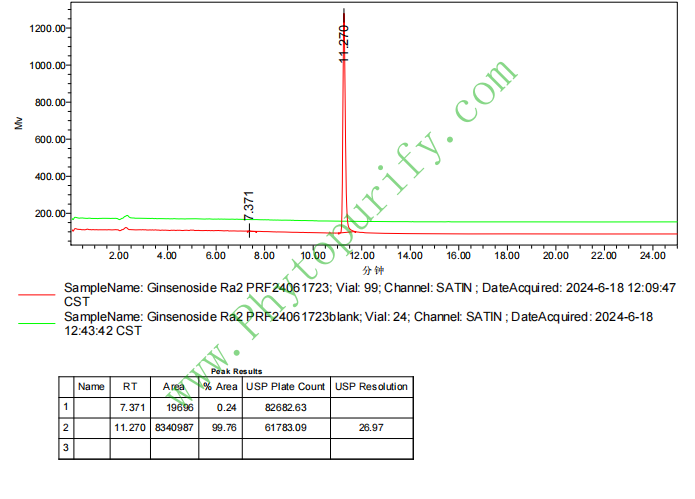
Purity: 95%~99%
Analysis Method: HPLC-DAD or/and HPLC-ELSD
Identification Method: Mass, NMR
Packing: Brown vial or HDPE plastic bottle
The product could be supplied from milligrams to grams. Inquire for bulk scale.
We provide solution to improve the water-solubility of compounds, thereby facilitating the variety of activity tests and clinic uses.
For Reference Standard and R&D, Not for Human Use Directly.
HPLC of Ginsenoside Ra2
Storage conditions:Short-term storage at 2~8℃, long-term storage at -20 ~ -80℃
415.9800
1.7760
1.7759
.2939
.4524
.1054
Low
65.6796
7.2259
Yes
No
No
No
No
No
0.0
Yes
No
No
No
Ginsenoside Ra2 is a natural active compound isolated and extracted from the traditional precious Chinese medicinal herb, ginseng (Panax ginseng C.A. Mey.), belonging to the class of dammarane triterpenoid saponins. Its CAS number is 83459-42-1, molecular formula is C58H98O26, and molecular weight is as high as 1211.38 g/mol. As a saponin component with relatively low content but unique structure in ginseng, ginsenoside Ra2 has not received as much attention as mainstream saponins such as ginsenoside Rg1 and Rb1 for a long time. However, with the deepening of modern natural product chemistry and pharmacology research, especially the development of high-throughput screening and network pharmacology, ginsenoside Ra2 has gradually demonstrated its unique biological activity, especially in antitumor The field shows remarkable potential. Existing research has shown that it can participate in regulating tumor cell proliferation, apoptosis, and cell cycle progression by acting on multiple key cellular targets such as BCL2, EGFR, TP53, KRAS, and CDKN1A. This article will provide a systematic and professional scientific interpretation of this potential natural product from the aspects of its chemical structure, plant origin, pharmacological mechanism, medicinal evaluation, and research prospects.
The chemical structure of ginsenoside Ra2 is complex and belongs to the protopanaxadiol type saponin. The SMILES string provides a detailed description of its stereochemical configuration: a tetracyclic triterpenoid dammarane glycoside (protopanaxadiol) is connected to three sugar chains, two of which are outer sugar chains and one is inner sugar chain. The structure of this polyhydroxy and polysaccharide chain determines its unique physicochemical properties.
According to the provided pharmacological parameters, its molecular weight (MW) is 1211.3960, far exceeding conventional small molecule drugs (usually<500 Da). The total polar surface area (TPSA) is as high as 415.98 Å ², mainly attributed to the abundant hydroxyl groups and oxygen atoms on the sugar ring in the molecule, indicating its strong hydrophilicity. The distribution coefficient (LogP) is 1.7760 and the LogD is 1.7759, indicating that the molecule's distribution behavior in the n-octanol/water system tends towards lipophilicity. However, considering its huge molecular weight and extremely high TPSA, its overall properties are more inclined towards lipophilicity Hydrophilic macromolecule The predicted value of its water solubility is 0.2939 (usually measured in mg/mL or mol/L, indicating low solubility), which is related to the high crystal lattice energy and hydration difficulty caused by high molecular weight and highly polar surfaces.
From the perspective of chemical stability, glycosidic bonds may undergo hydrolysis under acidic conditions, which is a common feature of many saponin components. Its complex chiral center and multiple glycosylation sites also pose significant challenges for its chemical synthesis, which currently relies mainly on extraction and separation from plants.
The only natural source of ginsenoside Ra2 is the Panax ginseng plant in the Araliaceae family. Ginseng is mainly produced in Northeast China, the Korean Peninsula, and the Far East of Russia. It is known as the "King of Herbs" and has a medicinal history of over two thousand years. In the "Shennong Bencao Jing", ginseng is listed as a top-grade herb with the effects of "tonifying the five organs, calming the spirit, calming the soul, stopping fear, eliminating evil qi, improving eyesight, happiness, and intelligence, and taking it for a long time to lighten the body and prolong life". Traditional Chinese medicine believes that ginseng has a warm nature, a sweet and slightly bitter taste, and can regulate the spleen, lungs, heart, and kidney meridians. Its main functions include replenishing vital energy, strengthening the pulse, nourishing the spleen and lungs, generating fluids and nourishing blood, calming the mind and improving intelligence. It is commonly used to treat diseases such as body deficiency and desire to leave, cold limbs and weak pulse, spleen deficiency and insufficient food intake, lung deficiency and wheezing, fluid damage and thirst, internal heat and thirst, qi and blood deficiency, chronic illness and weakness, palpitations and insomnia, impotence and uterine coldness.
The material basis for ginseng to exert its extensive pharmacological effects is precisely the various ginsenosides, polysaccharides, volatile oils, and other components it contains. Ginsenoside Ra2, as one of them, although not high in content, still carries some of the activity of ginseng. The traditional application is the decoction of ginseng whole herb or compound, where multiple saponins and other components work together to exert synergistic or antagonistic effects, forming the overall regulatory characteristics of traditional Chinese medicine's "multi-component, multi-target" approach. Modern research has isolated Ra2 separately for study, aiming to clarify the structure-activity relationship between its specific chemical entity and biological activity, which is an important path for the modernization of traditional Chinese medicine research.
The existing data clearly indicates that the core pharmacological activity of ginsenoside Ra2 is antitumor The mechanism of action involves the regulation of multiple key tumor related targets, reflecting the advantages of multi-target action of natural products.
1. Inducing tumor cell apoptosis (targeting BCL2 and TP53):
- BCL2 It is the encoded product of B-cell lymphoma 2 gene and belongs to the core member of the anti apoptotic protein family. Overexpression of BCL2 can inhibit mitochondrial pathway apoptosis in various tumor cells, which is a key factor for tumor cells to resist death and maintain survival. Ginsenoside Ra2 may alleviate its inhibition of apoptosis and promote programmed cell death in tumor cells by downregulating the expression of BCL2 protein or interfering with its interaction with pro apoptotic proteins such as BAX.
- TP53 The famous p53 protein is a tumor suppressor known as the "guardian of the genome". During cellular stress (such as DNA damage), p53 is activated, which can induce cell cycle arrest (to buy time for DNA repair) or directly initiate apoptosis programs (when the damage is irreparable). Many tumors lose their function through mutations in the TP53 gene. Ginsenoside Ra2 may restore or enhance the tumor suppressive function of p53 by stabilizing its protein, promoting its transcriptional activity, or acting on its upstream regulatory pathway, thereby inducing cell cycle arrest and apoptosis.
2. Inhibit tumor cell proliferation and signal transduction (targeting EGFR and KRAS):
- EGFR Epidermal growth factor receptor is a transmembrane tyrosine kinase receptor. Its excessive activation (such as overexpression or mutation) will continue to stimulate downstream survival and proliferation signaling pathways such as MAPK and PI3K/Akt, which are closely related to the occurrence and development of various solid tumors (such as non-small cell lung cancer and colorectal cancer). Ginsenoside Ra2 may act as an inhibitor of the EGFR signaling pathway, interfering with EGFR autophosphorylation or blocking its binding to downstream adaptor proteins, thereby inhibiting abnormal proliferation signals.
- KRAS It is an important member of the RAS family, located downstream of receptor tyrosine kinases such as EGFR, and is a key intracellular signaling switch protein. KRAS mutation (common in pancreatic cancer, colorectal cancer and lung cancer) will cause it to be continuously activated (GTP binding state), which will continue to drive cell proliferation. Targeting KRAS was once considered 'untreatable'. Ginsenoside Ra2 may indirectly affect the membrane localization of KRAS or interfere with its interaction with effector proteins, thereby inhibiting oncogenic signals driven by mutant KRAS.
3. Regulating cell cycle progression (targeting CDKN1A):
- CDKN1A Its encoded protein is p21WAF1/Cip1, which is a potent inhibitor of cyclin dependent kinase (CDK). P21 is regulated by p53 transcription and can cause cell cycle arrest in G1 phase. By activating the expression of CDKN1A, ginsenoside Ra2 can force tumor cells to exit the proliferation cycle, creating conditions for cell repair or apoptosis.
Integration of mechanism of action:
The anti-tumor effect of ginsenoside Ra2 is likely not achieved through a single target, but through the synergistic effect of the aforementioned multi-target network. For example, it may indirectly affect the KRAS pathway by inhibiting EGFR signaling; By activating TP53 while upregulating its downstream target genes CDKN1A (causing cycle arrest) and pro apoptotic genes (such as BAX), and possibly inhibiting BCL2. This multi-target and multi pathway mode of action helps overcome the single target drug resistance of tumor cells, but also requires more in-depth molecular biology and systems pharmacology research to map its precise mechanism of action.
Based on the provided pharmacological parameters, we evaluated the development potential of ginsenoside Ra2 using standards such as Lipinski's Rule of Five
Lipinski's Five Rules Analysis:
Absorption, distribution, metabolism, excretion (ADME) characteristics:
Toxicity assessment:
Conclusion of comprehensive evaluation of drug properties:
Ginsenoside Ra2, as a lead compound The powerful multi-target anti-tumor pharmacological activity is the biggest advantage However, it The extremely poor drug properties (especially the extremely low oral bioavailability) are the biggest obstacle to developing them into traditional oral formulations Future development strategies may need to shift towards:
- Prodrug modification Modify its sugar or glycoside structure to enhance lipid solubility and membrane permeability, and metabolize it back to its active form in vivo.
- New drug delivery system: Utilize Nano delivery technology(such as liposomes, polymer micelles, nanoparticles) encapsulate Ra2, improve its solubility, enhance targeted accumulation at the tumor site (through EPR effect or active targeting), and may bypass the absorption barrier.
- Injection administration Directly developing intravenous injection formulations, but addressing their solubility in water and formulation stability issues.
- As a component of combination therapy By utilizing its multi-target properties, it can be combined with existing targeted drugs or chemotherapy drugs to enhance efficacy or reverse drug resistance.
Research status:
At present, there are relatively few public research literature on ginsenoside Ra2, and its activity data mostly comes from high-throughput screening and computational prediction (such as the target information provided in this study). This indicates that the compound is still in the Early detection and validation stage Most studies focus on more common ginsenosides (such as Rg3, Rh2, CK, etc.), which have been proven to have clear anti-tumor activity, and some have entered clinical research or even become marketed drugs (such as Rg3 used for adjuvant therapy of tumors). Research on Ra2 may currently focus on:
1. Optimization of Extraction and Purification Process Due to its low natural content, efficient and large-scale acquisition of high-purity Ra2 is a prerequisite for conducting in-depth research.
2. In vitro activity validation Validate its effects on proliferation, apoptosis, cell cycle, migration and invasion in multiple tumor cell lines, and explore preliminary evidence of its direct interaction with targets such as BCL2 and EGFR.
3. Preliminary in vivo pharmacodynamics Evaluate the anti-tumor effect and preliminary safety of animal transplant tumor models after injection or special delivery.
Application prospects and future directions:
1. In depth mechanism clarification Using techniques such as gene knockout/knockdown, co crystallization, and surface plasmon resonance (SPR), clarify whether there is a direct interaction between Ra2 and the predicted targets mentioned above, and draw a detailed intracellular signaling network map.
2. Research on Structural Optimization and Structure Activity Relationship (SAR)The systematic study aims to investigate the effects of glycoside structure, glycosyl type, quantity, and connection mode on activity and drug formation, with the aim of discovering derivatives that retain activity but have better physicochemical properties.
3. Advanced delivery technology development This is the core driving force behind the application of Ra2. Combining nanomedicine and biomaterials, design intelligent responsive nanocarriers to achieve tumor targeted delivery and controlled release of Ra2, maximizing chemotherapy efficacy and reducing systemic toxicity.
4. Explore combination therapy strategies Study the synergistic effect of Ra2 with chemotherapy, radiotherapy, immunotherapy, or other targeted therapies, especially for refractory tumors with EGFR mutations, KRAS mutations, or p53 dysfunction.
5. Expand new indications In addition to anti-tumor effects, based on its potential to regulate key signaling pathways such as EGFR and p53, its applications in inflammatory diseases, fibrotic diseases, or neuroprotection can be explored.
Summary:
Ginsenoside Ra2 is a natural compound with unique structure and multi-target anti-tumor potential discovered from the traditional treasure ginseng. It is like a 'multi toothed key' that has the potential to intervene in multiple critical stages of tumor growth simultaneously. Although its enormous molecular weight and complex structure pose significant challenges for drug development, making it not meet the standards of traditional small molecule drugs, this does not mean the end of its development value. On the contrary, it represents an important type in the development of natural product drugs——New therapeutic agents based on complex natural macromolecules With the rapid development of modern pharmacy, nanotechnology, and molecular biology technologies, it is entirely possible to transform these highly active but unique molecules into effective therapeutic drugs through rational formulation modification and delivery strategies. The future of ginsenoside Ra2 will rely on deep interdisciplinary collaboration, from precise mechanism analysis to intelligent delivery system construction, ultimately achieving translation from laboratory to clinical use, providing new weapons for tumor treatment.
