


Synonym name: Protopanaxadiol
Catalogue No.: BP0045
Cas No.: 30636-90-9
Formula: C30H52O3
Mol Weight: 460.73
Botanical Source: Panax ginseng
Purity: 30%, 40%, 90%, 95%, 99%
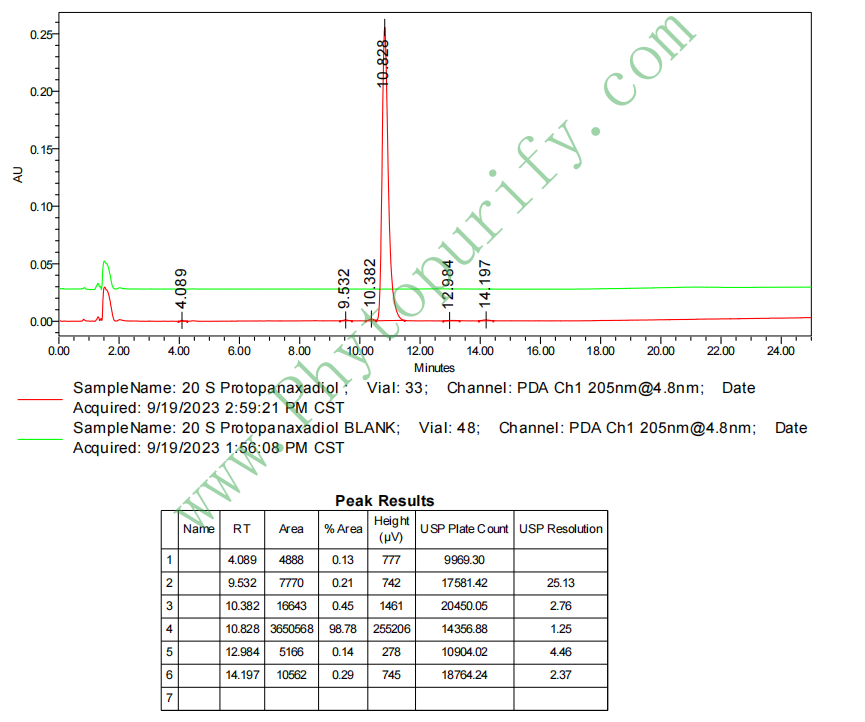
Analysis Method: HPLC-DAD or/and HPLC-ELSD
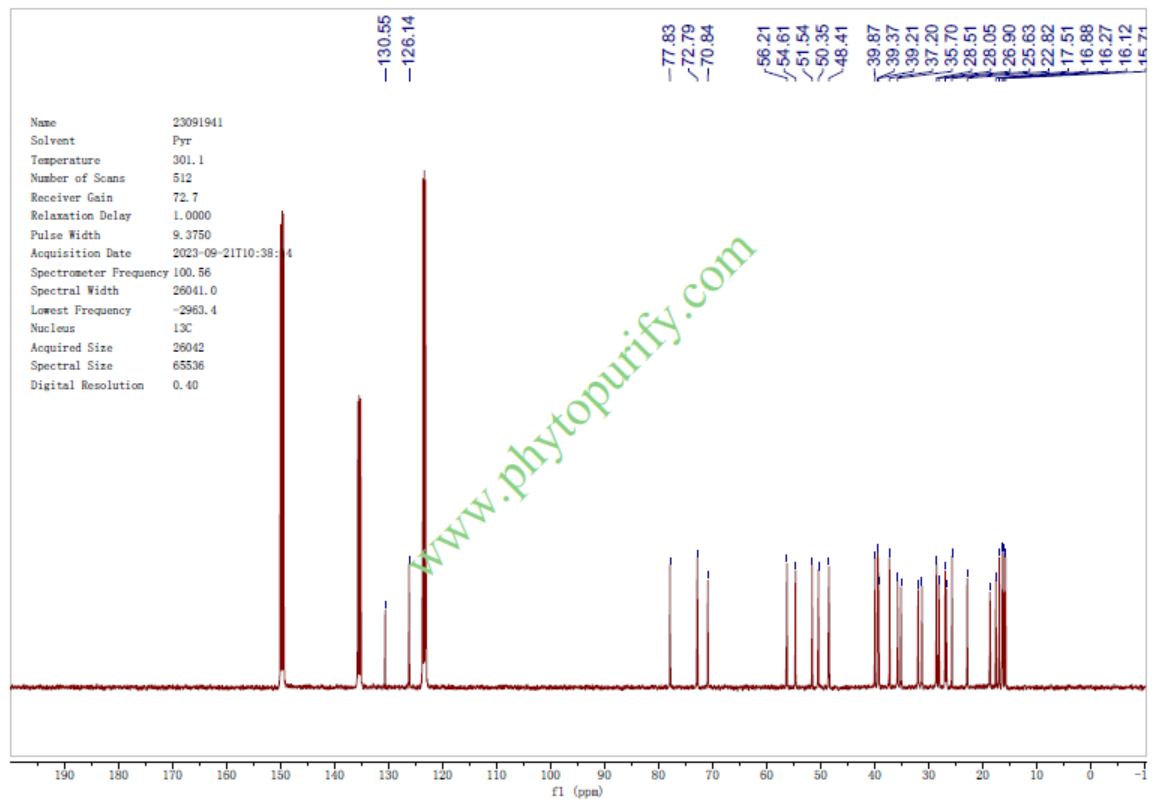
Identification Method: Mass, NMR
Packing: Brown vial or HDPE plastic bottle
Can be supplied from milligrams to grams, up to kilograms.
Inquire for bulk scale.
Storage conditions:Short-term storage at 2~8℃, long-term storage at -20 ~ -80℃
60.6900
6.0000
Low
No
No
No
No
No
No
Protopanaxadiol (PPD), as one of the main active metabolites of ginsenosides, has attracted widespread attention in the field of natural product pharmacology in recent years. PPD is not only the core structural unit of various saponins in ginseng, but also a potential candidate molecule for developing new therapeutic drugs due to its diverse biological activities and good safety performance. Especially in the research on the prevention and treatment of metabolic diseases such as hyperglycemia, PPD has shown significant regulatory effects, involving multiple key molecular pathways and targets. This article aims to provide a systematic review of the chemical structure and physicochemical properties, plant sources and extraction processes, pharmacological activity and mechanism of action, pharmacological evaluation, pharmacokinetic characteristics, and clinical application prospects of PPD, providing theoretical basis and practical guidance for subsequent research and drug development.
The molecular formula of PPD is C30H52O3, with a molecular weight of 460.73 and a CAS number of 30636-90-9. Its chemical structure belongs to the tetracyclic triterpenoid class, and its core skeleton is the deglycosylated mother nucleus of ginsenosides, with a 20 (S) stereoconfiguration. PPD molecules contain three hydroxyl groups, with 3 hydrogen bond acceptors and a polar surface area (TPSA) of 60.69 Å ², exhibiting moderate polarity characteristics. Its LogP value is as high as 6.0, indicating that the molecule has strong lipid solubility, which is beneficial for penetrating cell membranes but may affect water solubility and bioavailability.
The low blood-brain barrier permeability of PPD suggests limited distribution in the central nervous system. In terms of safety, PPD did not exhibit hepatotoxicity, cardiotoxicity, or hERG channel inhibition, and the Ames mutagenicity test was also negative, demonstrating good safety and low mutagenicity risk. These physicochemical and toxicological parameters lay the foundation for the drug development of PPD.
PPD mainly exists in plants of the Panax genus in the Araliaceae family, especially in the roots of Asian ginseng (Panax ginseng C.A. Meyer) and American ginseng (Panax quinquefolius L.). Ginseng contains various saponins, and PPD is the main product of deglycosylation in its metabolic process. It can also be obtained through enzymatic or microbial conversion in vivo.
Traditional extraction methods typically use alcohols (such as methanol and ethanol) as solvents to obtain a mixture of ginsenosides through thermal reflux or ultrasound assisted extraction. Subsequently, ginsenosides are converted into PPD using acid hydrolysis or enzymatic hydrolysis techniques. In recent years, the application of supercritical CO2 extraction, microwave-assisted extraction, and membrane separation technology has improved the extraction efficiency and purity of PPD.
The purification steps often use silica gel column chromatography, reverse phase high performance liquid chromatography (RP-HPLC), and preparative liquid chromatography techniques to ensure the acquisition of high-purity PPD samples. The optimization of extraction process not only affects the yield, but also relates to the accuracy of subsequent pharmacological research and the feasibility of drug development.
PPD exhibits a wide range of pharmacological activities, covering multiple aspects such as anti-tumor, anti-inflammatory, antioxidant, immune regulation, and metabolic regulation. Especially in the study of hyperglycemia and related metabolic diseases, PPD has shown significant hypoglycemic and insulin sensitivity improvement effects.
Multiple in vitro and in vivo experiments have shown that PPD can significantly reduce blood glucose levels and improve glucose metabolism disorders. Its mechanism involves promoting pancreatic beta cell function, enhancing insulin signaling, and inhibiting gluconeogenesis. PPD can also regulate the expression of glucose transporters, promoting tissue uptake and utilization of glucose.
High blood sugar levels are often accompanied by chronic inflammation and oxidative stress. PPD reduces tissue damage and protects pancreatic islet cells and target organ function by inhibiting the release of inflammatory factors (such as TNF - α, IL-6) and enhancing antioxidant enzyme activity.
PPD has also shown potential in cardiovascular protection, neuroprotection, and anti-tumor fields. For example, its protective effect on myocardial cells is related to its anti apoptotic mechanism; In the nervous system, PPD can regulate neurotransmitters and protect neuronal survival.
The molecular mechanism of PPD regulating hyperglycemia is complex, involving multiple signaling pathways and key targets.
PPD activates the AMPK pathway, inhibits NF - κ B mediated inflammatory response, regulates the PI3K/Akt signaling pathway, and promotes cell survival and metabolic homeostasis. In addition, PPD affects mTOR signaling, regulates cellular autophagy and energy metabolism, and synergistically improves the pathological state of hyperglycemia.
The pharmacological evaluation of PPD shows that it has good safety and potential clinical application value. Moderate molecular weight, although high LogP may limit its water solubility and oral bioavailability, lipid solubility is beneficial for cell membrane penetration.
Toxicological data shows that PPD has no significant hepatorenal toxicity, cardiac toxicity, or genetic toxicity, and has a wide safety window. Low blood-brain barrier permeability reduces the risk of central nervous system side effects.
Pharmacokinetic studies have shown that oral absorption of PPD is slow and its bioavailability is limited. It is mainly metabolized through the liver, and the metabolites are mostly water-soluble complexes. PPD is widely distributed in the body with a moderate half-life, making it suitable for daily administration.
To improve its pharmacokinetic properties, researchers have attempted to use modern pharmaceutical technologies such as nanocarriers, liposomes, and solid dispersions to increase the solubility and bioavailability of PPD, enhancing its clinical application potential.
PPD, as a natural product, has demonstrated unique advantages in the prevention and treatment of hyperglycemia and related metabolic diseases due to its multi-target and multi pathway regulatory abilities. Its good safety and diverse pharmacological activities make it a strong candidate for adjuvant treatment of diabetes and metabolic syndrome.
The key to future clinical applications lies in:
With the development of natural product pharmacology and modern pharmaceutical technology, PPD is expected to become a new paradigm for natural drug development, promoting the treatment of metabolic diseases into a new era of multi-target precise regulation.
20 (S) - Protopanaxadiol, as an important metabolite of ginsenosides, has shown broad application prospects in the prevention and treatment of hyperglycemia and related metabolic diseases due to its unique chemical structure and diverse biological activities. Its multi-target regulatory mechanism, good safety, and potential clinical value make it a hot topic in natural product pharmacology research and new drug development. In the future, combining modern pharmaceutical technology and systems biology methods, in-depth exploration of the mechanism of action and clinical value of PPD will provide new ideas and strategies for precise treatment of metabolic diseases.
