


Synonym name:
Catalogue No.: BP0044
Cas No.: 7755-01-3
Formula: C30H52O3
Mol Weight: 460.743
Botanical Source:
Purity: 95%~99%
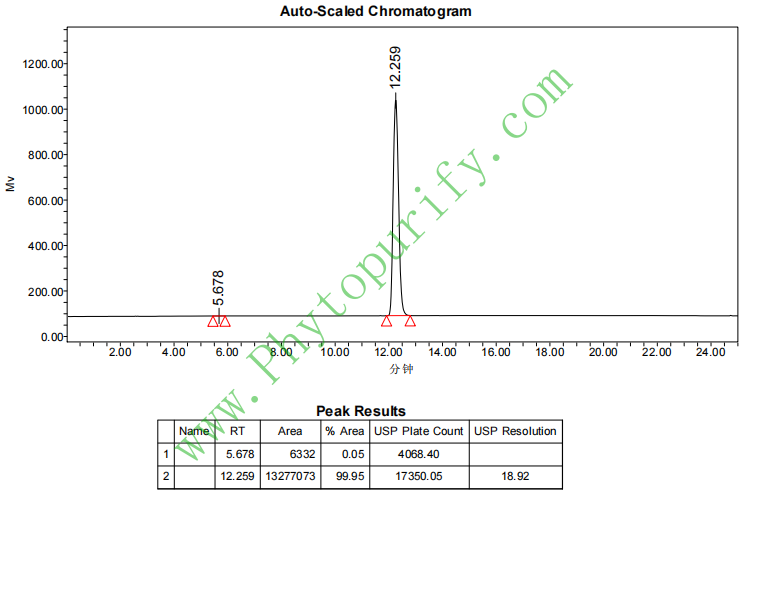
Analysis Method: HPLC-DAD or/and HPLC-ELSD
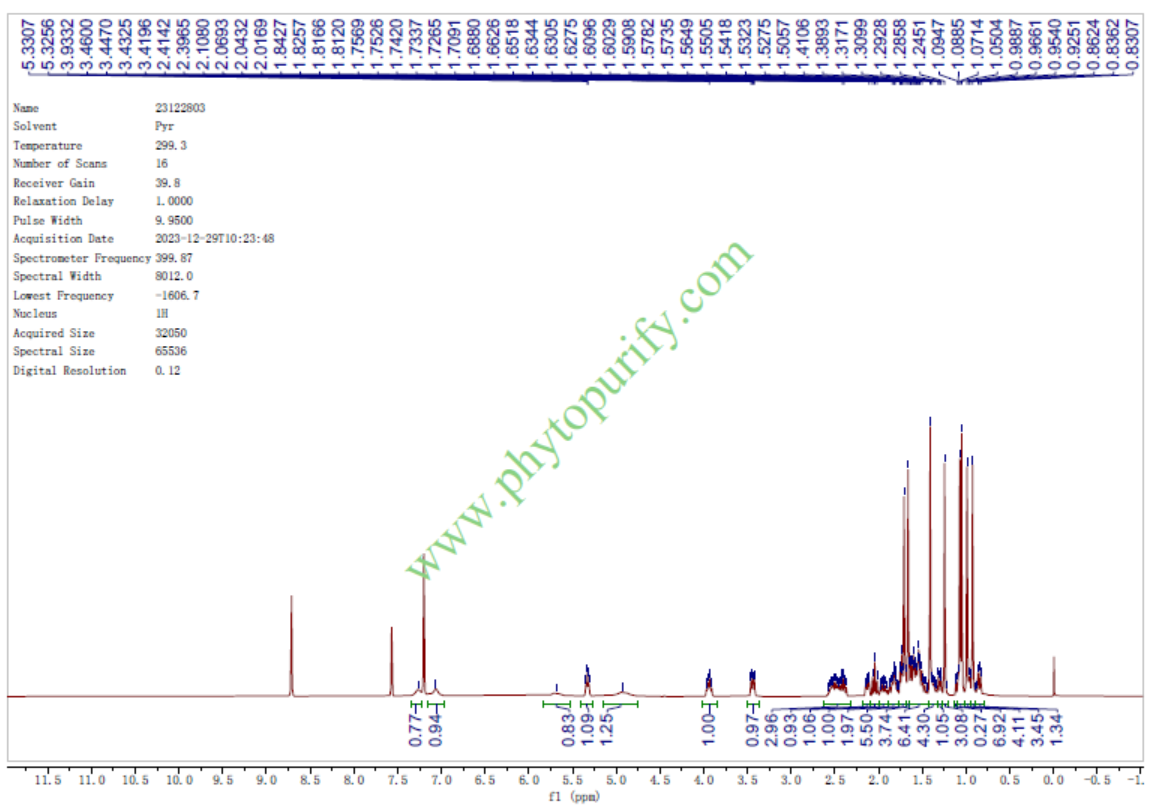
Identification Method: Mass, NMR
Packing: Brown vial or HDPE plastic bottle
Can be supplied from milligrams to grams.
For Reference Standard and R&D, Not for Human Use Directly.
Inquire for bulk scale.
HPLC of 20(R)-Protopanaxadiol
HNMR of 20(R)-Protopanaxadiol
Storage conditions:Short-term storage at 2~8℃, long-term storage at -20 ~ -80℃
20 (R) - Protopanaxadiol (20 (R) - PPD), as an important diastereomer of ginsenosides, has attracted widespread attention in the field of natural product pharmacology in recent years. Its unique molecular configuration and multi-target regulatory properties have demonstrated potential application value in the prevention and treatment of various chronic diseases such as cardiovascular diseases. 20 (R) - PPD is a diastereomer of Protopanaxadiol (PPD) with a 20 hydroxy substitution, which differs from the spatial configuration of 20 (S) - PPD, resulting in certain differences in its biological activity and pharmacological effects. This article provides a systematic review of the chemical structure and physicochemical properties, plant sources and extraction methods, pharmacological activity and mechanism of action, drug evaluation, and future clinical application prospects of 20 (R) - PPD, aiming to provide theoretical basis and reference for related research.
The molecular formula of 20 (R) - protopanaxadiol is C30H52O3, with a molecular weight of 460.7430. Its structure is based on a tetracyclic triterpenoid skeleton and belongs to the non sugar part of protopanaxadiol type saponins. The main difference between 20 (R) - PPD and 20 (S) - PPD lies in the spatial configuration of the hydroxyl group on the 20 carbon atom, with the former in the R configuration and the latter in the S configuration. This configuration difference not only affects its binding mode with biomolecules, but also affects its pharmacokinetic properties.
In terms of physical and chemical properties, the LogP value of 20 (R) - PPD is 6.3337, indicating its strong lipid solubility, which facilitates penetration of cell membranes but limits its water solubility (solubility is only 0.0004 mg/mL), posing a challenge to its bioavailability. Its polar surface area (TPSA) is 60.69 Å ², indicating that the molecule has moderate polarity that facilitates interaction with biological targets. The low permeability of the blood-brain barrier suggests its limited role in the central nervous system. In terms of safety, 20 (R) - PPD does not exhibit hERG channel inhibitory activity, and the Ames mutagenicity test is negative, indicating its good safety.
20 (R) - protopanaxadiol is mainly present in the Araliaceae plant Panax ginseng and its related species, and is the main non sugar component of ginsenosides. After in vivo or in vitro metabolism, 20 (R) - PPD, as an important metabolite of ginsenosides, has been widely studied.
Traditional extraction methods often use organic solvents (such as ethanol and methanol) to extract ginseng roots and stems, followed by separation and purification through liquid-liquid distribution, silica gel column chromatography, and other methods. In recent years, modern technologies such as supercritical CO2 extraction, microwave-assisted extraction, and ultrasound assisted extraction have been introduced to improve extraction efficiency and purity. During the purification process, reverse phase high-performance liquid chromatography (RP-HPLC) is widely used for the separation and identification of 20 (R) - PPD, ensuring the accuracy and purity of its structure.
20 (R) - PPD exhibits significant pharmacological activity in various disease models, with the most in-depth research in the field of cardiovascular disease. Its main pharmacological effects include anti-inflammatory, antioxidant, regulation of energy metabolism, and cell protection.
anti-inflammatory effect
20 (R) - PPD can inhibit the release of inflammatory mediators and alleviate inflammatory reactions. In vitro experiments have shown that it reduces the expression of pro-inflammatory cytokines such as TNF - α and IL-6 by inhibiting the TLR4 signaling pathway, thereby alleviating inflammatory damage to the cardiovascular system.
Antioxidant effect
20 (R) - PPD can activate the NFE2L2 (Nrf2) signaling pathway, induce the expression of antioxidant enzymes, and enhance the cell's resistance to oxidative stress. In animal experiments, 20 (R) - PPD significantly reduced oxidative stress markers in myocardial ischemia-reperfusion injury and protected myocardial cells.
Regulating energy metabolism
By activating the 5 'AMP activated protein kinase (AMPK) pathway, 20 (R) - PPD promotes the balance of lipid metabolism and glucose metabolism, which helps to improve cardiovascular metabolic disorder and reduce the risk of atherosclerosis.
Cell protection and anti apoptosis
20 (R) - PPD promotes cell survival, reduces apoptosis, and protects cardiomyocytes from damage by regulating targets such as PRKCA (protein kinase C alpha) and APEX1 (DNA repair enzyme).
In addition, 20 (R) - PPD has potential antithrombotic and anti diabetes complications effects in regulating platelet selectin (SELP) and proteasome related enzyme AKR1B1, further expanding its application potential in cardiovascular disease.
The multi-target mechanism of action of 20 (R) - PPD is an important basis for its pharmacological activity. Through molecular docking, gene knockout, and protein expression analysis, researchers have identified its main targets and signaling pathways.
AMPK(PRKAA1)
As a key regulator of cellular energy metabolism, AMPK activation promotes fatty acid oxidation and glucose uptake. 20 (R) - PPD improves myocardial energy metabolism and reduces the pathological progression of metabolic heart disease by activating AMPK.
TLR4
As the initiating receptor of inflammatory response, inhibition of TLR4 helps alleviate cardiovascular inflammation. 20 (R) - PPD reduces the release of inflammatory factors by inhibiting the TLR4 mediated NF - κ B signaling pathway.
NFE2L2 (Nrf2)
20 (R) - PPD activates the Nrf2 pathway, induces the expression of antioxidant enzymes, enhances cellular antioxidant capacity, and protects myocardial cells from oxidative damage.
PRKCA
Regulating cell proliferation and apoptosis, 20 (R) - PPD promotes cardiomyocyte survival by modulating PRKCA expression.
BACE1、PTPN1、ESR2、APEX1、AKR1B1、SELP
These targets involve multiple pathological processes of cardiovascular disease, including blood glucose regulation, platelet activation, DNA repair, etc. 20 (R) - PPD achieves a comprehensive effect of cardiovascular protection through the synergistic action of multiple targets.
From the perspective of drug development, 20 (R) - PPD has certain advantages and disadvantages. Its high lipid solubility (LogP 6.33) facilitates membrane penetration, but its extremely low water solubility limits oral absorption and bioavailability. In addition, the polar surface area of 20 (R) - PPD is moderate, indicating its strong binding ability to target proteins.
Toxicological evaluation shows that 20 (R) - PPD has no significant hERG channel inhibitory effect and reduces the risk of arrhythmia. A negative Ames test indicates a low risk of genetic toxicity and good safety.
Pharmacokinetic studies are still in the preliminary stage. Previous in vivo studies have shown that the plasma concentration of 20 (R) - PPD is lower after oral administration, indicating limited bioavailability. The metabolic pathway is mainly metabolized by the liver CYP450 enzyme system, and the activity of metabolites needs further research. In the future, it is necessary to improve its in vivo stability and absorption efficiency through formulation modifications such as nanocarriers and liposomes.
20 (R) - PPD, as a natural product derived multi-target small molecule, has shown broad application prospects in the prevention and treatment of cardiovascular diseases. Its anti-inflammatory, antioxidant and metabolic regulating effects make it a potential candidate drug for the treatment of atherosclerosis, myocardial ischemia, diabetes, heart disease and other diseases.
Future clinical development should focus on the following directions:
Formulation optimization
To address the issues of poor water solubility and low bioavailability, new drug delivery systems (such as nanoparticles, liposomes, solid dispersions) have been developed to improve oral absorption and in vivo stability.
In depth study of mechanisms
Combining multiple omics techniques, further reveal the multi-target synergistic mechanism of 20 (R) - PPD in cardiovascular disease, and explore potential biomarkers and therapeutic targets.
Safety and Toxicological Assessment
Conduct systematic long-term toxicology research and drug interaction assessment to ensure the safety of clinical applications.
Clinical trial design
Based on existing in vitro and in vivo pharmacological research, design a reasonable clinical trial plan to validate the efficacy and safety of 20 (R) - PPD in patients with cardiovascular disease.
In addition, 20 (R) - PPD has shown potential activity in other disease fields such as tumors and neurodegenerative diseases, and is worthy of further research.
20 (R) - protopanaxadiol, as a structurally unique natural product, has shown great potential in the field of cardiovascular disease prevention and treatment due to its multi-target and multi mechanism pharmacological properties. Although its poor water solubility and low bioavailability still need to be overcome as a drug, its clinical translation is expected to be achieved through the intervention of modern drug development technology. In the future, combined with in-depth mechanism research and innovative formulation technology, 20 (R) - PPD is expected to become an important natural drug resource in the field of cardiovascular disease treatment. Continuing to conduct systematic pharmacological, toxicological, and clinical research will provide new ideas and strategies for the development of natural product pharmacology and the treatment of cardiovascular diseases.
