


Synonym name: (20R)-Protopanaxatriol
Catalogue No.: BP1157
Cas No.: 1453-93-6
Formula: C30H52O4
Mol Weight: 476.731
Botanical Source: Panax ginseng
Purity: 95%~99%
Analysis Method: HPLC-DAD or/and HPLC-ELSD
Identification Method: Mass, NMR
Packing: Brown vial or HDPE plastic bottle
Can be supplied from milligrams to grams. Inquire for bulk scale.
For Reference Standard and R&D, Not for Human Use Directly.
HPLC of Protopanaxatriol
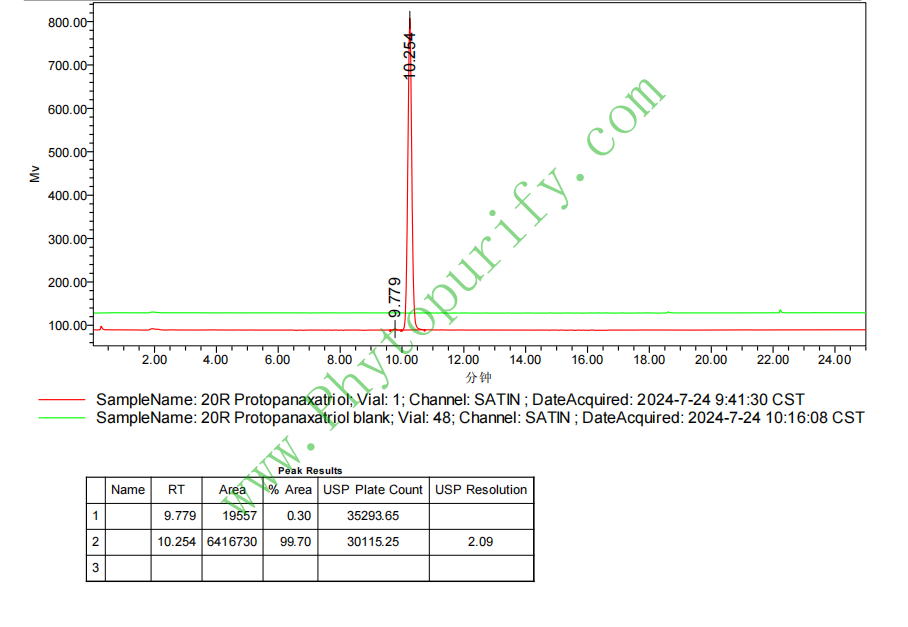
Storage conditions:Short-term storage at 2~8℃, long-term storage at -20 ~ -80℃
80.9200
5.3813
5.3813
.0012
4.2026
6.7789
Low
87.2657
5.0516
No
No
No
No
No
No
0.0
No
No
No
No
Aging is a complex biological process in which the physiological functions of organisms gradually decline over time, and is closely related to the occurrence and development of various chronic diseases such as neurodegenerative diseases, cardiovascular diseases, metabolic syndrome, and cancer. Therefore, finding safe and effective anti-aging strategies has become a cutting-edge hotspot in modern medicine and pharmacology research. Natural products have shown great potential in the development of anti-aging drugs due to their structural diversity and multi-target effects. Ginseng, as a traditional precious Chinese medicine, has attracted much attention in recent years for its core active ingredient, ginsenosides, which are metabolites of protopanaxatriol. Among them, (20R) - Protopanaxatriol (PPT), as one of the main active aglycones of ginsenosides Rg1, Re, etc. metabolized by gut microbiota in vivo, has become a research focus due to its direct and efficient biological activity. A large number of studies have shown that (20R) - PPT has significant effects in anti-aging, neuroprotection, anti-inflammatory, anti-tumor and other aspects, especially by regulating key aging related signaling pathways such as AMPK, SIRT1, NRF2, demonstrating the potential to delay cell and body aging. This article aims to systematically review the chemical properties, pharmacological activities, molecular mechanisms of action, and pharmacological properties of (20R) - PPT, in order to provide scientific basis for the development of anti-aging drugs based on this compound.
(20R) - Original ginseng triol, CAS number 1453-93-6, molecular formula C30H52O4, molecular weight 476.7420. Its chemical structure belongs to the damaane type tetracyclic triterpenoid, and it is one of the C-20 stereoisomers of protopanaxatriol (20R configuration). Its basic skeleton consists of a steroid nucleus and side chains, containing multiple hydroxyl groups (- OH). These polar groups determine its partial hydrophilicity, but the overall molecule exhibits strong hydrophobicity. The calculated lipid water partition coefficient (LogP) is 5.3813, indicating that the compound has high lipophilicity. Its topological polar surface area (TPSA) is 80.9200 Å ², reflecting the surface area of polar atoms (mainly oxygen atoms) in the molecule. The water solubility is extremely low, about 0.0012 mg/mL, which poses a challenge for its oral absorption and formulation development. This compound does not inhibit hERG potassium channels (hERG inhibition: No), indicating a low risk of cardiac toxicity. The Ames test result is 0.0, indicating no mutagenicity under the testing conditions and a good genetic toxicity safety basis. In addition, its blood-brain barrier permeability is predicted to be "low", suggesting that its entry into the central nervous system as a prototype drug may be limited, but its metabolites or indirect effects through the periphery may still affect brain function.
(20R) - PPT is not directly present in large quantities in plants of the ginseng genus (such as ginseng, American ginseng, and Panax notoginseng), but is the main glycoside product of its prototype ginsenosides (such as Rg1, Re, Rf, etc.) after processing or oral administration, which are hydrolyzed by gastrointestinal microbial enzymes to remove glycosides. Therefore, its main sources are twofold: firstly, total saponins are extracted from plant materials rich in ginsenosides, and then prepared specifically through methods such as acid hydrolysis, enzymatic hydrolysis, or microbial transformation; The second is obtained through chemical synthesis or semi synthetic pathways.
At present, the main methods for obtaining (20R) - PPT in laboratories and industries include:
1. Direct extraction and separation Although the content is extremely low, it can be separated and purified from ginseng stems, leaves, or processed products by organic solvent extraction (such as methanol, ethanol), macroporous resin enrichment, silica gel column chromatography, and high-performance liquid chromatography (HPLC) preparation. The process is complex and the yield is low.
2. Saponin hydrolysis conversion method This is a more commonly used method. Using ginsenosides Rg1 or Re as substrates, hydrolysis can be carried out under acidic conditions (such as dilute sulfuric acid or hydrochloric acid) to break glycosidic bonds and obtain a mixture of protopanaxatriol. The isomers (20R) and (20S) can then be separated by chromatographic techniques. This method is relatively simple, but harsh conditions may lead to side reactions.
3. Biotransformation method The selective glycoside hydrolysis of ginsenosides using specific intestinal bacteria (such as Bacteroides and Bifidobacterium) or screened fungi and enzyme preparations is a green and promising preparation method with mild conditions and good stereoselectivity, which can efficiently and specifically obtain (20R) - PPT.
4. chemical synthesis The complete synthesis route involves lengthy steps, but semi synthesis uses inexpensive and readily available steroids or triterpenes as starting materials for structural modification, which is a potential pathway to ensure stable supply.
(20R) - PPT exhibits a wide range of pharmacological activities, with its core research areas focused on anti-aging and related disease interventions.
1. Anti aging activity
This is the most notable activity of (20R) - PPT. In cell models, it can significantly delay cell aging induced by various aging inducers such as hydrogen peroxide and D-galactose, reduce the activity of aging related β - galactosidase (SA - β - gal), and maintain cell proliferation ability. In animal models, long-term administration of (20R) - PPT can improve the learning and memory abilities of D-galactose or naturally aging mice, enhance physical strength and endurance, alleviate age-related pathological changes in tissues and organs, and prolong the healthy lifespan of model organisms. Its anti-aging effect is closely related to enhancing antioxidant defense, reducing inflammation, maintaining mitochondrial function, and promoting autophagy.
2. Neuroprotective effect
(20R) - PPT has a protective effect on neurodegenerative disease models such as Alzheimer's disease and Parkinson's disease. It can improve cognitive dysfunction induced by amyloid beta (A β), reduce neuronal apoptosis, and inhibit neuroinflammation. Its mechanism involves regulating the expression of neurotrophic factors, inhibiting excessive phosphorylation of tau protein, and clearing reactive oxygen species.
3. Anti inflammatory and immune regulation
(20R) - PPT can effectively inhibit the excessive production of nitric oxide (NO), prostaglandin E2 (PGE2), and pro-inflammatory cytokines (such as TNF - α, IL-6, IL-1 β) in macrophages stimulated by lipopolysaccharide (LPS) and other factors. Its anti-inflammatory effect is of great significance in alleviating chronic low-grade inflammation related to aging ("inflammatory aging").
4. Antitumor activity
Studies have shown that (20R) - PPT can inhibit the growth and promote apoptosis of many cancer cell lines (such as lung cancer, liver cancer, breast cancer, colon cancer cells), and can enhance the sensitivity of some chemotherapy drugs. Its anti-tumor mechanism involves cell cycle arrest, induction of apoptosis, inhibition of invasion and metastasis, etc.
5. Cardiovascular protection
(20R) - PPT can improve myocardial ischemia-reperfusion injury, reduce cardiomyocyte apoptosis, and show a certain potential of lowering blood lipid and anti atherosclerosis.
The anti-aging and multi effect pharmacological effects of (20R) - PPT stem from its synergistic regulation of multiple key signaling pathways and molecular targets, forming a complex network.
1. Activate energy and metabolic sensing pathways: AMPK and SIRT1
* AMPK(AMP-activated protein kinase)As a "sensor" of cellular energy status, (20R) - PPT can activate AMPK. Activated AMPK promotes fatty acid oxidation, glucose uptake, inhibits synthetic metabolism, upregulates autophagy, clears damaged organelles, and maintains cellular energy homeostasis, which is the core of its ability to delay metabolic aging.
* SIRT1(Sirtuin 1)A NAD+- dependent class III histone deacetylase that is a key regulator of longevity related pathways. (20R) - PPT can upregulate SIRT1 activity by increasing NAD+levels or directly acting. SIRT1 plays a central role in antioxidant stress, mitochondrial biosynthesis, metabolic regulation, and anti apoptosis by deacetylating various substrates such as FOXO1, PGC-1 α, and p53. AMPK and SIRT1 often activate each other, forming a positive feedback loop.
2. Enhance antioxidant defense system: NRF2 pathway
* NRF2(Nuclear factor erythroid 2-related factor 2) It is the main regulator of antioxidant reactions. (20R) - PPT can promote the dissociation and translocation of NRF2 from the cytoplasmic chaperone protein Keap1 into the nucleus, initiating the transcription of downstream genes for a series of antioxidant enzymes and phase II detoxifying enzymes, including HMOX1(Heme oxygenase-1)、SOD1(Superoxide dismutase 1)、CAT(Catalase) Wait. SOD1 and CAT are first-line antioxidant enzymes that clear superoxide anions and hydrogen peroxide, while HMOX1 degrades hemoglobin to produce bilirubin and carbon monoxide, which have antioxidant and anti-inflammatory effects. The comprehensive enhancement of this system is the key to (20R) - PPT's resistance to oxidative stress-induced aging.
3. Regulating aging related genes: TP53, CDKN1A, and TERT
* TP53(p53) and CDKN1A(p21)P53 is a classic tumor suppressor protein that can also induce cellular senescence. Under non stress conditions, (20R) - PPT may activate SIRT1 to deacetylate p53, moderately regulate its activity, and avoid pathological aging caused by its excessive activation. P21 is an important cell cycle suppressor protein downstream of p53. (20R) - PPT can induce cell cycle arrest for repair in DNA damage by regulating the p53/p21 axis, while preventing premature aging caused by its abnormal overexpression under normal conditions.
* TERT(Telomerase reverse transcriptase)The telomerase catalytic subunit is responsible for maintaining telomere length. Some studies suggest that (20R) - PPT may have the potential to stably or mildly upregulate TERT expression under certain conditions, thereby delaying replicative aging, but this effect is highly dependent on cellular environment and dosage, and further clarification is needed.
4. Regulating transcription factor FOXO1
* FOXO1(Forkhead box protein O1) It is a key transcription factor downstream of the insulin/IGF-1 signaling pathway. When activated by AMPK and SIRT1, it can upregulate the expression of antioxidant, autophagy, and metabolism related genes, promoting stress resistance and longevity. (20R) - PPT indirectly enhances the activity and function of FOXO1 by activating the AMPK/SIRT1 axis.
In summary, (20R) - PPT synergistically activates the AMPK/SIRT1 energy sensing pathway, NRF2 antioxidant pathway, and finely regulates aging related factors such as TP53/p21 and FOXO1, forming a multi-target, networked action system that jointly promotes cellular homeostasis and delays the aging process.
Although (20R) - PPT has significant pharmacological activity, its drug like properties face challenges mainly due to its poor drug like parameters.
* Absorption and distribution The high LogP value (5.38) and extremely low water solubility severely limit its solubility in aqueous media and gastrointestinal dissolution, which may lead to low oral bioavailability. The predicted blood-brain barrier permeability is' low ', which limits its application as a prototype drug for the treatment of central nervous system diseases.
* Metabolism and excretion As a triterpenoid glycoside, (20R) - PPT may undergo phase I metabolism (such as hydroxylation and oxidation) and phase II metabolism (such as glucuronidation and sulfation) in the body, producing more polar metabolites that are excreted through bile or urine. The specific metabolic enzyme spectrum, main metabolites, and activities need to be further studied.
* Preliminary evaluation of safety The existing preliminary data (no hERG inhibition, negative Ames test) suggests a low risk of cardiac and genetic toxicity, but comprehensive preclinical toxicology studies (such as acute toxicity, long-term toxicity, reproductive toxicity, etc.) still need to be systematically conducted.
* Formulation strategy To enhance its pharmacological properties, advanced formulation techniques such as phospholipid complexes, cyclodextrin inclusion complexes, and solid dispersions are required to improve solubility and dissolution rate; Preparation of nano drug delivery systems such as nanoparticles, liposomes, and micelles to improve their absorption, targeting, and bioavailability; Or develop prodrugs by introducing hydrophilic groups through chemical modification to improve their physicochemical properties.
At present, pharmacokinetic studies on (20R) - PPT are relatively limited. Limited animal studies have shown that its oral absorption may be slow and incomplete, and it is widely distributed in the body, but specific parameters such as half-life and clearance rate need to be determined through more rigorous in vitro and in vivo studies.
(20R) - PPT, as a natural active molecule with a clear multi-target anti-aging mechanism, has broad clinical application prospects, but there are also many challenges.
Potential application directions:
1. Anti aging health products and drugs Develop dietary supplements or functional foods as core ingredients to delay aging and improve age-related functional decline (such as cognitive decline and physical weakness). At the drug level, it is expected to be developed for the treatment of age-related diseases such as mild cognitive impairment, sarcopenia, metabolic syndrome, etc.
2. Adjuvant therapy for neurodegenerative diseases Based on its neuroprotective, anti-inflammatory, and antioxidant effects, it can be used as a potential adjuvant therapy or disease modifier for Alzheimer's disease and Parkinson's disease.
3. Chemotherapy adjuvant and sensitizer Its anti-tumor activity and protective effect on normal cells make it a potential adjuvant drug for chemotherapy to reduce side effects and enhance efficacy.
4. Treatment of inflammatory diseases: It is used to treat chronic inflammatory diseases such as rheumatoid arthritis and atherosclerosis.
Challenges and Future Prospects:
1. Optimization of drug properties The primary task is to address the issues of low water solubility and bioavailability. We need to strengthen pharmaceutical research and develop efficient and stable delivery systems.
2. In depth mechanism research Further clarification is needed on its precise mechanism of action in different tissues and aging models, clarifying its direct target (whether it is a ligand for certain receptors), and analyzing the spatiotemporal dynamic relationship of its complex signal network.
3. Differences in stereoisomeric activity A systematic comparison is needed to determine the optimal configuration by comparing the differences in activity, metabolism, and toxicity between (20R) - PPT and its C-20 isomer (20S) - PPT.
4. Preclinical and clinical research Urgent need to conduct systematic pharmacological, pharmacokinetic, and toxicological evaluations to provide reliable data for clinical trials. Ultimately, its safety and efficacy in humans need to be validated through rigorous randomized controlled clinical trials.
5. Exploration of combination therapy Consider combining it with other natural products or drugs that have synergistic anti-aging effects (such as resveratrol, rapamycin, etc.) to explore synergistic effects.
(20R) - As a key active metabolite of ginsenosides, protopanaxatriol exhibits excellent anti-aging, neuroprotective, anti-inflammatory and other pharmacological activities due to its multi-target and networked regulation of core aging related pathways such as AMPK/SIRT1, NRF2, p53, making it a highly promising candidate molecule in the field of natural product anti-aging research. Although it currently faces the bottleneck of poor water solubility and low bioavailability as a drug, with the continuous development of modern formulation technology, molecular pharmacology, and translational medicine, it is expected to overcome these obstacles through structural optimization, innovative delivery system development, and in-depth preclinical research. In the future, the continuous exploration of (20R) - PPT will not only help reveal the deep scientific connotation of natural products in delaying aging, but also provide important scientific basis and material basis for the development of new, safe, and effective anti-aging intervention strategies and drugs, with significant theoretical significance and broad application prospects.
